
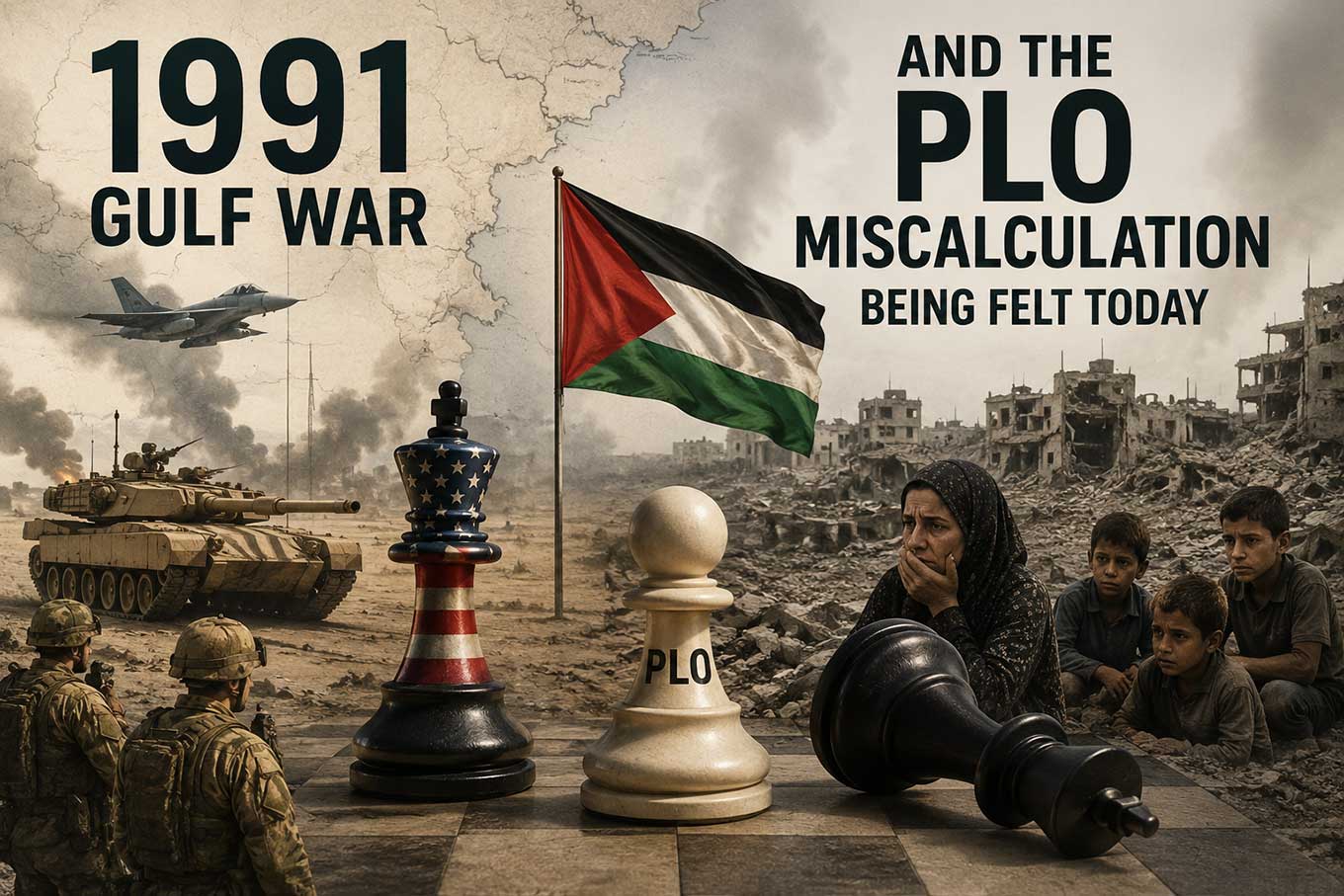
It has become a reflex in much commentary on the Palestinian economy to trace its condition to a single source: Israeli occupation, closures, and control over borders, water and movement. Those factors are real, extensively documented, and central to any honest account. But they are not the whole account. Some of the deepest wounds to Palestinian economic life were self-inflicted — the product of political decisions made by Palestinian leadership itself. The clearest example unfolded not in the West Bank or Gaza, but in the oil states of the Persian Gulf between 1990 and 1991.
In simple terms: when Iraq invaded Kuwait, the Palestine Liberation Organization (PLO) sided with the invader — and hundreds of thousands of Palestinians paid for that choice with their jobs, their savings, and their place in the Gulf economy.
Background: A Community Built on Gulf Labor
For four decades, the Gulf states were an economic lifeline for the Palestinian people. After the events of 1948 and 1967, Palestinians migrated in large numbers to Kuwait, Saudi Arabia and the smaller Gulf emirates, where oil wealth created demand for teachers, engineers, civil servants and skilled laborers. Kuwait in particular became the single largest Palestinian community outside the historic homeland.
On the eve of the Gulf War, roughly 357,000 to 400,000 Palestinians lived in Kuwait — close to 18 percent of the country’s total population, according to figures cited by Kuwaiti and international sources. From 1967 to 1969, Palestinians made up an estimated 60 percent of Kuwait’s teachers. This was not a transient labor force; it was a settled diaspora that had helped build the modern Gulf state, and whose remittances flowed back to families in the West Bank, Gaza and refugee camps across the region. The PLO itself drew a substantial share of its funding from Palestinian professionals in the Gulf and from the Gulf monarchies directly.
The Decision That Changed Everything
When Saddam Hussein’s forces invaded Kuwait on August 2, 1990, the Arab world split. At an emergency Arab League summit in Cairo days later, twelve states backed the use of force to reverse the invasion. The PLO was among the eight that rejected a military solution.
Arafat’s position was more calculated than open cheerleading for the invasion. He opposed U.S.-led intervention, called for an “Arab solution,” and embraced Saddam’s “linkage” argument — the idea that any Iraqi withdrawal from Kuwait should be tied to an Israeli withdrawal from the West Bank, Gaza and the Golan Heights. According to reporting later cited by The Washington Post, Arafat pressed Saddam to make that linkage explicit. But to Kuwaitis and their Gulf allies, the nuance was invisible. What registered was the image of the Palestinian leader embracing the man whose tanks were occupying their country.
It is worth stressing a fact often lost in the retelling: the PLO’s own office inside Kuwait opposed the invasion, and a PLO official there, Rafiq Shafiq Qiblawi, was killed by Iraqi forces for that opposition. Most Palestinian civilians in Kuwait were not partisans of Saddam. They were, in the end, collectively punished for a decision made by leadership they did not control — a point that matters both morally and for understanding what followed.
The Reckoning: Expulsion, Lost Wages and Severed Patronage
After a U.S.-led coalition liberated Kuwait in early 1991, retribution against the Palestinian community was swift and severe. Human rights investigators documented a sustained campaign between March and June 1991 that combined bureaucratic pressure with outright terror.
The mechanics of the collapse, as documented by Human Rights Watch’s Middle East Watch project and Palestinian scholars, included:
- Mass departure. The pre-war Palestinian population of roughly 357,000–400,000 fell to about 20,000–30,000 within months. By one widely cited account, more than 287,000 were forced out; others fled during the occupation and were barred from returning.
- Job destruction. Palestinian civil servants were fired or not rehired, children were expelled from public schools, and educational subsidies were terminated — erasing an entire professional class’s livelihood almost overnight.
- Financial pressure and abuse. Kuwaiti landlords were permitted to reclaim property and demand back rent; investigators documented arbitrary arrest, torture and killings in the post-liberation period.
- Collapsed remittances. The disappearance of Gulf wages severed a critical income stream for Palestinian families and institutions across the region.
The damage extended beyond Kuwait. The Gulf monarchies — Saudi Arabia and Kuwait foremost among them — had been the PLO’s principal financial patrons. After the war they cut off funding, plunging the organization into a fiscal crisis. Saudi Arabia, Bahrain, Qatar and the United Arab Emirates also tightened conditions on their Palestinian residents. In simple terms: the single most reliable source of Palestinian capital and employment outside the homeland was shut off, and it was shut off in direct response to a political choice made in Baghdad’s favor.
A Pattern, Not a One-Off
The Kuwait expulsion was the largest forced displacement of Palestinians from an Arab state, but it was not the first. The broader historical record complicates any story that places every Palestinian hardship at Israel’s door:
- Jordan, 1970–71 (“Black September”): The PLO, having built a state-within-a-state, clashed with the monarchy and was driven out — two decades before the Gulf War.
- Lebanon, 1982: The PLO leadership was expelled following the Israeli invasion, itself the product of years of PLO-Israel conflict on Lebanese soil.
- Libya, 1994–95: Muammar Gaddafi expelled tens of thousands of Palestinians, explicitly to embarrass the Oslo peace process.
These episodes had different triggers, and it would be dishonest to flatten them into a single narrative. But together they establish an uncomfortable truth: Palestinians have repeatedly been displaced and impoverished by conflicts with, and decisions by, Arab hosts and their own leadership — not solely by Israel.
Analysis: How a Bankrupt PLO Reshaped the Movement
The strategic aftermath of the Gulf War miscalculation is where the story reaches into the present. Two consequences stand out.
First, the PLO’s financial ruin and diplomatic isolation left Arafat negotiating from weakness. Many historians read the 1993 Oslo Accords as a product of that weakness — a bankrupt, sidelined leadership seeking rescue at the negotiating table. Whether one views Oslo as a breakthrough or a capitulation, the Gulf debacle was a major reason Arafat arrived there with so little leverage.
Second — and this requires precision — the collapse of the secular nationalist PLO helped open space for a different current in Palestinian politics: the Iranian-backed Islamist factions. This point is easy to overstate, so it is worth being exact. Iran’s alignment has been with Hamas and Palestinian Islamic Jihad (PIJ), not with Arafat’s PLO, which moved in the opposite direction toward Oslo and the West. But the timing is striking. In October 1991, as the U.S. convened the Madrid peace conference, Tehran hosted a rival conference to “support the Islamic revolution of the people of Palestine.” Analysts of the period note that the interests of Iran and Hamas began to converge precisely as the PLO discredited itself and its Gulf patronage evaporated.
Over the following decades, Iranian support for Palestinian Islamist groups grew into a defining feature of the conflict. By 2020, the U.S. State Department estimated Iran was providing more than $100 million annually to Hamas and PIJ combined. The through-line is not that Arafat “aligned Palestine with Iran” — he did not. It is that the self-inflicted collapse of the secular, Gulf-funded leadership helped create the vacuum that an Iranian-funded Islamist alternative would fill. In simple terms: when the PLO bankrupted its relationship with the Sunni Gulf monarchies, it weakened the very movement that had been the Palestinians’ economic and political anchor — and the movements that rose in its place looked to Tehran, not Riyadh or Kuwait City, for their money.
The Long Economic Shadow
The Gulf remittance economy never fully recovered. Where hundreds of thousands of Palestinians once earned Gulf salaries and sent money home, the community in Kuwait had climbed back only to roughly 70,000 by the mid-2010s, according to the Palestinian embassy there — still a fraction of its former size. The professional diaspora that had underwritten Palestinian institutions was scattered, largely to Jordan, and its economic weight was permanently diminished.
Relations were formally mended only years later. In 2004, PLO leader Mahmoud Abbas issued an official apology to Kuwait for the organization’s stance during the occupation — an acknowledgment, in effect, that the alignment with Saddam had been a historic error.
Conclusion
None of this erases the documented economic burdens of occupation, which remain central to the Palestinian condition. But an honest accounting has to hold two facts at once. Israeli policy has constrained the Palestinian economy for decades — and Palestinian leadership has, at critical junctures, inflicted grievous damage on its own people. The 1990–91 Gulf War alignment stands as the starkest case: a single strategic misjudgment that cost a generation its foothold in the Gulf, bankrupted the national movement, and helped redraw the map of who funds and directs Palestinian politics to this day.
For readers trying to understand why the Palestinian economy is where it is, the lesson is not to trade one simplistic story for another. It is that responsibility is rarely as one-sided as advocacy on either side prefers.
Key Takeaways
- The 1990–91 Gulf War, not Israeli policy, triggered the largest single collapse of Palestinian economic life outside the homeland.
- Arafat and the PLO’s alignment with Saddam Hussein led Kuwait to expel most of a 357,000–400,000-strong Palestinian community, cutting the population to roughly 20,000–30,000.
- Gulf monarchies severed PLO funding and remittance flows collapsed, bankrupting the national movement and weakening its negotiating position going into Oslo in 1993.
- Most Palestinian civilians in Kuwait opposed the PLO’s stance yet were collectively punished for it.
- The secular PLO’s decline helped open space for Iranian-backed Islamist factions — Hamas and PIJ — though Iran’s alignment was with them, never with Arafat’s PLO.
- Mahmoud Abbas formally apologized to Kuwait in 2004, tacitly conceding the decision was a historic miscalculation.
Sources
Human Rights Watch / Middle East Watch, “A Victory Turned Sour: Human Rights in Kuwait Since Liberation” and related 1991 reporting on the expulsion of Palestinians.
Ann M. Lesch, “Palestinians in Kuwait,” Journal of Palestine Studies, Vol. 20, No. 4 (Summer 1991).
Shafeeq Ghabra, “The PLO in Kuwait,” and academic accounts of the Palestinian community’s decline from ~350,000 to ~150,000 by December 1991.
Al Jazeera, “Palestine-Kuwait relations: ‘Ice has started to melt’” (2015) — population figures and community reflections.
Middle East Forum / Middle East Quarterly, “Kuwait Expels Palestinians” — comparative displacement data (Jordan 1970, Libya 1994–95).
The Washington Post reporting on Arafat’s “linkage” pressure on Saddam Hussein, as cited in subsequent histories.
Combating Terrorism Center at West Point, “The Path to October 7: How Iran Built Up and Managed a Palestinian ‘Axis of Resistance.’”
Wilson Center / U.S. Institute of Peace (Iran Primer), “Iran, Hamas & Palestinian Islamic Jihad” — funding estimates and timeline.
Contemporary analysis of the October 1991 Tehran counter-conference to the Madrid peace conference and the Iran–Hamas convergence.
Kuwait–Palestine relations records, including Mahmoud Abbas’s 2004 apology and the 2013 reopening of the Palestinian embassy.