
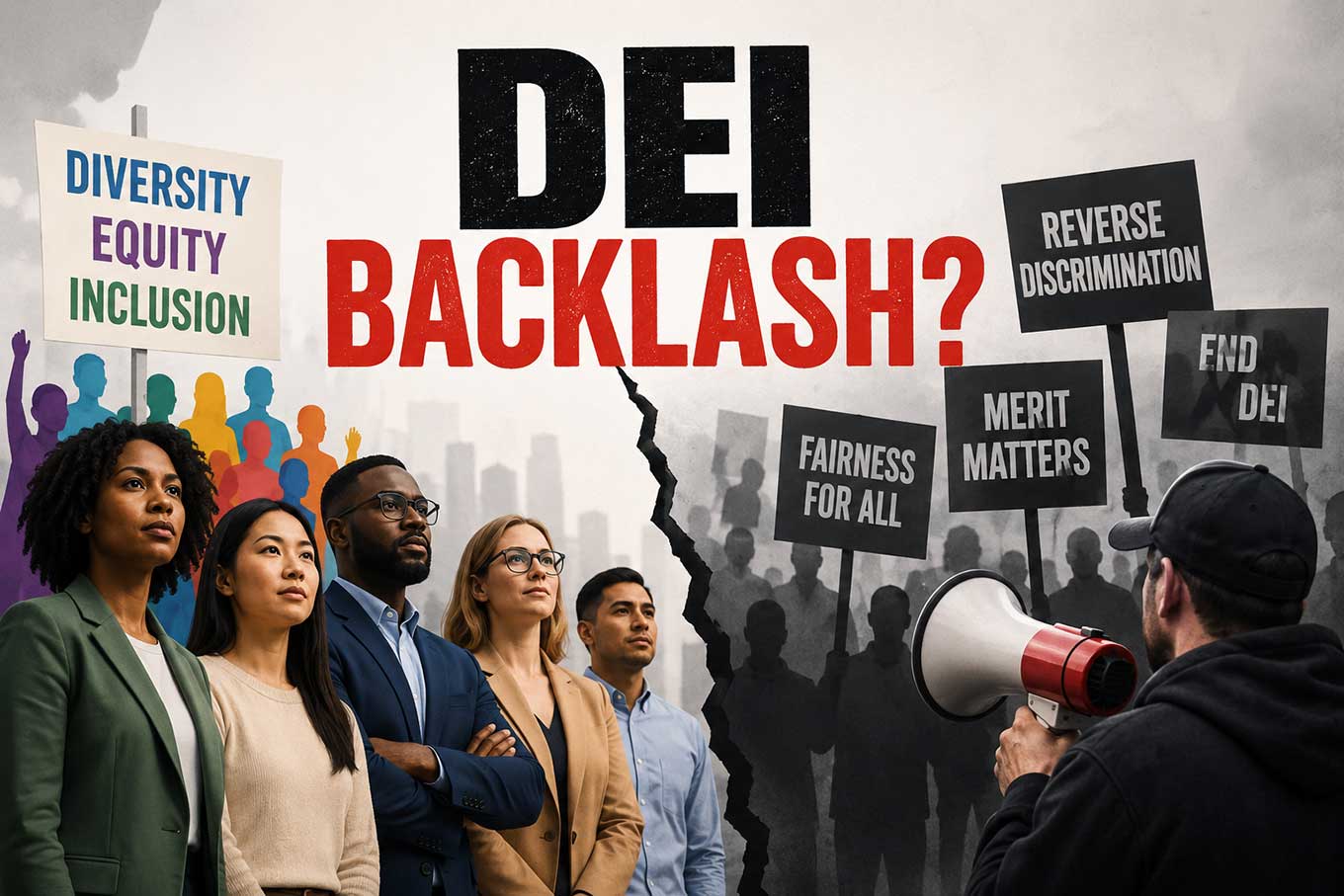
Two unrelated developments in American popular culture converged in the fall of 2025 and, together, revived a long-running argument about race, representation and the fate of diversity initiatives. In late October, Billboard reported that its Hot 100 chart had, for the first time since 1990, no rap songs in its top 40. Months later, the Los Angeles Lakers’ offseason moves produced a projected starting lineup composed entirely of white players. Neither event was planned as a statement, but both were quickly folded into a broader online debate over whether the cultural prominence of Black art and the corporate embrace of diversity, equity and inclusion (DEI) have entered a period of retreat.
This report examines what actually happened in each case, what the data show, and how commentators across the spectrum are interpreting the moment. It does not attempt to resolve the underlying cultural questions, which remain contested.
Background
The phrase “DEI backlash” entered mainstream usage after the U.S. Supreme Court struck down race-conscious college admissions in its 2023 Students for Fair Admissions decisions. In simple terms, the ruling barred colleges from explicitly considering an applicant’s race, and it triggered a wave of legal and political challenges to corporate diversity programs that had expanded rapidly after the 2020 killing of George Floyd.
In January 2025, a federal executive order directed agencies to wind down DEI programs, preferences and trainings, and a number of states passed measures restricting such initiatives at public institutions. Major companies including Google and Meta scaled back diversity efforts, and litigation targeted grant programs aimed at underrepresented founders. Supporters of these programs describe the shift as a rollback of hard-won gains; critics describe it as a correction to policies they view as discriminatory. Both characterizations are contested, and this article uses “backlash” only to name the observable trend of retrenchment, not to endorse either interpretation.
It is against this backdrop that the two cultural data points below were seized upon by online commentators as supposed evidence of a wider turn away from Black culture — a claim that, as the reporting shows, the underlying facts only partly support.
What Happened on the Chart
On the Billboard Hot 100 dated Oct. 25, 2025, no rap song appeared in the top 40 — the first such absence since Feb. 2, 1990, ending a streak of more than 35 years. The immediate trigger was the departure of “Luther,” the Kendrick Lamar and SZA collaboration that had spent 13 weeks at No. 1 and a total of 46 weeks on the chart. The highest-charting rap song that week was YoungBoy Never Broke Again’s “Shot Callin,” at No. 44.
The Role of a Rule Change
Reporting across Billboard, CNN and other outlets emphasized that a recent methodology change was a significant factor. Billboard had adjusted its rules so that long-running songs are moved to “recurrent” status — and removed from the chart — once they exceed certain durations and fall below certain positions. “Luther,” which had slipped to No. 38 after 46 weeks, was one of several songs cleared out under the new threshold. In simple terms, the chart’s own accounting rules, not only listener behavior, helped produce the milestone.
A second factor was crowding at the top. All 12 songs from Taylor Swift’s album The Life of a Showgirl occupied top-40 positions during the relevant weeks, leaving little room for other genres to climb.
A Real Underlying Decline
At the same time, the reporting identified a genuine longer-term trend independent of the rule change. Hip-hop’s share of the overall U.S. music market peaked near 30% in 2020, slipped to just over 25% in 2023, and stood at roughly 24% in 2025. For comparison, the equivalent chart week in 2020 featured 16 rap songs in the top 40; two years later, that number was eight. Analysts also pointed to timing: Drake had not yet released his delayed album, and Lamar had gone relatively quiet after an intense 18-month run.
What Happened With the Lakers
Separately, the Los Angeles Lakers’ roster moves in the 2026 offseason produced a projected opening-night starting five of Luka Dončić, Austin Reaves, Quentin Grimes, Sandro Mamukelashvili and Walker Kessler — a lineup that observers noted would be composed entirely of white players. The observation spread on social media, where posts framed it as historically unusual for a franchise long associated with Black stars such as Magic Johnson, Kobe Bryant and LeBron James.
The reporting indicates the lineup was the byproduct of basketball decisions rather than any stated racial design. The Lakers acquired center Walker Kessler from the Utah Jazz in a sign-and-trade and signed Grimes, Collin Sexton and Mamukelashvili during free agency, assembling a roster built around Dončić’s and Reaves’ shot creation. A subsequent trade sending Deandre Ayton to Washington left the projected starting group unchanged. In short, the composition emerged from personnel and salary-cap considerations, and the “all-white” description originates with online observers, not with any team announcement or policy.
How Commentators Are Connecting the Threads
The question posed by some online commentators — whether DEI has produced a “reverse effect” and whether there is now a broader “fatigue” around the prominence of Black culture — draws these separate events into a single narrative. Several distinct positions are visible in the public conversation.
One view holds that the events are early signals of a cultural correction: that after years of heightened emphasis on racial representation, audiences and institutions are gravitating back toward other genres, artists and demographics, and that the chart and roster figures are symptoms of that shift. Proponents connect this to the documented corporate and governmental pullback from DEI programs.
A competing view holds that the connection is largely coincidental and that treating a chart quirk and a basketball roster as evidence of a cultural verdict is a category error. In this reading, the Billboard result is substantially explained by a rule change and by album-driven crowding; hip-hop remains roughly a quarter of the U.S. market and by far its largest single genre; and an NBA lineup reflects trade math in a league that remains predominantly Black. On this account, the “fatigue” framing imposes a narrative on data that does not require it.
A third view is agnostic on causation but focused on perception: regardless of the underlying mechanics, the fact that these events are being read as a referendum on Black culture is itself a meaningful indicator of the current climate, in which cultural statistics are routinely enlisted as proxies in the DEI debate.
Impact and What to Watch
For the music industry, the durability of the trend is the open question. Billboard’s own predictions suggested rap songs were poised to re-enter the top 40 in subsequent weeks, which would undercut any reading of a permanent shift. The longer-term decline in hip-hop’s market share is the more substantive metric, and it will take several chart cycles and new major releases to assess.
For the Lakers, roster composition is inherently fluid; trades, injuries and rotation changes routinely alter a starting five over the course of a season. Whether the projected lineup ever takes the floor as constructed remains to be seen.
For the broader DEI debate, the episode illustrates a recurring dynamic: discrete cultural data points are rapidly generalized into evidence for pre-existing arguments. Readers encountering such claims are best served by separating the verifiable facts — the chart result, the roster projection — from the contested interpretations layered on top of them.
Conclusion
The two events at the center of this discussion are real: rap was absent from the Billboard Hot 100’s top 40 for the first time in 35 years, and the Lakers’ projected starting five is composed of white players. But the reporting complicates the tidy narrative that has attached to them. The chart milestone was shaped heavily by a methodology change and by one artist’s album dominating the rankings, and the Lakers’ lineup resulted from ordinary personnel decisions rather than a racial design. Whether these coincidences reflect a deeper cultural turn, or merely a moment when unrelated statistics were pressed into service for a larger argument, is a question the available evidence does not settle.
Key Takeaways
- For the first time since February 1990, no rap song appeared in the Billboard Hot 100’s top 40, on the chart dated Oct. 25, 2025.
- A Billboard methodology change that reclassified long-running hits as “recurrent” — removing “Luther” by Kendrick Lamar and SZA — plus 12 top-40 slots held by Taylor Swift, were major contributing factors.
- Hip-hop’s U.S. market share nonetheless shows a real longer-term decline, from about 30% in 2020 to roughly 24% in 2025.
- The Lakers’ projected starting five (Dončić, Reaves, Grimes, Mamukelashvili, Kessler) would be all-white, but resulted from trades and free-agency signings, not a stated racial strategy.
- Commentators have linked both events to a documented rollback of corporate and government DEI programs since 2023; that linkage is a contested interpretation, not an established fact.
Sources
Billboard, “No Rap Songs Are in the Billboard Hot 100’s Top 40 for the First Time Since 1990” (Oct. 2025).
CNN, “Is rap in a sad era? The Billboard charts suggest it is” (Oct. 30, 2025).
The FADER; Complex; The Source — coverage of the Hot 100 top-40 rap absence (Oct. 2025).
The Big Lead; Lakers Daily — Lakers 2026-27 projected starting lineup and offseason moves (July 2026).
Axios, “How college affirmative action’s end is causing a DEI reckoning” (Nov. 2023); TechCrunch, “DEI backlash” tracker (2024); This Is DEI, “DEI in the U.S.: What Changed from 2024 to 2025.”
Editor’s note: This article reports the factual record and presents competing interpretations without endorsing any of them. Figures reflect reporting available as of publication and are subject to change as charts and rosters update.