
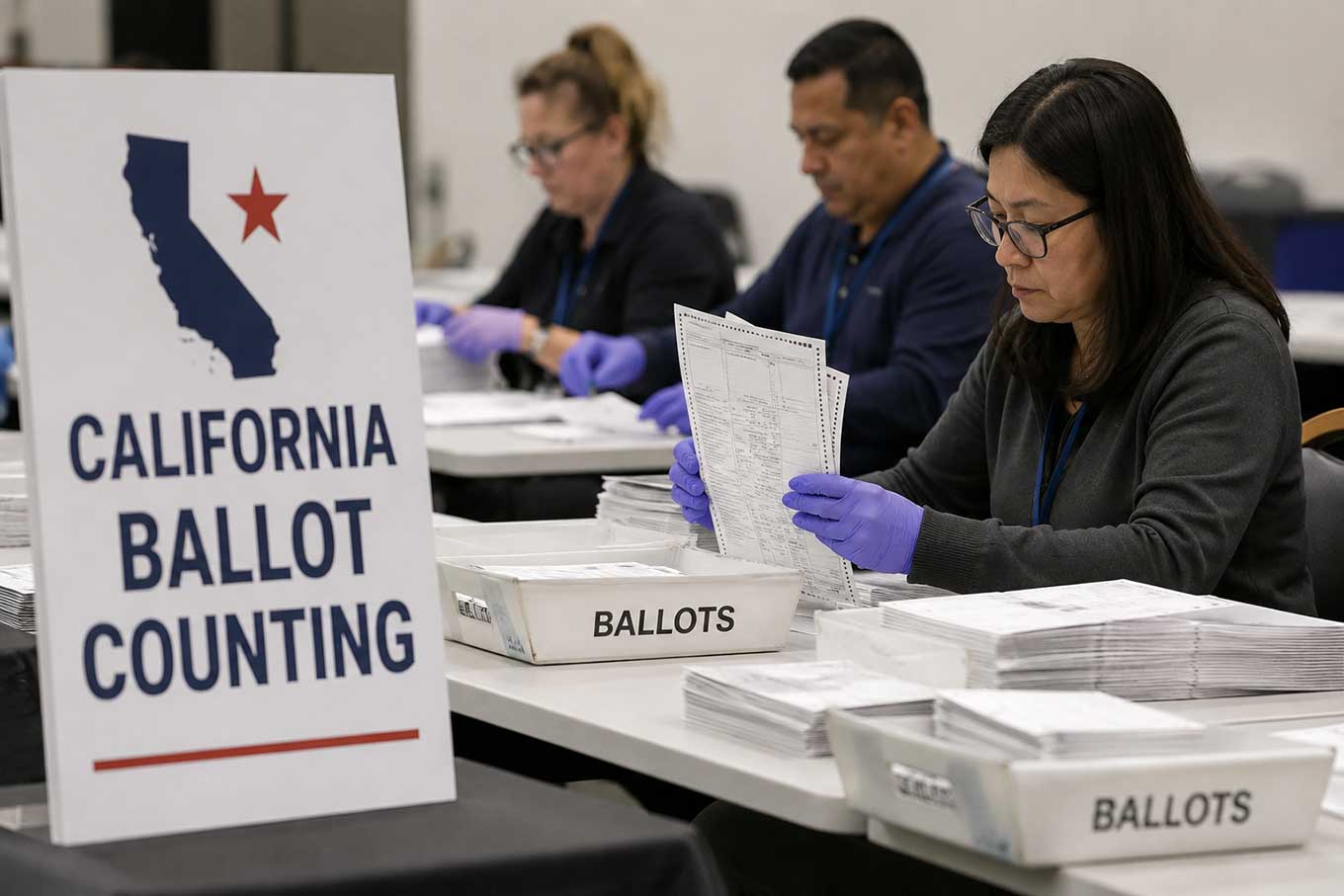
Eleven days after California’s June 2 primary, election officials in the nation’s most populous state were still counting ballots. The slow pace drew national attention, a federal review of ballot counting in Los Angeles County, and renewed political attacks on how the state runs its elections. The episode revived a recurring question: is California’s lengthy count a problem unique to the state, or a preview of friction that could spread to the November 2026 midterm elections across the country?
The short answer is that the delay is largely a product of California’s own laws and ballot mix, but the underlying issues — heavy reliance on mail voting, grace periods for late-arriving ballots, signature verification, and third-party ballot collection — are national in scope. A pending U.S. Supreme Court case could force as many as a dozen states to change their rules before November, making the timing of vote counts a midterm-wide story rather than a California curiosity.
Background
California has built one of the most access-oriented voting systems in the United States. Every active registered voter is automatically mailed a ballot, and the overwhelming majority of votes are cast that way. In the 2024 presidential election, roughly 13 million of the 16 million ballots cast statewide were returned by mail, according to election law analysts.
Mail ballots take longer to process than ballots cast in person. Each return envelope must be logged, and the voter’s signature must be matched against the signature on file before the ballot inside can be counted. In simple terms: an in-person ballot is verified at the polling place, while a mail ballot has to clear several administrative steps after it arrives.
California law also accepts ballots that are postmarked by Election Day and received up to seven days later, and it requires officials to give voters a chance to fix, or “cure,” problems such as a missing or mismatched signature. Those policies expand access but extend the timeline, because valid ballots can still be arriving and being resolved well after polls close.
The Policy Behind the Pace
The rules that govern California’s count are set in the state Elections Code and statewide law, not by individual counties. Counties generally cannot shorten the windows on their own; changing them would require action by the Legislature.
Lawmakers have already moved to speed things up. Assembly Bill 5, authored by Assemblymember Marc Berman and signed into law in 2025, requires county election officials to finish counting the vast majority of ballots on or before the 13th day after an election, rather than relying on the full 30-day canvass period that existed before. The law carves out exceptions for provisional ballots, ballots eligible to be cured, and certain late-arriving and out-of-county ballots.
In a statement on the bill, Berman framed it as an effort to balance speed with access, arguing that clear, achievable deadlines would give voters more confidence in results.
AB 5 did not change the separate 30-day deadline for counties to certify final results, and counties that cannot meet the 13-day mark may go past it if they provide public notice and a reason to the Secretary of State’s office. In other words, the law sets a faster target for releasing most results without removing the access provisions that slow the count in the first place.
The June 2 primary was the first major test of the new rules. Final certification of the primary results is due by July 10, 2026, with the Secretary of State noting that vote-by-mail, provisional, and other ballots would continue to be tallied throughout the canvass period.
How It Played Out in June
Several features of the June primary compounded the normal delay. California uses a top-two, or “jungle,” primary, in which the two highest vote-getters advance regardless of party. That means officials and the public need enough ballots counted to be certain not just of first place, but of second — a higher bar in a crowded field.
The governor’s race illustrated the effect. On election night, Republican Steve Hilton led the field, but as additional mail ballots were tallied, Democrat Xavier Becerra moved into first place. The Associated Press did not project Becerra and Hilton as the two advancing candidates until several days after Election Day. With about 88 percent of the expected vote counted, Becerra held roughly 28 percent and Hilton about 25 percent.
Analysts noted that Democratic voters appeared to hold their ballots longer than usual while deciding among a large slate of candidates, pushing more of the count into the days after the election. Because Republicans tend to return ballots earlier or vote in person, late-counted batches skewed more Democratic — a well-documented pattern sometimes called the “blue shift.” In simple terms: the order in which different voters return their ballots can change who appears to be ahead as counting continues.
The Los Angeles mayoral race showed a similar dynamic, with Nithya Raman overtaking another candidate for second place as later ballots were processed. None of this is evidence of irregularity; it reflects which ballots are counted when.
The Political Reaction
The extended count became a flashpoint. President Donald Trump, a Republican, used social media to question the delay and allege, without evidence, that Democrats were attempting to “steal” the gubernatorial and Los Angeles mayoral primaries. The U.S. Department of Justice sent a federal prosecutor to observe ballot counting in Los Angeles County, and the top federal prosecutor for the region said his office was overseeing election-related investigations.
Election administrators and outside experts pushed back on the fraud framing. Stephen Richer, a former Republican election official from Maricopa County, Arizona, has argued that disagreeing with how California runs its elections is not the same as evidence of fraud. Research on mail voting has repeatedly found fraud to be rare; a 2025 Brookings Institution analysis estimated roughly four cases per 10 million mail ballots.
The dispute underscores a core tension: a slow but transparent count can coexist with accurate results, but the gap between election night and final certification creates space for claims that erode public confidence.
The Ballot Harvesting Overlay
No element of California’s system draws the timing debate and the fraud debate together more often than ballot harvesting — the practice of one person collecting and returning completed mail ballots on behalf of other voters. Understanding how it fits requires separating two questions that are frequently merged: whether harvesting slows the count, and whether it threatens the integrity of the count.
Ballot collection is legal in California under Assembly Bill 1921, signed in 2016 and authored by then-Assemblymember Lorena Gonzalez. Before the law, only a voter’s family member or someone in the same household could return that voter’s mail ballot. AB 1921 removed those limits and now authorizes any designated person to return another voter’s ballot, with no cap on the number one person may collect. In simple terms: the pool of people legally allowed to carry your ballot expanded from a handful of relatives to essentially anyone.
The law does set conditions. A person returning someone else’s ballot may not be paid based on the number of ballots collected, and must print their name, their relationship to the voter, and their signature on the return envelope. State election officials and voter-information groups note that the statute permits an individual to turn in a ballot for another voter, but does not authorize setting up unofficial collection boxes to gather ballots in bulk.
How Harvesting Connects to the Count
The mechanical link to the timing story is direct. Harvested ballots tend to arrive in large batches close to or on Election Day, because an organized collection effort gathers ballots over a period of days before delivering them. Those ballots still must pass through the same processing steps as any other mail ballot — envelope logging, signature verification, and any required cure. As a result, harvesting does not create a separate category of delay so much as it concentrates more ballots into the post-Election-Day window that already slows California’s count.
This also reinforces the “blue shift” pattern described earlier, in which later-counted batches have tended to favor Democratic candidates. Organized collection operations have historically been more closely associated with labor and community-organizing infrastructure aligned with Democrats, though voters and campaigns across the spectrum use mail voting.
Fraud Versus Verifiability
On the question of fraud, the available evidence is consistent: documented cases tied to ballot collection are rare. After Republicans attributed 2018 losses in Orange County to harvesting, reviewers found no evidence the collection law had been misused. Broader studies reach similar conclusions; both the conservative-leaning Heritage Foundation and the centrist-to-liberal Brookings Institution have estimated mail-ballot fraud at a tiny fraction of total ballots cast over the past two decades.
Critics, however, increasingly frame the concern not as proven fraud but as a question of verifiability — that the system as designed would make certain abuses difficult to detect or disprove. They point out that people returning others’ ballots are not required to complete training, need only be adults, and are not required to show identification matching the voter whose ballot they deliver, while the signature on the collection attestation is not independently verified against a government ID. When same-day voter registration is added, a single interaction can both register a voter and collect that voter’s ballot.
Supporters of the law counter that it expands access for elderly, disabled, rural, and homebound voters who may struggle to return ballots on their own, and that the name-and-signature requirement plus the ban on per-ballot pay provide meaningful safeguards. The distinction matters for readers: “the count is slow,” “the system is hard to audit,” and “fraud occurred” are three separate claims, and evidence for the first two does not establish the third.
A State Issue, Not a Supreme Court Issue
Crucially for the national picture, ballot harvesting is governed state by state and is not the subject of the pending Supreme Court case. Rules vary widely: in 2026 a federal court upheld Texas’s ban on paid ballot harvesting, while other states permit collection with differing limits on who may collect and how many ballots. Any change to California’s harvesting rules would come from the Legislature or the courts in California, not from a national ruling.
Does the Problem Carry Into the Midterms?
This is where California stops being an outlier. While the specific seven-day grace period, cure rules, and permissive ballot-collection statute are California’s own, the broader practices that slow counts exist across the country — and one of them is now before the U.S. Supreme Court. It is worth noting what is and is not at issue nationally: the Court is weighing late-arriving ballots, not who is permitted to collect and return them. Ballot harvesting will remain a state-by-state question regardless of how the Court rules.
In Watson v. Republican National Committee, the justices are weighing Mississippi’s law allowing ballots postmarked by Election Day to be counted if they arrive shortly afterward. The case turns on whether such grace periods conflict with the federal definition of Election Day. According to the National Conference of State Legislatures, 18 states and the District of Columbia accept regularly mailed ballots received after Election Day if postmarked on time, and additional states extend similar grace periods to military and overseas voters — pushing the total number of affected states higher.
A ruling is expected by late June 2026. If the Court bars counting ballots that arrive after Election Day, election officials in roughly 14 states plus Washington, D.C., would have to change their rules just months before the November midterms, with more states potentially affected through their military and overseas ballot provisions.
The practical stakes are significant. A Votebeat analysis found that at least 750,000 ballots that were eligible to be counted arrived after Election Day in 2024. Voting-rights groups and some election officials have warned that an abrupt change could confuse voters and disenfranchise those affected by slow mail delivery or by the longer processing timelines for overseas service members. Supporters of an Election Day receipt deadline counter that it would reduce post-election uncertainty and the reporting delays that fuel disputes.
Several states have not waited for the Court. Four Republican-led states eliminated their ballot-arrival grace periods in the past year, and Congress has debated broader restrictions on mail voting, though sweeping federal legislation faces steep odds in the Senate. The net effect is that the rules governing how quickly results arrive are in flux nationwide heading into 2026.
In that sense, California’s June experience is less a one-state anomaly than the most visible example of a tension every state with significant mail voting will navigate this fall: the trade-off between counting speed and ballot access. States that rely heavily on mail — including swing states such as Nevada and mail-heavy states like Colorado, Oregon, and Utah — could see the same election-night-to-final-result gap that drew scrutiny in California, particularly in close races.
Conclusion
California’s slow count is primarily a function of its own choices: universal mail ballots, a seven-day postmark grace period, signature-cure provisions, and a top-two primary that requires resolving both first and second place. AB 5 is the state’s attempt to compress that timeline without rolling back access, and the June 2 primary was its first real test.
But the forces behind the delay are national, and a Supreme Court decision due in late June could reset the rules for counting late-arriving ballots in more than a dozen states just ahead of the midterms. Whether or not voters see California-style delays in November will depend less on any single state and more on how that ruling lands — and how quickly states can adjust before Election Day.
Key Takeaways
- California’s slow count stems mainly from state law: universal mail ballots, a seven-day postmark grace period, signature-cure rules, and a top-two primary that requires confirming both first and second place.
- AB 5 (2025) now requires counties to count most ballots within 13 days, but it did not change the 30-day certification deadline or remove the access provisions that lengthen the count.
- The June 2 primary saw leads shift as late mail ballots were tallied — a normal “blue shift” pattern, not evidence of fraud, according to election experts.
- Ballot harvesting, legal in California since AB 1921 (2016), concentrates ballots into late batches and amplifies the existing delay; documented fraud tied to it is rare, but critics raise verifiability concerns about how the system is structured. It is set state by state and is not before the Supreme Court.
- The delay drew federal scrutiny and unsubstantiated fraud claims, highlighting how the gap between election night and certification can fuel distrust.
- The issue is national: a pending Supreme Court case, Watson v. RNC, could force roughly 14 states plus D.C. to stop counting late-arriving ballots before the 2026 midterms, making vote-count timing a midterm-wide story.
Sources
- KQED, “Why Is California Still Counting Votes? And Other Questions About How Our Elections Actually Work,” June 2026.
- CalMatters, “New California law could speed up the state’s famously slow vote-counting process,” October 8, 2025.
- California Legislative Information, Assembly Bill 5 (Berman), filed October 3, 2025.
- Office of Assemblymember Marc Berman, “Governor Signs Critical Measure to Deliver Fast and Accurate Election Results,” October 6, 2025.
- California Secretary of State, 2026 Primary Election Results — Governor (Statewide), accessed June 2026.
- PBS NewsHour / Associated Press, “Supreme Court will decide whether states can count late-arriving mail ballots,” and oral-argument coverage, March 2026.
- Votebeat, “Supreme Court justices hear challenge to counting late-arriving mail ballots,” March 23, 2026.
- Stateline, “Supreme Court skeptical of allowing states to count mail ballots that arrive after Election Day,” March 23, 2026.
- R Street Institute, “An Election Day Deadline for Mail Ballots Is Common-Sense Policy,” April 6, 2026.
- PBS News / Associated Press, “California’s slow ballot count makes it a target for critics. It doesn’t mean elections are rigged,” June 2026.
- California Legislative Information, Assembly Bill 1921 (Gonzalez), Elections: vote by mail ballots, 2015–2016 session.
- California Voter Foundation, “Here’s what you need to know about ballot harvesting in California (Yes, it’s legal).”
- California Department of Justice, Information Bulletin 2024‑DLE‑15, “Ballot Collection Laws,” October 28, 2024.
- FindLaw, “What Is Ballot Harvesting?” reviewed April 28, 2026.
- Ballotpedia, “Ballot collection laws by state.”
- Brookings Institution, analysis of mail-ballot fraud rates, November 2025.