
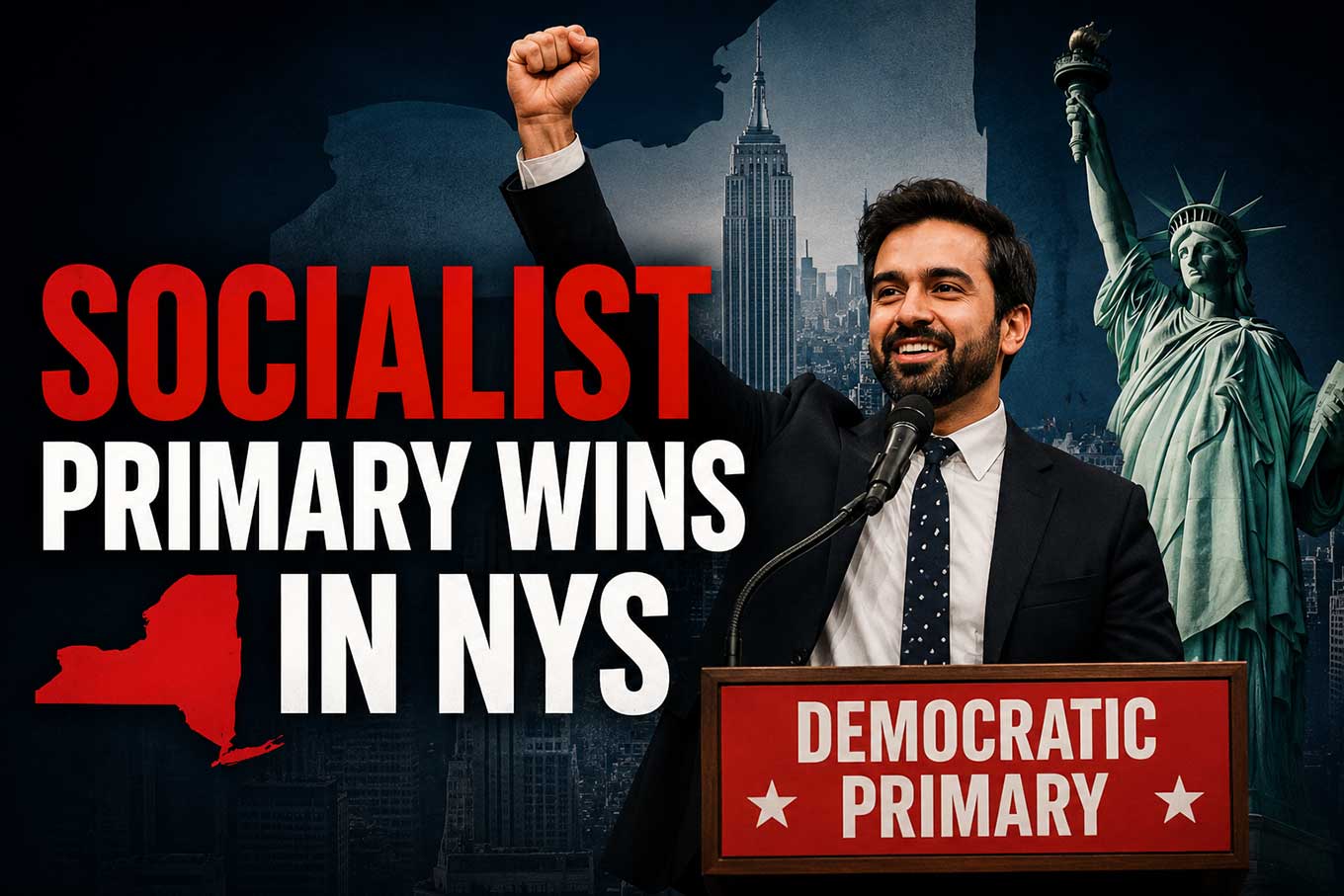
Democratic socialists scored a broad set of victories in New York’s June 23, 2026, primary elections, ousting two sitting members of Congress and expanding their bloc in the state legislature. The results have prompted competing explanations among political analysts, who disagree over whether the outcome reflects a genuine embrace of socialist policy, a shift in Democratic foreign-policy attitudes, or a younger electorate’s frustration with the cost of living.
Background
The wins build on the 2025 election of Zohran Mamdani, a democratic socialist, as mayor of New York City. Mamdani endorsed roughly eight candidates in the 2026 cycle, and as of late on primary night nearly all appeared poised to win, according to local reporting from Epicenter NYC.
In the most closely watched congressional races, former City Comptroller Brad Lander defeated Rep. Dan Goldman in New York’s 10th District, taking about two-thirds of the vote. State Assembly member Claire Valdez won the open 7th District seat being vacated by retiring Rep. Nydia Velázquez. And in the night’s biggest upset, 32-year-old community organizer Darializa Avila Chevalier narrowly unseated five-term Rep. Adriano Espaillat, 71, who chairs the Congressional Hispanic Caucus.
The Democratic Socialists of America (DSA) also made gains in Albany. According to a New York Focus analysis, the group was poised to pick up at least six state legislative seats, which would give it roughly 15 endorsed lawmakers across the State Senate and Assembly. In Brooklyn, Aber Kawas was on track to become New York’s first Palestinian state senator.
In simple terms: a wing of the Democratic Party that operated on the margins a decade ago now controls a growing share of the city’s congressional delegation and a larger foothold in the statehouse.
What the Candidates Ran On
The DSA-aligned candidates campaigned on a broadly shared economic platform. Valdez called for “Medicare for All” and what she described as a “public option for housing,” according to NBC News. Mamdani’s own governing agenda — universal childcare, lower food costs, and rent freezes for rent-stabilized apartments — served as a template for several of the candidates he backed.
In simple terms: “democratic socialist,” as used by these candidates, generally refers to expanded government provision of services such as housing, health care, and childcare, funded through higher taxes, rather than state ownership of the broader economy.
The campaigns also featured sharp disagreement over Israel. All three winning congressional challengers described Israel’s conduct in Gaza as “genocide” and criticized opponents’ ties to the pro-Israel lobbying group AIPAC. Lander, who is Jewish, has called for ending or conditioning U.S. military aid to Israel.
The Spending Battle
Outside groups spent heavily to stop the slate. Super PACs had spent $9.6 million on state Assembly and Senate primaries as of the day before the election — nearly five times the amount spent through the same point in 2024 — according to New York Focus. Anti-DSA spending alone totaled about $2.9 million and largely failed to deliver wins.
Jeff Leb, a strategist running a super PAC supporting moderate candidates, attributed the left’s momentum to Mamdani, telling reporters the mayor’s 2025 win “woke people up.”
Impact
The results reverberated beyond New York. National Republicans framed the outcome as evidence of a party captured by its left flank; House GOP campaign-arm spokesman Mike Marinella said the establishment had “surrendered” to the socialist wing. Centrist Democrats voiced their own unease, with former Colorado congressional candidate Adam Frisch saying flatly that he does not like the DSA.
Much of the post-election commentary centered on Democratic leadership. Both Senate Minority Leader Chuck Schumer and House Minority Leader Hakeem Jeffries face renewed questions about their hold on the party, given that the wins occurred in their home state.
Because the affected districts are heavily Democratic, the primary winners are favored to prevail in November’s general election.
Analysis: Three Competing Interpretations
Observers have offered at least three distinct readings of what the results mean.
An endorsement of the economic agenda. Some analysts argue the wins reflect voter alignment with the candidates’ affordability platform rather than ideology in the abstract. Research by the Searchlight Institute on Mamdani’s 2025 mayoral run found that words tied to prices and affordability appeared in 78% of his ad and video content, and that an April 2025 Siena College poll showed 72% of New York City voters considered affordability “a very serious problem” — well above the 47% who said the same of crime. By this reading, voters responded to a cost-of-living message that the candidates kept relentlessly on-topic.
A referendum on Israel. Other outlets, including the Times of Israel and The Forward, emphasized the prominence of Israel as a “litmus test” in the races, particularly attacks on opponents’ AIPAC ties. National polling supports a broader Democratic shift: a Gallup survey published in July 2025 recorded U.S. support for Israel at 46%, its lowest in the quarter-century Gallup has tracked the question, with 59% of Democrats expressing more sympathy for Palestinians than Israelis. Analysts are divided, however, on whether the issue moved the average voter. The Times of Israel noted it was unclear whether the anti-Israel positions motivated voters or simply did not deter them, and the Searchlight analysis of the 2025 mayoral race found only 4% of Mamdani voters named Israel or Gaza as a top-three priority. The Forward argued that pro-Israel groups themselves elevated the issue’s prominence through litmus tests that backfired.
A generational and economic realignment. A third interpretation focuses on who turned out. A Washington Post analysis described the winning coalition as multiracial, young, and college-educated, expanding beyond the DSA’s traditional base. Under this framing, the results reflect economic discontent among younger voters facing housing and wage pressures, with socialism functioning as a vehicle for that frustration rather than its primary driver.
These readings are not mutually exclusive, and the available data does not cleanly resolve which factor was decisive. Skeptics also caution against over-reading low-turnout primaries in deep-blue districts. As NBC News and others noted, the movement’s reach faces tests in less friendly terrain, including upcoming primaries in Colorado, Missouri, Michigan, and Wisconsin, where DSA- and Sanders-backed candidates are challenging entrenched incumbents.
Conclusion
New York’s 2026 primaries delivered an unambiguous tactical victory for Mamdani and the DSA, ousting incumbents and surviving a multimillion-dollar opposition campaign. What the wins signify in policy and electoral terms remains contested. The evidence assembled so far points to affordability as the dominant message, foreign policy as a defining fault line within the party, and a younger, broader electorate as the engine — without settling how those forces ranked in the minds of voters.
Key Takeaways
- Mamdani-backed democratic socialists swept New York’s June 23, 2026, primaries, unseating Reps. Dan Goldman and Adriano Espaillat and expanding the DSA’s state legislative bloc to roughly 15 lawmakers.
- Super PACs spent $9.6 million on legislative primaries, nearly five times the 2024 pace, with anti-DSA spending largely failing.
- Analysts dispute whether the results signal an embrace of socialist economics, a shift on Israel, or generational cost-of-living discontent — and the data does not clearly favor one explanation.
- Because the districts are heavily Democratic, the winners are favored in November.
- The movement’s national reach faces tests in upcoming primaries in less reliably Democratic states.
Sources
- New York Focus, “NY Primary Results: DSA Set to Pick Up 6+ Seats in Albany” (June 24, 2026)
- NBC News, “Zohran Mamdani’s picks take key House primaries” (June 24, 2026)
- NPR, “New York primary takeaways” (June 24, 2026)
- The Washington Post, “Democratic socialists in New York expanded their voting base to claim victory” (June 25, 2026)
- Times of Israel, “Mamdani-backed primary sweep further cements anti-Zionist politics in NYC” (June 24, 2026)
- The Forward, “Israel’s cheerleaders lost big in the New York primary” (June 24, 2026)
- Searchlight Institute, “How Zohran Mamdani Won” (Nov. 5, 2025)
- Siena College Research Institute (April 2025 poll); Gallup (July 2025 survey)
- Epicenter NYC, “Zohran Mamdani wins … again” (June 24, 2026)