
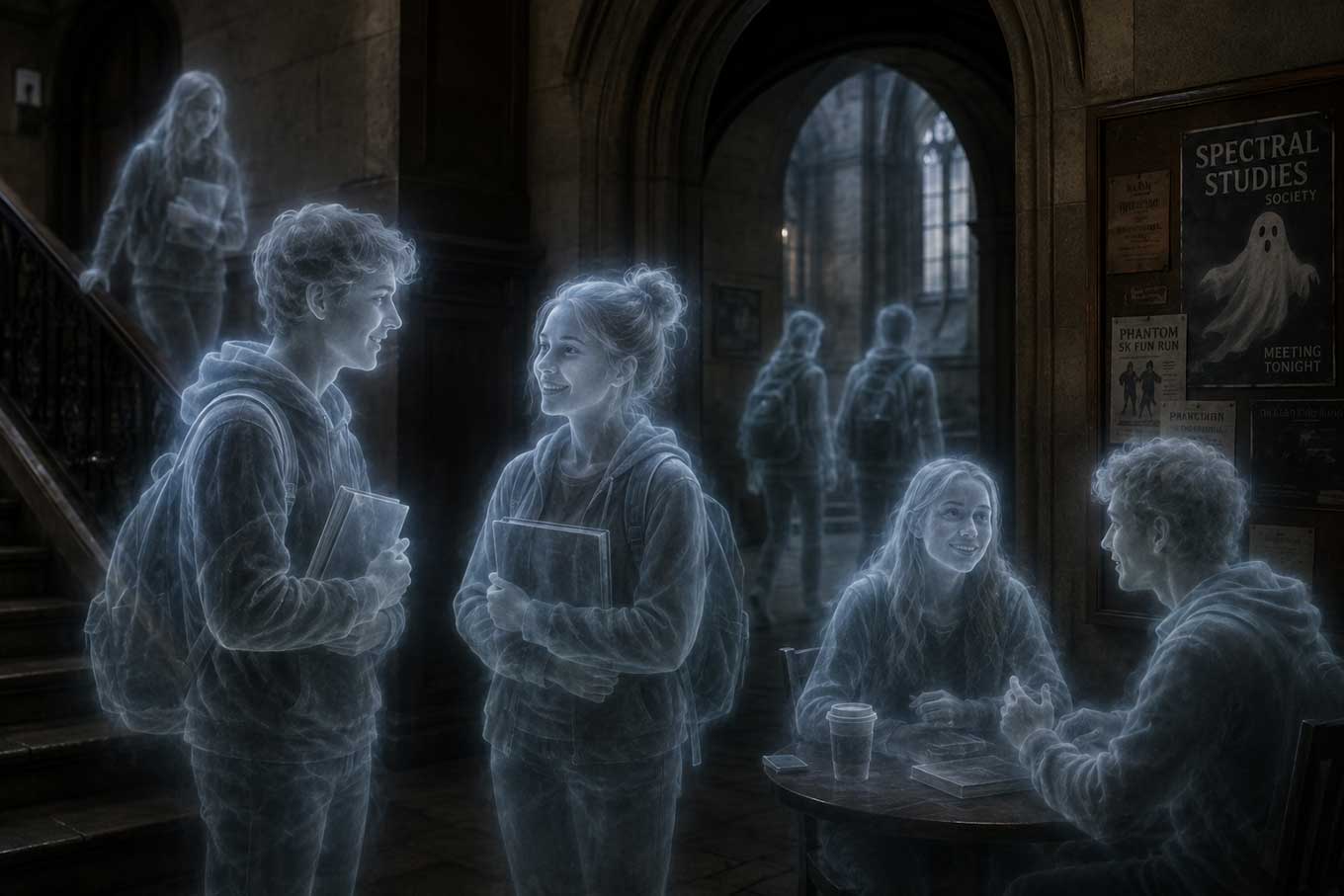
Across the United States, colleges are discovering that a growing share of the people on their class rosters do not exist. Known as “ghost students,” these are fraudulent or stolen identities used by individuals and organized crime rings to enroll in online courses, claim federal financial aid, and disappear once the money is disbursed. The scheme has grown rapidly as artificial-intelligence tools make it cheap to generate convincing fake applicants at scale.
The most-cited figure comes from California, where the community college system reported that roughly 31 percent of applications were flagged as fraudulent during the 2024–25 academic year. Other screening data place the rate between about 20 percent and 35 percent at affected institutions, with some individual campuses far higher.
Background
The term “ghost student” describes a fraudulent enrollment rather than a struggling freshman who stops attending. Fraudsters use stolen Social Security numbers, fabricated identities, or AI-generated synthetic personas to apply to colleges online. Once accepted, they enroll—typically in fully online programs that never require physical presence—file a Free Application for Federal Student Aid (FAFSA), and collect Pell Grant or loan disbursements before vanishing.
In simple terms: criminals sign up as fake students, take the aid money meant for real students, and never show up to class.
The problem accelerated during the COVID-19 pandemic, when remote enrollment expanded and verification requirements were relaxed. According to the U.S. Department of Education, fewer than 1 percent of aid applicants were required to verify their identity during that period. Community colleges became the primary targets because they generally have open-admission policies, simplified applications, no application fees, and large catalogs of online courses—conditions that let bots submit thousands of applications in minutes.
How the Federal Response Works
Beginning in June 2025, the Department of Education launched a nationwide effort to require institutions to verify the identity of newly enrolled students before releasing aid. On April 26, 2026, the Department went further, embedding real-time fraud detection directly into the FAFSA. Every applicant is now scored for fraud risk at submission, and high-risk applicants must present a government-issued photo ID before accessing funds such as Pell Grants and federal student loans.
Applicants are sorted into risk tiers, and the Department has said institutions are not required to act on the large majority of rejected applications, which it characterizes as genuinely fraudulent. The agency also ran a one-time retroactive review of previously submitted 2026–27 FAFSA forms using the new screening.
Congress is moving to codify the effort. On June 10, 2026, the U.S. House passed the No Aid for Ghost Students Act (H.R. 7892) by a vote of 249–172. The bill would require the Department to screen every FAFSA for identity fraud beginning October 1, 2026, and would bar institutions from disbursing aid to flagged applicants unless their identity is verified in person or by live video. The measure now awaits action in the Senate.
Examples: How Widespread Is It?
Screening data show the fraud rate varies sharply by region and campus, but the scale is consistent across providers:
- California Community Colleges: about 31 percent of applications flagged as fraudulent in 2024–25, with 223,000 confirmed fake enrollments and at least $11.1 million in unrecoverable aid reported in 2024.
- LightLeap.AI vendor data: roughly 26 percent of applicants flagged across 75 California colleges (about 1.2 million applications), and about one in five—near 20 percent—at 24 non-California colleges it screens.
- Individual districts: Lassen Community College district at 65.3 percent, Citrus at 34.6 percent, Ventura County at 21.4 percent, and Santa Barbara at 7.6 percent.
- Century College (Minnesota): instructors found roughly 15 percent of students in a single course were fraudulent enrollees.
- Pierce College (California): enrollment dropped by nearly 36 percent after ghost students were purged from the rolls.
Other states reporting active campaigns include Arizona, Indiana, Oregon, New Jersey, Michigan, and Minnesota. At one Oregon college, roughly 1,000 applications flooded a system serving about 5,000 students over a single weekend. Some schools have reported batches of fake applications submitted within seconds of one another.
Impact
The Department of Education says its identity-verification measures prevented more than $1 billion in attempted aid theft since January 2025, including more than $563 million nationwide and $171 million in California tied to the bolstered verification process. Separately, the agency identified roughly 150,000 suspect identities in federal aid forms, found that $90 million had been disbursed to ineligible recipients, and traced about $30 million in aid awarded using the identities of deceased people.
The harm extends beyond stolen dollars. When bots fill online classes, real students are waitlisted or shut out of courses they need to graduate. Faculty have reported grading AI-generated homework submitted by fraudulent accounts, and financial-aid staff have been forced to verify rosters by hand. In at least one documented case, a legitimate person discovered a grant had been awarded in his name for a course he never enrolled in, with someone else logging in and submitting work under his identity.
Analysis
Supporters of the new screening argue it closes a gap that left federal aid with weaker identity checks than opening a bank account. The Department maintains the process targets a small slice of high-risk applications and will not change the experience for the vast majority of families.
Critics, including financial-aid associations and student-advocacy groups, warn that verification requirements can create barriers for first-generation applicants, students without traditional identification, and those experiencing homelessness or lacking reliable internet access. The Hope Center for Student Basic Needs and others have cautioned that the No Aid for Ghost Students Act contains few guardrails to prevent legitimate students from being delayed or screened out. A separate line of analysis, advanced by researchers at the Information Technology and Innovation Foundation, holds that the deeper issue is the absence of a secure, interoperable national identity infrastructure rather than FAFSA policy alone.
In simple terms: nearly everyone agrees the fraud is real and serious; the debate is over whether the fixes might also block some real students.
Conclusion
Ghost-student fraud has shifted from a pandemic-era anomaly to a persistent feature of the federal aid landscape, propelled by AI tools that can fabricate applicants in seconds. With fraudulent application rates near a third at the hardest-hit systems, real-time FAFSA screening now in place, and federal legislation advancing, the coming year will test whether new defenses can curb the losses without slowing access for the students the programs were built to serve.
Key Takeaways
- “Ghost students” are fake or stolen identities used to enroll in college, claim federal aid, and disappear; community colleges are the prime target.
- In California’s community college system, roughly 31 percent of applications were flagged as fraudulent in 2024–25; vendor screening shows about 26 percent statewide and near 20 percent at non-California colleges, with some campuses above 60 percent.
- The Department of Education says it has prevented more than $1 billion in attempted aid theft since January 2025 and embedded real-time fraud detection into the FAFSA as of April 26, 2026.
- The House passed the No Aid for Ghost Students Act on June 10, 2026; if enacted, it would require fraud screening of every FAFSA beginning October 1, 2026.
- Advocacy groups warn stricter verification could delay or block legitimate students who lack standard identification or reliable internet access.
Sources
- U.S. Department of Education — Nationwide Federal Student Aid Fraud Prevention Effort (April 2026)
- Inside Higher Ed — Calif. Community Colleges Ramp Up Battle Against the Bots
- Inside Higher Ed — Education Dept. Launches New FAFSA Fraud Prevention Tool
- Fortune — Colleges’ ‘Ghost Students’ AI-powered fraud rings
- Fortune — AI tracked down nearly 80,000 ghost students in California colleges
- The College Investor — House Passes Bill to Screen Every FAFSA for Identity Fraud
- Congress.gov — H. Rept. 119-669, No Aid for Ghost Students Act of 2026
- NASFAA — House Passes No Aid for Ghost Students Act
- Univ. of Maryland, Robert H. Smith School — Ghosts in the Classroom