
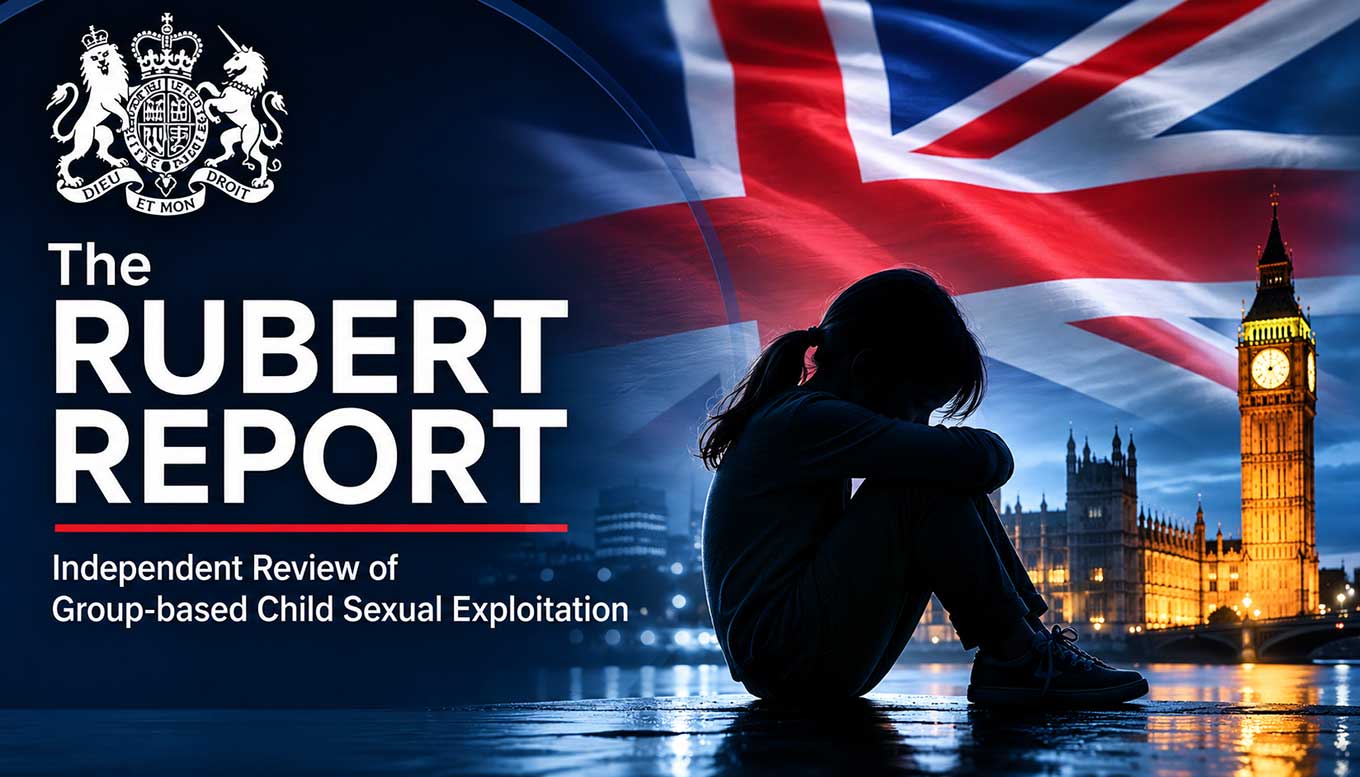
A privately funded inquiry led by independent Member of Parliament Rupert Lowe has reignited debate over how British institutions — including police forces, local councils, and successive governments — responded to organised child sexual exploitation, commonly referred to as the “grooming gangs” scandal. The 219-page document, titled The Rape Gang Inquiry Report, was released on the social platform X on June 16, 2026.
The report, produced by Lowe’s Restore Britain party and a survivor-led panel, argues that organised abuse networks operated across much of the country for decades and that public authorities failed — through what it characterises as either passive or active inaction — to stop them. The findings arrive as a separate, government-established statutory Independent Inquiry into Grooming Gangs begins its own investigation with formal legal powers.
Background
The grooming gangs scandal refers to a series of cases, uncovered across England over the past two decades, in which groups of men sexually exploited and trafficked children and adolescents. High-profile prosecutions in towns such as Rotherham, Rochdale, and Telford brought national attention to the issue and to repeated safeguarding failures by police, social services, and local authorities.
In June 2025, Baroness Louise Casey published a National Audit on Group-based Child Sexual Exploitation and Abuse, commissioned by the Labour government. The audit found that the ethnicity of perpetrators had historically been “shied away from” by authorities and that data was too poorly recorded to draw firm national conclusions. The government accepted all 12 of Casey’s recommendations, and Prime Minister Keir Starmer — who had previously resisted a fresh national inquiry — announced one on June 14, 2025.
In simple terms: Two separate efforts now exist. One is an official, legally empowered government inquiry. The other is Rupert Lowe’s privately funded report, which has no legal authority to compel evidence. They examine overlapping events but are not the same thing.
Lowe, the MP for Great Yarmouth, was elected for Reform UK in 2024, sat as an independent after the party suspended its whip in March 2025, and founded Restore Britain, which registered as a political party in March 2026. The Guardian has described the new party as positioned on the right to far right of British politics. The inquiry was headed in part by child sexual abuse campaigner Sammy Woodhouse, herself a survivor of abuse in Rotherham, and was funded by more than £600,000 in donations from over 20,000 members of the public after the government declined to launch a statutory probe on Lowe’s preferred terms.
The Allegations Against the State
The central claim of the report is that the abuse was a national pattern rather than a collection of isolated local scandals, and that the state’s response amounted to systemic failure. According to the document, opportunities to identify and protect vulnerable children were repeatedly missed across policing, social care, education, health services, and local taxi-licensing authorities.
As reported by GB News, the report asserts that the gangs “operated with either the active or passive consent of public authorities,” and it accuses both Labour and Conservative governments of failing to address the problem despite years of warnings. It contends that fear of being accused of racism, and concern for community relations, contributed to official inaction.
The report’s most contested figures concern scale. It claims organised exploitation occurred in at least 149 local authority districts — nearly 40 percent of the UK — and cites a figure of at least 250,000 victims. As IBTimes UK notes, the 149-district figure has not been independently verified by the government’s statutory inquiry, which is still gathering evidence using its formal investigative powers.
The 250,000 figure traces to a 2019 House of Lords debate rather than to original data collected by the inquiry. The report itself acknowledges imprecision, attributing the uncertainty to records that it says were never properly kept. Critics, including analysis cited by Wikipedia’s account of the scandal, have characterised the figure as unverified and potentially misleading. The report also states that 87 to 95 percent of those convicted in the cases it examined were of Pakistani Muslim heritage — a framing that has drawn both support and sharp criticism.
What the Report Recommends
The document sets out a wide-ranging slate of recommendations aimed at both accountability and prevention:
- Mandatory recording of the ethnicity and religion of offenders in child sexual exploitation cases.
- A statutory revision of sentencing so that group-based child sexual exploitation carries a starting point of life imprisonment, with minimum tariffs of 50 years for ringleaders and 25 years for participants.
- Automatic deportation of every foreign national convicted of group-based exploitation, and loss of British citizenship for convicted dual nationals.
- A national compensation scheme for survivors, funded by a levy on convicted perpetrators’ assets and on the pensions of officials found culpably negligent.
- Personal consequences — including potential prosecution — for public officials who failed to act on credible evidence.
- A binding public referendum on reintroducing the death penalty, which Lowe personally supports for the most serious cases.
In simple terms: Some of these proposals — such as deportation rules and a death-penalty referendum — go well beyond what the official government inquiry is examining, and several would require major changes to UK law.
The Government’s Position
The government has not issued a major formal response to Lowe’s report. Its parallel, statutory Independent Inquiry into Grooming Gangs was formally established under the Inquiries Act 2005 on April 13, 2026, chaired by former Children’s Commissioner Baroness Anne Longfield, alongside panellists Zoë Billingham and Eleanor Kelly. Unlike Lowe’s report, the statutory inquiry can compel witnesses and require disclosure of evidence. It covers England and Wales, carries a budget of £65 million, and is expected to conclude by 2029.
During a House of Commons exchange on June 18, 2026, recorded in Hansard, a Home Office minister said the government was “not waiting three years” for the inquiry’s report to act. The minister pointed to Operation Beaconport, a national police operation overseen by the National Crime Agency and backed by £38 million this year, to reopen cases; legislation removing ambiguity about the inability of 13- to 16-year-olds to consent; and the disregarding of historic convictions for so-called “child prostitution.” One MP urged the minister to engage directly with the recommendations in Lowe’s associated parliamentary motion rather than wait for the inquiry to conclude.
An Early Day Motion tabled in Parliament noted the report’s publication, paid tribute to survivors and whistleblowers, and called on the government to formally engage with its findings and provide a written response.
Analysis
The dispute is, in part, about method as much as conclusions. The statutory inquiry is built to withstand legal challenge: it can force testimony, must refer criminal evidence to Operation Beaconport, and cannot itself determine criminal or civil liability. Lowe’s report, by contrast, draws on survivor testimony, whistleblower accounts, court records, and previous inquiries, but lacks subpoena power and relies in places on advocacy material and pre-existing estimates rather than newly compiled data.
That distinction is central to how the two documents will be received. Supporters argue the independent report says plainly what official Britain spent years avoiding, particularly regarding offender demographics that Baroness Casey’s own audit said had been “shied away from.” Critics counter that the report blends documentation of real, serious crimes with sweeping political claims about immigration, multiculturalism, and Islam — and that unverified headline figures risk undermining the credibility of well-evidenced findings.
What both efforts share is a starting premise that the state failed. The government’s own ministers have repeatedly described the scandal as a betrayal by “the very institutions that should have protected” vulnerable children. The open questions are the true scale of that failure, who should be held individually accountable, and whether the official inquiry can deliver answers fast enough to satisfy survivors and a polarised public.
Conclusion
Rupert Lowe’s report has succeeded in forcing renewed attention onto the British state’s role in failing to prevent organised child sexual exploitation, even as its most dramatic statistics remain unverified and its political framing draws fierce dispute. The statutory inquiry now under way will determine, with legal powers the independent report lacks, how much of the picture can be authoritatively established — and whether accountability extends to the officials and institutions both efforts accuse of looking away.
Key Takeaways
- Independent MP Rupert Lowe released a 219-page “Rape Gang Inquiry Report” on June 16, 2026, accusing British police, councils, and successive governments of enabling decades of organised child sexual exploitation.
- The report is privately funded and non-statutory; it cannot compel evidence, unlike the government’s official inquiry.
- Its headline figures — 250,000 victims and 149 affected districts — are contested and have not been independently verified.
- A separate statutory Independent Inquiry into Grooming Gangs, chaired by Baroness Anne Longfield, began on April 13, 2026, with a £65 million budget and a 2029 deadline.
- The government has not formally responded to Lowe’s report but says it is acting through Operation Beaconport and new legislation rather than waiting for the inquiry to conclude.
Sources
- UK Parliament — Hansard, Grooming Gangs: Independent Inquiry (June 18, 2026) — https://hansard.parliament.uk/Commons/2026-06-18/debates/43EC98B7-082B-4D48-BE5A-737E895596AF/GroomingGangsIndependentInquiry
- GOV.UK — Independent Inquiry into Grooming Gangs (commencement statement) — https://questions-statements.parliament.uk/written-statements/detail/2026-04-13/hcws1492
- The Statutory Independent Inquiry into Grooming Gangs (official site) — https://www.grooming-gangs.independent-inquiry.uk/
- House of Commons Library — The Independent Inquiry into Grooming Gangs — https://commonslibrary.parliament.uk/research-briefings/cbp-10613/
- UK Parliament — Early Day Motion: Independent Rape Gang Inquiry Report — https://edm.parliament.uk/early-day-motion/66091/independent-rape-gang-inquiry-report
- GB News — Grooming gangs: Rupert Lowe releases independent report — https://www.gbnews.com/news/grooming-gangs-rupert-lowe-releases-independent-report
- IBTimes UK — Report claims grooming gangs operated in 149 UK areas — https://www.ibtimes.co.uk/independent-report-child-exploitation-uk-1803223
- Wikipedia — Grooming gangs scandal — https://en.wikipedia.org/wiki/Grooming_gangs_scandal
- Wikipedia — Rupert Lowe — https://en.wikipedia.org/wiki/Rupert_Lowe