
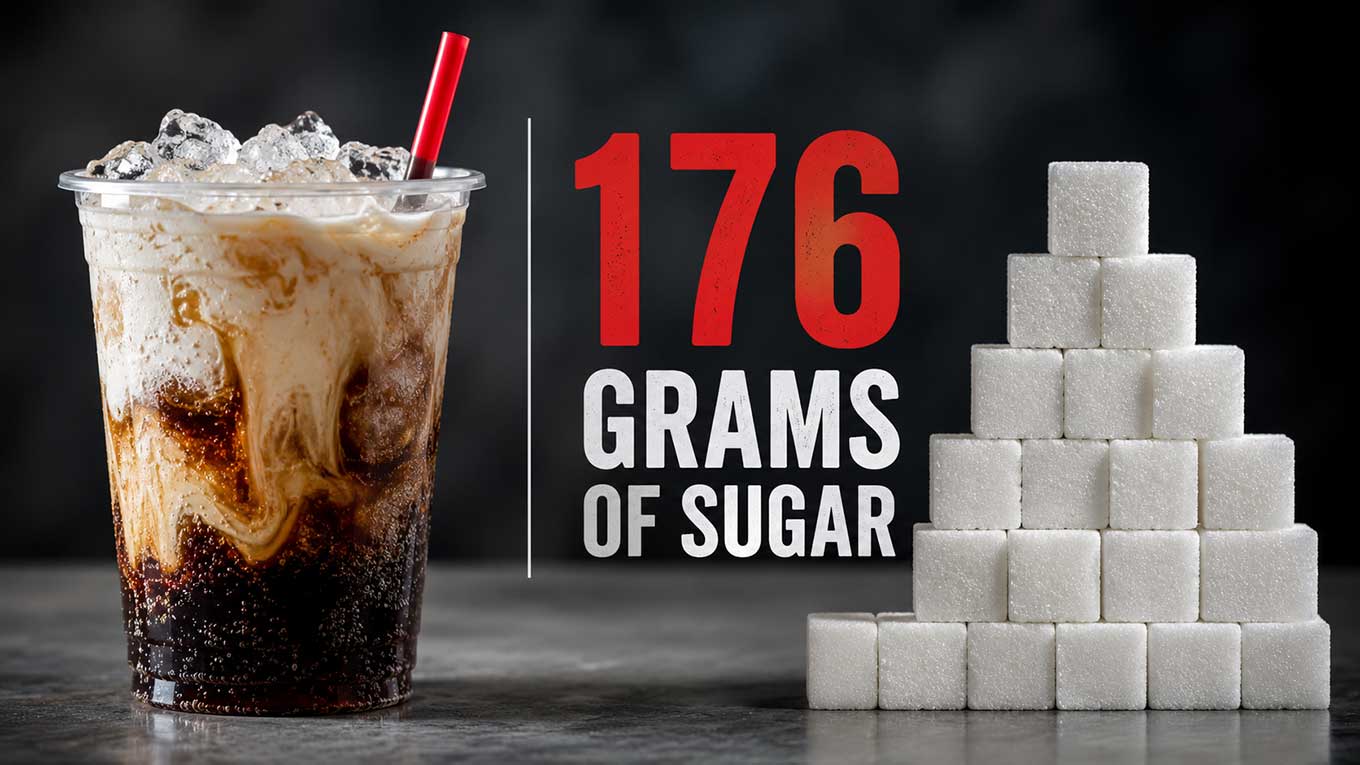
Just as a wave of public-health pressure pushes American consumers and food companies toward lower-sugar, less-processed products, the dessert chain Crumbl Cookies has introduced a beverage moving in the opposite direction.
A line of customizable “dirty sodas” sold by the chain has drawn public attention after one option was reported to contain 186 grams of sugar in a single 32-ounce serving, prompting commentary from physicians and dietitians about the health effects of high added-sugar beverages.
The drink at the center of the discussion, marketed as “Crazy Cousins,” combines an energy drink, soda, fruit syrup, fruit purée and coconut cream. Reporting on its nutrition figures placed its sugar content at several times the daily limits recommended by major health organizations — arriving at a moment when much of the industry is racing to cut sugar, not add it.
Background
Dirty soda is a beverage trend that began in Utah, where soda shops blend regular soft drinks with cream, flavored syrups and fruit purées to create dessert-style drinks. The category gained wider visibility through social media before larger chains adopted it.
In simple terms: a dirty soda takes an ordinary fizzy drink and adds sweet mix-ins until it resembles a milkshake more than a soda.
Crumbl Cookies, a chain known for its weekly rotating menu of large cookies, expanded into the category with a menu that reports describe as offering dozens of flavor combinations, including a build-your-own option and energy-drink-based blends listed as “Chargers.” Coverage noted that some lower-sugar versions on the menu contain far less sugar than the headline figure.
What the Drink Contains
According to multiple outlets, the Crazy Cousins drink combines an energy drink base with soda, pineapple syrup, strawberry purée and coconut cream. Reported figures place the 32-ounce serving at roughly 840 calories and about 186 grams of sugar.
Several news organizations reported that detailed per-drink nutrition figures were not consistently displayed on the company’s U.S. website or app at the time of their reporting, while other coverage stated that nutrition information is available in-store and online. Crumbl had not issued a formal public statement addressing the sugar criticism at the time of those reports.
How the Numbers Compare
The American Heart Association recommends that most women consume no more than about 25 grams of added sugar per day, and most men no more than about 36 grams. By that measure, the reported 186-gram figure is roughly five times the upper daily limit for an average adult.
To make the figure easier to picture, several outlets offered comparisons:
- Approximately the sugar found in five 12-ounce cans of cola.
- Roughly the equivalent of 19 standard glazed doughnuts, by widely cited comparisons.
- Nearly half a pound of sugar in one cup.
In simple terms: the reported sugar in one large drink is close to what dietary guidelines suggest a person consume across several days.
Reported Health Considerations
Public-health bodies have long linked high added-sugar intake, particularly from sugar-sweetened beverages, to elevated risk of several conditions. The American Heart Association states that excess added sugar is associated with increased risk of heart disease, stroke and Type 2 diabetes, and that sugar-sweetened beverages are the leading source of added sugars in U.S. diets.
Clinicians quoted in coverage of the Crumbl drinks raised similar points. Dr. Mark Hyman, a physician, described the drink as a “metabolic disaster” in a social-media post. Dr. Marc Siegel, a Fox News senior medical analyst, characterized dirty sodas as “very unhealthy,” citing processed sugar, empty calories and saturated fat, and noted that repeated consumption of sugary drinks can reinforce cravings over time.
Tanya Freirich, a registered dietitian nutritionist, said that high daily added-sugar intake is associated with greater risk of obesity, non-alcoholic fatty liver disease, cardiovascular disease and diabetes, and noted that the cream-based mix-ins common in dirty sodas also add saturated fat. She suggested a plain seltzer base as a lower-sugar alternative that retains a sweet taste with added flavorings.
In simple terms: the concern raised by these experts is less about a single drink and more about the effects of regularly consuming beverages that deliver large amounts of sugar quickly.
The Timing: A Push Toward Healthier Eating
The debate over the drinks lands during a period of heightened attention to sugar and ultra-processed foods in the United States. Federal data released in 2025 by the Centers for Disease Control and Prevention indicated that ultra-processed foods accounted for a mean of about 55 percent of total calories for Americans aged one and older in 2021–2023, but that the share was trending down among both adults and children.
In simple terms: Americans still eat a lot of processed food, but the data suggests the overall direction had begun shifting before recent policy efforts.
Those policy efforts have since intensified. The U.S. Food and Drug Administration listed ultra-processed foods among its 2026 priority deliverables, including work toward a federal definition of the category, as part of the broader “Make America Healthy Again” strategy associated with Health and Human Services Secretary Robert F. Kennedy Jr. Some Supplemental Nutrition Assistance Program waivers have also moved to exclude soda.
Public sentiment has tracked in the same direction. A poll published in the American Journal of Public Health found that roughly 77 percent of respondents across party lines favored mandatory warning labels on ultra-processed foods, while large majorities supported restrictions on marketing such products to children.
Industry has responded with reformulation. Major beverage and snack makers, including PepsiCo, have rolled out lower-sugar, prebiotic or dye-free versions of core products, and rising use of GLP-1 weight-loss medications has further pushed companies toward higher-protein, higher-fiber formulations. Against that backdrop, a single drink reported at 186 grams of sugar stands out as a countertrend.
The reaction to Crumbl’s drinks reflects a broader tension in the food and beverage market. Brightly colored, customizable, non-alcoholic drinks have grown in popularity, particularly among younger consumers, even as public, regulatory and corporate attention to added sugar and ultra-processed foods has intensified.
That juxtaposition is the heart of the story: at the same time many companies are reformulating to cut sugar and federal agencies are advancing an agenda focused on ultra-processed foods, a viral product moving sharply in the other direction has captured outsized attention. The contrast helps explain why a single menu item generated national commentary.
Crumbl is not the only chain to enter the dirty soda space; reporting indicates other large food companies have introduced or are developing similar products. The customizable structure of such menus means sugar content can vary widely depending on the combination a customer selects, from low-sugar options to the high-end blends that have drawn criticism.
Nutrition specialists cited in coverage generally framed occasional indulgence as compatible with an overall balanced diet, while cautioning that single servings of this size can account for a multiple of recommended daily sugar intake on their own.
Conclusion
The attention surrounding Crumbl’s dirty sodas centers on a specific, widely reported figure: roughly 186 grams of sugar in one large drink. Health organizations and individual clinicians point to established links between high added-sugar intake and chronic disease risk, while noting that the menu also includes lower-sugar choices.
As of the reporting reviewed for this article, Crumbl had not issued a formal public response to the criticism. The episode adds to an ongoing public conversation about added sugar in beverages and how nutrition information is presented to consumers.
Key Takeaways
- One Crumbl dirty soda option, “Crazy Cousins,” was reported to contain about 186 grams of sugar and roughly 840 calories in a 32-ounce serving.
- That sugar figure is roughly five times the American Heart Association’s recommended daily limit for an average adult (about 25 grams for women, 36 grams for men).
- Physicians and a registered dietitian quoted in coverage tied high added-sugar intake to risks including obesity, Type 2 diabetes, fatty liver disease and cardiovascular disease.
- Crumbl’s menu includes lower-sugar options, and sugar content varies by the customer’s chosen combination.
- The launch comes as U.S. ultra-processed food consumption has begun trending down and as regulators, public polls and major food companies push toward lower-sugar products — making the drink a notable countertrend.
- Crumbl had not issued a formal public statement on the sugar criticism at the time of the reports reviewed.
Sources
- American Heart Association — Added Sugars / How Much Sugar Is Too Much — https://www.heart.org/en/healthy-living/healthy-eating/eat-smart/sugar/added-sugars
- American Heart Association — Sugar: Shrink the Sweet Spot — https://www.heart.org/en/healthy-living/healthy-eating/eat-smart/sugar/sugar-shrink-the-sweet-spot-for-blood-sugar-health
- Yahoo Health — Crumbl’s dirty sodas are drawing backlash — https://health.yahoo.com/wellness/nutrition/article/crumbls-dirty-sodas-are-drawing-backlash-some-may-contain-more-sugar-than-19-doughnuts-173637749.html
- Yahoo Health / Fox News Digital — Doctors warn of health risks — https://health.yahoo.com/wellness/nutrition/articles/dirty-soda-drinks-everywhere-doctors-110026920.html
- The Takeout — The Astounding Amount of Sugar in Crumbl’s Dirty Sodas — https://www.thetakeout.com/2191359/crumbl-new-dirty-sodas-amount-sugar/
- Audacy — Crumbl dirty soda packs 186 grams of sugar — https://www.audacy.com/krld/news/local/crumbl-dirty-soda-packs-staggering-186-grams-of-sugar-in-one-serving
- CNN / American Journal of Public Health — Poll on ultra-processed food regulation — https://www.cnn.com/2026/06/03/health/ultraprocessed-food-campaign-wellness
- FDA — Human Foods Program 2026 Priority Deliverables — https://www.fda.gov/about-fda/human-foods-program/human-foods-program-2026-priority-deliverables
- Food Dive — Food and beverage trends to watch in 2026 — https://www.fooddive.com/news/food-beverage-trends-2026/809061/