
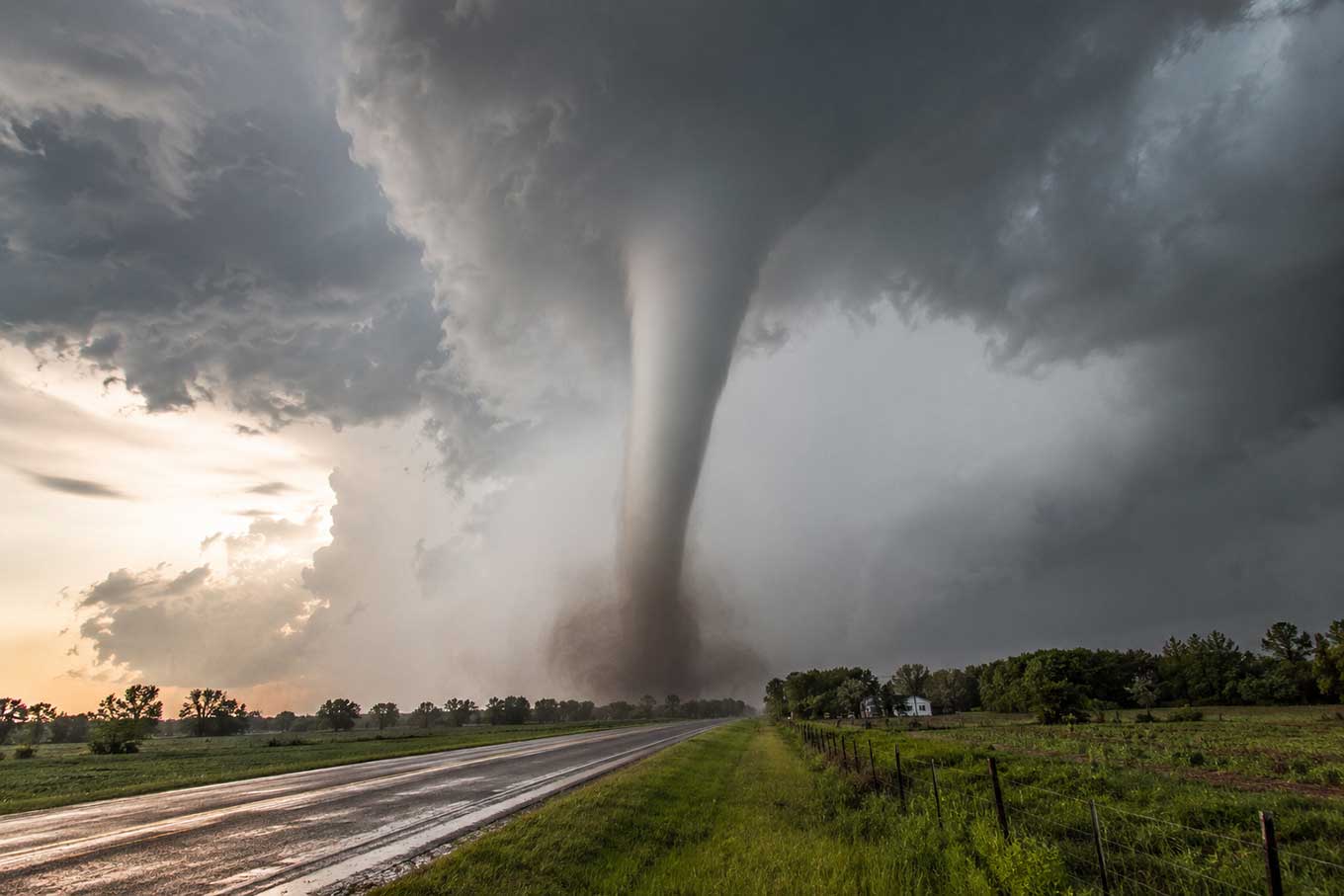
The geographic center of U.S. tornado activity is no longer fixed over the open Plains. Peer-reviewed research has documented a sustained eastward migration of tornado frequency and intensity over the past several decades, moving the zone of greatest risk toward the densely populated, heavily forested states of the Deep South.
That shift carries two intertwined consequences for the region’s environment: a natural one, rooted in the drought and moisture patterns driving the change, and a built one, tied to how millions of homes in the affected states are constructed, sheltered, and regulated. Across both, experts say the Southeast’s exposure is rising faster than its defenses.
This report examines why the activity is moving, whether the storms arriving in the East are as strong as those on the Plains, and what the trend means for new construction across Mississippi, Alabama, Arkansas, Louisiana, and Tennessee — with implications extending into Missouri, Kentucky, and Georgia.
Background: A Documented Eastward Shift
The traditional “Tornado Alley” — an oval centered on northeastern Texas and south-central Oklahoma — dominated U.S. tornado activity from the 1950s through the 1990s. Research led by Victor Gensini of Northern Illinois University and Harold Brooks of the National Oceanic and Atmospheric Administration (NOAA) has since documented an eastward shift of roughly 400 to 500 miles in the center of tornado activity.
The new corridor of concentrated storms now runs through eastern Missouri and Arkansas, western Tennessee and Kentucky, and northern Mississippi and Alabama — a region long nicknamed “Dixie Alley,” a term coined in 1971 by Allen Pearson, then director of the National Severe Storms Forecast Center.
The trend is visible in state-level counts. In 2024, Ohio — hundreds of miles from the historical alley — recorded 71 tornadoes, surpassing Oklahoma’s long-term annual average of about 69. Mississippi now records roughly 115 tornadoes a year, among the highest per-capita totals in the country.
The Environmental Mechanism: Drought, Moisture, and a Moving Storm Track
The migration is not random. Researchers tie it to a long-running drought across the Southwest, which feeds drier air into the Central Plains and suppresses storm formation there. As that dry air expands, the jet stream and storm tracks shift eastward, toward the warm, moisture-rich air streaming off the Gulf of Mexico.
In simple terms: the “bullseye” where the key tornado ingredients — instability, humidity, and wind shear — overlap most often has slid east toward the moisture, and the dry-line boundary that helps trigger storms has itself migrated roughly 140 miles east since the late 1800s.
The result is a regional environment increasingly primed for high-precipitation supercells, the storm type that dominates Deep South severe weather and that tends to wrap its tornadoes in heavy rain. Not all meteorologists frame the change as a permanent migration; Brooks has noted that the highest concentration of tornadoes naturally swings around an L-shaped zone over each 15-year period. The debate is whether the recent eastward trend reflects a lasting structural shift or variability captured within a particular window.
Are the Storms as Strong in the East?
On a per-storm basis, eastern tornadoes are not, on average, stronger than those that form on the Plains. The Plains still produce the highest raw count of tornadoes, including violent ones rated EF4 and EF5, which together make up only about two percent of all tornadoes nationwide.
The more consequential finding concerns significant storms. When the count is narrowed to EF2-and-stronger tornadoes, Dixie Alley and the Mid-South rank just behind Oklahoma and the Red River Valley, exceeding most other Plains states. Strong tornadoes in Dixie Alley have more than doubled since 1990.
In simple terms: the eastward shift is not relocating weak storms — it is moving a meaningful share of the dangerous ones into a region less prepared to absorb them.
The Deep South’s deadlier reputation, however, stems largely from factors unrelated to raw wind speed. Tornadoes there more often strike at night and earlier in the year, when daylight is short; Tennessee records the nation’s highest share of nighttime tornado fatalities, above 73 percent. High-precipitation storms hide funnels in rain, and dense tree cover and rolling terrain obscure approaching storms that would be visible for miles on the open Plains. The honest summary, researchers say, is that the region’s tornadoes are deadlier — not necessarily stronger.
Impact on New Construction and the Built Environment
The clearest policy gap lies in how the affected states build. Roughly two-thirds of tornado-induced damage is attributed to residential buildings, and the Southeast’s housing stock is, on average, less resistant than the Plains’.
Manufactured and mobile homes are central to the risk. The Southern United States has the highest concentration of manufactured housing in the country, and the risk of death in such a home during a tornado is 15 to 20 times higher than in a permanent structure. Federal data since 1996 indicate manufactured homes accounted for 53 percent of at-home tornado deaths despite representing only 8 to 12 percent of the region’s housing stock. Permanent homes in the Southeast also tend to be framed more lightly than those in other tornado regions, and many sit on slab foundations without basements, leaving residents fewer options for shelter.
New construction is compounding rather than relieving the exposure. As subdivisions expand into the shifting risk corridor, more homes and people fall into the path of storms — frequently in slab-built houses with no safe room and in communities where public shelters are scarce and storm awareness is lower than in the Plains, where safe rooms and shelters are long established.
Building-code strength varies widely. The Insurance Institute for Business & Home Safety (IBHS), in its 2024 “Rating the States” report, placed several at-risk states in the bottom third for residential code adoption and enforcement — Mississippi ranked 15th and Alabama 17th among the 18 coastal states evaluated. IBHS reported that since 2008, no state in the study had adopted a new residential code and enforced it uniformly statewide, leaving a patchwork of local rules and uneven protection.
Federal data reinforce the picture. Mississippi’s codes have been rated “poor” by IBHS and “lower resistance” by the Federal Emergency Management Agency (FEMA). Under FEMA’s Building Resilient Infrastructure and Communities (BRIC) program, Alabama secured the full $2 million in available “Building Code Plus-Up” funding, while Mississippi applied for none.
There is a model for stronger standards. After the 2011 Joplin, Missouri disaster, the National Institute of Standards and Technology (NIST) issued 16 recommendations for tornado-resilient construction and shelters. Those informed the storm-shelter requirements published in the International Code Council’s 2018 International Building Code, which cover both Tornado Alley and Dixie Alley. The open question is how widely the affected states adopt and enforce such provisions in new residential building.
Impact on the Natural Environment
The eastward shift also changes what tornadoes do to the land. On the open Plains, a tornado may cross miles of farmland without striking a structure. In the Deep South, the same storm moves through forests and closely spaced communities, converting tree cover into wind-borne debris that intensifies property damage and prolongs cleanup.
Forest disturbance carries longer-term ecological effects — blowdown of mature stands, fragmentation of wildlife habitat, and debris loads that raise wildfire fuel and complicate watershed management. Rolling, wooded terrain that hides storms from spotters is the same terrain that turns a tornado track into a sustained environmental disturbance rather than a brief pass over open ground.
Analysis
The data describe a mismatch between where tornado risk is heading and where the affected states’ defenses stand. The natural driver — drought-shifted storm tracks meeting Gulf moisture — is steering more significant storms into terrain and communities that amplify their human and ecological cost. The built driver — light framing, manufactured housing, slab foundations, scarce shelters, and a patchwork of codes — leaves new construction exposed even when individual storms are no stronger than those on the Plains.
Whether the shift proves a permanent migration or a long swing within natural variability, the near-term exposure is the same: more people and structures in the path, in a region whose regulatory and physical infrastructure was largely built for a milder severe-weather history. The available levers — statewide code adoption, safe-room requirements in new builds, and federal resilience funding — already exist; the variable is uptake.
Conclusion
The center of American tornado activity has moved hundreds of miles east, into states whose homes and codes were not designed around it. The storms arriving are not categorically stronger than those of the Plains, but they are deadlier and more environmentally disruptive because of when they strike, the terrain they cross, and the structures they meet. For the Southeast, the trend reframes tornado resilience from a Plains-state concern into a central question of how the region builds, regulates, and plans for the years ahead.
Key Takeaways
- Peer-reviewed research from NOAA and Northern Illinois University documents a 400-to-500-mile eastward shift in the center of U.S. tornado activity since the mid-20th century.
- The driver is environmental: Southwest drought pushes drier air east, shifting the storm track toward Gulf of Mexico moisture and the “bullseye” of tornado-forming conditions.
- Eastern tornadoes are not stronger on average, but the region sees a rising share of significant (EF2+) storms — strong tornadoes in Dixie Alley have more than doubled since 1990.
- They are deadlier due to nighttime occurrence, rain-wrapped funnels, forested terrain, high manufactured-home density, and fewer shelters — not greater wind speed.
- New construction exposure is rising; IBHS rated Mississippi and Alabama in the bottom third for building codes, and federal NIST/ICC standards for storm shelters remain unevenly adopted.
Sources
- Scientific American — “Watch Out: Tornado Alley Is Migrating Eastward.” https://www.scientificamerican.com/article/watch-out-tornado-alley-is-migrating-eastward/
- Farmers’ Almanac — “What is Tornado Alley? Map, States, History, and Why It’s Shifting East.” https://www.farmersalmanac.com/tornado-alley
- Farmers’ Almanac — “Dixie Alley: The Other Tornado Belt You Should Know About.” https://www.farmersalmanac.com/dixie-alley
- AccuWeather — “Is ‘Tornado Alley’ Shifting East?” https://www.accuweather.com/en/severe-weather/is-tornado-alley-shifting-east/1162839
- NOAA NSSL / Wikipedia — “Dixie Alley” (manufactured-home fatality risk; nighttime and rain-wrapped storm characteristics). https://en.wikipedia.org/wiki/Dixie_Alley
- Frontiers in Built Environment — “State-of-the-art review on reducing residential buildings’ risk to tornado hazards.” https://www.frontiersin.org/journals/built-environment/articles/10.3389/fbuil.2025.1543800/full
- Insurance Institute for Business & Home Safety (IBHS) — “Rating the States 2024.” https://ibhs.org/public-policy/rating-the-states/
- NIST — “First Code Improvements Adopted Based on NIST Joplin Tornado Study” (2018 International Building Code shelter requirements). https://www.nist.gov/news-events/news/2015/12/first-code-improvements-adopted-based-nist-joplin-tornado-study
- Natural Resources Defense Council (NRDC) — “Outdated Building Codes Are Costly and Dangerous” (FEMA BRIC funding; Mississippi and Alabama). https://www.nrdc.org/bio/anna-weber/outdated-building-codes-are-costly-and-dangerous
- MemphisWeather.Net — “10 Reasons Why Tornadoes in Dixie Alley Are More Dangerous Than Tornado Alley.” https://www.memphisweather.net/blog/2025/03/12/10-reasons-dixie-alley-is-more-dangerous/