
When grocery prices surged across the United States during 2021 and 2022, most consumers blamed inflation. Rising fuel costs, supply-chain disruptions, labor shortages, and broader economic pressures appeared to offer a straightforward explanation for higher food bills.
A newly settled antitrust case involving Agri Stats, Inc., however, has renewed a more complex debate among economists and regulators: Can periods of widespread inflation also provide cover for companies in concentrated industries to raise prices in parallel without explicitly colluding?
The question sits at the center of a major settlement announced by federal and state authorities in May 2026, one that could shape how regulators approach pricing practices in the food industry and beyond.
DOJ Reaches Settlement With Agri Stats
On May 7, 2026, the U.S. Department of Justice and attorneys general from six states reached a proposed settlement with Agri Stats, an Indiana-based benchmarking and analytics company serving the meat-processing industry.
Federal prosecutors alleged that Agri Stats facilitated the exchange of highly detailed business information among competing chicken, pork, and turkey processors. According to the government, the firm’s reporting system enabled competitors to monitor one another’s pricing, production levels, costs, and profitability with a level of precision that could support coordinated market behavior.
The lawsuit was originally filed in September 2023 and was scheduled for trial in Minnesota before the parties reached a settlement agreement.
Under the proposed settlement, Agri Stats must:
- End most sales-data reporting practices.
- Increase data aggregation and aging requirements.
- Make certain reports available to buyers as well as sellers.
- Operate under the supervision of a court-appointed monitor for up to seven years.
The agreement does not include any admission of wrongdoing by Agri Stats.
How Inflation Can Become a Shield for Coordination
The case has attracted attention because it intersects with a growing body of economic research examining how inflationary environments can make coordinated price increases more difficult to detect.
Traditional cartel behavior typically involves explicit agreements among competitors. Modern antitrust concerns, however, increasingly focus on what economists call implicit coordination—situations in which firms move together without formal communication or written agreements.
During the post-pandemic inflation surge, economist Hal Singer argued that periods of broad inflation can create ideal conditions for coordinated pricing behavior. When consumers already expect prices to rise, companies may face less scrutiny when increasing prices simultaneously.
In such an environment, parallel price increases can appear indistinguishable from ordinary inflation, even when market participants are closely tracking one another’s actions.
The Rise of the “Sellers’ Inflation” Theory
Academic interest in the phenomenon intensified following a 2025 study published in Structural Change and Economic Dynamics by economists Isabella Weber, Evan Wasner, and colleagues.
The researchers analyzed approximately 139,000 corporate earnings-call transcripts and developed a framework they describe as “sellers’ inflation.”
Their argument is that large economy-wide cost shocks can act as a coordinating signal. Because competitors experience similar cost pressures simultaneously, each company understands that rivals have similar incentives to increase prices. As a result, firms may move in parallel without needing direct communication.
According to this theory, inflation itself becomes the mechanism that enables coordination.
Former Federal Trade Commission Chair Lina Khan expressed a similar concern in 2022, arguing that companies with significant market power may use inflationary periods to push through larger price increases while attracting less public scrutiny.
Why Agri Stats Became a Target
The Agri Stats case is particularly significant because regulators allege the company provided far more than a general market signal.
Prosecutors argued that Agri Stats supplied detailed, non-public data that allowed processors to identify competitors’ operational performance, margins, production levels, and pricing behavior.
Critics say this effectively removed uncertainty from the market.
Rather than inferring what competitors might do, processors allegedly had access to detailed information showing what competitors were already doing. Regulators argue that such visibility can make coordinated pricing easier to sustain without requiring explicit agreements.
The government’s theory is that Agri Stats functioned as an information-sharing platform that helped competitors align their behavior while maintaining plausible deniability.
What It Means for Consumers
For American households, the debate is more than academic.
Food prices rose sharply during the post-pandemic inflation cycle, with many categories recording double-digit annual increases. Consumers paying more for chicken, pork, or turkey typically cannot determine whether higher prices stem from legitimate cost increases, supply constraints, market power, or coordinated industry behavior.
That uncertainty is precisely why regulators view information-sharing arrangements as a potential concern.
Federal officials have presented the Agri Stats settlement as part of a broader effort to improve competition and reduce upward pressure on food prices.
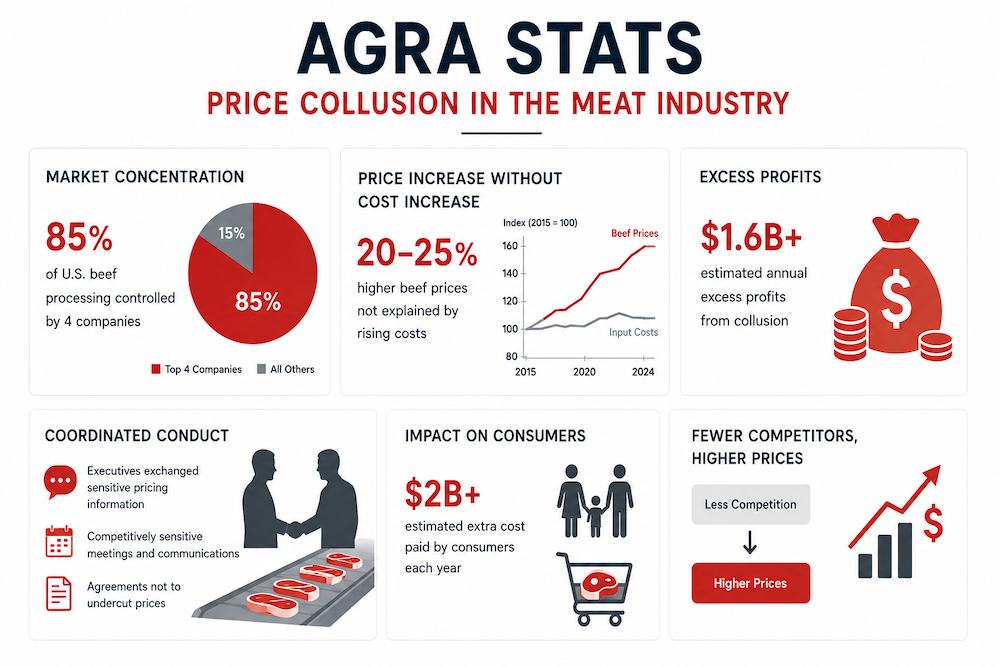
The Justice Department has also expanded scrutiny of other protein markets, including an ongoing investigation involving major U.S. beef processors. Beef markets were not part of the Agri Stats litigation, but regulators have indicated a broader interest in examining competitive dynamics across the meat industry.
Critics Say the Theory Remains Unproven
Despite growing regulatory attention, the “inflation as cover” theory remains heavily debated.
Economists such as Ryan Bourne and Christopher Conlon argue that parallel price increases do not automatically indicate coordination. In competitive markets, firms facing similar costs and similar demand conditions would be expected to raise prices around the same time.
From this perspective, synchronized pricing behavior may simply reflect rational responses to shared economic circumstances rather than anticompetitive conduct.
Critics also note that the Agri Stats settlement does not establish legal liability.
Because the case concluded through negotiation rather than trial, no court determined that antitrust laws were violated. Agri Stats has consistently maintained that its services helped processors improve efficiency, expand output, and reduce costs.
Some antitrust advocates, meanwhile, argue the settlement does not go far enough because the company remains operational under modified reporting rules.
A New Era of Antitrust Enforcement
Regardless of where the academic debate ultimately lands, the Agri Stats settlement highlights an important shift in antitrust enforcement.
Rather than focusing exclusively on explicit agreements, regulators are increasingly examining the systems, algorithms, and data-sharing platforms that may facilitate coordinated market behavior.
This approach mirrors recent enforcement efforts involving algorithmic pricing tools and digital information-sharing systems in other sectors of the economy.
For regulators, the concern is no longer limited to whether competitors communicate directly. The focus is increasingly on whether market participants have access to information that makes coordinated conduct easier to achieve.
The Bottom Line
The Agri Stats settlement crystallizes one of the most important economic questions to emerge from the inflationary period of the early 2020s: Can widespread inflation make coordinated pricing harder to detect?
The settlement does not prove that meat producers engaged in unlawful coordination, nor does it establish that inflation-driven price increases were improperly amplified. What it does demonstrate is that regulators are paying closer attention to the information systems that allow competitors to monitor one another.
As the seven-year monitoring period unfolds and broader investigations into food markets continue, the case may become a key test of whether modern antitrust enforcement can address forms of coordination that resemble ordinary market behavior.
Key Takeaways
- The DOJ and six states settled their antitrust case against Agri Stats on May 7, 2026.
- The settlement includes no admission of wrongdoing and no judicial finding of liability.
- Regulators alleged Agri Stats enabled meat processors to access detailed competitor information.
- Economists have increasingly examined “implicit coordination” and “sellers’ inflation” theories.
- Critics argue parallel price increases may simply reflect shared economic conditions.
- The settlement imposes significant restrictions on Agri Stats’ reporting practices and establishes a monitoring regime lasting up to seven years.
- The case may influence future enforcement actions involving data-sharing platforms and algorithmic pricing systems.