
Intro
City councils from Syracuse to Denver have spent the past year voting down contracts with Flock Safety, the Atlanta company whose automated license plate readers became the most visible symbol of American street-level surveillance. Activists have called the votes a privacy victory.
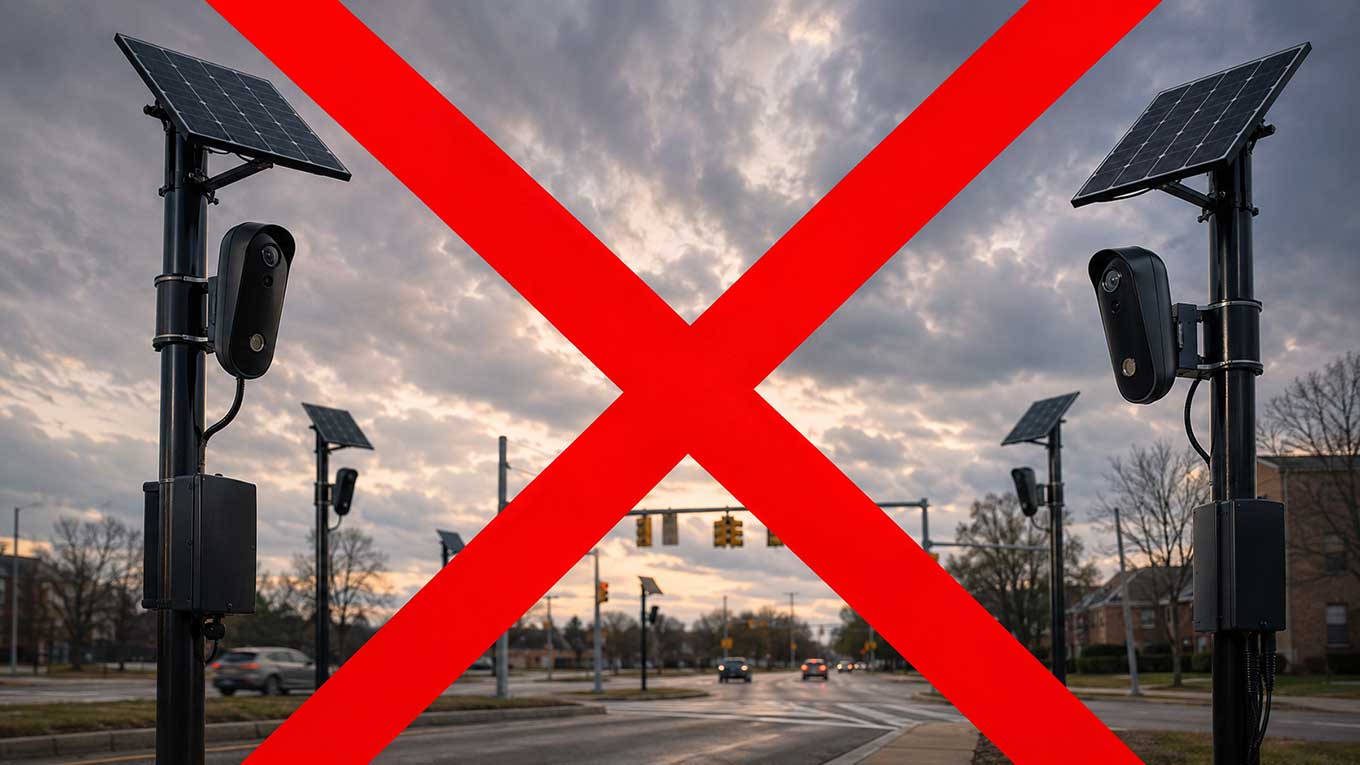
In a growing number of those cities, the poles did not stay empty. Crews returned within months to mount replacement cameras made by Axon Enterprise, the Scottsdale, Arizona company best known for the TASER and the police body camera.
The vendor changed. The scanning did not.
That distinction — between rejecting a company and rejecting a capability — is now the central question in local surveillance fights, and it is one most council votes have not squarely answered.
Background: How Flock Became the Target
Flock Safety built a business on a simple premise. Cameras mounted on poles photograph the rear of every passing vehicle, software converts the plate into searchable text, and police query the database when investigating a crime.
The scale is what turned a tool into a controversy. Flock has amassed contracts with more than 5,000 law enforcement agencies and, as Central Current reported, maintains a network recording roughly 20 billion vehicle scans a month — fewer than 1% of which are linked to any crime.
In simple terms: the system photographs nearly everyone in order to find almost no one, and the record of everyone else’s movements is what remains.
The backlash accelerated when it became clear that data collected by one city could be searched by agencies far outside it. In August 2025, a Colorado news outlet found that Customs and Border Protection had accessed Flock data generated by customers who never intended to share with federal authorities; Flock attributed the access to a previously undisclosed pilot program. Researchers at the University of Washington Center for Human Rights later catalogued three distinct access routes — front door, back door, and side door — through which federal immigration agents reached local plate data.
Sen. Ron Wyden’s office conducted its own review. Wyden’s investigation found that Homeland Security Investigations, the Secret Service and the Naval Criminal Investigative Service also had access to Flock cameras, and that Flock does not proactively audit how its cameras are used or whether agencies state valid reasons for searches. He urged local officials to remove Flock from their communities.
Congressional scrutiny arrived from the House as well. Reps. Robert Garcia and Raja Krishnamoorthi wrote to Flock CEO Garrett Langley in August 2025 after Texas authorities reportedly searched more than 83,000 cameras nationwide to locate a woman they claimed had a self-administered abortion, including cameras in states where the procedure is legally protected.
What the Cancellations Actually Look Like
The commonly cited figure is 53 municipalities. That number traces to crowdsourced tracking by DeFlock, an open-source mapping project founded by software engineer Will Freeman and backed by the Electronic Frontier Foundation after Flock sent Freeman a cease-and-desist letter. The count was picked up by trade and aggregator outlets before circulating widely. Futurism reported that at least 53 municipalities have ended contracts with Flock over concerns about federal access to the data, citing DeFlock’s tally. The ACLU puts the count above 55 localities in the past year.
Independent confirmation of the full list has not been published, and readers should treat the total as an activist tally rather than a government record.
The underlying trend is well documented regardless of the exact count. NPR identified at least 30 localities that deactivated cameras or canceled contracts since the start of 2025 — including Flagstaff, Arizona; Cambridge, Massachusetts; Eugene, Oregon; and Santa Cruz, California — with much of the activity concentrated in a three-month window.
The cancellations are not confined to college towns. GovTech reported that at least four Detroit-area communities canceled Flock contracts beginning in November 2024, with Clawson, Milford and Westland voting to cancel since the beginning of May, while Warren’s council narrowly voted 4-3 to renew a $132,000 contract. In May 2026, the El Cerrito, California council voted 3-2 against renewal, ending an agreement the ACLU says saves the city $315,000 over three years.
Litigation followed the politics. On February 26, 2026, the firms Gibbs Mura and Milberg PLLC filed a class action in San Francisco Superior Court alleging Flock violated California’s ALPR Privacy Act, citing more than 1.6 million queries of San Francisco’s database by out-of-state and federal agencies over seven months and seeking $2,500 per violation.
Scale: How Many Cameras Are Actually Live
The two companies are not comparable in size, and one of them will not say how big it is.
Flock. The company’s own count keeps climbing. CNN reported on July 26, 2026 that Flock says it operates a network of roughly 120,000 surveillance cameras in the United States. Independent estimates ran lower earlier in the year: the Electronic Frontier Foundation put the figure at 80,000 to 100,000 as of early 2026, and Fox News reported the same range citing the ACLU. Flock’s marketing claims presence in more than 6,000 communities, more than 1,000 businesses, and more than 5,000 law enforcement agencies.
Those readers log roughly 20 billion plate scans a month, and the majority of ALPRs operating nationwide were sold by Flock. DeFlock’s crowdsourced map has plotted roughly half of that network, and now offers routing that lets drivers avoid mapped cameras by a chosen buffer distance.
Two figures give the scale a texture. The EFF reports that more than 75% of Flock’s police customers opt into a shared national lookup, and that queries against it generally require no warrant. Customs and Border Protection was granted access to more than 80,000 Flock cameras.
At the municipal level the density is easier to picture. Oakland’s 293 readers logged more than 638 million reads in 2025, with very few flagging an actual crime and most hits involving stolen plates. Dayton, Ohio found its cameras had been searched more than 7,100 times for immigration enforcement in violation of city policy, and covered the lenses with trash bags while it worked to exit the contract.
Axon. No public deployment count exists. The company has not disclosed how many fixed ALPR units are live, and its quarterly filings report revenue and recurring contracts rather than sensor counts.
What Axon does publish is throughput from its older in-car product. As of April 2025, Fleet 3 in-car cameras with ALPR had read a cumulative 8.1 billion license plates, which the company credited with more than 20,000 felony arrests and 50,000 vehicle recoveries in the preceding year.
Axon’s pole-mounted hardware — the direct Flock competitor — is barely a year old. Axon Outpost and Axon Lightpost, its two fixed ALPR cameras, were announced on April 22, 2025. Lightpost was developed with Ubicquia and installs on existing streetlights in under an hour.
That timeline matters for reading the vendor swap. Cities leaving a network of roughly 120,000 mature cameras are moving to a fixed-camera product line that entered the market fifteen months ago, from a company that does not report how many are in the ground.
The asymmetry is itself worth noting. Flock’s scale is knowable — imperfectly, through activist mapping, EFF estimates and company statements — because it became a political target. Axon’s is not, because it has not. Any council comparing the two on privacy grounds is comparing a documented number against an undisclosed one.
The Replacement: Who Owns Axon
Axon Enterprise is not a startup and has no parent company. It trades on the Nasdaq under the ticker AXON, and its ownership is dominated by index and institutional money rather than venture capital.
Axon is roughly 80% owned by institutional shareholders, about 9% by insiders and about 11% by retail investors, with co-founder Patrick “Rick” Smith the largest individual holder at approximately 3.9% of shares. Vanguard, BlackRock and State Street hold the largest institutional positions. The company uses a one-share, one-vote structure with no parent company or government controller, meaning institutions exert influence primarily through proxy voting.
Smith founded the company as TASER International in 1993 with his brother Tom, took it public in 2001, and renamed it Axon in 2017. Forbes reports he became a billionaire through a 2018 performance-based option package equal to an 8% stake, and that Axon’s market capitalization exceeded $40 billion by early 2025. He remains CEO and board chairman.
This is the first structural difference from Flock. Flock is privately held and was valued at $7.5 billion in a March funding round. Axon files quarterly with the SEC, discloses federal contract exposure to investors, and answers to institutional shareholders. Flock answers to its board and its backers.
How the Two Companies Differ
Network architecture. This is the difference cities cite most often. Flock’s national lookup network allowed agencies to search well beyond their own jurisdiction — and, in several documented cases, allowed outsiders to search theirs. In Syracuse, a mistake by a single officer connected the city to Flock’s national network for nearly a year, allowing federal immigration agents to run more than 2,000 immigration-related searches that included Syracuse drivers’ data. Axon’s municipal contracts have generally been written so the agency retains control of its own data rather than joining a vendor-operated national pool.
Product scope. Flock sells plate readers, the Nova intelligence platform, and Aerodome drones. Axon sells substantially more. Its Fusus real-time crime center unifies live video, ALPR data and field information into a single operational picture, and its $625 million acquisition of Carbyne extends the company into 911 call intake — signaling an intention to own the entire public safety stack from call to prosecution. A 2025 Ring partnership lets Ring users share footage with police through Axon’s evidence platform.
That breadth cuts against the privacy argument for switching. A plate read that lands in a standalone ALPR database is one data point. The same read landing in a platform that also holds body camera video, drone footage, 911 audio, doorbell clips and AI-generated reports is a different object.
Federal relationships. Here the comparison inverts. Flock’s federal problem was informal and undisclosed. Axon’s is contractual and public — and larger. CNBC reported that Axon holds a $370 million DHS body camera and software contract awarded in 2023, of which roughly $67.5 million had been obligated as of mid-2026. OpenSecrets found the company received more than $31.8 million in ICE contract obligations in 2025, largely for body-worn camera systems and taser equipment, while its federal lobbying spending rose from $480,000 in 2020 to $2.5 million in 2025. Axon also hired former Border Patrol chief Ronald D. Vitiello to lead its DHS program and strategy.
History between them. The two companies were partners until 2025. Axon was a financial investor in Flock Safety, and Axon’s in-car cameras fed plate-read data directly into Flock’s search platform before the companies split and became competitors. Forbes reported that Smith accused Flock of creating a digital silo and coercing customers, and said he was “embarrassed” to have recommended the company. Two months later, Axon announced pole-mounted plate readers that also record distinguishing vehicle features such as bumper stickers or specific damage.
The vendor swap now benefiting Axon was, in part, engineered by Axon.
Examples: What Cities Bought
Syracuse, New York. The city completed removal of 131 Flock cameras after a Common Council vote in early February to end the partnership and move to Axon, with city attorneys arguing the new contract would give police greater control over their own data. Council approved the Axon contract in February and revoked Flock’s permissions in March, ordering hardware removed from city rights-of-way by May 26 — a deadline the company missed by weeks. Police continued using the readers until June 19, unplugging them only after a local outlet began asking whether they were still active.
Oversight has not kept pace with procurement. Daniel Schwarz, a senior privacy and technology strategist with the NYCLU and a member of Syracuse’s Surveillance Technology Working Group, said he requested the city’s ALPR policy and the Axon contract more than six months ago and received neither, and that the working group created in 2020 to vet surveillance technology has not met since the beginning of the year.
Denver, Colorado. The city cut Flock cameras and advanced an Axon ALPR contract in March 2026 with 50 cameras instead of 100, 21-day retention instead of 30, no access to a vendor-run national database, and mandatory audit trails for every query. Those are real concessions, and they are the strongest case that vendor choice can be leveraged into policy. Local critics argued the swap traded one federal exposure for a deeper one.
Ferndale, Michigan. Police briefly considered Axon as a replacement vendor before abandoning the search after public pushback, and are not currently looking for a Flock replacement. Ferndale is the counterexample: the only city in this set that reduced surveillance rather than reassigning it.
Impact
Three effects are visible so far.
First, the total number of cameras is falling in some cities and holding steady in others, but the category is not in retreat. Denver halved its deployment. Syracuse replaced its system entirely. Flock’s national footprint grew.
Second, the accuracy problem travels with the technology. Reporting has flagged elevated rates of false stolen-vehicle alerts from plate readers, meaning traffic stops initiated against drivers who did nothing wrong. Nothing about changing vendors addresses optical character recognition error rates.
Third, misuse is an operator problem, not a brand problem. CNN documented a Milwaukee officer who used the system to track a romantic partner’s location 124 times, an internal affairs detective on that same case later arrested for misusing the system himself, five Albany, Georgia officers arrested and fired, and two officers fired in Greer, South Carolina. A different vendor’s login does not change the incentive structure behind those searches.
Contractual protections are also only as durable as the next council. Retention limits, audit requirements and sharing prohibitions written into a procurement agreement can be renegotiated, amended by a future administration, or silently undone. Oxnard, California set its Flock cameras to California-only access, and a routine audit revealed that a vendor-based issue had re-enabled the nationwide query feature.
Analysis
The pattern across these votes suggests cities were adjudicating a narrower question than the public debate implied. Councils were asked whether a specific company had mishandled data. Most concluded that it had. Few were asked whether continuous, warrantless logging of vehicle movement should occur at all.
That framing produces the outcome now visible on the poles. A council can vote unanimously against Flock, satisfy the residents who filled the chamber, and sign a functionally equivalent system the following quarter without contradicting itself.
Privacy advocates argue the swap can make matters worse. Schwarz has warned that Axon’s reach raises rather than lowers the stakes, given how many data streams the company already holds. The counterargument, made by city attorneys in Syracuse and by Denver’s mayor, is that data control is the actual variable — that a system without a vendor-run national lookup is meaningfully safer regardless of who builds it.
Both can be true. Removing the national database closes the specific hole that federal agents used. It does not address aggregation, retention, mission creep, or the fact that the ACLU has filed suit challenging warrantless ALPR mass surveillance and argued in a Fourth Circuit amicus brief that these systems give government unprecedented surveillance powers in violation of the Fourth Amendment.
The structural point is that vendor selection is a weak instrument for civil liberties policy. The ACLU released model ALPR legislation in February 2026 with strict usage guidelines, and statutory limits — retention caps, warrant requirements, audit mandates, prohibitions on immigration-enforcement use — survive procurement cycles in a way contract riders do not.
Conclusion
The story of the past eighteen months is not that American cities rejected license plate surveillance. It is that they rejected a brand.
Flock absorbed the reputational cost of an industry-wide practice — and kept growing, from an estimated 80,000 cameras to a company-stated 120,000. Its principal competitor, a public company with deeper federal contracts, broader data holdings and a former Border Patrol chief running its DHS strategy, collected the contracts that got canceled. Whether that represents progress depends entirely on what the residents in those council chambers thought they were voting against.
Key Takeaways
- Flock says it now operates roughly 120,000 cameras nationwide across more than 5,000 law enforcement agencies, logging roughly 20 billion plate scans a month. Independent estimates earlier in 2026 ran between 80,000 and 100,000.
- Axon does not disclose how many ALPR cameras it has deployed. Its fixed cameras, Outpost and Lightpost, launched in April 2025; its in-car system had read 8.1 billion plates as of that date.
- Activist tracking puts the number of municipalities canceling Flock contracts at 53 or more; the figure is crowdsourced through DeFlock, not official, and independent verification is limited.
- Several cities, including Syracuse and Denver, replaced Flock with Axon plate readers rather than eliminating the technology.
- Axon has no parent company. It is roughly 80% institutionally owned, with Vanguard, BlackRock and State Street the largest holders and founder-CEO Rick Smith the largest individual shareholder at about 4%.
- Axon’s federal exposure exceeds Flock’s: a $370 million DHS contract, more than $31.8 million in ICE obligations in 2025, and a former Border Patrol chief leading its DHS strategy.
- Axon and Flock were partners until 2025, with Axon an early investor in Flock before a public split.
- Denver negotiated fewer cameras, shorter retention and mandatory audit trails — the clearest example of a city converting vendor choice into policy.
- Advocates argue only state legislation, not contract terms, survives a vendor swap.
Related Coverage from NexfinityNews
- License Plate to Person: The LexisNexis Data Correlation Pipeline — how a plate read becomes an identity, and the commercial brokers that close the gap between the two.
- States Are Selling Driver Data: $282 Million in DMV Records — the government side of the same pipeline, and the revenue that sustains it.
- Automakers Are Becoming Data Companies — vehicle telematics as a second, consent-shaped stream of the same location data.
- How “Free” Apps Like Life360 and GasBuddy May Increase Your Auto Insurance Premiums — where driver data lands once it leaves the vehicle.
- How to Opt Out of Driver Data Tracking in 2026: The Complete Privacy Guide — practical steps, and the limits of opting out of infrastructure you never signed up for.
- The Data Paradox: We Have All the Information, Just Not the Will to Use It — editorial on the accountability gap this story sits inside.
Editor’s note — internal linking: Our prior Flock/ALPR reporting is not currently returning in search indexes, so its slug is not linked above. Drop the live URL from the CMS into the first bullet position before publication and anchor it on “our earlier reporting on Flock Safety’s ALPR network.”
Sources
- CNN, “Inside the growing police use and misuse of Flock’s license-plate reader cameras”, July 26, 2026
- NPR, “Why some cities are canceling Flock license plate reader contracts”, Feb. 17, 2026
- Central Current, “Flock Safety removes its license plate readers”
- CNY Central, “Months after Syracuse ditched Flock, critics say switch to Axon solved nothing”, July 24, 2026
- LocalSYR, “Syracuse removes Flock license plate readers, sets course for Axon system”
- Gadget Review, “Cities Are Ditching Flock Safety Cameras — Then Hiring Axon to Do the Same Job” (Denver contract terms via Denverite)
- Futurism, “Flock Is in Serious Trouble After Massive Backlash”
- GovTech, “Detroit Area Cities Increasingly Parting Ways With Flock Safety”
- CNBC, “Trump bought as much as $5 million in Axon stock before ICE sought $220 million Taser deal”, June 29, 2026
- OpenSecrets, “Tech firms triple lobbying expenditures while raking in millions from ICE contracts”, April 2026
- Office of Sen. Ron Wyden, press release on Flock oversight findings
- Reps. Garcia and Krishnamoorthi, letter to Flock CEO Garrett Langley, Aug. 6, 2025
- University of Washington Center for Human Rights, “Leaving the Door Wide Open”
- ACLU, “Fight Creepy ALPR Cameras” campaign page and model ALPR legislation
- EFF, “Anti-Surveillance Mapmaker Refuses Flock Safety’s Cease and Desist Demand”
- DeFlock, crowdsourced ALPR map and camera tracker
- Forbes, “Axon Vs. Flock: Two Policing Tech Giants Just Had A Big Falling Out” and “Axon Goes After Rival Flock With New Car Surveillance”
- Axon, fixed ALPR product announcement, April 22, 2025
- Fox News, “License plate cameras spark privacy debate”, July 2026
- Boing Boing/TechSpot, national ALPR scan-volume reporting, July 2026
- SlashGear, Oakland ALPR read-volume figures, June 2026
- SOFX, DeFlock routing tool and ELSAG SignalTrace reporting, June 2026
- WallStreetZen, Axon Enterprise ownership breakdown
- Forbes, Rick Smith profile
- Westword opinion, “Denver Already Rejected Flock, It Shouldn’t Okay Axon Enterprises”