
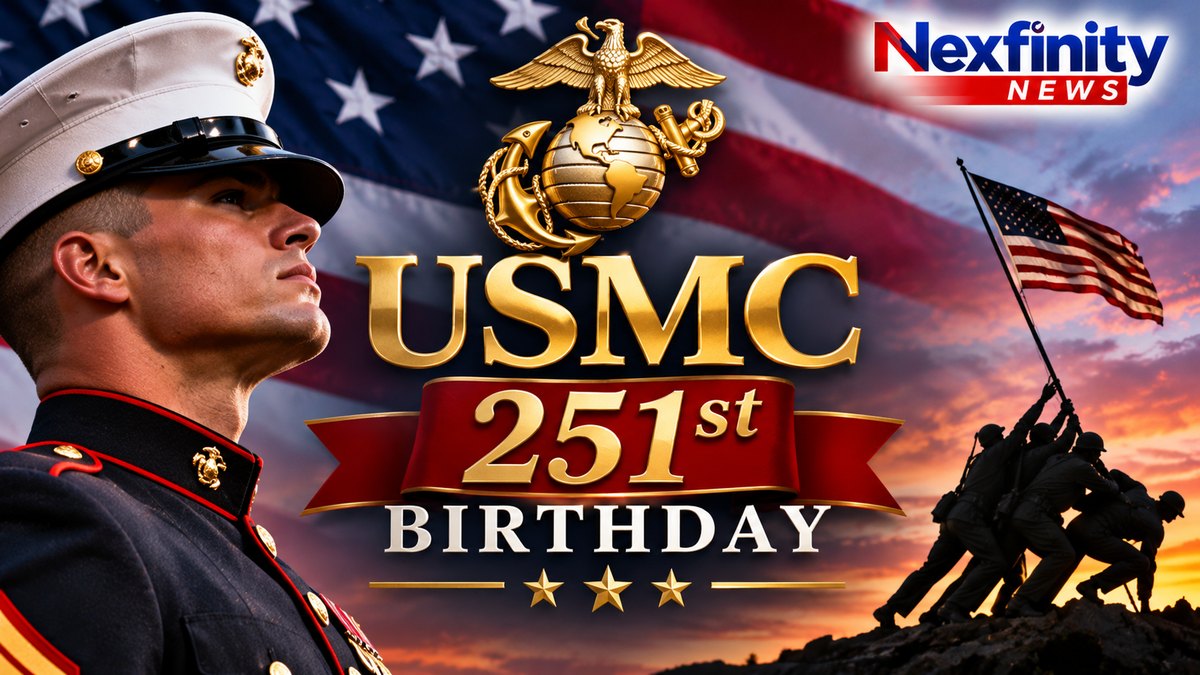
The United States Marine Corps turns 251 today, Nov. 10, 2026. Since a resolution of the Second Continental Congress created it in 1775, the Corps has fought in nearly every war the nation has waged from a Bahamian beach in 1776 to the gates of Kabul’s airport in 2021.
Along the way it built a record few institutions can match. Nearly 300 Marines have received the Medal of Honor. Marine battles gave the nation some of its most recognized words and images, from “the shores of Tripoli” to the flag over Iwo Jima.
How many Americans have earned the title “Marine” since 1775? The Corps does not publish an official all-time count, and records from its first century are incomplete. The numbers that do exist give a sense of scale. About 669,000 men and women served as Marines in World War II, and about 794,000 during the Vietnam War, according to the Oxford Companion to American Military History. A Department of Veterans Affairs national survey counted more than 2 million living Marine Corps veterans, according to VA data a figure that leaves out every Marine who had already died.
This is a look back at the milestones of two and a half centuries.
1775–1776: Born in a Tavern, Tested at Sea
On Nov. 10, 1775, the Second Continental Congress resolved to raise two battalions of Marines. The New York State Assembly cited that founding this year in Resolution K1611, commemorating the 251st birthday.
By tradition, the first recruits signed on at Tun Tavern in Philadelphia. Capt. Samuel Nicholas, commissioned Nov. 28, 1775, is regarded as the Corps’ first Commandant. History.com notes that the Tun Tavern muster is a story the Corps tells rather than a fully documented event.
The new Marines went into action within four months. On March 3, 1776, Nicholas led roughly 250 Marines and sailors ashore on New Providence Island in the Bahamas and seized British cannon and powder at Nassau, according to the U.S. Naval Academy’s Nimitz Library. It was the Corps’ first amphibious landing the mission that still defines it.
In simple terms: an amphibious landing is an attack launched from ships onto a defended shore.
The Continental Marines were disbanded after the Revolution. Congress re-established the Marine Corps by statute on July 11, 1798.
1805–1898: “From the Halls of Montezuma to the Shores of Tripoli”
The opening line of the Marines’ Hymn records two 19th-century campaigns.
Derna, 1805. During the First Barbary War, 1st Lt. Presley O’Bannon and a handful of Marines joined a mixed force that marched hundreds of miles across the Libyan desert from Egypt. On April 27, 1805, they took the port of Derna. Marine Corps reporting describes it as the first time the U.S. flag was raised in victory over foreign soil. By Corps tradition, the Mameluke sword carried by Marine officers since the 1820s honors O’Bannon, though historians note the story of a sword presented to him at Derna is not documented in contemporary records.
Chapultepec, 1847. During the Mexican-American War, Marines took part in the September 1847 assault on Chapultepec Castle and the entry into Mexico City the “Halls of Montezuma.”
Semper Fidelis, 1883. The Corps’ motto dates to this era. “Semper Fidelis” Latin for “Always Faithful,” shortened by Marines to “Semper Fi” was adopted about 1883, according to the Marine Corps History Division. Commandant Col. Charles McCawley is credited with the choice, though he left little documentation of why. Before it, the Corps used three unofficial mottoes, the earliest being “Fortitudine” (“With Fortitude”), which predates the War of 1812.
Five years later, in 1888, Marine Band leader John Philip Sousa composed the march “Semper Fidelis,” which became the Corps’ official march. The Marine Band notes that Sousa considered it his best march.
Guantánamo Bay, 1898. In the Spanish-American War, a Marine battalion landed at Guantánamo Bay, Cuba, in June 1898 and seized ground for a naval coaling station. The U.S. Navy still operates a base there.
The late 19th and early 20th centuries brought service in Korea in 1871, the Boxer Rebellion in China, and a long series of interventions in the Caribbean and Central America. Marines received 63 Medals of Honor across the 1871 Korean campaign, the Spanish-American War, the Philippine Insurrection and the Boxer Rebellion, according to the Marine Corps History Division.
1918: Belleau Wood and the First Women Marines
In June 1918, the 4th Marine Brigade attacked German positions in Belleau Wood, northeast of Paris, as Germany’s spring offensive pressed toward the city. The fighting ran from June 1 to June 26, according to Britannica.
June 6, 1918, was the bloodiest day in Marine Corps history to that point. Its toll was not surpassed until Tarawa in 1943. After the battle, the French army renamed the forest “Bois de la Brigade de Marine” Wood of the Marine Brigade.
Belleau Wood is also where Marine Corps lore places the birth of the nickname “Devil Dogs.” As the story goes, German soldiers were so struck by the Marines’ ferocity that they called them “Teufel Hunden” devil dogs. A Marine recruiting poster by artist Charles B. Falls carried the phrase, and the name stuck.
The historical record is less tidy. U.S. newspapers reported the “Teufel Hunden” nickname on April 14, 1918 about seven weeks before Marines entered Belleau Wood. Robert Aquilina of the Marine Corps History Division has said there is no evidence German troops coined the term and that it was likely first used by Marines themselves, as Marine Corps Times reported. The History Division’s own brief history of the nickname says it “reportedly grew out of the legend” of Belleau Wood.
Whatever its source, Marines adopted the name as their own, and it remains one of the Corps’ proudest nicknames. The bulldog became an unofficial Marine mascot as a result.
The same year brought a different milestone. On Aug. 13, 1918, Opha May Johnson enlisted in the Marine Corps Reserve, becoming the first woman Marine. She was the first of just over 300 women to join during World War I, according to the Marine Corps.
1941–1945: World War II and the Amphibious War
The amphibious doctrine the Corps developed between the world wars was put to the test in the Pacific.
- Guadalcanal (Aug. 7, 1942): The 1st Marine Division landed in the Solomon Islands in the first major U.S. ground offensive of the Pacific war.
- Tarawa (November 1943): A costly assault on a fortified atoll that reshaped Marine and Navy landing tactics.
- Iwo Jima (Feb. 19–March 1945): The bloodiest battle in Marine Corps history. 5,931 Marines and 881 Navy personnel were killed, according to the Naval History and Heritage Command. Twenty-seven Medals of Honor were awarded for the battle 22 to Marines and five to sailors more than for any other battle in U.S. history.
- Okinawa (April–June 1945): The last major campaign of the Pacific war, fought by Marine and Army divisions together.
Adm. Chester Nimitz summed up Iwo Jima in a line now carved on the Marine Corps War Memorial in Arlington: “Uncommon valor was a common virtue.” The memorial itself is modeled on Joe Rosenthal’s Feb. 23, 1945, photograph of Marines raising the flag on Mount Suribachi.
World War II also reshaped who served. From 1942 to 1949, about 20,000 Black recruits trained at the segregated Montford Point camp in North Carolina the first Black Marines. Congress awarded them the Congressional Gold Medal, presented June 27, 2012. Navajo Code Talkers in Marine units used their language to transmit messages the enemy never broke.
Marines received 82 Medals of Honor in World War II, according to the Marine Corps History Division.
1950–1975: Korea and Vietnam
On Sept. 15, 1950, Marines led the amphibious landing at Inchon, behind North Korean lines. Within weeks, Seoul was retaken.
That November, Chinese forces entered the war and surrounded the 1st Marine Division at the Chosin Reservoir. In subzero cold, from late November to mid-December 1950, the division fought its way out to the coast with its wounded and much of its equipment. Its veterans are still known as the “Chosin Few.”
In Vietnam, Marines landed at Da Nang in March 1965 and fought there for most of the next eight years. The 1968 battles for Hue City and the siege of Khe Sanh are among the best-known actions in Corps history.
Marines received 42 Medals of Honor for Korea and 57 for Vietnam, according to the History Division.
In simple terms: the Medal of Honor is the nation’s highest military decoration for valor in combat.
1983–2021: From Beirut to Abbey Gate
The modern era opened with a loss. On Oct. 23, 1983, a suicide truck bomb destroyed the Marine barracks at Beirut International Airport, where Marines were deployed as peacekeepers. The attack killed 241 U.S. service members 220 Marines, 18 sailors and three soldiers, according to the VFW. It was the Corps’ deadliest single day since Iwo Jima.
In 1991, two Marine divisions drove into Kuwait during Operation Desert Storm. After Sept. 11, 2001, Marines were among the first conventional U.S. forces in Afghanistan. In Iraq, they fought in Fallujah, Ramadi and across Anbar province. Cpl. Jason Dunham received the Medal of Honor posthumously for covering a grenade in Iraq in 2004.
The Afghanistan war ended with the Marines again at the center. During the August 2021 evacuation of Kabul, Marines manned the gates of Hamid Karzai International Airport as tens of thousands of people were flown out. On Aug. 26, 2021, a suicide bomber struck Abbey Gate, killing 13 U.S. service members 11 Marines, a Navy corpsman and an Army soldier and about 170 Afghan civilians, Task & Purpose reported.
Between wars, Marines have also been the nation’s first responders abroad: evacuating embassies, delivering disaster relief, and guarding U.S. diplomatic posts around the world.
The Commandant’s 251st Birthday Message
Commandant of the Marine Corps Gen. Eric M. Smith marked the anniversary with a written message dated Nov. 10, 2026. It traces the Corps’ path “from our first amphibious landing 250 years ago at Nassau to the volcanic sands of Iwo Jima, and from the bold invasion of Inchon to the mountains of Afghanistan.”
Smith wrote that about 40,000 Marines are forward deployed and stationed around the world today, and that he and Sgt. Maj. of the Marine Corps Carlos A. Ruiz “could not be prouder” of Marines carrying on that legacy. He closed: “Happy 251st Birthday, Marines!”
How Marines Mark the Day
Wherever Marines are stationed bases, embassies, ships at sea Nov. 10 is observed. Ceremonies traditionally include a reading of Gen. John A. Lejeune’s 1921 birthday message, Marine Corps Order No. 47, followed by the current Commandant’s message.
A birthday cake is cut with a Mameluke sword. The first piece goes to the guest of honor. The oldest Marine present then passes a piece to the youngest, symbolizing the handing down of experience from one generation to the next.
The National WWII Museum in New Orleans is offering free admission today to active-duty, reserve, retired and veteran Marines. The birthday falls one day before Veterans Day.
Conclusion
In 251 years, the Marine Corps has gone from two battalions raised by a revolutionary congress to a force with Marines serving around the world. Its record runs through Nassau, Derna, Belleau Wood, Iwo Jima, Chosin, Hue, Fallujah and Kabul.
It is also a record of firsts and of sacrifice: the first women and Black Marines, nearly 300 Medal of Honor recipients, and the Marines lost from Belleau Wood to Abbey Gate.
For 251 years, the Corps has measured itself against two words adopted in 1883: Semper Fidelis. Always Faithful.
Key Takeaways
- The U.S. Marine Corps was founded Nov. 10, 1775, by resolution of the Second Continental Congress; Nov. 10, 2026, is its 251st birthday.
- Its first amphibious landing came at Nassau in the Bahamas on March 3, 1776.
- The Marines’ Hymn lines “Halls of Montezuma” and “shores of Tripoli” refer to Chapultepec (1847) and Derna (1805).
- Iwo Jima (1945) was the bloodiest battle in Corps history, with 27 Medals of Honor awarded more than any other U.S. battle.
- Opha May Johnson became the first woman Marine in 1918; about 20,000 Montford Point Marines became the first Black Marines from 1942 to 1949.
- Commandant Gen. Eric M. Smith’s 2026 birthday message says about 40,000 Marines are forward deployed or stationed abroad today.
Disclosure: The author is a U.S. Marine Corps veteran and a member of the Marine Corps League.
Sources
- Commandant of the Marine Corps, “A Message from the Commandant of the Marine Corps,” Nov. 10, 2026 (written birthday message)
- New York State Assembly Resolution K1611
- History.com, “7 Things You May Not Know About the U.S. Marine Corps”
- U.S. Naval Academy Nimitz Library, “The First Amphibious Landing of the Marines, March 3, 1776”
- DVIDS, “‘To the shores of Tripoli,’ reserve Marines make historic first”
- Marine Corps History Division, “The Marine Corps Motto”
- U.S. Marine Band, “Semper Fidelis” (1888)
- Marine Corps History Division, Marine Corps Medal of Honor Recipients
- Britannica, Battle of Belleau Wood
- Marine Corps History Division, “Devil Dogs” (brief history)
- Marine Corps Times, Gen. Neller at the Devil Dog Fountain, Belleau (2016)
- Marines.mil, “A century of solidarity: Celebrating 100 years of women serving in the Marine Corps”
- Naval History and Heritage Command, H-Gram 042: The Battle for Iwo Jima
- U.S. Mint, Montford Point Marines Awarded Congressional Gold Medal
- VFW, “Beirut Bombing: 40 Years Later”
- Task & Purpose, Abbey Gate review
- The National WWII Museum, Marine Corps Birthday
- Encyclopedia.com (Oxford Companion to American Military History), “Marine Corps, U.S.”
- U.S. Department of Veterans Affairs, National Survey of Veterans, “Military Service Experience”