
Intro
For the first time since Gallup began asking the question in 2001, more Americans say their sympathies lie with the Palestinians than with the Israelis. In Gallup’s February 2026 survey, 41% chose the Palestinians and 36% the Israelis a reversal from 54% to 31% in Israel’s favor just three years earlier, according to the Associated Press. Support for a Palestinian state reached a 23-year high of 57%, JNS reported.
Abroad, the shift is formal. Roughly 157 to 159 of the 193 UN member states now recognize a State of Palestine, after the United Kingdom, Canada, Australia, Portugal, France and several smaller European states joined in September 2025, per a Wafa-sourced timeline. (Counts differ by method; AFP has documented why.)
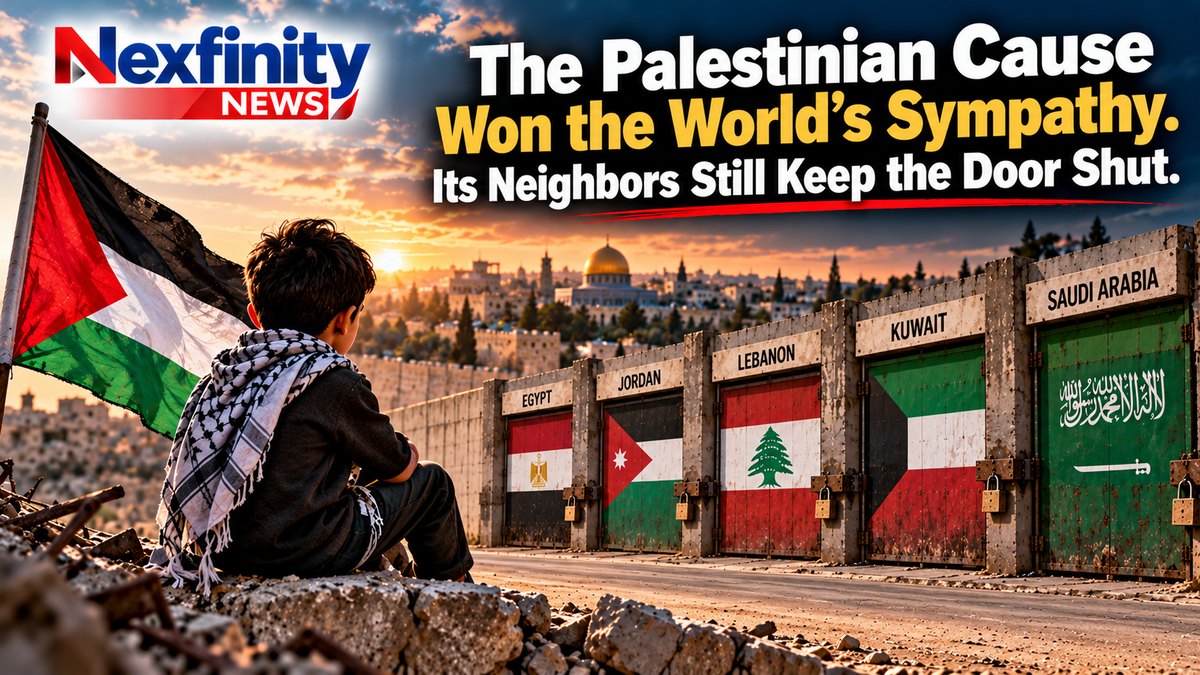
Yet the countries closest to the conflict Egypt, Jordan and Lebanon have refused to absorb displaced Palestinians, and some restrict the ones they already host. That contradiction raises three questions this piece examines: How did the Palestinian cause become a global movement? What do Arab governments say and what does their history suggest about why they keep the door closed? And is the movement’s growth tied to rising antisemitism?
Background
The cause was not “rebranded” in a single campaign. It changed shape over six decades.
The Palestine Liberation Organization (PLO) spent decades pursuing recognition through official channels Yasser Arafat’s 1974 address to the UN General Assembly, the 1988 declaration of statehood in Algiers, the 1993 Oslo Accords. Those efforts won the PLO a seat at the negotiating table. They did not build a mass public following in the West. Diplomacy works between governments; it rarely moves people into the street.
The grassroots turn came from outside government. In 2005, a coalition of Palestinian civil-society groups issued the call for Boycott, Divestment and Sanctions (BDS), recasting the conflict in the vocabulary of human rights and international law. That framing traveled through campus groups, churches, unions and activist networks the infrastructure that would later carry the movement onto social media.
The largest shift came after the Hamas-led attack of Oct. 7, 2023 the deadliest day in Israel’s history and the war that followed. Gaza’s health ministry, which operates under Hamas and whose figures the UN treats as reliable, counted more than 72,500 Palestinians killed by April 2026, per The New Arab. A U.S.-brokered ceasefire took effect Oct. 10, 2025. One year later, Israel controls about 70% of Gaza, near-daily strikes have killed some 1,450 more people, and reconstruction has not begun in earnest, AFP reported.
What Changed After October 7
Hamas started the war. So why did public sympathy move toward Palestinians afterward? The evidence points to four factors.
1. Israel held the sympathy first. In the weeks after the attack, pro-Israel content surged online. Researchers at Northeastern University found that pro-Israeli posts on TikTok followed the pattern of a major news event a spike, then a steady decline while pro-Palestinian posts grew steadily, a pattern consistent with a prolonged social movement, Phys.org reported. October 7 was a single day of atrocity. The war that followed has lasted three years.
2. The response became the story. Gaza’s health authorities count more than 72,500 Palestinians killed, and the UN estimates that 82% of standing structures in Gaza were damaged or destroyed as of mid-2026, according to AFP. Over time, much of the public judged the scale and duration of Israel’s campaign rather than the attack that triggered it.
3. The camera was in Gaza. Israel has largely barred independent foreign journalists from entering Gaza since the war began. As a result, much of the imagery the world saw came from Gazan journalists and residents with phones a continuous stream of civilian footage, while images of October 7 receded.
4. The trend predated the war. Gallup shows Democrats tilting toward Palestinians since about 2017 and younger Americans since about 2020. October 7 briefly interrupted that trend; the war accelerated it. In 2026, the change was driven largely by independents, who now favor Palestinians 41% to 30%, while Republicans remain strongly pro-Israel, Arab News reported from Gallup’s data. The growing alignment of Israel’s government with one U.S. party has likely contributed.
In simple terms: sympathy for Palestinians is not the same as support for Hamas. Pollsters ask about “Palestinians,” and many respondents separate Gaza’s civilians from the group that governs them. Some analysts argue Hamas anticipated that Israel’s response would isolate it internationally; the polling suggests that has partly occurred, though Hamas’s intent remains a matter of interpretation.
Policy Explanation: Why Arab States Won’t Take Them
When President Trump proposed in early 2025 that Egypt and Jordan take in Gaza’s population, Egypt, Jordan, Saudi Arabia, the UAE, Qatar, the Palestinian Authority and the Arab League issued a joint rejection. Their stated reasons fall into four categories.
1. Fear the exit is permanent. Egypt, Jordan and the Palestinians themselves worry Israel would never allow Gazans to return once they leave, the AP reported. Arab governments frame this as refusing a second “Nakba” the 1948 flight or expulsion of some 700,000 Palestinians, most of whose descendants remain refugees today.
2. Preserving the claim. Since the 1950s, Arab states have largely refused to naturalize Palestinians a policy known as rafd al-tawtin, or “refusal of settlement” citing the need to keep Palestinian identity and the right of return intact, according to citizenship scholar Gianluca Parolin. The Arab League’s 1965 Casablanca Protocol promised Palestinians equal employment rights while retaining their Palestinian nationality. Implementation was uneven.
3. Security and domestic stability. Egyptian President Abdel Fattah al-Sisi has called mass transfer into Sinai a “red line” for national security. Jordan’s foreign minister put it bluntly: “Jordan is for Jordanians and Palestine is for Palestinians,”The New Arab reported.
4. Economics. Both Cairo and Amman cite strained economies and the political risk of a sudden population influx.
In simple terms: Arab governments argue that taking in Palestinians would help Israel empty the territory and would kill the political claim to a state. Critics argue the same policy has left millions of people stateless for generations.
Examples: What History Taught the Neighbors
The official reasons are not the whole story. Each host government carries a history that shapes its caution.
Jordan is the exception that proves the rule. It hosts about 40% of the roughly 5.9 million Palestinian refugees registered with UNRWA, per the Palestinian Central Bureau of Statistics, and most have Jordanian citizenship. But in September 1970 “Black September” the Jordanian army fought PLO factions that had challenged the monarchy’s authority, and drove them out. Amman has guarded against a repeat ever since.
Lebanon absorbed the PLO after 1970, and Palestinian armed groups became a major force in the 1975–1990 civil war. Today, Palestinians in Lebanon are treated as foreigners, barred from dozens of syndicate-regulated professions including medicine, law and engineering, and blocked from registering property under a 2001 law, according to UNRWA and IRIN reporting and Amnesty International.
Kuwait expelled or pressured out most of its large Palestinian community after the 1991 Gulf War, following PLO leader Arafat’s support for Saddam Hussein’s invasion.
Egypt did admit Gazans during the war but on its own terms. An estimated 110,000 Palestinians entered Egypt after Oct. 7, 2023, per the Palestinian ambassador in Cairo, many by paying thousands of dollars per person to Hala, a company owned by a prominent Sinai businessman, Reuters reported. Most lack residency, which limits their ability to work, open bank accounts or register phones, +972 Magazine found. Egypt has also cited Hamas’s roots in the Muslim Brotherhood a movement Cairo outlawed as a security concern.
What do they know? In plain terms: the governments nearest the conflict have firsthand experience of Palestinian armed movements destabilizing host states, and they fear both a permanent loss of the territory and the domestic politics of absorbing a large, politically mobilized population. Those calculations coexist with and sometimes contradict their public championing of the Palestinian cause.
Impact: Who Built the Global Message?
No single organization owns the Palestinian “brand.” The evidence points to several layers of actors, some organic and some state-directed.
- Civil society and diaspora networks. The BDS movement, student groups and Palestinian diaspora organizations translated the conflict into the language of Western campus and human-rights activism.
- Social media creators. A Cybersecurity for Democracy study using TikTok’s research API found roughly 17 pro-Palestinian posts for every pro-Israel post but the median pro-Israel video actually drew slightly more views, meaning a small number of viral pro-Palestinian videos drive the gap, the researchers reported. TikTok has called hashtag-only analysis “severely flawed.”
- State money and media. Qatar, which hosts Al Jazeera and Hamas’s political office, is the largest foreign source of reported gifts and contracts to U.S. universities about $6.6 billion cumulatively and $1.1 billion in 2025 alone, according to Department of Education Section 117 data. Disclosure of funding is not evidence of message control, and scholars quoted by Times Higher Education warned against politicizing the data.
- Covert foreign influence. In July 2024, the Director of National Intelligence said Iranian government actors had posed as activists online, encouraged protests over Gaza, and in some cases provided financial support to protesters, ABC News reported.
- Official diplomacy a lagging indicator. The PLO and Palestinian Authority have pursued recognition for decades, but the 2025 Western recognitions came after public opinion had already shifted. They ratified the movement rather than creating it.
The information war runs both ways. In 2024, The New York Times reported that Israel’s Ministry of Diaspora Affairs paid roughly $2 million for a covert campaign run by the firm STOIC, using fake accounts and AI-generated comments to target U.S. lawmakers; Meta and OpenAI both attributed the operation to STOIC. The ministry denied involvement.
In simple terms: the message spread through activism, organic social media and foreign governments at once and the imagery of the Gaza war did more to move opinion than any single campaign.
Foreign Influence on American Campuses
Campuses became the movement’s most visible stage, and they are where questions about outside money have drawn the most scrutiny. The record separates into three tiers: what is documented, what is alleged, and what remains unproven.
The money is documented. U.S. colleges disclosed 8,300 foreign gifts and contracts worth $5.2 billion in 2025. Qatar was the largest source at $1.1 billion, followed by Britain at $633 million and China at $528 million, Reuters reported. Much of Qatar’s money funds American branch campuses in Doha’s Education City, including Cornell, Carnegie Mellon, Georgetown and Northwestern. Texas A&M voted in 2024 to close its Qatar campus by 2028, The College Fix reported. In September 2026, the Institute for the Study of Global Antisemitism and Policy (ISGAP) called for a federal investigation of Cornell after new disclosures brought its reported Qatari funding to $3.38 billion, including previously unreported faculty restrictions, according to ISGAP.
Cornell’s denial, and its own filings. Cornell President Michael Kotlikoff has said the idea that Qatari funding affects the university’s decisions or courses “could not be further from the truth,”The College Fix reported. The university’s own filings complicate that account. Its July 2026 disclosure added more than $1 billion in Qatari funding and, according to ISGAP’s review of the Education Department data, previously unreported faculty restrictions dating to 2020 and a 2025 knowledge-transfer agreement tied to Qatar’s national interests. A judge in a separate lawsuit has ordered Cornell to reveal the details of its Qatari funding. Much of the money supports Weill Cornell Medicine-Qatar, the university’s Doha medical campus. Readers can weigh a $3.38 billion relationship, with conditions attached, against the assurance that it carries no influence.
If there are no strings, why the secrecy? That may be the more revealing question. The pattern of late or missing disclosure is not limited to Cornell. Section 117 was lightly enforced before 2019, AllSides noted, and when the Education Department investigated underreporting in 2020, Texas A&M’s reported Qatari funding rose to more than $600 million, according to the National Association of Scholars. The NAS found that schools in its sample reported $1.6 billion in foreign funds for 2021–2022 when the true figure was at least $2.6 billion. The NCRI study put undisclosed foreign contributions across more than 200 institutions at about $13 billion.
There are innocent explanations: weak federal enforcement, confusing reporting rules, and donor contracts written with confidentiality clauses. But Cornell’s newest filings show that at least some agreements did carry terms faculty restrictions and a knowledge-transfer arrangement that went unreported for years. Disclosure law exists precisely so the public does not have to take a university’s word for it. NexfinityNews has asked Cornell why the restrictions disclosed in July 2026 were not reported when the agreements were signed.
Enforcement has expanded, but without named cases. President Trump’s April 2025 executive order directed enforcement of Section 117 of the Higher Education Act, which requires disclosure of foreign gifts or contracts over $250,000. In February 2026, the State Department joined the Education Department’s oversight effort. Officials declined to give specific examples of foreign funding unduly influencing a university, saying the goal was compliance and transparency, Reuters reported.
The link to antisemitism is contested. A 2023 report by the Network Contagion Research Institute and ISGAP, “The Corruption of the American Mind,” found that campuses receiving undisclosed funding from Middle Eastern regimes reported more antisemitic incidents, The Algemeiner reported. Even some pro-Israel analysts dispute the conclusion. Mitchell Bard, a longtime U.S.-Israel policy analyst, wrote that the study shows correlation, not causation, and noted that major Qatari recipients such as Texas A&M and Carnegie Mellon are not known for campus antisemitism, in JNS.
Protest organizers with foreign ties are under investigation. Two networks have drawn congressional and state scrutiny:
- The Singham network. Neville Roy Singham, an American-born tech entrepreneur living in Shanghai, and his wife Jodie Evans have been identified as the primary funders of The People’s Forum, a Manhattan group that co-organized major protests after Oct. 7. The New York Post, reviewing disclosure forms, reported that the couple gave more than $20.4 million to the group from 2017 to 2022, as summarized by the John Locke Foundation. Senate Judiciary Chairman Chuck Grassley has said evidence suggests The People’s Forum and Code Pink were funded and influenced by Singham and the Chinese government, and the House Ways and Means Committee is investigating, Jewish News reported. These are allegations by lawmakers, not findings by a court.
- American Muslims for Palestine (AMP). AMP, a Virginia nonprofit, sponsors National Students for Justice in Palestine, the umbrella for campus SJP chapters. Virginia Attorney General Jason Miyares opened a charitable-solicitation investigation in October 2023 into whether AMP’s funds supported terrorist organizations, and a Richmond court ordered AMP to turn over financial records in 2025, Jewish Insider reported. The Senate HELP Committee opened its own inquiry. AMP’s counsel has called the challenges baseless, and AMP won dismissal of a separate lawsuit making similar allegations, according to the Muslim Legal Fund of America.
State actors are also documented. U.S. intelligence has said Iranian operatives posed as activists and funded some protesters, as noted above. And the influence effort ran in both directions: the Israeli-government-funded STOIC campaign built websites aimed at younger, progressive Americans with pro-Israel messaging about the war, NPR reported.
In simple terms: foreign money in American universities is real and large, and some protest organizers face serious investigations into who funds them. What has not been shown publicly is that foreign governments directed what students believed or chanted. Even the officials enforcing the disclosure law have not named a case where that happened.
Analysis: Is It Fueled by Antisemitism?
The data supports two statements that are both true.
First, antisemitism has risen alongside the movement. The ADL recorded 6,274 antisemitic incidents in the U.S. in 2025 down 33% from the record 2024 but still the third-highest year since 1979 including a record 203 physical assaults and three killings, according to its May 2026 audit. Incidents tied to Israel or Zionism made up 45% of the total, compared with about 10% in 2020–2022, and the ADL logged 856 incidents at anti-Israel protests, the Washington Examiner reported.
Second, the broad opinion shift is not explained by antisemitism alone. Gallup’s movement is driven by independents and Americans aged 35 to 54 groups that also shifted during a war with large civilian casualties. The ADL’s methodology has itself drawn criticism for counting some anti-Israel speech as antisemitic, JTA noted, though a former ADL researcher now at the rival Nexus Project called it the best incident dataset available.
Israeli Prime Minister Benjamin Netanyahu has blamed falling U.S. support partly on antisemitic social media content. Critics of Israel’s government reply that the cause is the war itself. The line between criticism of a government and hostility toward Jews is the central dispute and it is exactly where definitions such as the IHRA working definition are contested.
The fair reading: antisemitism is present within parts of the movement and has produced real violence against Jews. But the evidence does not show that it is the engine of global sympathy for Palestinians, which tracks most closely with the course of the war.
Conclusion
The Palestinian cause won the international messaging contest through grassroots activism, viral media and foreign-state amplification with formal diplomacy following public opinion rather than leading it set against the backdrop of a devastating war.
The neighboring Arab governments tell a different story with their policies than with their statements. They champion the cause abroad while refusing resettlement at home, citing the right of return and their own security. Their histories in Amman, Beirut and Kuwait City suggest the caution is not new.
That gap between global sympathy and regional reluctance is the part of the story most coverage leaves out.
Key Takeaways
- Gallup’s February 2026 poll found 41% of Americans sympathize more with Palestinians versus 36% with Israelis the first reversal since 2001.
- About 157–159 UN member states now recognize Palestine, including the UK, France, Canada and Australia since September 2025.
- Egypt, Jordan and Arab League members reject mass relocation of Gazans, citing fear of permanent displacement, security and economics.
- Jordan naturalized most of its Palestinian refugees; Lebanon bars them from dozens of professions and property registration; Egypt admitted about 110,000 Gazans largely without residency.
- No single entity owns the “brand”: BDS, diaspora and student groups, social media, Qatari funding and documented Iranian influence operations drove it, and formal diplomacy largely followed while Israel ran its own covert campaign.
- Qatar was the top foreign funder of U.S. universities in 2025 at $1.1 billion, and protest organizers tied to Neville Roy Singham and American Muslims for Palestine face congressional and state investigations but no public case has shown foreign money directing campus protests.
- U.S. antisemitic incidents remain historically high, with record assaults in 2025, but the evidence ties the opinion shift more closely to the war than to antisemitism.
Sources
- Associated Press / Gallup Americans’ sympathies shift in Israeli-Palestinian conflict (Feb. 27, 2026)
- JNS Americans more sympathetic to Palestinians for first time
- Arab News Japan Gallup data on independents and age groups
- Yeni Şafak / Wafa Timeline of recognitions since 1988
- AFP via Macau Business How AFP counted recognitions
- AFP via Oman Observer Year later, Gaza ceasefire promises mostly unfulfilled (Oct. 10, 2026)
- AFP via Malay Mail One year on, Gazans still displaced (Oct. 12, 2026)
- The New Arab Israeli strikes kill four amid new ceasefire push (Apr. 30, 2026)
- Phys.org / Northeastern University Pro-Palestinian posts outnumber pro-Israeli posts on TikTok
- CBS News / AP Arab nations reject relocation proposal
- The New Arab Egypt, Jordan reject forced displacement
- GlobalCit / Gianluca Parolin Egyptian citizenship and Palestinians
- Refworld Casablanca Protocol (1965)
- Al-Quds / PCBS UNRWA registered refugee figures
- UN / IRIN Lebanon labor law and Palestinians
- Amnesty International Palestinian refugees in Lebanon
- Al Manassa Palestinians in Egypt after the ceasefire
- Reuters via AOL Palestinian Embassy seeks status for Gazans in Egypt
- +972 Magazine Gazans in Egypt in legal limbo
- Cybersecurity for Democracy Israel/Gaza TikTok analysis, two years on
- Times Higher Education Qatar tops Section 117 donor list
- ABC News DNI: Iranian actors exploiting Gaza protests
- Boston Globe / New York Times Israel covert influence campaign targeting U.S. lawmakers
- NPR How Israel tried to use AI to covertly sway Americans about Gaza
- Reuters via AOL Trump administration steps up scrutiny of foreign university funding (Feb. 2026)
- The College Fix Foreign countries gave $67 billion to U.S. universities
- ISGAP Call for federal investigation into Cornell’s Qatar funding (Sept. 8, 2026)
- AllSides U.S. colleges received over $5.2B in foreign funding in 2025
- National Association of Scholars Shadows of Influence
- The Algemeiner Concealed foreign money linked to campus antisemitism: report
- JNS / Mitchell Bard Study doesn’t show Arab donations cause antisemitism
- John Locke Foundation (summarizing New York Post) Funding behind The People’s Forum
- Jewish News U.S. investigates alleged China-linked protest funding
- Jewish Insider Judge orders AMP to disclose financial documents
- Muslim Legal Fund of America AMP response to legal challenges
- Jewish Virtual Library ADL 2025 Audit summary
- Washington Examiner ADL audit finds assaults soaring
- J. Weekly / JTA ADL incidents dropped by a third, assaults at record