
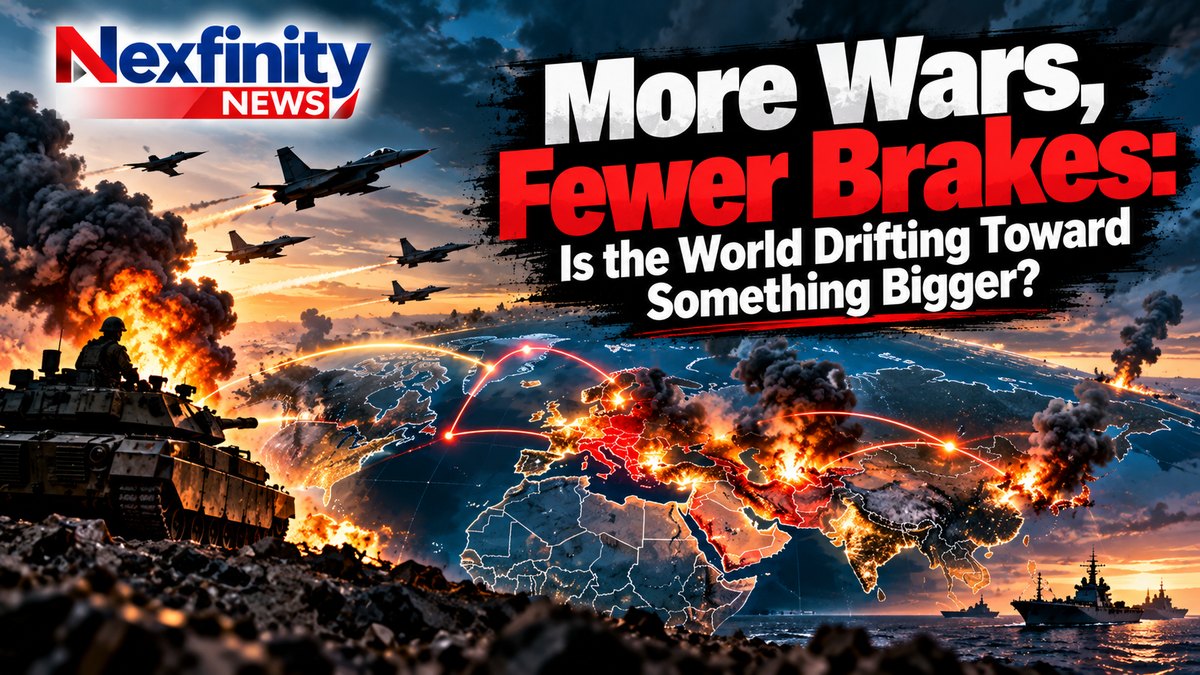
Many readers have the same sense right now: that the world is less stable than it has been in decades, and that the pressure is building rather than easing.
The data supports part of that feeling. In June 2026, two widely cited sources on armed conflict, Uppsala University’s conflict database and the Institute for Economics & Peace, both reported that the number of active conflicts is at or near its highest point since the end of World War II. This weekend, the unrest showed up closer to home. Protests over the cost of living turned violent in France, Italy and Belgium, and rioters burned down the 19th-century town hall in Limoges, France.
This article looks at what the numbers measure, what they don’t, and whether they point toward a larger war.
What the Data Shows
The Uppsala Conflict Data Program (UCDP) at Uppsala University in Sweden has tracked armed conflict since 1946. For 2025, it counted 65 conflicts involving at least one government, the most in its records and six above the previous high. Those conflicts took place in 35 countries.
In simple terms: a “state-based conflict” is any armed conflict in which a government is one of the sides. That includes civil wars, not just wars between nations.
The bigger change is in the kind of wars being fought. The Peace Research Institute Oslo (PRIO), which publishes analysis based on the Uppsala data, recorded eight conflicts between countries in 2025. That is twice the 2024 number and the most since 1946. For decades, civil wars made up nearly all conflicts. Wars between countries had become rare. That is no longer true.
The Institute for Economics & Peace (IEP), a Sydney-based think tank, reached a similar conclusion in its 2026 Global Peace Index. The index found that peacefulness has fallen for twelve years in a row, and that 119 countries are less peaceful than they were in 2008. The number of countries involved in conflicts outside their own borders rose from 59 in 2008 to 103 in this year’s edition.
The Pressure at Home
The Global Peace Index also measures stability inside countries. Since 2008, two of the three indicators that have worsened most are violent demonstrations and internal conflict.
Europe has been the most stable part of the world for decades. This autumn, protests over the cost of living, school conditions and fuel prices have turned violent in several of its largest countries at the same time.
France: A Month of Escalation
France’s unrest started small. In mid-September, students walked out of a secondary school in Créteil, southeast of Paris. They were protesting staff shortages, absent teachers, large class sizes and run-down buildings.
The walkouts spread nationwide within two weeks. French authorities reported more than 5,000 arrests between September 28 and October 2. About 85% of those detained were minors, mostly high school students. More than 600 police officers and gendarmes were injured. Education Minister Édouard Geffray said 24 schools were burned or ransacked, with damage estimated at €20 million to €30 million.
Fuel prices added a second front. On September 17, fishermen blockaded the entrances to the ports of Nice and Sète and set tires on fire on a road leading to an oil depot in Frontignan. Diesel had passed €2.37 a liter that day, just below its record of €2.38, according to an AFP analysis of government data. AFP linked the rise in crude prices to the US-Iran war and to a Saudi pipeline shutdown during fighting with Houthi forces in Yemen. The fishermen lifted the blockades after six hours of talks, and Prime Minister Sébastien Lecornu extended emergency fuel subsidies for farming, fishing and construction through the end of the year.
By mid-October the two movements had merged into a broader protest over purchasing power. On Saturday, October 17, the Interior Ministry estimated about 550,000 people marched nationwide, including about 110,000 in Paris. Most marches were peaceful. Violent groups targeted public buildings, luxury shops, supermarkets and police:
- City halls in Marseille and Lille were broken into and vandalized.
- Protesters set fire to the tourist office in Lyon.
- Paris Mayor Emmanuel Grégoire said whole streets in the capital “have been devastated.”
Arrest figures for the day differ. Interior Minister Laurent Nuñez reported about 400. Prime Minister Sébastien Lecornu later put the number at 1,200, with 150 police officers injured. “It’s a miracle the toll wasn’t higher,” Lecornu said.
The Limoges Town Hall Fire
The most visible loss was in Limoges, a city in central France.
According to the Haute-Vienne prefecture, masked rioters broke into the city’s town hall at around 6 p.m. on October 17 and set it on fire. The fire spread across the roof overnight, and video showed the building’s spire collapsing in flames. Prefect Maurice Barate told AFP that the roof fell onto the lower floors everywhere except the west wing, and that two-thirds of the exterior was gone. He called the fire “a deliberate act by hooligans” and “a catastrophe for heritage.”
Construction of the town hall began in 1879, 147 years ago, to a design by the Paris architect Charles-Alfred Leclerc. It opened on July 14, 1883. According to France’s national heritage register, its façades and roofs, along with the fountain on the square, were listed as a historic monument in 1975.
Police detained 19 people in the region. Four police vehicles were destroyed, and four officers suffered what the prefecture described as more serious injuries. About 2,000 people had gathered in the city’s Casseaux area. The prefecture said more than 500 of them were “deliberately seeking confrontation.” Protesters also blocked the A20 motorway and looted shops on Rue Jean Jaurès.
Mayor Guillaume Guérin said protest is a right, but that no grievance justifies destroying public property. President Emmanuel Macron said there is “no place for violence” in France and promised that those responsible would be “prosecuted and punished.” Nuñez and Lecornu blamed violent far-left groups for the nationwide unrest. Officials have not publicly identified who set the Limoges fire.
In simple terms: this was not one protest that got out of hand. It was a month of student protests, fuel blockades and budget anger that came together in a single weekend.
The Fiscal Backdrop
The protests come on top of a debt problem. France’s public debt has reached about $4 trillion, or 119% of GDP. That is its highest level relative to the economy since just after World War II. Its 10-year borrowing costs are at their highest in 24 years. Lecornu’s 2027 budget faces a key vote in the National Assembly this week.
In simple terms: when a heavily indebted country loses lenders’ confidence, its borrowing costs rise. That leaves less money for the schools and services people are protesting about.
The presidential election is in April 2027. Marine Le Pen was convicted in 2025 of misusing public funds. In July 2026, an appeals court cleared her to run, while sentencing her to three years: two suspended and one under electronic monitoring. She is appealing to France’s highest court. Her National Rally party leads the presidential polls. Lecornu has rejected the idea that the unrest is a “warm-up” for the election.
Italy, Belgium and Portugal
France was not alone on October 17. Separate protests took place the same day in at least three other countries.
Italy. More than 5,000 people marched in Milan against inflation, low wages and underfunded health care and schools. Masked protesters threw stones and paving blocks at police, set barricades on fire and looted shops. About 50 people were detained, many of them minors. In Bologna, a group of young people attacked the central railway station, which was closed as a precaution. Prime Minister Giorgia Meloni wrote: “Demonstrating is a right. Setting our cities ablaze is not.”
Fuel costs are part of the pressure. Italy’s last fuel tax discount expired on October 6. It was the end of cuts first introduced in March after the Iran war began. The road haulage association Assotir has not ruled out a sector-wide strike.
Belgium. Police used tear gas and water cannon in Brussels and Liège after weeks of student protests over university fees. Interior Minister Bernard Quintin called it“pure and simple violence, organised and repeated to destabilise our society.”
Portugal. Tens of thousands marched peacefully in Lisbon in a march called by the CGTP union, over low wages, housing costs and fuel prices. Portuguese house prices have more than doubled since 2017. A government minister said the government “will not yield to shouts from the street.”
Germany and the United Kingdom
In April 2026, the Alternative for Germany (AfD) party led the governing CDU/CSU in four major polls on the same day for the first time. An INSA poll later put it at a record 28%. In the September 20 state elections, the AfD won Mecklenburg-Western Pomerania with 38%, and the far-left Die Linke beat the CDU in Berlin.
The United Kingdom shows that the trend is not one-directional. Reform UK led national polls from May 2025. Its average has since fallen about eight points, to around 24%, and it has lost its lead to Labour.
The Connection
These protests have different local causes: school conditions in France, university fees in Belgium, housing in Portugal. They share a pattern. A war fought far from Europe raised fuel and energy costs inside it. Governments already carrying heavy debt have little room to cushion the impact. In several countries, voters are turning to parties outside the political mainstream, and the street protests are increasingly ending in violence.
The Slow Build-Up
The case that pressure is building rests less on any single war than on the weakening of the systems that kept wars contained.
Nuclear arms control has lapsed. New START, the last treaty limiting the US and Russian nuclear arsenals, expired on February 5, 2026, with no replacement. For the first time in more than half a century, the two largest nuclear powers have no binding limits on their strategic forces. Meanwhile, according to the Stockholm International Peace Research Institute (SIPRI), China’s arsenal has grown faster than any other country’s since 2023, by about 100 warheads a year. China has said it will not join arms-reduction talks.
Military spending is at a record. SIPRI reports that global military spending reached $2,887 billion in 2025, the eleventh straight annual increase. That is 2.5% of global GDP, the highest share since 2009. European spending rose 14%. US military spending approved for 2026 is over $1 trillion, and SIPRI expects global spending to keep rising.
Fewer wars end in agreements. The IEP reports that the share of conflicts ending in a peace agreement has fallen over the past 60 years. It describes a new pattern of overlapping conflict systems, in which local wars spread instability across whole regions. Refugee flows are one of the ways that happens.
Wars are lasting longer and spreading. The Iran war began on February 28, 2026, and is now in its eighth month. A ceasefire in April and a memorandum of understanding in June both broke down, and strikes resumed in July. In late September, Iran proposed reopening the Strait of Hormuz in exchange for lifting the US naval blockade and oil sanctions. President Trump rejected the proposal, and on October 6 Iran’s President Masoud Pezeshkian called further talks futile. Gulf oil shipments recovered to about 81% of pre-war levels in September, according to the shipping-data firm Kpler, but attacks on tankers continue. The war’s effects reach far beyond the Middle East, all the way to diesel prices on the docks of Nice and the fuel tax debate in Rome. (See our earlier coverage: Caspian: Iran’s Limited Gateway to Unencumbered Trade, and how drones are rewriting modern warfare.)
What the Numbers Don’t Show
The record conflict count needs context.
Deaths are high but nowhere near World War II-era levels. About 244,600 people were killed in organized violence in 2025. That is the highest since the Rwandan genocide in 1994, not since 1945. The Korean, Vietnam and Iran-Iraq wars each killed far more people per year.
Some measures are improving. Deaths from terrorism fell to their lowest level since 2008. Deaths from conflicts between non-state groups, such as Mexican drug cartels, fell to about 14,500, the lowest since 2013.
Most protesters are peaceful. Of the roughly 550,000 people who marched in France on October 17, the Limoges prefecture identified about 500 people at that site as seeking confrontation. Lisbon’s march of tens of thousands was peaceful. The violence is real, but it is concentrated in small groups.
Arms control experts are divided on an arms race.RAND analysts wrote that New START’s expiration is a bad signal but unlikely to trigger a Cold War-style arms race right away. The more lasting damage is to transparency and dialogue.
Many conflicts are small. Uppsala counts any conflict with at least 25 battle deaths in a year. A rising count does not automatically mean rising devastation.
Analysis: 1914, 1939, or Neither?
Comparisons to the years before the two world wars are common. They fit in some ways and not in others.
Where the comparison fits:
- rising arms spending
- the breakdown of agreements between major powers
- economic strain feeding political extremes and street violence, the pattern most associated with the 1930s
Where it doesn’t:
- Nuclear weapons have so far deterred direct war between major powers.
- Global economies are far more interconnected, which raises the cost of a major war.
- Western Europe, the center of both world wars, remains among the most peaceful regions in the world, even with this autumn’s unrest.
The evidence does not show that a larger war is coming. It does show that the systems built after 1945 to prevent one are weaker than they have been in decades: arms treaties, negotiated settlements, and stable centrist governments. When those systems weaken, the outcome depends more on decisions by individual leaders and less on rules.
Conclusion
The sense that the world is less stable is supported by the data on the number and kind of conflicts. It is not supported by the death toll, which is high but well below past peaks.
The most important trend may be the least visible one. The guardrails that have kept regional wars from becoming global ones are weakening at the same moment that wars, debt and domestic unrest are feeding into each other. A war in the Persian Gulf raised fuel prices in Europe. Fuel prices and budget cuts brought hundreds of thousands into the streets. In Limoges, a building that stood through two world wars burned in a single night.
Key Takeaways
- Uppsala recorded 65 state-based conflicts in 2025, the most since its records began in 1946.
- Wars between countries doubled to eight, the highest since 1946.
- The Global Peace Index has declined for 12 straight years. 119 countries are less peaceful than in 2008.
- France’s protests grew from a school walkout in September to about 550,000 marchers on October 17. Rioters burned Limoges’s town hall, begun in 1879, whose façades are a listed historic monument.
- Protests also turned violent the same day in Italy and Belgium, and tens of thousands marched in Portugal.
- New START expired in February 2026, leaving the US and Russia without limits on their nuclear arsenals.
- Global military spending hit a record $2,887 billion in 2025.
- Conflict deaths, about 244,600, are the highest since 1994 but far below World War II-era levels.
Sources
- PRIO Conflict Trends: A Global Overview, 19462025
- Uppsala University UCDP: record number of conflicts between states
- NPR Conflicts on rise globally, highest level since WWII
- Institute for Economics & Peace Global Peace Index 2026
- IEP Global Peace Index 2026 report (PDF)
- India Outbound Global Peace Index 2026 findings
- Euronews Spire collapses at historic Limoges town hall
- Fox News Limoges Town Hall “largely lost”
- France 24 Town hall in Limoges “largely lost” to blaze
- IBTimes French student protests: 5,000 arrests, 600 police injured
- Al Jazeera Cost of living protests hit Belgium, Italy, Portugal and France
- Open Meloni warns against setting cities ablaze, Macron vows prosecutions
- ANI via WebIndia Belgium clashes
- Euronews Fuel prices in Italy: tax cuts end
- AFP via African News Agency French fishermen block ports over petrol prices
- Reuters via Global Banking & Finance French fishermen lift port blockade
- Ministère de la Culture, Mérimée PA00100361 Hôtel de ville de Limoges
- Fortune France debt crisis
- Sky News via Coast FM Le Pen to run after court ruling
- NAMPA AfD tops polls for first time
- Polskie Radio AfD hits record 28%
- Kuwait Times AfD wins Mecklenburg-Western Pomerania
- Irish News How long has Reform led the polls?
- Sky News via Radio X Reform’s polling slide
- Al Jazeera Russia and the expired New START treaty
- RAND New START’s expiration will make the world less safe
- SIPRI World military expenditure 2025 press release
- SIPRI Military Expenditure 2025 fact sheet (PDF)
- Al Jazeera US sets new demands for Iran deal