
British Prime Minister Andy Burnham is telling households to keep emergency food on hand. He has suggested households keep at least three days’ worth of bottled water and tinned food at home, citing growing risks from severe weather, cyberattacks and other unexpected events.
The timing is notable. Earlier this month, Western food retail took two hits in a single weekend. On the night of Oct. 11–12, attackers took control of connected Danfoss refrigeration controllers in French supermarkets and changed temperature settings remotely. Separately, Food Lion, Hannaford, Stop & Shop and both Giant Food websites went offline, and online ordering and deliveries were suspended after a security issue in the Ahold Delhaize network.
Then this week, two critical flaws were disclosed in PHP, the software that runs most of the web. Attack attempts reached the millions within a day.
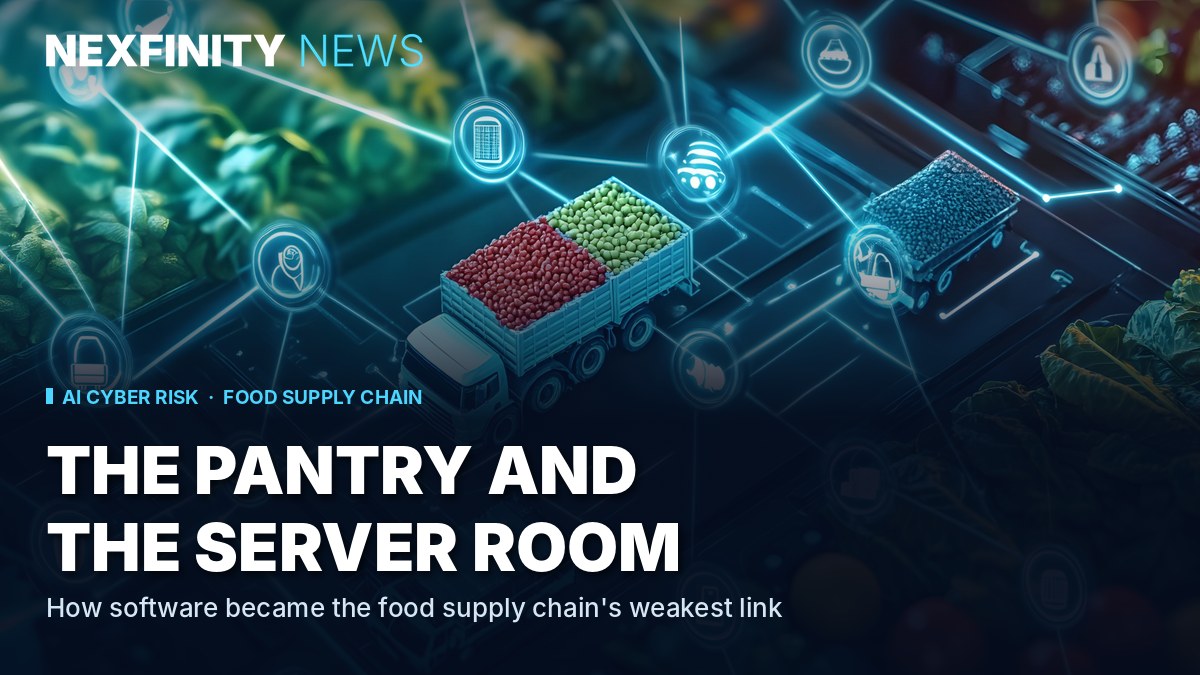
No connection among these incidents has been confirmed. Together, though, they show where food supply risk now sits: in the software that orders, stores, chills and moves food, more than in the fields that grow it.
Background: What London Is Actually Saying
Burnham spoke on BBC Radio 5 Live with storms hitting Britain. He framed it as being prepared and keeping a sensible amount of supplies at home, noting that people in Cornwall would be glad of extra water and food.
The advice itself has a history. In May 2024, under the previous government, the U.K. urged people to keep three days’ worth of supplies, and supermarkets warned against panic buying.
The renewed push follows a formal warning. A National Audit Office report published Sept. 4 said Defra must work more closely with households, communities and industry so the food supply chain can withstand increasingly likely and severe shocks, including extreme weather, cyberattacks and disease outbreaks. The NAO found Defra’s actions in recent years have not been sufficient to make the supply chain resilient to such events. Parliament’s Public Accounts Committee took oral evidence on the report on Oct. 15.
The advice has also been misread. A Sept. 18 Polymarket post claimed the government was urging stockpiling because it was preparing for war, citing the BBC. The government has issued no such order. The food-and-water advice is part of broader civil-resilience guidance.
How a Hack Becomes an Empty Shelf
Modern food distribution runs on three digital layers. Each one can fail.
Websites and ordering systems. Retailers, wholesalers and their customers place and track orders online. When those systems go down, products stop being ordered even when they exist.
Supply chain software. Warehouse management, forecasting and scheduling platforms decide what moves where. Many retailers share the same vendors, so one breach can spread to several chains.
Transportation and cold chain controls. Refrigerated trucks, cold stores and in-store freezers are increasingly managed remotely. More than half of the U.K.’s food is stored or transported under temperature control.
In simple terms: hackers don’t need to touch the food. They only need to stop the systems that know where it is.
Phil Pluck, chief executive of the Cold Chain Federation, has described the concentration risk. Criminals understand that 450 food warehouses is not many, so disrupting the supply chain becomes serious quickly. An attack can leave a company unable to see what is in its warehouses or where its trucks are.
The Incident Record
The pattern goes back several years, and it has been accelerating.
- JBS (May–June 2021). A REvil ransomware attack idled 13 U.S. meatpacking plants and took about 22% of daily U.S. beef and pork slaughter capacity offline for two days. JBS USA paid the equivalent of $11 million in ransom.
- Blue Yonder (November 2024). This supply chain software vendor serves more than 3,000 customers, including Tesco, Morrisons, Sainsbury’s, ASDA and Starbucks. Morrisons said a ransomware attack on the vendor interrupted the smooth flow of goods and that some items might not reach shelves on schedule.
- M&S and Co-op (spring 2025). The Co-op said its cyberattack would cost £120 million in lost profits. M&S expected a £300 million hit to profits.
- UNFI (June 2025). The distributor supplies more than 30,000 locations from over 50 distribution centers. After detecting unauthorized activity on June 5, it shut down systems, including those used to fulfill and distribute customer orders. Whole Foods shelves thinned in the following days.
- Nichirei, Japan (July 2026). A cyberattack on the frozen-food supplier and logistics firm curtailed shipments and led KFC franchises in Japan to warn of shortages. Nichirei runs about 7,000 refrigerated vehicles from 141 logistics centers and warehouses.
- France (Oct. 12, 2026). At least 300 Intermarché/Netto stores, fewer than 100 Coopérative U stores, several E.Leclerc locations and about 30 Monoprix stores were affected. About 100 Intermarché stores had to discard all food in refrigerated cases. Danfoss confirmed incidents affecting a limited number of refrigeration management systems in France.
- Ahold Delhaize (Oct. 11–20, 2026). At one point Stop & Shop pharmacies could not refill prescriptions, Food Lion faced missing and delayed deliveries, and Instacart return dates kept slipping. Stop & Shop’s website came back online on Oct. 20, more than a week after the attack.
Where AI Enters the Picture
None of the food-sector incidents above has been publicly attributed to AI-driven attacks. The AI risk is about what comes next: how much faster and cheaper these attacks are likely to become.
The U.K.’s National Cyber Security Centre has put that risk on paper. It found that the time between a vulnerability’s disclosure and its exploitation has already shrunk to days, and AI will almost certainly reduce it further. The NCSC assesses a realistic possibility of critical systems becoming more vulnerable to advanced threat actors by 2027 if defenses lag.
There is also a documented precedent outside the food sector. Anthropic reported a September 2025 espionage campaign in which a suspected Chinese state-sponsored group used Claude Code as an autonomous agent against roughly thirty global targets. The autonomy claim drew pushback. Anthropic itself noted the model sometimes hallucinated credentials or claimed to have extracted secrets that were actually public.
In simple terms: AI hasn’t yet emptied a supermarket. It is shortening the time between a flaw being found and a flaw being used, and food logistics often runs on older, unpatched equipment.
The French case shows that exposure. The attack hit the industrial controllers that keep food cold, not point-of-sale systems or customer databases. Trucking is also lightly regulated. A vendor report from Black Kite counted 457 disclosed ransomware victims across trucking, freight and warehousing from January 2023 to July 2026, and noted that general freight trucking falls outside NIS2’s core annexes, outside the U.K. bill’s scope, and outside any binding U.S. federal cyber mandate.
The Website Layer: PHP2Shell and the UpdraftPlus Breach
PHP2Shell. The week’s widest web exposure is underneath WordPress itself. PHP is the server language on 69.3% of websites where the language is known, and WordPress alone runs 39.6% of all websites. WordPress, its plugins and its themes are all written in PHP, so the flaw sits under every one of them.
The PHP team released fixes on Oct. 21 in versions 8.5.12, 8.4.27, 8.3.36 and 8.2.35. Both flaws are rated 9.2 and let attackers run code remotely without logging in. Researchers demonstrated attacks against the latest WordPress, Drupal and Joomla container images.
In simple terms: anyone who sends a vulnerable server the right request can take it over. Updating WordPress does not fix it. Wordfence warned that WordPress’s automatic updates would not install the PHP fix and told site owners to find out who manages their server environment.
The attack volume climbed fast. Cloudflare’s CEO reported thousands of exploit attempts before the announcement, hundreds of thousands within two hours of it, and millions by the next day. Cybersecurity agencies in Europe, Australia, Japan and the U.K. issued advisories, and some government sites were taken offline as a precaution. CISA advised that organizations unable to update immediately, or still running PHP 8.1 or older, take PHP-based systems offline until patched.
The way the flaw was found matters for this story. Calif found the first bug in August with help from OpenAI’s GPT-5.6 Sol model, during a PHP source-code audit OpenAI funded through its Patch the Planet initiative. Google’s Wiz team found the flaws independently weeks later using Wiz Atlas, Gemini 4 Argon and GPT-5.6 Sol.
AI found the bugs months ahead of disclosure, and attackers still moved first. Details leaked on social media on Oct. 20, ahead of the planned Oct. 22 disclosure. Amazon Threat Intelligence traced an exploitation attempt to Oct. 17, four days before public disclosure. That compression between discovery and attack is what the NCSC predicted.
UpdraftPlus. A separate incident hit WordPress’s management layer. TeamUpdraft, maker of the UpdraftPlus backup plugin, identified unauthorized access to its website over the weekend of Oct. 17–18. The breach potentially exposed connection keys that can send commands to connected sites.
Patchstack observed attacks beginning Oct. 18 that used the keys to install malicious plugins and create accounts with administrative privileges. It identified at least 99 variants, some disguised as routine maintenance or optimization tools.
UpdraftPlus has more than four million active installations. Only sites connected to UpdraftCentral through an active key are exposed to this attack.
Why it matters for food. Grocers, wholesalers, specialty producers and logistics firms run supplier portals, ordering pages and storefronts on the same open-source stack as the rest of the web. No food company has been publicly linked to either incident. The pattern matches the rest of this story, though: one shared component, compromised once, reaches thousands of businesses at the same time.
Impact
The costs fall on companies first and consumers second. Albert Heijn’s outage lasted nearly two weeks, with damages estimated at €120 million to €150 million. Much of the food that could not be delivered went to Dutch food banks.
For shoppers the effects have mostly been partial: thinner shelves, failed loyalty programs, wrong prices and suspended deliveries, not bare stores. During the Ahold Delhaize incident, stores across Europe and the U.S. stayed open.
Analysis
Four points stand out.
First, the duration gap. Household guidance on both sides of the Atlantic is built around roughly 72 hours. The recent cyber disruptions ran about a week or longer. That doesn’t make three-day kits pointless, since stores have generally stayed open. It does mean a 72-hour kit covers a storm better than it covers a software outage.
Second, efficiency is the vulnerability. The NAO said the supply chain was built to prioritize efficiency, which lowers costs for businesses and consumers but leaves it more exposed to disruption. Shared vendors, lean inventory and centralized warehousing amplify any single breach.
Third, the attack surface is moving into physical equipment. Earlier incidents locked up back-office IT. The French attack changed the temperature of the food itself. If AI speeds up exploitation of known flaws, as the NCSC expects, connected refrigeration and fleet systems are the obvious next targets.
Fourth, AI cuts both ways, and speed favors the attacker. PHP2Shell was found by AI-assisted researchers months before disclosure, which is the defensive promise of the technology. Exploitation still began before the patch shipped and reached the millions within a day. Patching depends on thousands of hosts and site owners each acting on their own, while attacks can be automated across all of them at once.
Conclusion
Burnham’s pantry advice is ordinary preparedness, not a war warning. The more useful question is whether governments and grocers are treating food logistics software, and the open-source code underneath it, as critical infrastructure. The NAO says Defra hasn’t yet. The October incidents in France, at Ahold Delhaize and across the PHP web suggest attackers already are.
Key Takeaways
- Burnham’s advice to keep three days of food and water is a renewal of existing U.K. guidance. The government ties it to storms and cyber risk, not to war.
- On the weekend of Oct. 11–12, 2026, attacks hit French supermarket refrigeration controls and Ahold Delhaize, parent of Stop & Shop. No link between the two has been confirmed.
- The food supply’s weak points are digital: ordering systems, shared supply chain software, and connected cold chain and transport equipment.
- PHP2Shell, disclosed Oct. 20–21, affects most PHP websites, including WordPress. AI models found it months earlier, yet attacks reached millions of attempts within a day of the patch.
- Stolen UpdraftCentral keys were used to plant backdoor plugins on connected WordPress sites starting Oct. 18.
- Recent cyber outages lasted about a week or more, longer than the 72-hour window household kits are built for.