
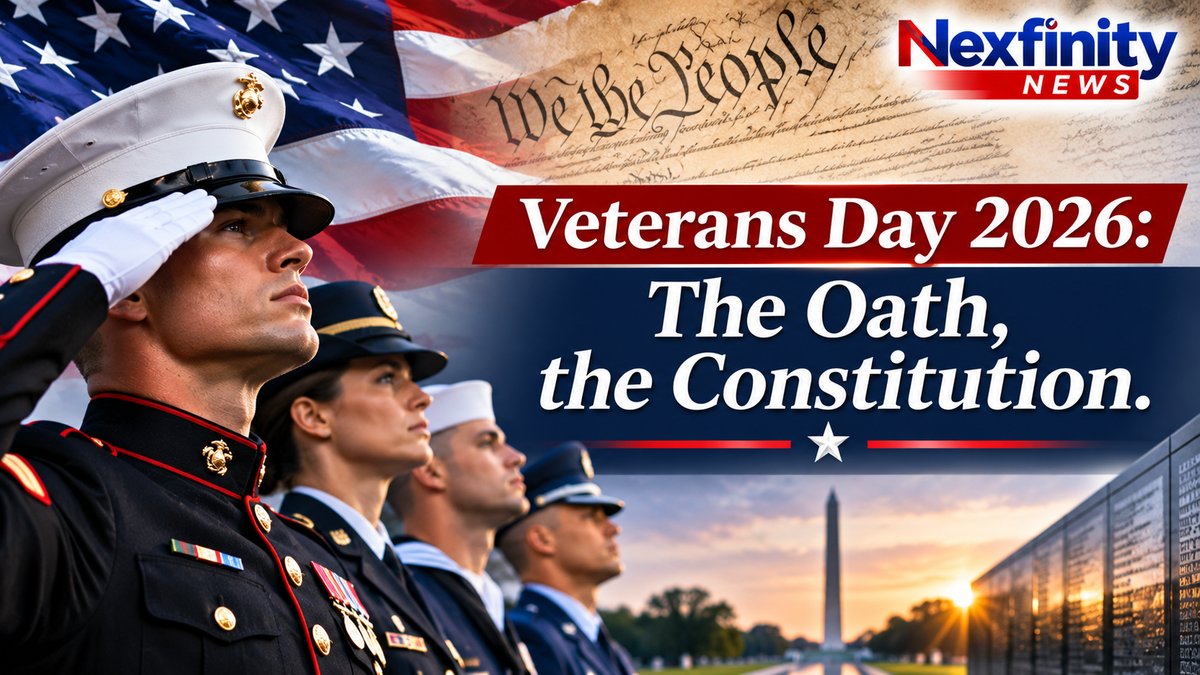
On Wednesday, the nation marks Veterans Day in the 250th year since the Declaration of Independence. The Department of Veterans Affairs’ 2026 Veterans Day poster pairs the modern flag with an early American flag to mark the anniversary (Awareness Days summary of the VA poster).
Roughly 17 million Americans have worn the uniform and come home. Every one of them, on the day they joined, swore an oath. It was not to a president, a party or a flag. It was to the Constitution.
This year that oath sits next to a live political question. Eight days ago, voters sent six candidates endorsed by the Democratic Socialists of America (DSA) or its local chapters to the House. The DSA’s national program calls for abolishing the Senate and the Electoral College and replacing the presidency and Supreme Court. In January, those members-elect will swear the same core promise service members do: to support and defend the Constitution.
This article explains what the oath says, what the DSA program proposes, what the Constitution allows, and where the honest disagreement lies.
Background: From Armistice Day to Veterans Day
Veterans Day began as Armistice Day, marking the 11 a.m. ceasefire on Nov. 11, 1918, that ended fighting in World War I. Congress made Nov. 11 a legal holiday on May 13, 1938. On June 1, 1954, Congress struck the word “Armistice” and renamed it Veterans Day to honor veterans of all wars (GovInfo).
The Uniform Holiday Bill of 1968 moved the observance to the fourth Monday in October beginning in 1971. Many states kept the November date anyway. On Sept. 20, 1975, President Gerald Ford signed a law returning Veterans Day to Nov. 11, beginning in 1978 (GovInfo). Unlike Memorial Day, which honors those who died in service, Veterans Day honors everyone who served.
The veteran population is shrinking. The Bureau of Labor Statistics counted about 17.1 million veterans in the civilian population in December 2025, down from about 17.4 million in February of that year (BLS via FRED, series LNU00049526). The VA’s own model, which counts differently, estimated 17.9 million in fiscal 2024 and projects a steady decline. In 1980, about 18% of U.S. adults were veterans; by 2022, the share was 6% (Pew Research Center).
Policy Explanation: What the Oath Actually Says
The enlistment oath is set in federal law at 10 U.S.C. § 502. It reads in part:
“I, ___, do solemnly swear (or affirm) that I will support and defend the Constitution of the United States against all enemies, foreign and domestic; that I will bear true faith and allegiance to the same…”
Commissioned officers take a nearly identical oath under 5 U.S.C. § 3331, the same oath sworn by members of Congress and federal civil servants. Article VI of the Constitution requires senators, representatives, state legislators and executive and judicial officers to be bound by oath to support it.
In simple terms: service members do not swear loyalty to any person. They swear to the framework of government itself.
That framework includes its own method for change. Article V lets the Constitution be amended with two-thirds of both chambers of Congress (or a convention called by two-thirds of the states) and ratification by three-quarters of the states. It also contains one entrenched rule: no state may be deprived of its equal vote in the Senate without its own consent.
What the DSA Program Proposes
The DSA launched its updated “Workers Deserve More” program on July 14, 2026. Its structural proposals include (DSA program; Washington Examiner):
- Abolish the Senate, expand the House, and adopt proportional representation and ranked-choice voting.
- Abolish the Electoral College.
- Replace the presidency and the Supreme Court with an executive and judiciary “chosen by and subordinate to Congress.”
- Pursue a new democratic constitution built on a single federal legislature (Washington Examiner).
The program also addresses the military directly. It calls for defunding the Department of War, closing overseas bases, and supporting and fully employing veterans (DSA program).
DSA leaders have defended the structural changes in public. Co-chair Ashik Siddique called the Senate fundamentally undemocratic and said abolishing it is not extreme (Washington Examiner). Co-chair Megan Romer confirmed the Senate plank on Fox News Sunday on July 26 (Washington Examiner). DSA has tied its national endorsement process to the program (IBTimes).
The proposal is not new. DSA’s 2021 platform already called for abolishing the Senate and Electoral College, and acknowledged that doing so would require a constitutional amendment (Democratic Constitution Blog).
Examples: The Election and the Oath Question
On Nov. 3, six candidates endorsed by DSA or its local chapters won House seats, according to AP race calls reported by NPR: Darializa Avila Chevalier and Claire Valdez in New York, Melat Kiros in Colorado, Angela Gonzales-Torres in California, Donavan McKinney in Michigan, and Chris Rabb in Pennsylvania (NPR). Chevalier and Valdez were endorsed by the New York City chapter (City & State). They join two sitting DSA members, Reps. Rashida Tlaib and Alexandria Ocasio-Cortez.
That has turned the oath into a political argument. Rep. Keith Self, R-Texas, told Fox News Digital he could challenge the swearing-in of DSA members, arguing that no one can swear to defend the Constitution while working to destroy it (Fox News). A July essay in The Federalist made the same case, arguing that members of an organization seeking to replace the Constitution should not assume office (The Federalist).
Some Democrats have also distanced themselves. Sen. Tim Kaine, D-Va., said DSA-aligned voters he knows do not want to abolish the Senate or the presidency (VTDigger).
Impact: What Would It Take?
None of the structural proposals can happen by statute. Each requires a constitutional amendment, and abolishing the Senate faces a higher bar than the others: under Article V, every state that would lose its equal Senate vote would have to consent. In practice, that means near-unanimity among the states.
The Electoral College is a different case, and it should not be lumped in with the others. Abolishing it has long had majority public support. A Gallup poll conducted Sept. 3–15, 2024, found 58% of Americans favored amending the Constitution to elect presidents by popular vote, with 39% preferring to keep the Electoral College. Support split sharply by party: 82% of Democrats and 32% of Republicans (Gallup). Gallup’s highest reading was 80%, in November 1968.
Congress came close once. On Sept. 18, 1969, the House passed the Bayh-Celler amendment to replace the Electoral College with a national popular vote, by far more than the two-thirds required. A Senate filibuster killed it in 1970 (History.com).
In simple terms: ending the Electoral College is a mainstream, long-debated amendment proposal. Replacing the presidency and Supreme Court with bodies “subordinate to Congress” is a far more sweeping change to the separation of powers.
Analysis: Does the Oath Forbid Advocating Change?
This is where veterans, and all readers, deserve the full picture.
The case critics make. The oath is to “support and defend” the Constitution, and to “bear true faith and allegiance to the same.” Critics argue that a program seeking a new constitution, rather than amendments to the existing one, is in tension with that promise. They note that DSA’s own writers describe the goal as replacing the current order, not refining it. For many who served, the Constitution is not an abstraction. It is what they agreed to risk their lives for.
The case defenders make. Article V is part of the Constitution. Proposing amendments, even sweeping ones, through the process the framers wrote is an act within the Constitution, not against it. The framers themselves replaced the Articles of Confederation, and the Constitution has been amended 27 times, including changes to how senators are chosen (the 17th Amendment). Defenders also note the oath’s “enemies, foreign and domestic” language has historically been understood to mean those who would overthrow the government by force, not those who campaign and vote for change.
What the courts have said. The Supreme Court has addressed the oath-as-test argument. In Bond v. Floyd, 385 U.S. 116 (1966), a unanimous Court held that the Georgia House could not refuse to seat Julian Bond over his statements against the Vietnam War. The oath requirement, it said, does not let legislators test the sincerity of a colleague’s oath. In Powell v. McCormack, 395 U.S. 486 (1969), the Court held that the House cannot exclude a member-elect who meets the Constitution’s age, citizenship and residency requirements. Those rulings make an exclusion effort like the one Rep. Self described difficult to sustain. Expelling a sitting member is a separate power and requires a two-thirds vote.
What we could not find. We found no polling of veterans specifically on the DSA program, and no public statement on it from the major veterans service organizations. The American Legion and VFW’s 2026 legislative priorities center on veteran suicide, homelessness and benefits. Veterans are politically diverse, and any claim about how “veterans” as a group view the program should be treated with caution.
NexfinityNews requested comment on Nov. 9 from Rep. Self’s office, the DSA national office and the VFW. This article will be updated with any responses.
Conclusion
Veterans Day is about service, not politics. But the oath at the center of that service is, by its nature, a promise about how Americans govern themselves.
The Constitution veterans swore to defend is the same document that protects the right to argue for changing it, and that sets a deliberately difficult path for doing so. Whether the DSA program is a legitimate use of that path or a rejection of the oath’s spirit is a question voters, and the new Congress, will continue to answer. On Nov. 11, it is worth remembering that 17 million living Americans made that promise without conditions.
Key Takeaways
- Veterans Day 2026 falls on Wednesday, Nov. 11, during the nation’s 250th anniversary year.
- About 17 million living veterans swore an oath to “support and defend the Constitution,” not to any person or party (10 U.S.C. § 502).
- The DSA’s July 2026 program calls for abolishing the Senate and Electoral College and replacing the presidency and Supreme Court; six candidates endorsed by DSA or its chapters won House seats on Nov. 3.
- All of these changes would require constitutional amendments; abolishing the Senate also requires each affected state’s consent under Article V.
- Abolishing the Electoral College has had majority public support in most Gallup polls since 2000 (58% in 2024) and is a distinct, long-debated proposal.
- Supreme Court precedent (Bond v. Floyd, Powell v. McCormack) limits Congress’s ability to refuse to seat elected members over their views.
Related Coverage
Sources
- 10 U.S.C. § 502, Enlistment oath
- 5 U.S.C. § 3331, Oath of office
- U.S. Constitution, Article V
- GovInfo, Veterans Day history
- Bureau of Labor Statistics, veteran population series LNU00049526 (FRED)
- Pew Research Center, The changing face of America’s veteran population
- DSA, Workers Deserve More program
- Washington Examiner, DSA platform (July 2026)
- Washington Examiner, What’s in the DSA platform
- Washington Examiner, DSA co-chair defends Senate plank
- Washington Examiner, Romer interview
- IBTimes, DSA endorsements tied to platform
- Democratic Constitution Blog, How has DSA changed
- NPR, 6 DSA candidates elected to the House
- City & State, NYC-DSA endorses Chevalier and Valdez
- Fox News, Rep. Keith Self on swearing-in
- The Federalist, oath essay
- VTDigger, Kaine remarks
- Gallup, Americans Still Favor Replacing Electoral College System (Sept. 27, 2024)
- History.com, How the Electoral College was nearly abolished in 1970
- Bond v. Floyd, 385 U.S. 116 (1966)
- Powell v. McCormack, 395 U.S. 486 (1969)
- Awareness Days, Veterans Day 2026