
Voters approved voter ID requirements in Nevada, North Carolina and Ohio on Nov. 3. They rejected them in California and Arizona, where the Associated Press called Prop 144’s defeat on Thursday evening.
A separate set of measures had a different outcome. Constitutional language saying only U.S. citizens may vote passed in all five states that voted on it: Alaska, Arkansas, Kansas, South Dakota and West Virginia.
In simple terms, voters were nearly unanimous on who may vote. They were split on what voters must show to cast a ballot, especially by mail.
Results below are unofficial and reflect counts as of Nov. 4–6, 2026. States certify later in November.
Background
2026 set a record for voter ID on the ballot. Nevada was one of six states voting on voter ID measures this year, the most in a single year, according to Ballotpedia as reported by the Las Vegas Sun. Oklahoma voted in August. Arizona, California, Nevada, North Carolina and Ohio voted Nov. 3.
Oklahoma went first. On Aug. 25, voters approved State Question 846 with about 55% of the vote, writing the state’s existing ID requirement into its constitution.
Citizenship-to-vote amendments have a longer record. Ballotpedia counts 15 such statewide measures decided from 2018 to 2025, including eight approved in 2024. Five more were on the 2026 ballot.
Two Different Kinds of Measure
Voter ID measures and citizenship measures are often grouped together. They do different things.
Voter ID measures set what a voter must show to cast a ballot. Most of this year’s measures also reached mail ballots:
- Nevada Question 7 requires a government-issued photo ID in person. Mail voters must give the last four digits of a Nevada driver’s license, a Social Security number or a voter registration number, per the Las Vegas Sun.
- North Carolina’s amendment extends the constitutional photo ID requirement from in-person voters to all voters, per Ballotpedia. State law already required mail voters to include a copy of their ID.
- Ohio Issue 3 writes the state’s existing photo ID law into the constitution, per Signal Ohio. Mail voters must provide photo ID unless state law lets them use a signature and another identifier, per the Secretary of State’s explanation. Current law does, so mail voters can still use the last four digits of a Social Security number, Signal Ohio reported.
- California Prop 39 would have required ID at the polls and the last four digits of a government ID number on mail ballots, per NBC San Diego. It also required officials to verify that registered voters are citizens.
- Arizona Prop 144 would have required government-issued ID in every election starting in 2028, including by mail, where ballots are now checked by signature, per KJZZ. It also bundled a citizenship clause, a foreign-funding ban and on-site ballot tabulation.
Citizenship-to-vote measures add language saying only U.S. citizens may vote. Noncitizens are already barred from federal elections. The amendments mainly close the door on local elections and future changes.
In simple terms: voter ID decides how you prove who you are. Citizenship language decides who is allowed to vote at all.
The Results
Every citizenship measure cleared 60%. Voter ID results ranged from 41% in California to 65% in Ohio.
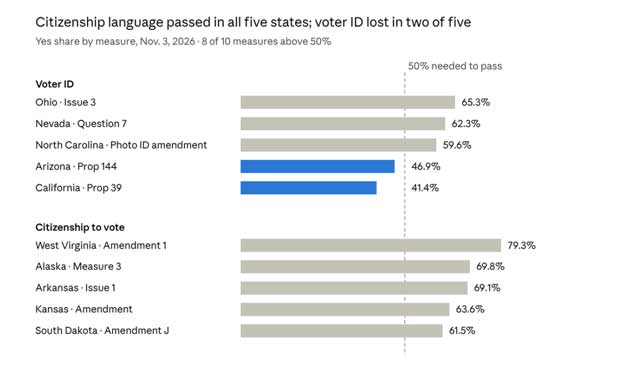
Sources: NBC News, AP, Decision Desk HQ, KTAR (Arizona). Unofficial counts as of Nov. 4–6, 2026.
Every measure has now been called or shown as decided by at least one major outlet.
| State | Measure | Status | Source |
| California | Prop 39 (voter ID) | Rejected; called by AP | ABC10, CBS LA |
| Arizona | Prop 144 (voter ID) | Rejected; called by AP Thursday, Nov. 5 | KJZZ, Votebeat |
| Ohio | Issue 3 (voter ID) | Passed; called by AP and DDHQ | FOX 8, DDHQ |
| Nevada | Question 7 (voter ID) | Passed, per NBC News | NBC News |
| North Carolina | Photo ID amendment | Passed, per NBC News | NBC News |
| West Virginia | Amendment 1 (citizenship) | Passed; called by AP | West Virginia Watch, News and Sentinel |
| Arkansas | Issue 1 (citizenship) | Passed; called by AP | Arkansas Advocate, Arkansas Democrat-Gazette |
| Alaska, Kansas, South Dakota | Citizenship measures | Passed, per NBC News | NBC News |
What Changes, and What Doesn’t
Nevada’s change is the largest of the three. The state has no photo ID rule today. Question 7 needed a second approval after passing with 73% in 2024, and voter ID would take effect for the 2028 elections, News 3 Las Vegas reported. Support fell about 11 points between the two votes.
In North Carolina and Ohio, day-to-day voting changes little. Both states already required ID by statute. The amendments move those rules into the constitution, so a future legislature cannot repeal them without another statewide vote. Ohio’s Issue 3 changes little today but makes ID rules harder to alter, Signal Ohio reported. Oklahoma’s August measure works the same way.
In California, nothing changes. The state does not require ID at the polls, and with Prop 39 rejected, the proposed changes will not take effect.
In Arizona, mail ballots will continue to be verified by signature. Prop 144 would have applied its mail-ballot ID rule starting with the 2028 presidential election, Votebeat reported.
The citizenship amendments have little immediate effect. Federal law already bars noncitizens from federal elections. The new language mainly prevents cities from allowing noncitizen voting in local races.
Analysis: Why Voters Split on ID
The simplest explanation is not mail ballots. Nevada and North Carolina both extended ID rules to mail voters, and both passed. California and Arizona would have done the same, and both lost.
Three differences stand out.
Codifying versus changing. Three of the four measures that passed this year, in Ohio, North Carolina and Oklahoma, wrote existing law into the constitution. Voters were asked to lock in a status quo. California and Arizona asked voters to change how they currently vote.
How much a state votes by mail. U.S. Sen. Mark Kelly, opposing Prop 144, said more than 80% of Arizonans vote by mail, per The Center Square. A new ID step on mail ballots touches most of that electorate. Opponents argued the measure did not say how early voters would provide proof.
Bundling and partisanship. Prop 144 combined voter ID with three unrelated election changes. Prop 39 drew $37 million in support from Republicans nationwide, and Democratic leaders campaigned against it as a bloc. Ohio ran the other way: Democratic gubernatorial candidate Amy Acton backed Issue 3, breaking from her party’s usual stance.
These are patterns, not proven causes. Exit polling on individual measures would be needed to test them.
The citizenship result needs less explaining. Supporters frame the language as confirming existing law. Opponents, including the ACLU of Kansas, argued the amendment could open the floodgates to problematic voting restrictions, such as a revived proof-of-citizenship rule. Neither argument moved enough voters to bring any of the five under 61%.
Conclusion
Voters in 2026 drew a clear line on who may vote and a less clear one on how they prove it. Citizenship language passed everywhere it appeared. Voter ID passed where it confirmed existing practice, or where voters had already approved it once. It failed in the two states where it would have changed how most people vote.
Official canvasses will finish later this month. Percentages may shift slightly; none of the outcomes is close enough to change.
Key Takeaways
- Voter ID passed in Ohio, Nevada and North Carolina, and in Oklahoma in August.
- California rejected Prop 39 and Arizona rejected Prop 144, both called by the AP.
- Citizenship-to-vote language passed in all five states, with support ranging from 61.5% to over 79%.
- Nevada is the only one of these states adding a new photo ID rule; it takes effect for 2028.
- North Carolina, Ohio and Oklahoma mostly moved existing law into their constitutions.
Sources
- NBC News: 2026 ballot measure results
- NBC News: Nevada ballot measures
- NBC News: North Carolina ballot measures
- NBC News: Ohio results
- Decision Desk HQ: Ohio Issue 3
- Ohio Secretary of State: Explanation of Issue 3
- Signal Ohio: Issue 3 win adds voter ID to state constitution
- Signal Ohio: Ballot language set for Issue 3
- FOX 8: Issue 3 passes in Ohio
- ABC10: Prop 39 fails, per AP
- CBS Los Angeles: California election live updates
- LAist: Prop 39 rejected
- NBC San Diego: California proposition results
- KJZZ: Arizona voters reject Prop 144
- KJZZ: Prop 144 early results
- Votebeat: Arizonans vote no on Prop 144
- KTAR: Arizona ballot measure results
- The Center Square via Yahoo: Arizona measures
- Ballotpedia: Nevada Question 7 (2026)
- Las Vegas Sun: Nevada ballot measures
- News 3 Las Vegas: Nevada ballot questions
- Ballotpedia: North Carolina voter ID amendment (2026)
- Oklahoma Voice: SQ 846 passes
- West Virginia Watch: Voters approve noncitizen voting amendment
- News and Sentinel: W.Va. voters support amendment
- Arkansas Advocate: Arkansans approve 3 of 4 ballot measures
- Arkansas Democrat-Gazette: Arkansas voters approve ballot measures
- Ballotpedia: Arkansas citizenship amendment
- Ballotpedia News: Kansas amendment and the 2024 measures
- HPPR: Why Kansas has a citizenship amendment