
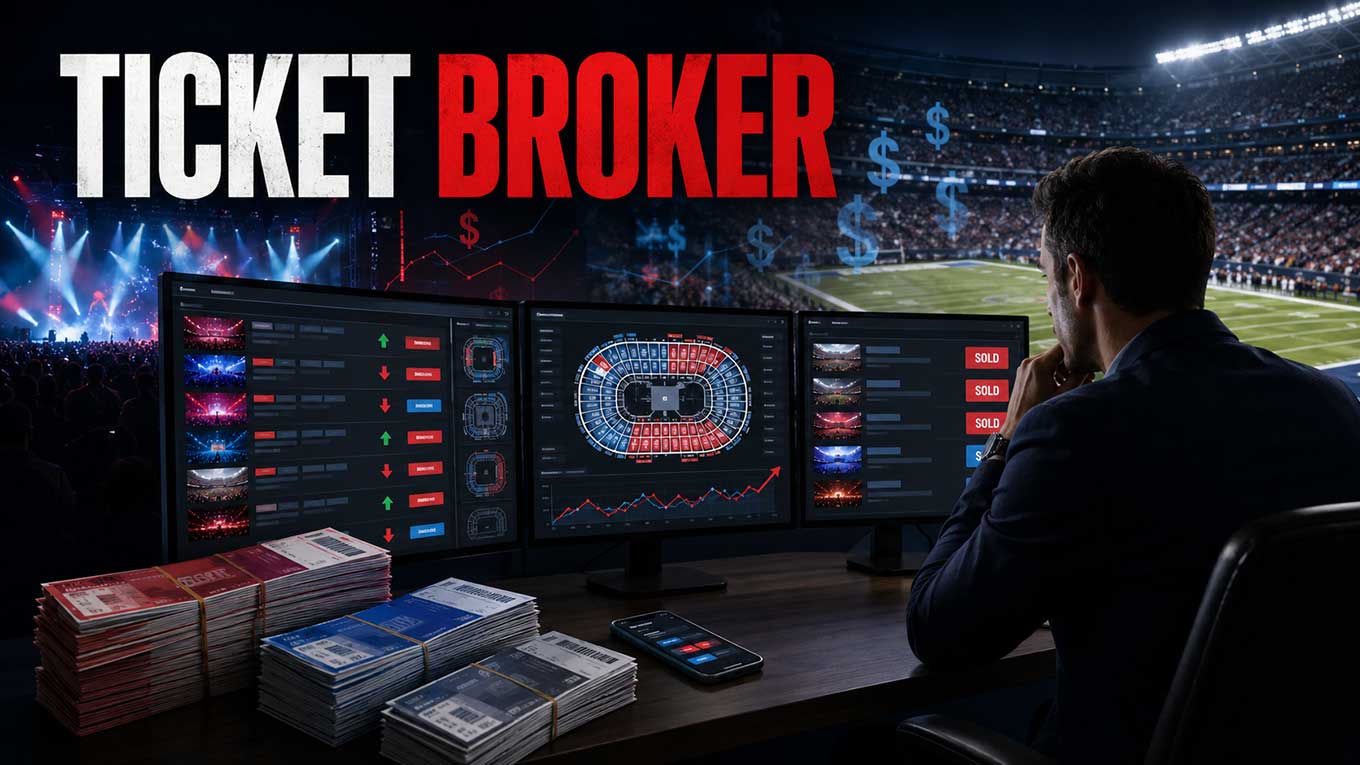
StubHub founder and chief executive Eric Baker is a part owner and managing partner of Andro Capital, an investment fund that operates as a professional ticket reseller and has sold tickets on StubHub since 2008, according to the company’s filings with the U.S. Securities and Exchange Commission.
The relationship, along with a separate arrangement in which StubHub refers sellers to an Andro affiliate for short-term financing, was surfaced in a CBC News investigation published July 10, 2026. StubHub does not dispute the underlying facts. A company spokesperson said the information had been fully disclosed in its public SEC filings and that it had nothing to add beyond what those filings contain. Baker and the company declined CBC’s repeated interview requests.
The disclosures land at an unusually difficult moment for StubHub, which went public in September 2025 and is now facing a state attorney general investigation, a proposed class-action lawsuit and a wave of consumer complaints tied to canceled FIFA World Cup tickets.
Background
Baker co-founded StubHub in 2000 as an online marketplace for secondary, or resale, tickets. He later founded the competing platform Viagogo in 2006, which bought StubHub back from eBay for roughly $4.05 billion in 2020. The combined company listed on the New York Stock Exchange on September 17, 2025, with Baker ringing the opening bell.
StubHub is the largest secondary ticketing marketplace in the world by transaction volume. The company facilitated approximately $9.2 billion in ticket sales in 2025.
In simple terms: the “secondary market” is where tickets are resold after their original sale. StubHub does not sell tickets itself — it operates the venue where other people sell them, and takes a fee on each transaction. That neutrality is the foundation of the company’s public identity.
StubHub has consistently marketed itself on that premise. The company told CBC it does not own, possess or sell tickets, describing itself as a technology platform connecting independent buyers and sellers, and drawing an explicit comparison to eBay.
What the Filings Actually Disclose
The SEC filings describe several distinct financial relationships between StubHub, its chief executive and professional resale operations.
Andro Capital. StubHub disclosed that Baker is the managing partner of Andro Capital, a professional ticket reseller that has sold tickets through the StubHub platform since 2008. StubHub has provided services to Andro, including managing its ticket inventory, listing tickets and fulfilling orders on its behalf.
The financial terms are itemized. StubHub earned roughly $100,000 in fees from Andro’s ticket sales in each of 2022 and 2023, and reported no such fees in 2024 or the first half of 2025. StubHub owed Andro $4 million in ticket proceeds and related costs at the end of 2022, and $100,000 at the end of 2024. Under a separate agreement covering tickets owned by a fund that Andro manages, StubHub paid Andro $1.6 million in 2023. The following year, StubHub agreed to cover certain costs Andro incurred for ticket-management services.
Colloquy Capital. In 2024, StubHub entered into an agreement with Colloquy Capital, an Andro affiliate, under which StubHub refers certain sellers to the firm for short-term financing. Those loans can be underwritten against a seller’s current proceeds or the revenue they expect to generate from future ticket sales on StubHub. StubHub then routes a portion of the seller’s proceeds directly to Colloquy to repay the loan.
That program has scaled quickly. By June 2025, Colloquy held claims on $4.8 million in seller proceeds, up from roughly $100,000 at the end of 2024. StubHub also has a separate agreement to sell and service tickets owned by Colloquy itself.
Who Actually Buys the Tickets
The disclosures matter because of a fact most ticket buyers do not know: the person selling them a seat is, in the overwhelming majority of cases, not a fan.
Industry estimates cited by CBC put mass resellers at 70 to 80 percent of sales on global ticket resale platforms. The scale of professional acquisition on the primary market is even more striking. Ticketmaster has estimated that bots purchase 60 percent of the most desirable tickets for some shows, and analysts have found that bot traffic can account for up to 90 percent of visitors to Ticketmaster’s site at a given moment.
Fans are competing for a small remainder to begin with. A landmark 2016 investigation by the New York Attorney General, titled “Obstructed View,” analyzed ticket allocation for top-grossing New York shows from 2012 to 2015 and found that only about 46 percent of tickets were ever reserved for the general public. The other 54 percent were split between industry holds (16 percent) and presales (38 percent).
What reaches the public is then absorbed at machine speed. The same investigation documented a single broker, Prestige Entertainment, using a bot to buy 1,012 tickets to a U2 show at Madison Square Garden within one minute of the sale opening. Another bought 520 tickets to a Beyoncé concert at Barclays Center in three minutes. The Attorney General’s office ultimately reached settlements with 15 firms involved in the illegal ticket trade, totaling $7.1 million.
Those tickets then reappear on the secondary market at a markup. The New York investigation found the brokers it studied resold at margins averaging 49 percent above face value, ranging from 15 percent to 118 percent, with isolated resales reaching 7,000 percent of face.
In simple terms: roughly half the tickets to a major show never reach the public at all. Of the half that does, professional operations using automated software take the best of what remains within seconds. By the time an ordinary fan reaches a resale site, they are usually buying from a business — and paying a markup for the privilege.
The Price Curve Since 2000
StubHub was founded in 2000. Over the quarter-century since, the cost of seeing live music has risen at roughly three times the rate of general inflation.
The New York Times has reported that the average concert ticket cost about $25 in 1996 — roughly $52 in today’s dollars — and reached about $130 by 2024. Pollstar, the live-industry trade publication that maintains the standard dataset, put the 2025 average for the Top 100 worldwide touring artists at $132.62, down slightly from a $135.92 peak in 2024. Stadium shows now average $216.13 per ticket, up 18.3 percent in a single year.
| Year | Avg. Ticket Price | Note |
| 1996 | ~$25 | Roughly $52 in today’s dollars (New York Times) |
| 2000 | ~$41 | StubHub founded. Prices had risen 57.8% since 1996 |
| 2010 | ~$62 | Up roughly 139% from 1996 |
| 2019 | $96.17 | Pollstar Top 100 worldwide touring artists |
| 2022 | $106.07 | First year the average crossed $100 |
| 2024 | $135.92 | Peak. Up 80.5% from 2021 alone |
| 2025 | $132.62 | Down 2.4% from peak; stadium avg. hit $216.13 |
Sources: Pollstar year-end business analyses; New York Times; Hypebot/Pollstar longitudinal study. Figures are nominal averages for major tours and are not adjusted for inflation except where noted.
The steepest climb has come recently. Prices rose 80.5 percent between 2021 and 2024 alone — roughly four times the rate of general inflation over the same period. For comparison, the U.S. consumer price index has risen approximately 93 percent since 1996, while top-tour ticket prices have risen more than 400 percent.
Causation is contested, and it would be wrong to lay this trajectory at the feet of any single company. Economists disagree over whether resale markets cause higher prices or simply reveal demand that was always there, and the primary market bears substantial responsibility of its own. In April 2026, a federal jury in New York found that Live Nation and Ticketmaster had operated an illegal monopoly in violation of federal and state antitrust law, in a case originally brought by the Department of Justice and a bipartisan coalition of state attorneys general. What is not in dispute is that the rise of large-scale, capitalized, technology-driven resale is contemporaneous with the price curve, and that the resale platforms earn a percentage of every dollar of it.
The Data Question the Filings Do Not Answer
The financial relationships are disclosed. What is not disclosed — and what neither the filings nor StubHub’s public statements address — is the question of information.
A ticket marketplace sits on an extraordinary dataset. It sees which events are heating up and which are cooling. It sees seat-level pricing across an entire venue, and how fast each section is clearing. It sees what buyers are searching for before they buy, and what sellers are asking before the market corrects them. It can see, in effect, the shape of demand before the market does.
StubHub does not treat this as incidental. In its S-1 registration statement, the company identifies “data intelligence” as one of the core assets it intends to extend into new categories of live events — language that appears in the filing’s description of its own competitive advantages.
That dataset is what makes the Andro disclosure structurally significant rather than merely awkward. A fund partly owned by the chief executive trades on a marketplace whose data the chief executive oversees. The filings describe StubHub providing that fund with inventory-management, listing and fulfillment services. Nothing in the public record describes an information barrier separating the platform’s data operations from the resale entity in which its CEO holds a stake.
Important: no regulator, litigant or news organization has alleged that Baker, Andro Capital or Colloquy Capital used non-public StubHub data to buy or price tickets. There is no evidence in the public record that they did. The point is narrower and, arguably, more serious: no rule appears to require that they could not.
This is where the gap with financial markets becomes instructive. A broker-dealer that trades for its own account while handling customer order flow operates under a dense body of law built specifically for this conflict — front-running prohibitions, information-barrier requirements, best-execution duties, and FINRA supervisory rules. Those regimes exist because regulators concluded, decades ago, that disclosure alone is not sufficient when one participant can see the order book and the others cannot.
Ticket marketplaces have no equivalent regime. There is no statute requiring a resale platform to wall off its pricing and demand data from an affiliated reseller. There is no rule prohibiting a platform insider from acting on information the platform generates. There is no disclosure obligation running to the fan at checkout.
In simple terms: if a stock exchange’s CEO also ran a hedge fund that traded on that exchange, the arrangement would trigger an entire architecture of regulatory supervision. On a ticket exchange, it triggers a footnote.
The World Cup Cancellations
The Andro disclosures surfaced against the backdrop of a separate and more immediate crisis.
Thousands of StubHub customers across North America have reported that World Cup tickets they purchased were canceled or never delivered, in some cases within hours of kickoff. On July 3, 2026, Texas Attorney General Ken Paxton opened a formal investigation into whether StubHub engaged in “ghost ticketing” — selling tickets that sellers never actually held. Paxton said his office would use every available tool to hold the company accountable if the allegations are borne out. British Columbia’s attorney general has opened a parallel probe.
A proposed class-action lawsuit filed in the Southern District of New York seeks at least $5 million in damages, alleging that StubHub misrepresented its authority to sell World Cup tickets to buyers who then traveled to matches only to find no tickets waiting for them.
StubHub has attributed the failures to ticket-transfer problems in FIFA’s electronic ticketing system and points to its FanProtect Guarantee, which promises replacement tickets or a full refund. FIFA has referred questions back to StubHub.
The speculative-ticket problem is not new, and the New York Attorney General flagged it a decade ago: brokers routinely sell tickets they do not yet possess, planning to acquire them later, using the buyer’s money to fund the purchase. When the acquisition fails, the buyer is the one holding nothing.
The Regulatory Frame
None of the arrangements described above is alleged to be illegal, and StubHub’s central defense is a disclosure defense: the relationships appear in filings the company was legally required to make. Related-party transactions are permitted under SEC rules provided they are disclosed, which is precisely what Item 404 of Regulation S-K exists to compel.
The legal exposure, if any, lies elsewhere. The Better Online Ticket Sales Act of 2016 — the BOTS Act — makes it unlawful to circumvent the security measures or purchase limits that ticket sellers use to control access to inventory, with enforcement by the Federal Trade Commission and state attorneys general.
Notably, the statute has begun to reach platforms and not only brokers. In September 2025, the FTC and the attorneys general of seven states sued Live Nation and Ticketmaster in the Central District of California, alleging among other things that the company deceived consumers about the enforcement of ticket purchase limits and facilitated the sale of tickets unlawfully acquired by ticket brokers, in violation of the BOTS Act and Section 5 of the FTC Act. That theory — platform liability for broker-acquired inventory — has no obvious stopping point at the primary market.
The FTC’s Rule on Unfair or Deceptive Fees — the junk fees rule, effective May 12, 2025 — governs how prices must be advertised. StubHub has already been caught by it. On April 9, 2026, the FTC announced a $10 million settlement resolving allegations that StubHub failed to clearly disclose mandatory fees upfront. The complaint covered a three-day window in May 2025, in the lead-up to the NFL schedule announcement. StubHub neither admitted nor denied the allegations, characterized the conduct as affecting a limited number of transactions, and said it strongly disagreed with the agency’s view of the case.
Impact
For investors, the disclosures compound an already poor record. StubHub shares debuted at $23.50 in September 2025 and had fallen to roughly $6.82 by mid-April 2026 — a decline of about 71 percent. The company reported fourth-quarter 2025 revenue of $449.2 million, down 15.8 percent year over year and below analyst expectations.
For regulators, the seller-financing program raises a structural question. When a marketplace helps underwrite the working capital that professional resellers use to acquire inventory, and collects fees when that inventory is resold, the platform’s revenue rises with the volume of professional resale activity on it — an incentive that sits uneasily alongside consumer-protection pressure to reduce exactly that activity.
For fans, the practical consequence is the one that started the story: the buyer who believes they are purchasing from someone with a scheduling conflict is, four times out of five, buying from a business. The filings establish that at least one of those businesses is partly owned by the man who runs the marketplace.
Analysis
StubHub’s response is narrow but not trivial. The company disclosed what securities law required it to disclose, in documents available to anyone who wanted to read them. Nothing was hidden in the technical sense, and the CBC investigation is built entirely from StubHub’s own filings.
The gap is between legal disclosure and practical awareness. A related-party footnote in an S-1 registration statement is not a consumer-facing communication. The buyer purchasing a $200 concert ticket is reading the checkout page, not Item 404. StubHub’s marketing describes a fan-to-fan marketplace; its filings describe a platform financially entangled with the professional resellers who dominate it. Both statements can be true at once, and that is the substance of the criticism.
The harder question is whether disclosure is a sufficient remedy for a conflict of this shape, or whether it merely documents one. Securities law protects investors from being misled about a company’s financial relationships. It was never designed to protect ticket buyers from misunderstanding who is on the other side of the trade — or from a counterparty who may be able to see more of the market than they can. No federal rule requires a resale platform to tell a fan at the point of sale whether the seller is a person or a fund, and none governs what the platform’s own insiders may do with the data the platform collects.
That regulatory vacuum, rather than any single transaction in the filings, is what this episode exposes.
Questions StubHub Has Not Answered
StubHub declined CBC’s repeated interview requests and said it had nothing to add beyond what appears in its public SEC filings. The following questions are not answered in those filings.
On the company’s own description of itself
StubHub says it “does not own, possess, or sell tickets” and compares itself to eBay. Yet the filings describe agreements under which StubHub sells and services tickets owned by a fund Andro manages, and tickets owned by Colloquy Capital. How does the company reconcile the public statement with the disclosed agreements?
On information barriers
Does StubHub maintain any information barrier between its platform data — seat-level pricing, sell-through velocity, search and demand signals, unsold inventory — and Andro Capital or Colloquy Capital? If so, when was it established, and who supervises it?
Do Andro or Colloquy have access to any StubHub data not available to an ordinary seller on the platform?
The filings state that StubHub has managed Andro’s ticket inventory, listed its tickets and fulfilled its orders. Which StubHub personnel performed that work, and did they simultaneously have visibility into competing listings from individual sellers?
On governance
Does Baker recuse himself from company decisions that could affect Andro or Colloquy? Has the board adopted a formal recusal or conflicts policy covering the relationship, and does an independent committee review it?
Fee income from Andro’s ticket sales was reported at roughly $100,000 in 2022 and 2023, then zero in 2024 and the first half of 2025. What changed?
On the composition of the marketplace
What share of StubHub’s $9.2 billion in 2025 ticket volume came from professional resellers, as opposed to individual fans? The company markets a fan-to-fan marketplace but has never disclosed the split.
How many sellers have received financing referred to Colloquy, and on what terms and rates?
On the World Cup failures
Does the Colloquy financing program lend against tickets a seller does not yet possess — that is, speculative inventory? The filings state that loans can be underwritten against revenue a seller expects to generate from future sales.
Did Andro, Colloquy, or any Colloquy-financed seller list World Cup tickets on StubHub? Were any of the canceled or undelivered orders theirs?
NexfinityNews has sought comment from StubHub. This section will be updated if the company responds.
Conclusion
StubHub is now defending itself on three fronts: an FTC settlement over fee disclosure, a multi-jurisdiction investigation into undelivered World Cup tickets, and revelations — drawn from its own SEC filings — that its chief executive holds a stake in a fund that resells tickets on the platform he runs.
The company’s position is that all of this was public. The reporting confirms that it was. Whether public and understood are the same thing is the question now in front of regulators, litigants and the fans buying tickets.
Key Takeaways
- SEC filings identify StubHub CEO Eric Baker as a part owner and managing partner of Andro Capital, a fund that has resold tickets on StubHub since 2008.
- StubHub has provided inventory-management, listing and fulfillment services to Andro, and paid the fund $1.6 million in 2023 under a ticket-servicing agreement.
- Since 2024, StubHub has referred sellers to Colloquy Capital — an Andro affiliate — for short-term financing repaid directly out of seller proceeds. Colloquy’s claims on those proceeds grew from about $100,000 in late 2024 to $4.8 million by June 2025.
- Mass resellers account for an estimated 70 to 80 percent of sales on global resale platforms. Ticketmaster has estimated bots take 60 percent of the most desirable tickets for some shows, and only about 46 percent of tickets to top shows are reserved for the public in the first place.
- Average top-tour ticket prices have risen from roughly $25 in 1996 to $132.62 in 2025 — more than 400 percent, against roughly 93 percent general inflation. Prices rose 80.5 percent between 2021 and 2024 alone.
- No rule requires a ticket marketplace to wall off its pricing, demand and seat-level data from an affiliated reseller — a conflict that in securities markets would trigger front-running and information-barrier regulation. No party has alleged such data was misused here.
- StubHub says the arrangements were fully disclosed in public SEC filings and declined further comment. The relationships are not alleged to be illegal.
- StubHub shares are down roughly 71 percent from their September 2025 IPO price. The company facilitated $9.2 billion in ticket sales in 2025.
Sources
Gizmodo — “StubHub Founder Has Ties to Major Scalpers on the Platform” (July 10, 2026)
StubHub Holdings, Inc. — Form S-1 Registration Statement, U.S. Securities and Exchange Commission
Pollstar — 2025 Year-End Business Analysis (average ticket price data)
Hypebot — “Concert ticket prices increased 80.5% in 3 years, 4X inflation” (July 14, 2025)
FTC — Better Online Ticket Sales (BOTS) Act of 2016
Live Nation Entertainment — Form 10-Q (Sept. 30, 2025), disclosing the FTC/state BOTS Act complaint
CBC News — “Soccer fans file class-action lawsuit against StubHub over cancelled World Cup tickets”
Editor’s note: The financial relationships described in this article were disclosed by StubHub in mandatory SEC filings and are not alleged to violate any law. No party has alleged that StubHub, Eric Baker, Andro Capital or Colloquy Capital used non-public platform data in connection with ticket purchases or pricing; this article raises the absence of any rule governing such use, not an allegation that it occurred. StubHub and Eric Baker declined interview requests from CBC News.