
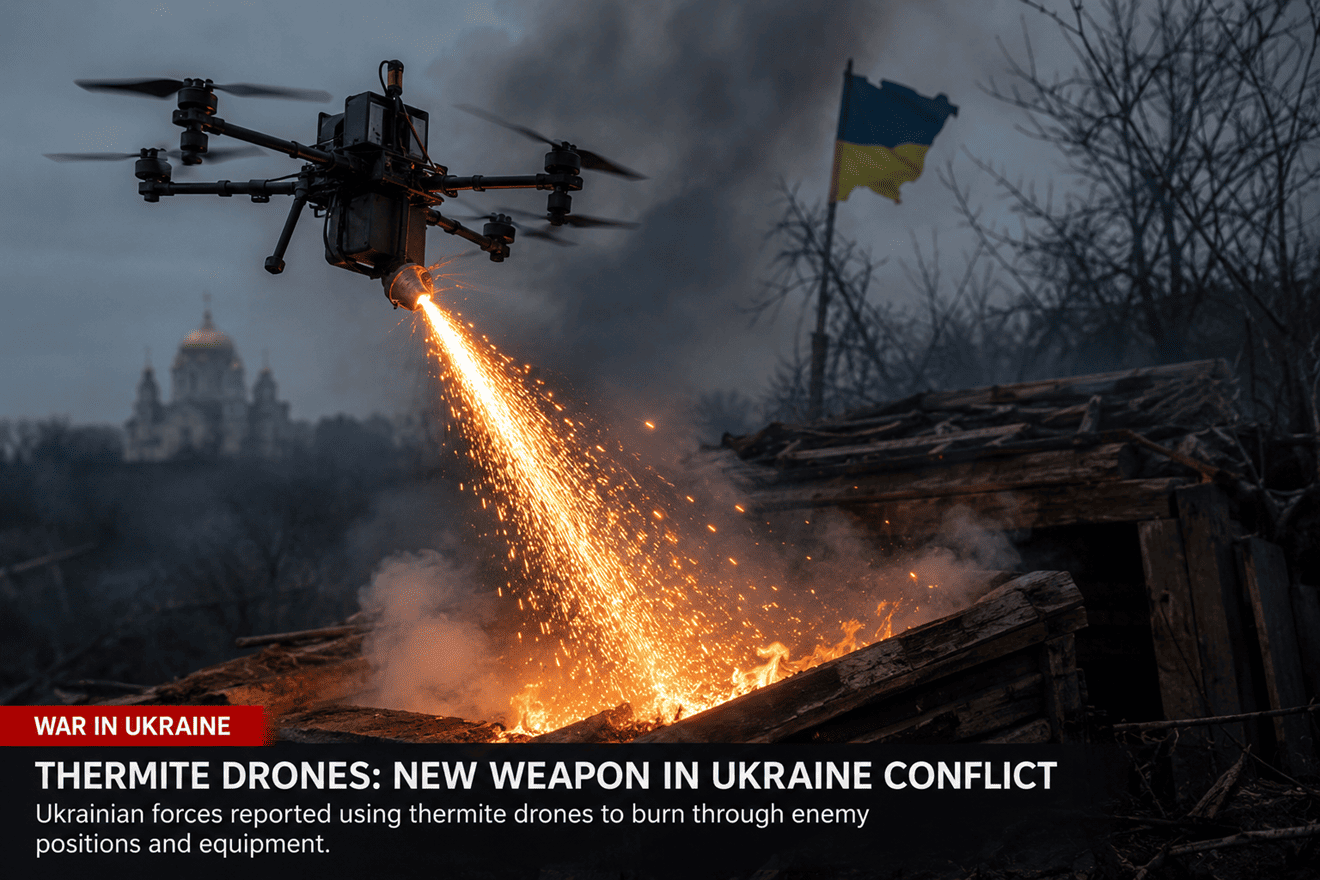
Picture a trench somewhere along the eastern front in Ukraine. It’s dark, it’s cold, and the soldiers in it have done everything right dug in deep, parked under tree cover, stayed quiet. For most of military history, that would have been enough to stay hidden for a night. Then a faint buzzing drifts in overhead, and a small quadcopter tips forward and rains down a stream of molten, white-hot metal that burns at temperatures hot enough to melt an engine block.
That’s a “dragon drone,” and it’s become one of the most talked-about and unsettling images of a war that has quietly turned into the world’s largest live laboratory for unmanned warfare. But the dragon drone is really just the dramatic tip of a much bigger story: small, cheap drones have stopped being a novelty and become the single deadliest thing on the modern battlefield.
The number that should stop you cold
Let’s start with the statistic that sums up the whole shift. According to reporting from Reuters and NPR earlier this year, by some estimates more than 80% of casualties in the Ukraine war are now caused by drones. Not artillery. Not tanks. Not rifles. Drones.
Sit with that for a second, because it overturns roughly a century of assumptions. Artillery earned the nickname “the king of battle” for good reason it was the dominant killer of the 20th century. In Ukraine, a swarm of buzzing machines, many of them costing a few hundred to a few thousand dollars, has taken the crown.
The growth curve is just as startling. One analysis from the Center for Civilians in Conflict found that drone attacks in conflict zones jumped from roughly 4,525 in 2023 to 19,704 in 2024 more than a fourfold increase in a single year, and a roughly 4,000% rise since 2020. On the offensive side, Ukrainian officials reported their drones struck close to 100,000 Russian troops in just the final three months of 2025, with more than 106,000 targets hit in December alone.
In simple terms: Wars used to be won by whoever had the biggest guns and the most of them. Increasingly, they’re shaped by whoever has the most small, smart, expendable robots and the factories to keep churning them out.
So what makes a “dragon drone” different?
Most attack drones in Ukraine fall into two buckets: small FPV (first-person-view) drones that a pilot flies straight into a target like a guided missile, and larger loitering munitions the Iranian-designed Shahed being the famous example that fly long distances and crash into things. Both blow up on impact.
Dragon drones do something else entirely. Instead of exploding, they dispense thermite a burning mixture that pours down like a firehose of sparks. Ukrainian units began showing off the tactic in the autumn of 2024, and the footage went viral precisely because it looks like something out of a fantasy film: a glowing orange waterfall of fire sweeping along a tree line.
The chemistry is almost mundane. Thermite is essentially a blend of aluminum powder and iron oxide the same basic reaction used in industry to weld railway tracks together. Once ignited, it burns at around 2,448°C (about 4,440°F), hot enough to torch vegetation, set trees alight, and burn through metal. CNN-cited analysts noted the thermite can be dropped directly through a vehicle hatch, where the heat ignites everything inside.
In simple terms: It’s less a bomb and more a controllable rain of fire. The drone doesn’t need a direct hit it just needs to be overhead and pour.
Why fire, when explosives are easier?
Here’s the part that reveals how clever and how grim modern drone warfare has become. Thermite is genuinely useful for two specific jobs.
First, it strips away cover. A huge amount of the Ukraine war is fought from positions hidden under trees and brush, exactly because drones are watching from above. Burn the foliage away, and the soldiers underneath suddenly have nowhere to hide from the next strike. The dragon drone isn’t always the killer sometimes it just removes the roof so something else can finish the job.
Second, and bluntly, it terrifies people. Defense analyst and former British Army officer Nicholas Drummond told CNN that the main effect of these weapons is psychological more than physical, calling it “very nasty stuff” and a niche capability rather than a war-winning mainstream weapon. Ukraine’s own 60th Mechanized Brigade leaned into the imagery, nicknaming one of its systems “Vidar” after the Norse god of vengeance and boasting that the enemy “will never sleep again.”
That second point matters for keeping perspective. For all the dramatic video, multiple analysts including Axios’s defense coverage caution that dragon drones are unlikely to swing the war on their own. Their numbers are limited and their role is specialized. The ordinary FPV drone, produced by the millions, is still doing the overwhelming bulk of the damage.
This isn’t one-sided and it isn’t new
It’s tempting to frame thermite drones as a Ukrainian invention, but Russia has fielded its own versions, and thermite itself has an ugly, long pedigree. Russia reportedly used thermite-based incendiaries in Syria in 2012 and in the brutal fight for Bakhmut in 2023. The dragon drone is a new delivery method for a very old idea the same way napalm and white phosphorus haunted earlier wars.
That history is exactly why incendiary weapons sit in a sensitive legal gray zone, which brings us to the part most viral videos skip over.
The law is watching and it’s complicated
Incendiary weapons are regulated under Protocol III of the 1980 Convention on Certain Conventional Weapons (CCW), which entered into force in 1983. In plain language, it restricts air-delivered incendiary weapons against military targets located among civilians and is designed to limit the horrific burn injuries these weapons cause.
Legal scholars at the Lieber Institute at West Point have noted that dragon drones, like any weapon, also have to comply with the broader laws of armed conflict the rules on distinction (hitting military, not civilian, targets) and proportionality. The UN Office for Disarmament Affairs warns that incendiaries are effectively “area weapons” because the fires they start are hard to predict and contain. Human-rights groups have criticized both sides over civilian risk.
In simple terms: There are rules for this. The trouble is that a $1,000 drone built from commercial parts can be in the air long before any treaty body has a chance to weigh in and the technology is moving far faster than the law governing it.
The bigger picture: a permanent change in how wars are fought
Step back from the thermite, and the dragon drone is best understood as a symptom of a deeper transformation. A few shifts are now hard to ignore:
- The “kill zone” has expanded dramatically. Ukrainian commanders told Reuters that open-field maneuver is effectively impossible tanks hide, and evacuating a wounded soldier can take days because anything that moves can be spotted and struck from above.
- Cost has flipped the math of war. A cheap drone can destroy a multi-million-dollar tank. That asymmetry rewards mass production over expensive prestige hardware, and it’s pushing every modern military to rethink procurement.
- Robots go first. Facing a manpower disadvantage, Ukraine has openly embraced the slogan that “robots and drones go into battle first,” even using ground drones to resupply and evacuate the wounded.
- Medicine is adapting too. Because drones now cause such a large share of injuries and make rescue so dangerous battlefield medicine itself is being rewritten, a shift the U.S. military is studying closely.
None of this stays confined to Eastern Europe. Defense planners in Washington, Beijing, Brussels and beyond are treating Ukraine as a preview of the next war, not a one-off. The lessons about cheap mass, about counter-drone defenses, about how quickly a hobbyist technology becomes a weapon are being absorbed everywhere at once.
The bottom line
Dragon drones make for unforgettable footage, and it’s worth being honest about why: fire is primal, and a machine that pours it from the sky is genuinely frightening. But the thermite is the spectacle, not the substance. The real revolution is the boring-looking quadcopter cheap, expendable, produced by the millions that has quietly become the deadliest weapon on the modern battlefield.
Traditional warfare assumed that mass, armor, and firepower lived with whoever could afford the most expensive machines. Ukraine has shown that a war can increasingly be shaped by whoever can build the cheapest ones the fastest. That’s the change that will outlast this conflict long after the dragon drone footage stops trending.
Key takeaways
- Drones now account for an estimated 80%+ of casualties in the Ukraine war, displacing artillery as the dominant killer.
- “Dragon drones” dispense thermite an aluminum/iron-oxide mix burning at roughly 2,448°C rather than exploding.
- Their main value is stripping away natural cover and inflicting psychological terror; analysts call them a niche capability, not a war-winner.
- Both Ukraine and Russia use thermite; incendiary weapons are regulated under Protocol III of the 1980 CCW.
- The lasting shift isn’t the fire it’s the rise of cheap, mass-produced drones reshaping the cost, tactics, and medicine of war worldwide.
Related from NexfinityNews
Placeholder links replace each slug with the live permalink before publishing.
‘#250for250’: Profiling 250 Exceptional Living Veterans Ahead of America’s 250th
Inside the U.S. Battery-Storage Buildout: Why Grid Resilience Is the Next Defense Frontier
Chatrie v. United States: The Supreme Court Geofence Case That Could Redraw Digital Privacy
Ibogaine and the Executive Order: A New Front in Veteran Mental-Health Treatment
Sources
NPR / Reuters “Drones are changing the face of warfare, including battlefield medicine” (May 2026)
UNITED24 Media Ukraine’s drones hit ~100,000 Russian troops in late 2025 (Jan 2026)
CNN via Ukranews Ukraine’s “dragon drones” with thermite (Sept 2024)
Lieber Institute, West Point “Dragon Drones and the Law of Armed Conflict” (Oct 2024)
Axios “Ukraine war: dragon drones, thermite” (Sept 2024)
Euromaidan Press / Reuters How Ukraine’s war transformed in 4 years (Feb 2026)