
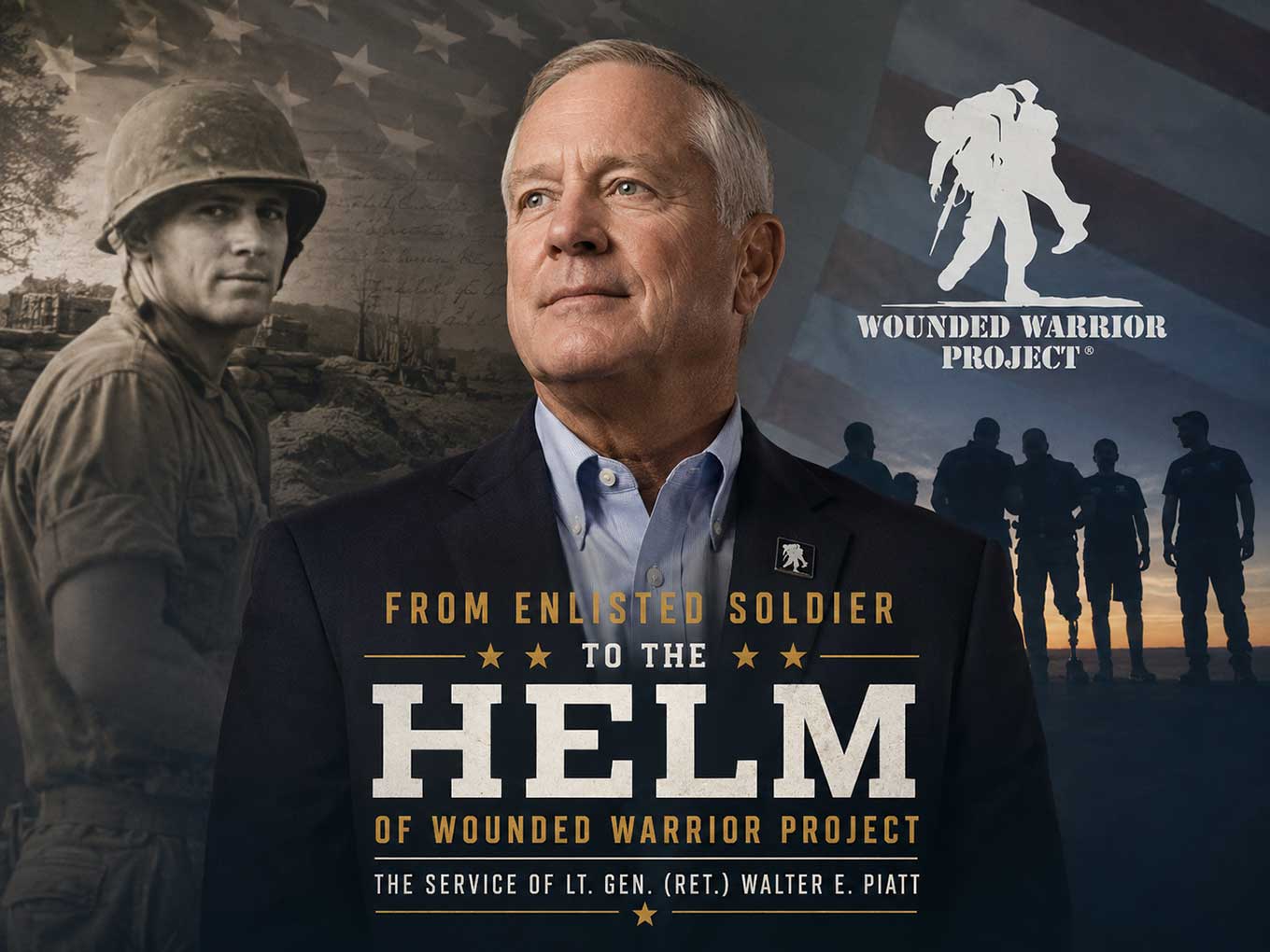
JACKSONVILLE, Fla. — When Lt. Gen. (Ret.) Walter E. Piatt became chief executive officer of Wounded Warrior Project (WWP) on March 18, 2024, he capped a 42-year Army career that began not at a service academy but with a high school senior’s decision to enlist. That arc, from a western Pennsylvania steel town to the top of one of the nation’s largest veterans charities, frames a leadership story the organization is betting can carry it into its next decade.
This profile is part of #250for250, a NexfinityNews series marking America’s 250th anniversary in 2026 by recognizing 250 veterans and the leaders who serve them — Americans whose commitment to country did not end when they left the uniform. Lt. Gen. Piatt is honored for carrying that ethic from a high-school enlistment to the leadership of one of the nation’s largest organizations for wounded veterans.
An Enlisted Beginning
Piatt enlisted in the U.S. Army at 17, while still a senior in high school, on the advice of his father, a steel-mill worker. He served four years in the infantry with the 82nd and 101st Airborne Divisions, rising to sergeant before leaving active duty to attend Lock Haven University of Pennsylvania, where he earned a degree in biology.
That path is notable. Unlike many three-star generals, Piatt is not a West Point graduate. He returned to the Army as a commissioned officer and spent the next four decades in uniform. In simple terms, he rose from the lowest enlisted ranks to one of the service’s most senior leadership tiers, a trajectory that is uncommon at the general-officer level.
Four Decades in Uniform
Over a 42-year career, Piatt held a series of senior command and staff positions. From 2017 to 2019 he served as commanding general at Fort Drum, New York, home of the 10th Mountain Division, overseeing roughly 20,000 soldiers and a surrounding military and civilian community of more than 40,000 people.
In 2019 he became Director of the Army Staff at Army headquarters in Washington, a role in which he supervised more than 6,000 personnel and helped manage an annual budget exceeding $180 billion. During that tenure he played a central role in the Army’s response to the COVID-19 pandemic and in the 2021 resettlement of more than 80,000 displaced Afghan nationals following the U.S. withdrawal from Afghanistan.
He also built a public profile outside conventional command, becoming an early advocate for mindfulness practices in the military and publishing two volumes of poetry drawn from his deployments to Afghanistan.
Taking the Helm at WWP
Piatt succeeded Lt. Gen. (Ret.) Michael Linnington, who led WWP from 2016 to 2024 before departing to head the USO. Founded in 2003 and headquartered in Jacksonville, Florida, WWP is among the largest U.S. veterans service organizations. It reported approximately $385 million in revenue for fiscal year 2024, according to its IRS filings, and says it serves more than 270,000 wounded veterans, caregivers, and family members.
The organization focuses on post-9/11 veterans living with physical and psychological injuries, offering mental-health programming, financial-wellness services, career counseling, and connection events at no cost to participants.
A Leadership Philosophy Built on Connection
Piatt has framed his approach around meeting veterans “where they are” and addressing the isolation many feel after leaving the military. He has emphasized mental-health access, family support, and direct advocacy that brings veterans’ voices to lawmakers.
The need is substantial. Veteran-advocacy organizations estimate that more than half of U.S. veterans are not connected to the Department of Veterans Affairs or any veterans service organization, a gap that WWP’s programs are designed to close. In simple terms, many veterans who could qualify for support never enroll, and reaching them is a central challenge.
Analysis: A Veteran Leading Veterans
Piatt’s appointment continues a pattern at major veterans organizations of selecting senior retired officers with combat and institutional experience. Supporters argue that a leader who has commanded soldiers in Iraq and Afghanistan brings credibility with the population WWP serves and an understanding of the bureaucratic systems veterans must navigate.
The challenge is scale and trust. WWP weathered a significant reputational crisis in 2016 over its spending practices, and its recovery under Linnington left Piatt with both a rebuilt institution and an expectation of continued discipline. His public emphasis on transparency and measurable program impact suggests an awareness of that history.
Conclusion
More than two years into his tenure, Piatt has positioned WWP around a long-term vision he describes as spanning the organization’s next 30 years. Whether that vision succeeds will depend in large part on the same connection problem he repeatedly identifies: reaching the veterans who have not yet asked for help.
Key Takeaways
- Lt. Gen. (Ret.) Walter E. Piatt became CEO of Wounded Warrior Project on March 18, 2024, succeeding Lt. Gen. (Ret.) Michael Linnington.
- Piatt enlisted at 17 and rose from the enlisted ranks; he is not a West Point graduate, an uncommon path among three-star generals.
- His 42-year Army career included command at Fort Drum and service as Director of the Army Staff, helping oversee a budget exceeding $180 billion.
- WWP reported roughly $385 million in FY2024 revenue and says it serves more than 270,000 warriors and family members.
- Piatt’s leadership emphasizes mental health, family support, and closing the gap of veterans not connected to support services.
Sources
- Wounded Warrior Project — Walter E. Piatt leadership bio: https://www.woundedwarriorproject.org/mission/leadership/walter-piatt
- Wounded Warrior Project Newsroom — Helping Warriors Find Hope and Purpose: https://newsroom.woundedwarriorproject.org/Helping-Warriors-Find-Hope-and-Purpose-Meet-Wounded-Warrior-Project-CEO-Walter-E-Piatt
- ProPublica Nonprofit Explorer — Wounded Warrior Project Inc.: https://projects.propublica.org/nonprofits/organizations/202370934
- Wounded Warrior Project FY2024 Annual Report: https://www.woundedwarriorproject.org/mission/financials/annual-report