
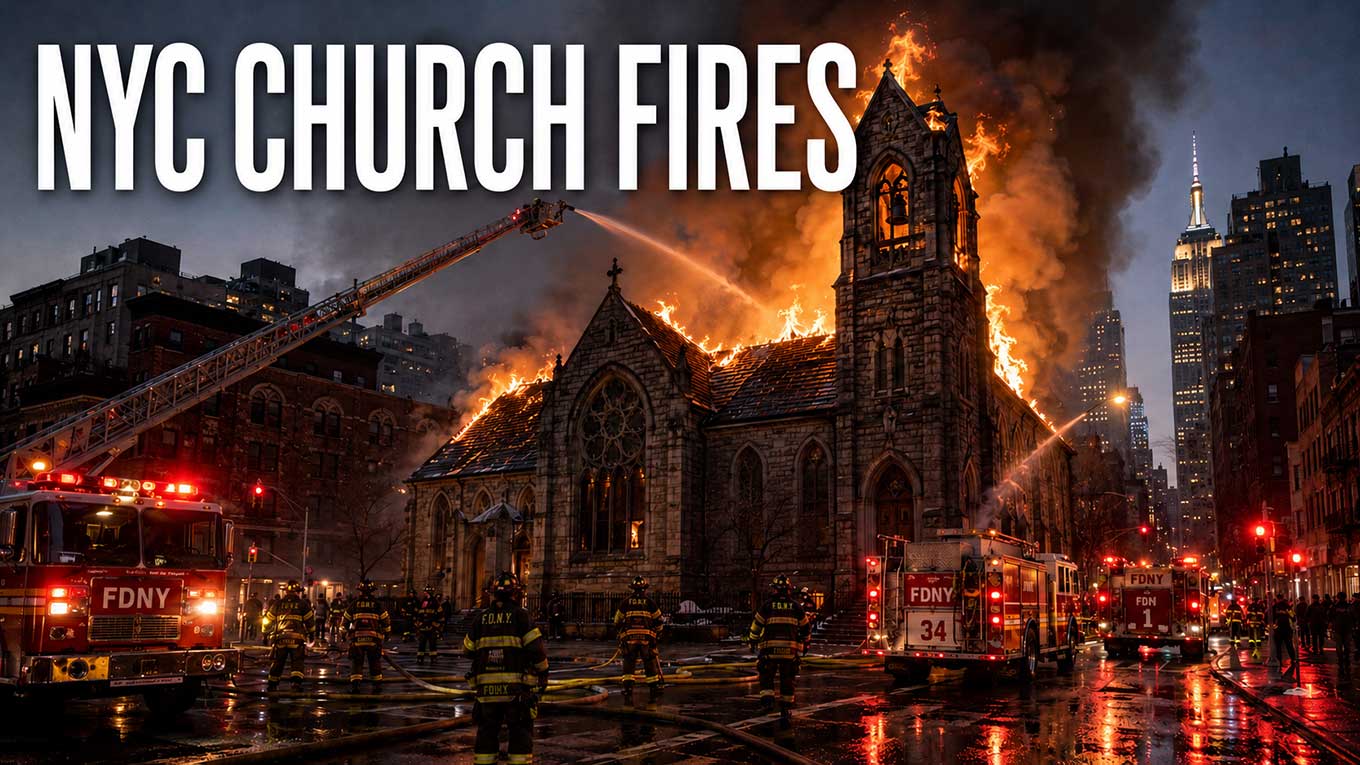
There is a fire spreading through New York City’s houses of worship, and most of the country has not noticed.
On the night of July 9, a man walked up to Iglesia Bautista El Mesias on 75th Street in Queens, stood on the sidewalk outside the church fence, lit a Molotov cocktail, and hurled it at the front doors. Surveillance cameras caught the fireball erupting against the building. Minutes later, the same pattern repeated at a Kingdom Hall of Jehovah’s Witnesses a few blocks away on 78th Street. Two houses of worship, two firebombs, one night. Police later tied the suspect to a third blaze nearby. A 36-year-old man was arrested, and reports indicate he had been picked up and released over armed threats earlier in the summer.
Three weeks before that, on June 19, the historic South Bushwick Reform Church in Brooklyn — a landmark built in 1863 — was consumed by flames. On July 13, the FDNY confirmed what the congregation feared: the fire was deliberately set. The 173-year-old structure is a total loss. Its pastor, James E. Steward II, put words to the grief plainly: “Now we understand it is intentional, which brings another layer of grief.”
Firebombings. Arson. Landmark churches reduced to ash. And yet if you were not scrolling local New York headlines at exactly the right moment, you could be forgiven for not knowing any of it happened.
That silence is the story.
The response we know we’re capable of
To be clear about what this piece is and is not arguing: antisemitism in America is real, it is rising, and it deserves every ounce of the attention it receives. Jewish communities have watched vandalism, threats, and violence climb, and no one who cares about religious freedom should want that scrutiny to shrink.
We know exactly what a serious response looks like, because we have seen it. When an arsonist set fire to Beth Israel Congregation in Jackson, Mississippi, the state’s largest and oldest synagogue, this past January, the story went national within a day. The FBI moved in and publicly named an antisemitic motive. NPR, ProPublica, and every major network covered it. Officials condemned it in the strongest terms, and the country was told — correctly — that an assault on one house of worship is an assault on all of them.
That is exactly how it should work. That is the model.
So let us face the reality the headlines keep dancing around: if the buildings firebombed in Queens on July 9 had been temples or synagogues, we would not be talking about media silence — we would be talking about a national emergency. There would be political outrage by morning. There would be press conferences, task forces, and a chorus of leaders demanding answers. And they would be right to demand them. The uncomfortable question is why that same machinery of alarm does not turn over when the doors set on fire belong to a Spanish-language Baptist congregation or a Kingdom Hall.
Two fires, two very different afterlives
Consider how differently these stories travel. A slur painted on a synagogue becomes a national conversation within a day, as it should. But two churches firebombed in a single night in America’s largest city stays a local crime story, filed under “vandalism,” discussed for a news cycle and then gone. There are no cable panels, no statements from national figures, no sustained demand for answers. The congregations grieve quietly and start fundraising to rebuild, and the rest of the country moves on before it ever really arrived.
This is not a call to dial down the outrage over antisemitism. It is a call to notice that the outrage exists — that we are fully capable of treating an attack on a house of worship as the emergency it is — and to ask why that capacity switches off depending on which faith is under the flame.
Part of it is a discomfort with the framing. Attacks on Christians in America cut against a familiar narrative in which Christianity is the majority culture and therefore assumed to be powerful, safe, unthreatened. That assumption may hold in the abstract, but it does nothing for a small immigrant Baptist congregation in Queens watching flames lick at their doors, or for a Brooklyn parish standing in the rubble of a sanctuary their great-grandparents helped build. A worshipper does not feel like a member of a dominant majority when someone is trying to burn down the place they pray.
Part of it, too, is that these attacks resist a tidy political label. The Queens suspect targeted a Spanish-language Baptist church and a Kingdom Hall — two very different communities. That messiness makes the incidents hard to slot into any pre-written script, and stories that cannot be slotted tend to get dropped. It is worth noting this comes at a moment when New York’s politics are being reshaped around exactly these questions of which grievances command attention and which do not.
A principle that belongs to everyone
But a firebomb does not care about our narratives. It burns a food pantry that fed the neighborhood. It burns the room where a community held funerals and weddings and Sunday mornings for a century and a half. It burns the sense of safety that every congregation, of every faith, is supposed to be able to take for granted when they gather to pray.
The principle that should unite us is simple and it is old: no one should have to fear for their life because of where they choose to worship. That principle does not belong to one faith. It protects the synagogue and the mosque and the temple and the church equally, or it protects none of them honestly. When we defend it loudly for some communities and quietly for others, we are not really defending the principle at all — we are just defending the communities we have decided are worth the noise.
New York’s churches are burning. The people inside them are Americans, immigrants, believers, neighbors. They deserve more than a paragraph in the metro section and a shrug. They deserve the same alarm, the same outrage, and the same insistence on answers that we rightly summon when any house of God is attacked.
The fires are real. The only question is whether the rest of us will keep pretending not to see the smoke.