
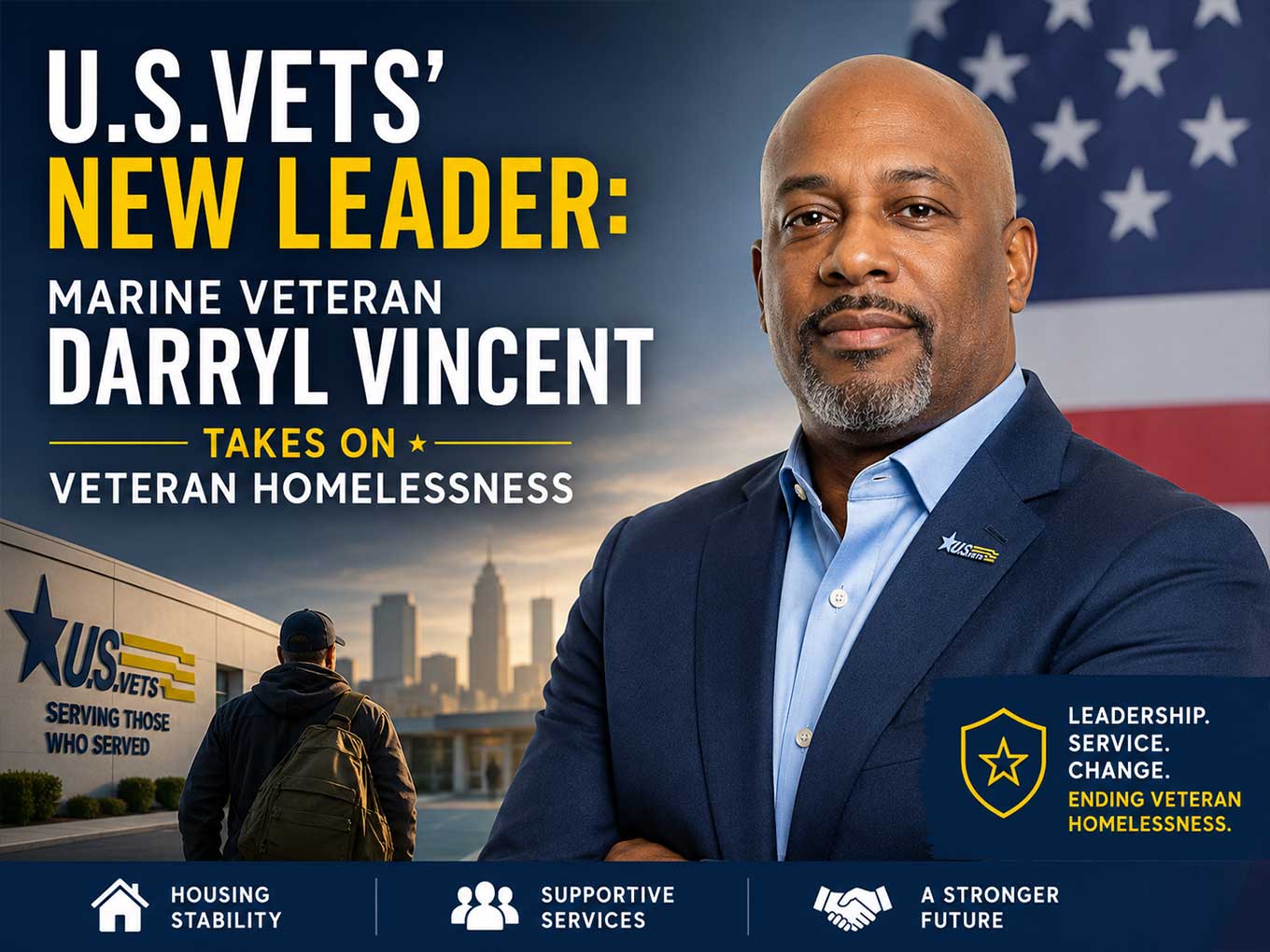
LOS ANGELES — On January 1, 2025, Darryl J. Vincent became president and chief executive officer of U.S.VETS, the nation’s largest nonprofit dedicated to preventing and ending veteran homelessness, after more than two decades climbing the organization’s ranks.
This profile is part of #250for250, a NexfinityNews series marking America’s 250th anniversary in 2026 by recognizing 250 veterans and the leaders who serve them — Americans whose commitment to country did not end when they left the uniform. Vincent is honored for two decades of work to ensure that those who served the country do not end up without a home.
Two Decades at U.S.VETS
A U.S. Marine Corps veteran, Vincent joined U.S.VETS in 2003. He was instrumental in building the organization’s presence in Hawai’i, leading the expansion at Barber’s Point and opening a site in Wai’anae — work that earned him recognition including the Honolulu Star-Bulletin’s “10 Who Made a Difference in Hawaii” and an “Unsung Hero” award from the National Coalition for Homeless Veterans.
He became chief operating officer in 2012, then president and COO in 2024, before succeeding longtime chief executive Stephen Peck. Vincent also serves on the Department of Veterans Affairs Secretary’s Advisory Committee on Homeless Veterans.
The Mission
U.S.VETS reaches more than 12,000 veterans a year, providing affordable housing, mental-health treatment, employment services, and food security across sites nationwide. The organization operates what it calls therapeutic communities — residential settings designed to stabilize veterans and move them toward independent living. In simple terms, it combines a roof over a veteran’s head with the clinical and social support needed to keep them housed.
With roughly 380 employees and locations stretching from Hawai’i and California to Texas, Arizona, and Washington, D.C., U.S.VETS is among the largest organizations of its kind. Its work spans prevention and intervention: keeping at-risk veterans from falling into homelessness, and helping those already on the street find a path back to stability. As CEO, Vincent has prioritized expanding clinical and higher-acuity services, peer support, and programs for an aging veteran population.
A View of the Crisis
Vincent frames veteran homelessness not as an isolated problem but as a healthcare and social-equity issue affecting the whole country. “Serving this country should not be a reason to become homeless,” he has said, arguing that ending the crisis requires partnerships across government and the private sector.
Although the number of homeless veterans nationally has fallen substantially over the past 15 years, the problem has proven stubborn, complicated by housing costs, mental-health needs, and substance use. Vincent has argued that the country cannot claim to support veterans while tolerating the social inequities that leave some of them without homes — a stance that has shaped his approach to both program design and advocacy.
Analysis
Vincent’s elevation reflects U.S.VETS’ confidence in internal continuity. Rather than recruiting an outside executive, the board promoted a leader who had spent more than 20 years building the organization’s programs from the field level up. His operational background positions him to scale services at a moment when veteran homelessness, though reduced from its peak, remains a persistent national challenge.
Conclusion
From a Marine to a frontline program builder to chief executive, Vincent now leads the largest organized effort in the country to ensure that those who served do not end up without a home — a mission he describes as both a duty and a measure of the nation’s values.
Key Takeaways
- Darryl J. Vincent became president and CEO of U.S.VETS on January 1, 2025, succeeding Stephen Peck.
- A Marine Corps veteran, he joined U.S.VETS in 2003 and served as COO from 2012 and president and COO from 2024.
- He helped build U.S.VETS’ Hawai’i operations, including the Barber’s Point expansion and the Wai’anae site.
- U.S.VETS is the nation’s largest nonprofit fighting veteran homelessness, reaching more than 12,000 veterans a year.
- Vincent frames veteran homelessness as a healthcare and social-equity issue requiring cross-sector partnerships.
Sources
- U.S.VETS — Our Leaders: https://usvets.org/about-us/our-leaders/
- EIN Presswire — Darryl Vincent Becomes President and CEO of U.S.VETS: https://www.einpresswire.com/article/785198435/longtime-u-s-vets-leader-u-s-marine-darryl-vincent-becomes-president-and-ceo
- California Association of Veteran Service Agencies — Peck retirement, Vincent succession: https://californiaveterans.org/longtime-u-s-vets-ceo-and-marine-veteran-steve-peck-announces-retirement-at-end-of-2024/