
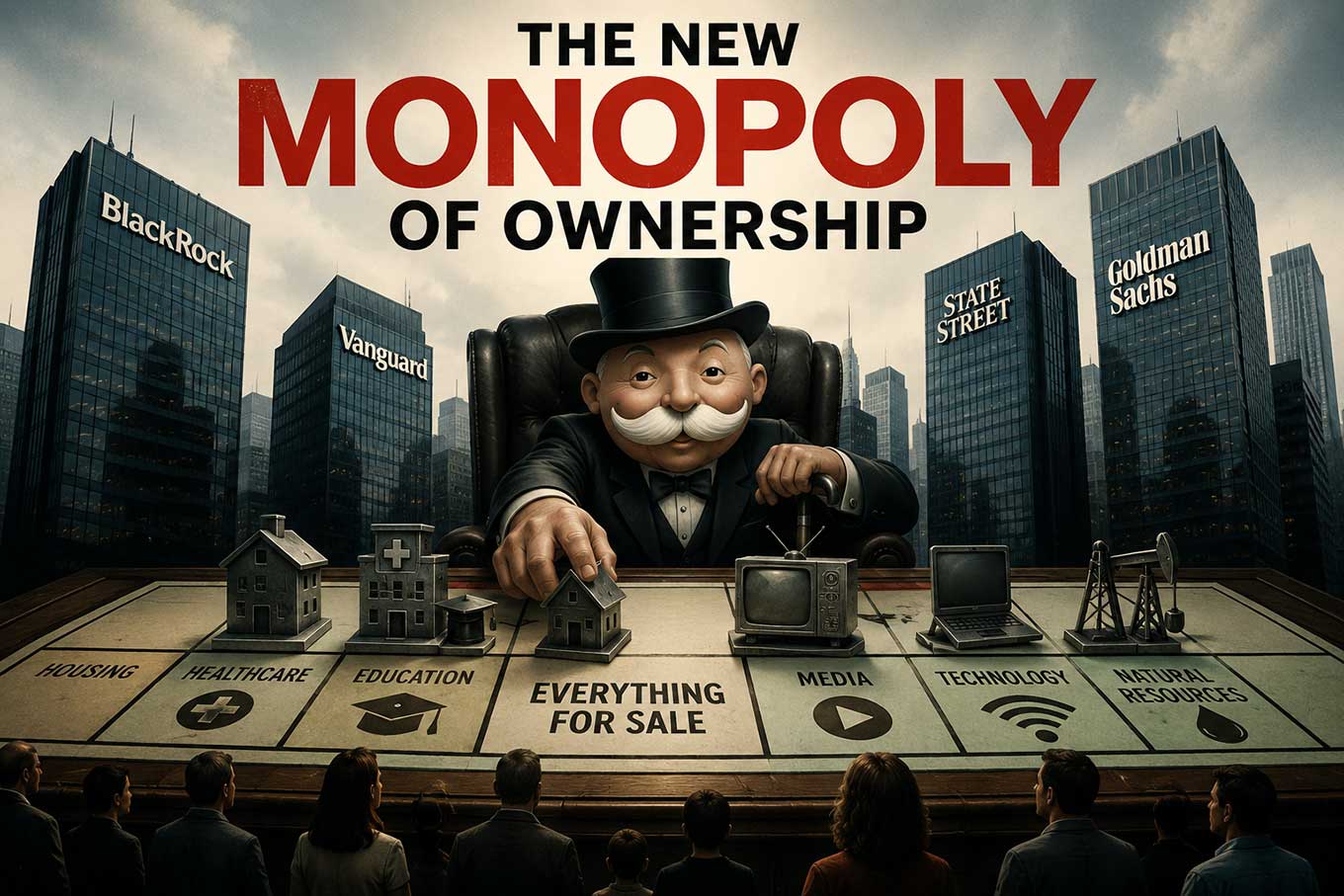
A decades-old assumption underlies American antitrust law: that competing companies are run by rivals with opposing interests. A growing body of legal and economic scholarship—and now a federal lawsuit proceeding in Texas—is testing whether that assumption still holds when the same small group of asset managers ranks among the largest shareholders of nearly every major firm in an industry.
At issue is a theory known as “common ownership,” which asks whether large, diversified investors that hold stakes in competing companies weaken the incentive for those companies to compete. The question has moved from academic journals into a courtroom, where the U.S. Department of Justice and Federal Trade Commission have signaled a willingness to apply existing antitrust statutes to institutional shareholders.
Background
Traditional monopoly analysis focuses on market structure. A monopoly, in the classic sense, exists when a single company controls enough of a market’s supply to raise prices above competitive levels. Antitrust statutes—chiefly the Sherman Act of 1890 and the Clayton Act of 1914—were written to catch firms that dominate a market, or that merge or conspire to restrain trade.
Common ownership describes a different arrangement. Rather than one firm dominating, several nominally independent competitors share the same major shareholders. The pattern has grown alongside the rise of passive index funds, which by design hold every company in a given index, including direct competitors.
Three firms—BlackRock, Vanguard, and State Street, often called the “Big Three”—sit at the center of the debate. Studies have found the three, taken together, are the largest shareholder in roughly 88 percent of S&P 500 companies, and collectively cast about one-quarter of the votes at those companies’ shareholder meetings.
In simple terms: when a single fund family owns a large slice of every airline, bank, or producer in a sector at once, it has little financial reason to want any one of them to start a price war with the others.
The Legal Question
The central issue is whether common ownership can violate existing law. Harvard Law professor Einer Elhauge has argued that it can, pointing to Section 7 of the Clayton Act, which prohibits stock acquisitions whose effect “may be substantially to lessen competition.” The statute, he notes, does not require the acquiring party to be a competitor—only that the acquisition harm competition.
The economic mechanism was popularized by a 2018 study by economists José Azar, Martin Schmalz, and Isabel Tecu, published in the Journal of Finance, which associated common ownership among U.S. airlines with higher ticket prices. Related research examined banking fees.
Critics dispute both the mechanism and the evidence. They argue that index funds hold competing shares automatically rather than by design, and that passive investors lack both the incentive and the means to orchestrate reduced competition across thousands of companies. The methodology of the airline study has also been challenged by other economists.
In simple terms: researchers broadly agree that diversified owners benefit when competition softens, but disagree over whether—and how—the funds actually cause it.
A Test Case in Texas
The theory is now being tested in Texas et al. v. BlackRock. In November 2024, Texas Attorney General Ken Paxton, later joined by additional Republican-led states, sued BlackRock, Vanguard, and State Street. The complaint alleges the firms used their collective shareholdings in competing coal producers—reported at between 24 and 34 percent across seven of the largest U.S. coal companies—to pressure those producers to reduce output, raising energy prices.
The states cite the firms’ participation in climate initiatives, including the Net Zero Asset Managers Initiative and Climate Action 100+, as evidence of coordination. The asset managers counter that they are passive investors who exercise no control over the coal companies, and warn that the states’ theory would imply asset managers harm competition across every sector of the economy.
In May 2025, the DOJ and FTC filed a joint statement of interest—their first formal position in federal court on the antitrust implications of common shareholdings—arguing that institutional investors can be held liable under Section 7 of the Clayton Act when they use holdings in competitors toward anticompetitive ends. On Aug. 1, 2025, a federal judge in the Eastern District of Texas largely denied the firms’ motions to dismiss, allowing the case to proceed to discovery.
Sectors Where the Question Arises
Coal is the subject of the current lawsuit, but the academic debate has ranged across much of the economy. Common ownership tends to draw scrutiny in industries that are already concentrated—where a handful of large firms compete and the same institutional investors rank among the top shareholders of each. Researchers caution that evidence of actual harm is strongest in a few studied sectors and remains contested elsewhere.
The share of institutional investors simultaneously holding at least 5 percent of two or more competing U.S. public firms in the same industry rose from under 10 percent in 1980 to roughly 60 percent in 2014, according to one widely cited estimate. Sectors that have drawn the most research attention include:
- Airlines. The most-studied case. The 2018 Azar-Schmalz-Tecu paper linked overlapping ownership among carriers such as American, Delta, United, and Southwest to higher fares on some routes. Subsequent studies reached mixed conclusions.
- Banking. A follow-up study by Azar, Sahil Raina, and Schmalz associated common ownership among retail banks with higher account fees and lower deposit rates. Major lenders including JPMorgan Chase, Bank of America, and Wells Fargo share the same top institutional holders.
- Consumer packaged goods. Economists at New York University’s Stern School examined the ready-to-eat cereal market—where General Mills, Kellanova (formerly Kellogg), and Post compete—as a testing ground for the theory. The rivalry between Coca-Cola and PepsiCo, both S&P 500 members with the same largest shareholders, is a frequently cited illustration.
- Pharmaceuticals. Research has examined whether common ownership discourages aggressive market entry by generic-drug makers, which would otherwise tend to lower prices.
- Retail pharmacy. Chains such as CVS and Walgreens, which dominate the sector, share overlapping institutional ownership.
- Technology. Apple, Microsoft, and Alphabet count the same asset managers among their largest shareholders, though direct evidence of competitive harm in tech is less developed than in airlines or banking.
Critics stress that finding overlapping ownership in a sector is not the same as proving reduced competition. A comprehensive 2020 study reported little robust evidence of anticompetitive effects once other factors—such as firms’ differing responses to the 2008 financial crisis—were taken into account.
Why It Matters
The dispute carries implications well beyond coal. The Big Three collectively manage more than $26 trillion in assets and, by some measures, are the largest single shareholder in roughly 40 percent of all publicly listed U.S. companies. A ruling that common ownership can violate antitrust law could reshape how index funds are structured and how they exercise their voting rights.
Legal scholars at Columbia University have written that the case brings the common ownership theory before a judge for the first time and could carry consequences across the financial sector.
Any change would also touch ordinary investors. The same low-cost index funds at the center of the debate hold the retirement savings of millions of Americans through 401(k) and individual retirement accounts.
Analysis
Observers describe a tension between two legitimate goals. On one side is the concern that antitrust law, built for an economy of independent operating companies, was not designed to address the concentration of shareholdings in a few large asset managers. On the other is the concern that aggressive enforcement could disrupt the passive-investing model that has lowered costs for retail savers.
Proposed remedies vary. Elhauge favors enforcing the existing Clayton Act against horizontal shareholding. Economists including Eric Posner, Fiona Scott Morton, and Glen Weyl have proposed limiting institutional investors to either a large stake in one firm per concentrated industry, or small diversified stakes across many firms—but not large stakes in all major rivals at once.
Most proposals stop short of redefining “monopoly” itself. Analysts note that monopoly refers specifically to single-seller dominance, while common ownership more closely resembles a mechanism for coordinated behavior among nominally separate firms. The reform debate therefore centers on ownership rules rather than on the monopoly definition.
Conclusion
Whether common ownership violates antitrust law remains unsettled. The Texas case has cleared its first major procedural hurdle but has not been decided on the merits, and the underlying theory has never been tested at trial. Its outcome may determine whether the largest asset managers face new limits on how they hold and vote shares in competing companies—and whether the century-old framework of American antitrust law adapts to a market dominated by a small number of diversified owners.
Key Takeaways
- Common ownership refers to a few large investors holding stakes in competing companies, potentially weakening competition without any single firm dominating a market.
- The “Big Three”—BlackRock, Vanguard, and State Street—are the largest shareholder in roughly 88 percent of S&P 500 companies.
- A federal lawsuit, Texas v. BlackRock, is testing the theory in court for the first time; a judge allowed it to proceed in August 2025.
- The DOJ and FTC have stated that asset managers can be liable under Section 7 of the Clayton Act for anticompetitive use of common shareholdings.
- Most reform proposals target ownership rules rather than redefining “monopoly” itself.
SOURCES
Fichtner, Heemskerk & Garcia-Bernardo, “Hidden Power of the Big Three,” Business and Politics (2017).
Azar, Schmalz & Tecu, “Anticompetitive Effects of Common Ownership,” Journal of Finance (2018).
Azar, Raina & Schmalz, “Ultimate Ownership and Bank Competition,” Financial Management (2022).
Backus, Conlon & Sinkinson, “Common Ownership in America: 1980–2017,” NBER (2019).
Dennis, Gerardi & Schenone, “Common Ownership Does Not Have Anticompetitive Effects in the Airline Industry,” Journal of Finance (2022).
Einer Elhauge, “Horizontal Shareholding,” Harvard Law Review (2016).
Bebchuk & Hirst, “The Specter of the Giant Three,” National Bureau of Economic Research (2019).
U.S. Department of Justice & Federal Trade Commission, Statement of Interest, Texas et al. v. BlackRock (May 2025).
U.S. District Court for the Eastern District of Texas, ruling on motions to dismiss (August 2025).
Hearn & Hanawalt, Columbia University, “Texas v. BlackRock Puts the Common Ownership Theory on Trial” (2025).