
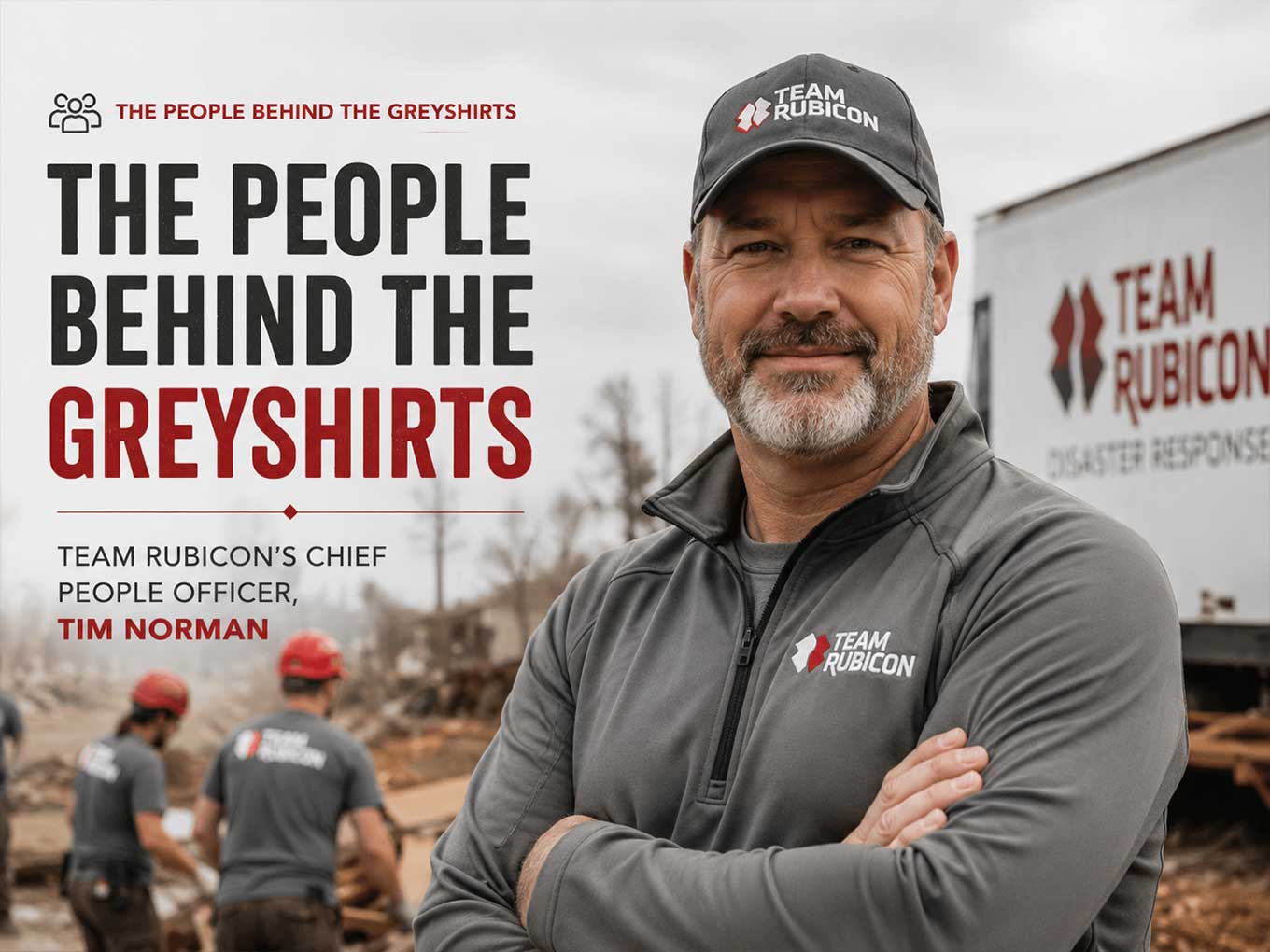
LOS ANGELES — Tim Norman, a U.S. Army veteran of the Desert Storm era, serves as chief people officer of Team Rubicon, the human-resources lead for an organization built on a workforce of more than 180,000 volunteers.
This profile is part of #250for250, a NexfinityNews series marking America’s 250th anniversary in 2026 by recognizing 250 veterans and the leaders who serve them — Americans whose commitment to country did not end when they left the uniform. Norman is honored for sustaining the people and volunteers who give veterans renewed purpose through continued service.
An Army Veteran’s Foundation
Norman served in the U.S. Army as part of F Company, 51st Infantry, a Long Range Surveillance Unit (LRSU), during Operation Desert Storm. In simple terms, long-range surveillance units are small reconnaissance teams trained to operate deep in unfamiliar territory and report on what they observe — a discipline built on trust, preparation, and tight-knit teamwork. Team Rubicon describes Norman’s dedication to service as evident both in his human-resources work and in his broader involvement across nonprofit organizations.
The Workforce Challenge
Team Rubicon presents an unusual human-resources problem. The organization employs a relatively small professional staff but mobilizes a volunteer force of more than 180,000 — the Greyshirts who deploy to disaster zones. As chief people officer, Norman is responsible for the systems that recruit, support, and retain both populations, aligning the expectations of paid employees and unpaid volunteers around a single mission.
That dual structure makes culture, not just compensation, the central lever of people management. Team Rubicon leans on guiding principles such as “Built to Serve” and “Mission First, Greyshirts Always,” phrases meant to keep both staff and volunteers oriented toward the communities they serve rather than toward internal process.
Built to Serve
For Norman, Team Rubicon frames the role as a continuation of military service by other means: the conviction that the most fulfilling use of one’s professional time is in service of others. That ethos shapes how the organization treats its people, from how it onboards volunteers to how it supports staff who themselves are often veterans carrying their own post-service transitions.
Team Rubicon also treats its own ranks as part of its mission. Many of its staff and volunteers are veterans, and the organization presents continued service as a pathway to the sense of purpose and community that can fade after leaving the military. Managing that promise — ensuring people find meaning, not merely assignments — sits at the heart of the people function Norman leads.
What Team Rubicon Does
Founded in 2010 by U.S. Marines Jake Wood and William McNulty in response to the Haiti earthquake, Team Rubicon mobilizes military veterans, first responders, and civilians to help communities prepare for, respond to, and recover from disasters and humanitarian crises. Headquartered in Los Angeles, it has grown into one of the most recognizable veteran-led humanitarian organizations in the United States.
Analysis
In a mission-driven, volunteer-heavy organization, the people function is not a back-office afterthought but a core operational capability. The ability to surge tens of thousands of volunteers to a disaster, and to sustain a professional staff that supports them, depends on the unglamorous work of recruitment, training, and retention. A veteran in that seat brings firsthand understanding of what draws former service members to keep serving.
Conclusion
Norman’s work is largely invisible to the communities Team Rubicon serves, but it is foundational to the organization’s reach. Behind every Greyshirt deployed to a flood or a wildfire is a people system designed to get them there — and to bring them back ready to serve again.
Key Takeaways
- Tim Norman serves as chief people officer of Team Rubicon, leading its human-resources function.
- He is a U.S. Army veteran who served with F Company, 51st Infantry, a Long Range Surveillance Unit, during Desert Storm.
- Team Rubicon pairs a small professional staff with a volunteer force of more than 180,000 Greyshirts, an unusual HR structure.
- The organization’s culture is anchored in principles such as “Built to Serve” and “Mission First, Greyshirts Always.”
- Team Rubicon was founded in 2010 by Marines Jake Wood and William McNulty for veteran-led disaster response.
Sources
- Team Rubicon — Leadership and Board: https://teamrubiconusa.org/about-us/leadership-and-board/
- Team Rubicon — Press Center (leadership profiles): https://teamrubiconusa.org/about-us/press-center/
- Wikipedia — Team Rubicon: https://en.wikipedia.org/wiki/Team_Rubicon