
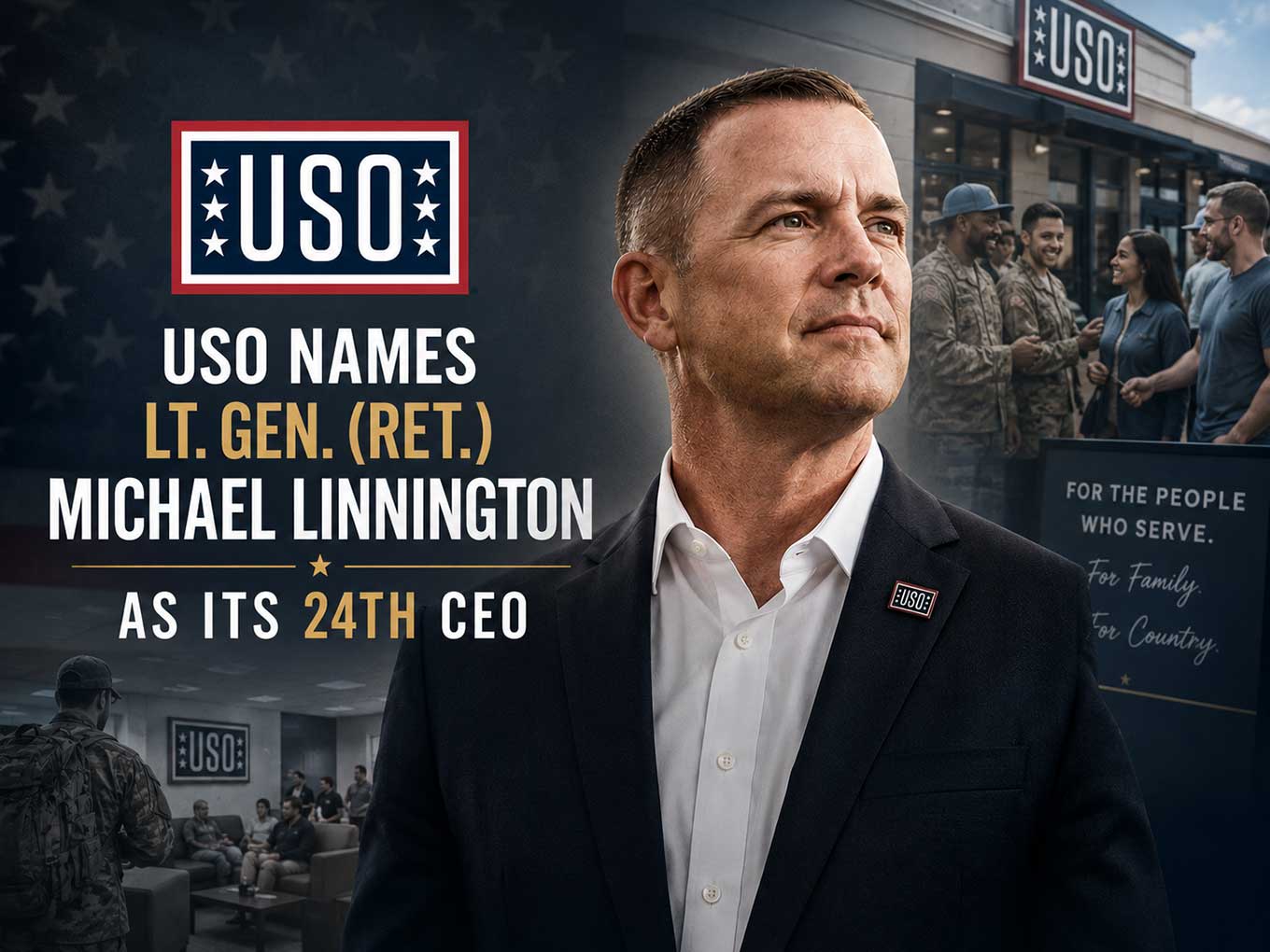
ARLINGTON, Va. — The USO, the 84-year-old nonprofit that has supported American troops since World War II, has a new leader with a deep resume in both military command and veterans philanthropy. In August 2025 the organization announced that retired Army Lt. Gen. Michael Linnington would become its 24th chief executive officer, effective October 20, 2025.
This profile is part of #250for250, a NexfinityNews series marking America’s 250th anniversary in 2026 by recognizing 250 veterans and the leaders who serve them — Americans whose commitment to country did not end when they left the uniform. Lt. Gen. Linnington is honored for a second act of service — leading the USO after a 35-year Army career and his turnaround of Wounded Warrior Project.
The Appointment
Linnington succeeds J.D. Crouch II, who stepped down after 11 years leading the organization. USO Board Chair retired Air Force Gen. David Goldfein, a former Chief of Staff of the Air Force, said the board had conducted an extensive search for a leader who could honor the organization’s legacy while positioning it for the future, adding that “Mike Linnington is exactly the leader our organization needs for this next chapter.”
A Familiar Mission
For Linnington, the USO role extends a second career in service to the military community. After 35 years in the Army, including brigade command in the 101st Airborne Division in Iraq and Afghanistan, a tour as Commandant of Cadets at West Point, and command of the Military District of Washington, he served as the first civilian director of the Defense POW/MIA Accounting Agency.
He then spent 2016 to 2024 as CEO of Wounded Warrior Project, where he is credited with steering the charity through a post-controversy recovery and expanding its programs. In simple terms, he arrives at the USO having already run one of the country’s largest veterans nonprofits.
What the USO Does
Founded in 1941, the USO operates more than 250 locations worldwide, providing services that range from airport lounges and care packages to entertainment tours and programs supporting military families and service members transitioning to civilian life. Unlike organizations focused on wounded or post-service veterans, the USO’s mission centers on active-duty personnel and their families throughout a service member’s career.
The organization traces its roots to the eve of U.S. entry into World War II and became known over the following decades for its entertainment tours, which historically featured performers such as Bob Hope and continue today with celebrity visits to deployed units. The USO operates largely through volunteers and private donations rather than government appropriations, a model that has sustained it across more than eight decades of American conflicts and peacetime deployments.
Crouch’s tenure was defined in part by a major structural reform: the consolidation of 19 independent USO chapters into a single unified organization, a change the board credited with strengthening the nonprofit’s national footprint.
The Road Ahead
Linnington inherits an organization that, unlike the WWP he joined in 2016, is not in crisis. His challenge is different: sustaining and modernizing a legacy institution rather than rescuing a troubled one. He has spoken throughout his career about meeting the evolving needs of the military community, and the leadership transition comes as the USO continues adapting its services to a smaller, more globally dispersed force.
Like many legacy nonprofits, the USO also faces the task of staying relevant to a younger generation of service members and donors. Fundraising for active-duty support can be less visible than appeals tied to wounded or homeless veterans, and the organization competes for attention in a crowded field of military charities. Linnington’s experience rebuilding donor confidence at WWP may prove directly applicable to that work.
Analysis
The appointment reflects a now-common practice among large military-support nonprofits: recruiting senior retired officers whose command experience and standing within the armed forces lend credibility with donors and beneficiaries alike. Linnington’s particular profile is rare. He is one of the few leaders to have run two major veterans organizations consecutively, giving the USO board a candidate with both military and nonprofit-executive track records.
Conclusion
As the USO approaches its 85th year, Linnington’s selection signals continuity of mission paired with experienced leadership. Whether he can carry the institution’s wartime-born mandate into a new era will help define the next chapter of one of America’s most recognizable service organizations.
Key Takeaways
- The USO named retired Army Lt. Gen. Michael Linnington its 24th CEO, effective October 20, 2025.
- He succeeds J.D. Crouch II, who led the USO for 11 years and consolidated 19 chapters into one organization.
- Linnington brings 35 years of Army service, leadership of the Defense POW/MIA Accounting Agency, and eight years as CEO of Wounded Warrior Project.
- Founded in 1941, the USO operates more than 250 locations worldwide supporting active-duty service members and their families.
- USO Board Chair Gen. (Ret.) David Goldfein cited Linnington’s record of service and leadership in announcing the appointment.
Sources
- GlobeNewswire — The USO Appoints Lt. Gen. (Ret.) Michael Linnington as New CEO: https://www.globenewswire.com/news-release/2025/08/15/3134213/0/en/The-USO-Appoints-Lieutenant-General-retired-Michael-Linnington-as-New-Chief-Executive-Officer-to-Lead-Its-Next-Chapter-of-Service-and-Innovation.html
- United Service Organizations — Lt. Gen. (Ret.) Michael Linnington bio: https://www.uso.org/about/lt-gen-ret-michael-linnington
- West Point Association of Graduates — USO Names LTG Michael Linnington as CEO: https://www.westpointaog.org/news/uso-appoints-ltg-r-linnington-80-as-new-chief-executive-officer/