
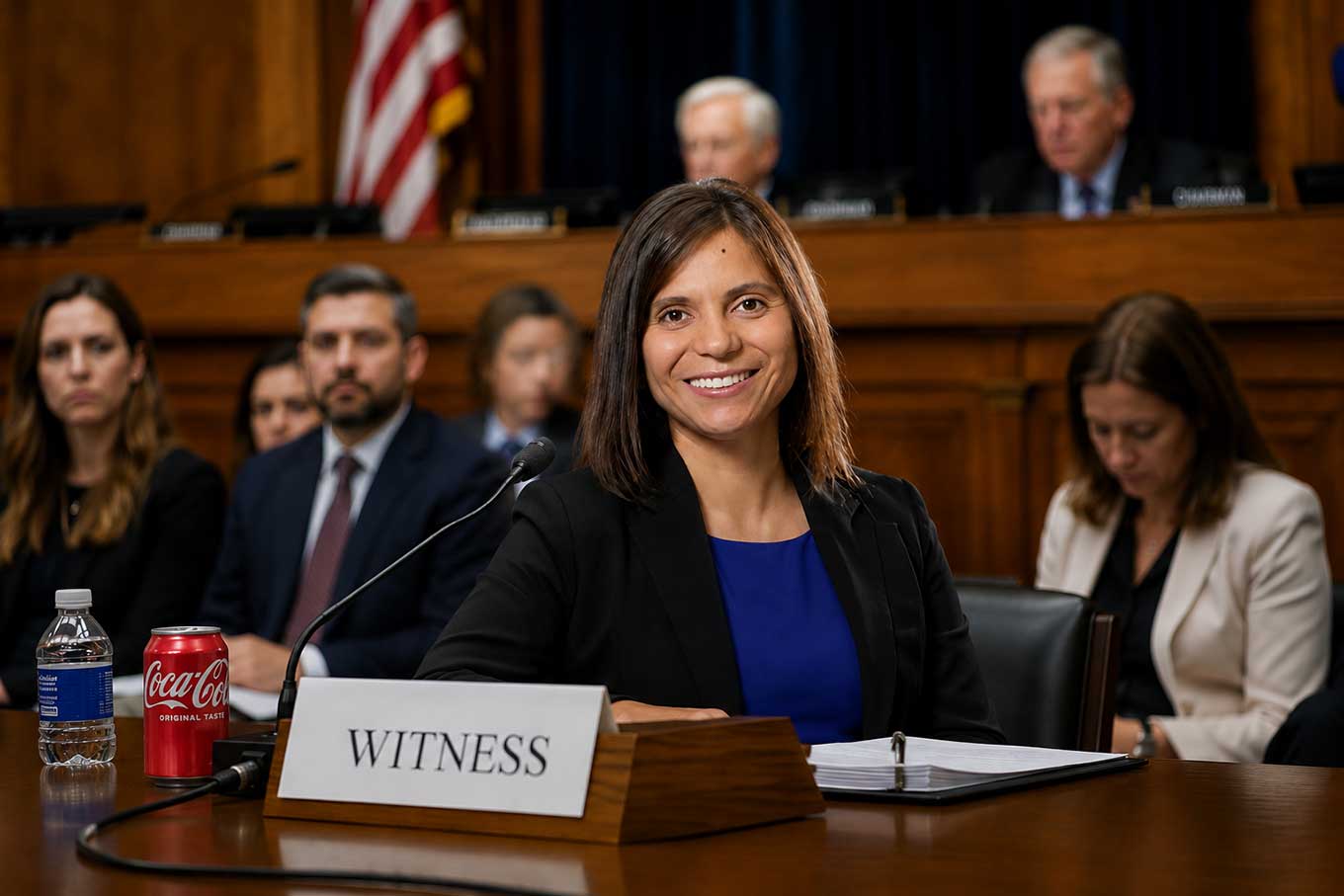
When a witness before Congress declines to affirm something nearly every cardiologist in the country accepts, the moment tends to outlast the hearing. That is what happened June 25, 2026, when Gina Plata-Niño of the Food Research & Action Center (FRAC) repeatedly would not give a direct answer on whether sugary soda is healthy or whether taxpayers should fund it through food stamps.
The exchange, before the House Oversight Subcommittee on Delivering on Government Efficiency (DOGE), illustrates a recurring dynamic in adversarial oversight hearings: a credentialed expert declining to concede a widely established fact because the concession is rhetorically costly to a policy position. It also revives a legitimate, documented question — whether opposition to restricting soda in the Supplemental Nutrition Assistance Program (SNAP) is purely ideological, or whether it is reinforced by the financial ties between anti-hunger advocacy and the food and beverage industry.
Background
The hearing, chaired by Rep. Tim Burchett (R-Tenn.), was titled “Combating Waste, Fraud, and Abuse in SNAP” and focused largely on improper payments. SNAP, formerly known as food stamps, serves roughly 42 million Americans at a cost of about $100 billion a year.
The most-shared moment came when Rep. Brandon Gill (R-Texas) asked Plata-Niño, FRAC’s Director of SNAP Policy and Advocacy, whether benefits should pay for sugary drinks and whether soda is nutritious. She declined to answer directly, saying she would not “dictate what Americans should or should not eat,” that she was a “food-security expert” rather than a nutritionist, and at one point that she would not answer because there was no data “proving” soda is unhealthy.
In simple terms: she was asked a yes-or-no question most Americans would answer quickly, and chose to redirect rather than concede the point.
The Established Science on Soda
On the factual question itself, there is little genuine dispute. The American Heart Association states that drinking sugar-sweetened beverages every day increases the risk of cardiovascular disease and type 2 diabetes — even for people who exercise regularly. The AHA identifies these drinks as the single largest source of added sugars in the American diet and recommends sharply limiting them.
The supporting research is extensive and consistent across decades, appearing in journals including Circulation, Diabetes Care and JAMA, and linking habitual consumption to weight gain, metabolic syndrome and type 2 diabetes. A Tufts University analysis estimated that sugar-sweetened beverages contribute to roughly 2.2 million new cases of type 2 diabetes and 1.2 million new cases of cardiovascular disease worldwide each year.
In simple terms: calling soda “not healthy” is not a partisan claim. It is mainstream medical consensus.
This is what made the testimony notable. The contested policy question — whether the government should restrict soda purchases — is genuinely debatable. The premise underneath it, that soda is unhealthy, is not.
Ideology or Industry? The Funding Question
Plata-Niño’s reluctance reflects a clear advocacy posture: FRAC’s public position is that the core problem is hunger and food affordability, that restrictions stigmatize low-income shoppers, and that limiting specific items is administratively costly without clearly improving health. Those are defensible arguments on their own terms, and FRAC is, by mission, a food-security organization rather than a nutrition regulator.
But the funding context is also a matter of public record, and it complicates a purely ideological reading.
FRAC’s own current supporter list names corporate donors with a direct commercial stake in keeping SNAP eligibility broad: General Mills, the Walmart Foundation, Amazon, Instacart, National Co-op Grocers and Albertsons’ Nourishing Neighbors program, among others, alongside foundations and the USDA itself. Every additional category of eligible product, and every additional dollar of SNAP spending, flows through manufacturers and retailers like these.
The beverage industry specifically has a documented history with FRAC. Reporting drawing on FRAC’s own donor disclosures notes that Coca-Cola, PepsiCo and the American Beverage Association appeared on the organization’s funder lists in the 2010s and were acknowledged as donors at FRAC benefit dinners in 2014 and 2017. Coca-Cola, Pepsi and the trade association do not appear on FRAC’s current public supporter list, and Plata-Niño testified that FRAC is not currently funded by soft-drink makers.
The broader pattern is heavily documented. In soda-tax fights of the past decade, Coca-Cola and PepsiCo financed advocacy campaigns to block local levies — pouring more than $25 million into Washington and Oregon ballot measures alone, according to New York Times reporting. The Center for Public Integrity documented how industry-backed coalitions such as Americans Against Food Taxes recruited and encouraged Hispanic and African-American advocacy groups to oppose the taxes as unfair to the poor — the same framing now deployed against SNAP soda restrictions.
In simple terms: the argument that restrictions “punish the poor” is sincere among advocates, but it is also the exact message the beverage industry has spent heavily to promote.
The Pattern in the Hearing Room
The soda exchange fits a recognizable template in oversight hearings. A witness with strong credentials is asked to concede a simple, factually settled point that happens to undercut their preferred policy — and refuses, because conceding it cedes rhetorical ground. The result is an expert appearing evasive on a question a layperson would answer in seconds, and a hearing that produces a viral clip rather than a substantive record.
Political scientists describe this as motivated reasoning: positions are defended not by weighing evidence neutrally but by protecting a prior commitment. In an adversarial setting built for sound bites, that instinct is amplified. When a witness will not grant that soda is unhealthy, the exchange stops being about policy and becomes about credibility — and the underlying questions of fraud, cost and program design go unexamined.
That dynamic is bipartisan and not unique to any one issue. But it carries a particular cost in welfare oversight, where the stakes — billions in spending and the health of tens of millions of recipients — reward clarity, not avoidance.
Impact
The clip spread rapidly, with critics framing it as evasion and FRAC’s defenders casting the questioning as a distraction from hunger. The reaction underscores how soda has become a proxy for a larger fight over the purpose and limits of SNAP.
The commercial stakes are real. The data firm Numerator has estimated that state-level soda-and-candy restrictions could cut soda sales by roughly $430 million, and found that soft drinks appeared in about 23% of SNAP shopping trips in states with active 2026 waivers, versus 18% elsewhere. Those figures help explain why retailers, manufacturers and advocacy groups alike treat the issue as more than symbolic — and why scrutiny of who funds the advocacy is fair.
Analysis
The honest answer to “ideology or industry?” appears to be both, operating together rather than in competition. There is a genuine ideological commitment among anti-hunger advocates to recipient autonomy and to resisting what they see as paternalism. There is also a financial ecosystem — food manufacturers, grocers and, historically, beverage companies — that benefits directly when SNAP eligibility stays broad, and that has demonstrably funded the advocacy infrastructure making that case.
Acknowledging the funding does not by itself prove that positions are bought; donors do not automatically dictate conclusions, and FRAC’s hunger-first framing predates much of its corporate support. But the refusal to concede an uncontested health fact invites exactly the scrutiny that followed. Had the witness simply said, “Yes, soda is not nutritious, and here is why restricting it is still bad policy,” the conflict-of-interest question would have far less oxygen. The evasion is what fused the two stories together.
The deeper problem is structural. As long as the advocacy organizations shaping SNAP policy are partly financed by the industries that profit from SNAP spending, lawmakers and the public are entitled to ask whose interests a given position serves — and witnesses who decline to state the obvious make that question louder, not quieter.
Conclusion
A hearing convened to examine fraud produced its most lasting moment over a question with a settled answer. Soda’s health effects are not genuinely in dispute; the policy of restricting it is. By refusing to separate the two, an expert witness turned a debatable policy disagreement into a credibility problem — and reopened a documented question about the financial ties between hunger advocacy and the food and beverage industry. Whether that question is answered with transparency or deflection will shape how seriously the next hearing is taken.
Key Takeaways
- At a June 25, 2026 House Oversight DOGE Subcommittee hearing, FRAC’s Gina Plata-Niño repeatedly declined to affirm that sugary soda is unhealthy or to say whether SNAP should fund it.
- The health science is not in dispute: the American Heart Association links daily sugar-sweetened beverages to cardiovascular disease and type 2 diabetes, and a Tufts analysis ties them to ~2.2 million new diabetes cases globally each year.
- FRAC’s current donors include food and grocery interests with a stake in broad SNAP eligibility (General Mills, Walmart Foundation, Amazon, Instacart, Albertsons), and the group historically received beverage-industry money (Coca-Cola, PepsiCo, the American Beverage Association) in the 2010s.
- The beverage industry has a documented record of funding advocacy campaigns against soda taxes and restrictions, including $25M+ on Washington and Oregon ballot measures, often using a “punishes the poor” message.
- The exchange illustrates a broader hearing dynamic — motivated reasoning that makes oversight unproductive when witnesses won’t concede settled facts — while leaving the “ideology vs. industry” question best answered as both.
Sources
- House Committee on Oversight and Government Reform, “Hearing Wrap Up: SNAP Integrity is Undermined by Waste, Fraud, and Abuse,” June 25, 2026
- RealClearPolitics, transcript/video of Rep. Gill questioning at SNAP hearing, June 25, 2026
- American Heart Association, “What does the sugar in beverages do to your body?” (citing Tufts University global burden analysis)
- American Heart Association scientific statement on dietary sugars and cardiovascular health (Circulation); Diabetes Care meta-analyses on sugar-sweetened beverages
- Food Research & Action Center, “FRAC Supporters” (current donor list), frac.org
- Mises Institute, “How Food Industry Lobbyists Keep the Food-Stamp Gravy Train Going” (citing FRAC donor disclosures and benefit-dinner programs)
- The New York Times via CNBC, beverage-industry spending against soda taxes in Washington and Oregon
- Center for Public Integrity, “The food lobby’s war on a soda tax”
- Numerator, “SNAP Spending in 2026: How OBBBA and Food Restrictions Are Changing Consumer Behavior”