
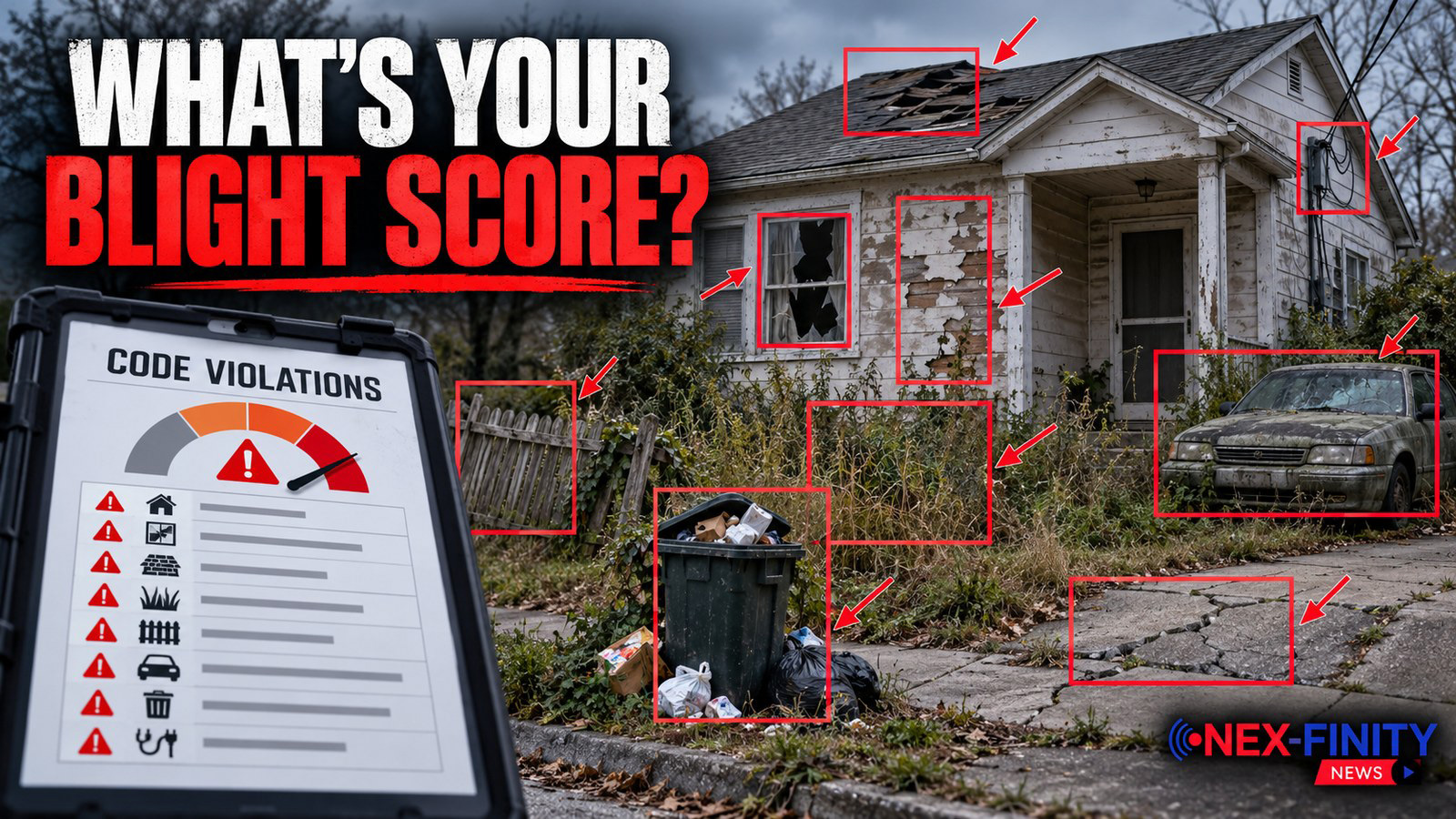
The city mounted 100 cameras on sanitation trucks, flagged 21,000 properties in four months, and set a target of 5,200 enforcement notices a year. Homeowners on fixed incomes are the ones holding the notices.
Twice a month, a brush and bulky-waste truck rolls past a house in southern Dallas. It does not stop. Mounted on each side of the cab is a camera that photographs whatever is within its frame the roof, the porch, the fence line, the chimney, the yard. Within days, software has parsed the image, identified what it believes to be a code violation, and assigned the property a number from 1 to 4.
That number is called a blight score. The homeowner is not told it exists, is not shown the photograph that produced it, and has no mechanism to contest it. What the homeowner may eventually receive is a piece of paper on the door: a courtesy notice from Dallas Code Compliance, the first step in an enforcement chain that ends, if ignored, in municipal court, civil penalties, city-performed abatement billed back to the owner, and a lien recorded against the property at the county clerk’s office.
Records obtained by NBC 5 Investigates through an open records request show the system flagged at least one possible violation at more than 21,000 Dallas properties between April and early August 2026. More than 500 of those properties were sent courtesy notices in that window. By the time the story published on September 1, the city put the total at roughly 1,800.
The most consequential number in the record is none of those. Asked what the program was supposed to achieve, the city told NBC 5 that before implementation, its only measurable goal was the issuance of 5,200 courtesy notices per year following full rollout.
Not 5,200 properties brought into compliance. Not 5,200 hazards abated. Notices issued.
The machine
The system consists of 100 cameras mounted in pairs on 50 brush and bulky-waste trucks, one facing each side of the street. Dallas City Council approved a three-year contract worth roughly $2.556 million with City Detect Inc., a Tuscaloosa, Alabama company, paying about $852,000 a year out of the Sanitation Operation Fund. City documents describe the arrangement as producing an automated visual scan of the entire city roughly every 30 days, riding along on collection routes the trucks already run.
The cameras are 1920×1080 with fixed-focal-length lenses and no optical or digital zoom, operating at street level from the public right-of-way. The detection classes include high weeds and grass, litter, debris, illegal dumping, graffiti, and deteriorating structures.
Code Compliance Director Christopher Christian briefed the council on the initiative during an August 2025 budget workshop, citing a four-day pilot that flagged more than 3,000 violations at what he described as 95 percent accuracy. He told council members a human would review every camera-identified violation and that he expected the department’s labor demand to hold steady. Assistant City Manager Alina Ciocan had briefed the plan in a memo the previous November, noting the collected data could also feed planning, neighborhood outreach, and grant reporting.
That last clause matters more than it reads. The pitch is code enforcement. The asset is a rolling, timestamped, monthly photographic survey of every parcel in a city of 1.3 million people.
Who is actually being served
Follow the money and the shape of the incentive becomes clearer.
City Detect was founded in 2021 and closed a $13 million Series A in March 2026 led by Prudence Venture Capital, with Zeal Capital Partners, Knoll Ventures, and Las Olas Venture Capital participating roughly $15 million raised to date. The company says it operates in at least seventeen cities. Its CEO has publicly identified the “status quo” of manual inspection as its primary competitor, which is an honest description of the business: the product replaces the natural friction that limited how many violations a city could find.
That friction was not a bug in the old system. It was the rate limiter. A complaint-driven regime enforces where a neighbor complains. An inspector on foot covers roughly fifty properties. A truck-mounted fleet processes thousands a week, forever, whether or not anyone asked.
The revenue logic runs in both directions. The vendor sells recurring per-city subscriptions and needs renewal, which means demonstrating throughput detections found, notices generated, cases closed. The city, facing a $50.9 million General Fund shortfall and the elimination of 296 budgeted positions in its FY 2026-27 recommendation, gets a force multiplier for an enforcement apparatus that generates fines, abatement billings, and liens. Neither party’s success metric is a homeowner who can afford the repair.
Ty Williams, a real estate broker whose North Dallas property was flagged for chimney paint and scored a 2, reduced it to four words for NBC 5: “It’s a money grab.”
The map is the story
NBC 5 mapped the 21,000-plus detections against the city’s own data. The zip codes with the heaviest concentrations sit in economically distressed parts of southern Dallas.
There is nothing surprising about this, and that is the problem. Deferred maintenance is what poverty looks like from the street. Peeling paint, a sagging fence, a roof patched rather than replaced, a yard that got away from someone during a hospital stay these are the visible residue of not having money. A camera trained to detect visible disrepair will, with mechanical reliability, find the most of it where people have the least capacity to fix it. The algorithm does not need to be biased to produce a regressive result. It only needs to be accurate.
Dennis Edwards, whose family has lived in the historic Bottom neighborhood for three generations, told NBC 5 he lives on Social Security and has no budget to fight code enforcement. His home was scored a 2. With new construction rising around him and property taxes climbing, he read the notices on his door as pressure to leave.
Council member Chad West, who moved to strip the program’s funding, framed the same concern from the dais: that the cameras could operate as an unintended tax on the poor, concentrated in neighborhoods least able to absorb it. Daniel Woislaw, a civil rights attorney with the Institute for Justice, told the station that the word “blight” itself has a history cities have used blight designations as a pretext to take properties and transfer them to private developers.
What a courtesy notice actually starts
City officials emphasize that the AI issues no citations and that humans decide what action to take. Both statements are true. Neither addresses what happens after a human decides.
In Dallas, a property-maintenance case escalates on a schedule. A courtesy notice asks for voluntary correction ahead of re-inspection. If the condition persists, a formal violation notice follows. If it still persists, the case moves to municipal court or to the Building and Standards Commission.
From there the exposure compounds:
· Fines. Violations of ordinances governing public health and sanitation carry a maximum fine of $2,000 under Texas law, and Dallas ordinances amending Chapter 27, “Minimum Property Standards,” carry a penalty not to exceed $2,000 upon conviction. Each day a violation continues is a separate offense.
· Civil penalties. Texas Local Government Code Chapter 54 gives municipalities a parallel civil track, including quasi-judicial enforcement through a building and standards commission, injunctions, and civil penalties assessed per day.
· Abatement billed to the owner. If the owner does not act, the city can mow, secure, repair, or demolish and charge the cost back. In Dallas, that expense and any civil penalty constitute a lien against the real property, attaching when the notice is recorded and indexed with the county clerk subject to Texas homestead protections.
· Liens that follow the property. A recorded lien surfaces in any title search and generally must be cleared at closing before a title company will insure. That converts a code case into a transaction-blocking encumbrance on the single asset most working-class families hold.
· Warrants and collections. Unpaid municipal court fines in Dallas can produce capias pro fine warrants and referral to collections. Under the Texas scofflaw framework, the county may refuse to renew vehicle registration for someone with past-due fines and fees owed to a municipality meaning a chimney-paint case can, several steps down the chain, cost someone the legal ability to drive to work.
The national cautionary example is Jim Ficken, a retiree in Dunedin, Florida, who accrued nearly $30,000 in fines at $500 a day while out of state settling his late mother’s estate, after the man he paid to mow his lawn died unexpectedly. The city classified him a repeat offender based on a 2015 warning and threatened foreclosure. In 2022 the Eleventh Circuit held the fines did not violate the Eighth Amendment’s Excessive Fines Clause. The matter finally resolved in 2024 after two lawsuits and a fine-reduction ordinance the city adopted only under public pressure.
Nothing in the Ficken record required advanced technology. It required only that the violations be found. That is precisely the variable Dallas has now automated.
Data safety: the part nobody voted on
City Detect publishes a Responsible AI Strategy setting out six commitments: it blurs faces and license plates by default; it requires human review of every detection before action; its cloud computation and storage sit in the United States; it undergoes an annual independent SOC 2 audit; it does not tie into federal or law enforcement databases; and it takes “No revenue from detections,” stating that it never collects revenue based on the number of citations issued.
That is a more specific set of promises than most surveillance vendors publish, and it deserves to be reported as such. Take all of it at face value and material questions remain unanswered.
Blurring implies detection. A system cannot obscure faces and plates without first locating them. The capability exists in the pipeline; blurring is a policy applied on top of it, and policies are configuration settings.
Vendor policy is not city policy. Asked in Huntsville whether the imagery would be shared with police for investigations, the company’s CEO said that would be up to the city “at their discretion,” he told WHNT. Dallas has published no ordinance governing who may query the archive, under what predicate, with what audit trail, or whether outside agencies may request access.
Retention is still unspecified. The six commitments cover blurring, human review, domestic storage, auditing, database ties, and revenue. None of them states how long images are kept, or under what conditions they are deleted. A monthly citywide sweep, retained indefinitely, is a longitudinal record of how every property in Dallas changed over time and by extension, who was outside, what vehicles sat in which driveway, and when a house went dark. That is a discovery target, a subpoena target, and a breach target.
The no-quota premise is in tension with the record. The same commitment that disclaims detection revenue also asserts that local government neighborhood services departments do not operate with quotas and use citations only as a last resort. Dallas told NBC 5 that before implementation, its only measurable goal was 5,200 courtesy notices a year. A courtesy notice is not a citation and a stated goal is not formally a quota. But the vendor’s largest publicly identified deployment set a numeric annual notice target before launch, and both parties should be asked to reconcile that on the record.
The public cannot see its own images. NBC 5 requested the photographs of Williams’s home under the Texas Public Information Act. The city had not released them. A resident scored by the system currently has less access to the evidence than the vendor that produced it.
The trajectory of automated license plate readers is the relevant precedent, and Dallas is living it in real time. The city’s own council spent the same budget cycle fighting over Flock Safety, with the police department canceling 321 cameras after the governor barred state funds from being used for them. ALPRs were also sold as narrow tools for a specific municipal problem.
An unsettled question under Texas law
The Texas Responsible Artificial Intelligence Governance Act (HB 149) took effect January 1, 2026. Among its provisions, it bars governmental entities from developing or deploying AI systems for social scoring classifying individuals by behavior or personal characteristics in ways that produce detrimental or unfavorable treatment and requires government agencies to disclose when a person is interacting with an AI system. Enforcement rests with the Attorney General, with civil penalties reaching six figures per violation.
Dallas’s defensible reading is that a blight score classifies a parcel, not a person, and that a human reviewer makes every enforcement decision. That is a real distinction and it may well hold.
It is also untested. A score generated by machine, attached to an address, used to rank whose door gets a notice, and correlated with the poorest zip codes in the city is close enough to the statute’s concern that the question deserves an answer from the city attorney rather than a shrug. No Texas court has drawn the line, and no one has asked.
What other municipalities are doing
Huntsville, Alabama rejected essentially the same deal. A proposed three-year, $972,200 City Detect contract drew organized opposition from a coalition led by the North Alabama Area Labor Council, 50501, and Indivisible. After more than a hundred residents pushed back, the council withdrew the item in September 2025; the mayor said the contract would sit for six to eight months. City administrator John Hamilton had argued the system involved “no automatic citations or fines.”
Tuscaloosa, Stockton, Columbia, Springfield, and Miami appear among City Detect’s deployments, with the company claiming at least seventeen cities and stated plans for national expansion using its Series A capital.
Sonoma County, California shows where this goes without guardrails. A drone program launched to find unpermitted cannabis grows quietly expanded into general code enforcement decks, fences, trailers, outbuildings. By 2023, seventy percent of flights found no cannabis violation at all. Records showed 5,600 photographs from 700 flights since 2019, and more than $3 million in fines. On September 2, 2026, the county settled an ACLU of Northern California lawsuit, agreeing to obtain a warrant or consent before flying over a home and its curtilage, and paying $50,000 to each of three residents. Some residents in that program had faced six-figure fines; some lost their homes.
Los Angeles takes the aerial route administratively rather than by drone, with assessor-funded high-resolution imagery on a two-to-three-year cycle cross-checked against permit records, generating investigation leads for unpermitted structures built decades ago.
The pattern across all four is consistent. The stated purpose is narrow. The capability is general. The scope expands without a second vote.
What happens next
Council member West withdrew his amendment to defund the cameras after the city manager agreed to a hearing, with staff set to brief the council’s Quality of Life, Arts and Culture committee before the end of the year. The Dallas City Council is scheduled to adopt the FY 2026-27 budget on final reading September 16, with the new fiscal year beginning October 1. As of publication, the $852,000 annual line remains in the budget. West’s amendment would have redirected it to cut the average monthly sanitation collection rate by twenty cents.
The questions the December briefing should have to answer are not complicated:
1. How long are images retained, and who has authority to release them?
2. What is the written policy on law enforcement or outside-agency access?
3. What is the actual false-positive rate in deployment, as against a 95 percent figure drawn from a four-day pilot?
4. Why is the program’s only measurable goal a notice count rather than a compliance or abatement outcome?
5. Is there a hardship or repair-assistance pathway attached to camera-generated notices, and how is a resident told one exists?
6. Can a property owner obtain the image that generated a score, on request, without filing a public information request?
Until those are answered on the record, the city is running a citywide photographic survey of private property, scoring homes by machine, and measuring its own success in notices delivered.
If you receive a notice
Do not ignore it. A courtesy notice is the cheapest stage of the process and the only one where nothing has been assessed yet. Photograph the condition yourself with a date stamp. Correct what you can and document it before re-inspection. If you cannot correct it in time, contact Code Compliance in writing before the deadline rather than after a documented request is far easier to raise later than silence. Request the underlying detection record and image. If the case reaches municipal court, appear; default is what converts a fine into a warrant, and a warrant into a registration hold.
Frequently asked questions
What is a blight score?
A 1-to-4 severity rating that Dallas’s camera system assigns to a property where its software believes it has detected a code violation. The city says the score is used to prioritize which detections human reviewers examine first, not to issue citations automatically.
Can the cameras photograph my backyard?
The cameras are fixed-focal-length units with no zoom, mounted at street level on sanitation trucks, capturing from the public right-of-way. What is visible from the street is within frame; what is screened from the street generally is not.
Does the AI issue fines?
No. City staff review detections and decide whether to send a notice. The AI determines what gets looked at, which is a meaningful form of discretion even though it is not the final one.
Can a code violation cost me my house?
Not directly, but the chain is real. Unpaid fines and city abatement costs can become recorded liens that must be cleared at sale, and in other jurisdictions have escalated to foreclosure proceedings. Texas homestead protections limit some lien attachment.
What happens if I never pay a code fine in Dallas?
Municipal court can issue a capias pro fine warrant, the case can be referred to collections, and under the Texas scofflaw framework the county may refuse to renew your vehicle registration until the debt is resolved.
Is any of this illegal?
No court has said so. Photography from a public right-of-way is broadly lawful. The unsettled questions are whether machine scoring of homes implicates the Texas Responsible AI Governance Act’s social-scoring prohibition, and whether accumulated fines in specific cases become constitutionally excessive.
Related coverage
· When Cities Cancel Flock: The Municipal Backlash Against ALPR Surveillance
· The Driver Data Economy, Part One: How Your DMV Record Became a Product
· Axon’s Second Act: The Company Buying Up the Surveillance Market It Once Funded
· Who Buys Your Driving Habits: Inside the Arity and Life360 Data Pipeline