
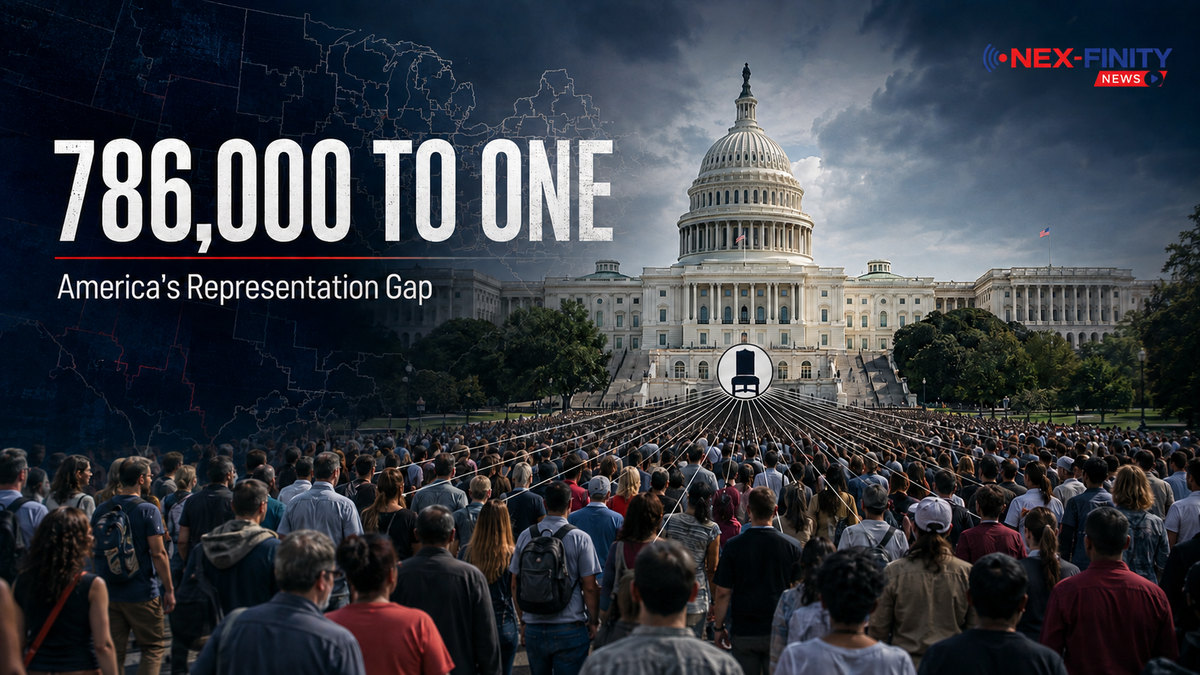
The Democratic Socialists of America released a national program in July 2026 called “Workers Deserve More,” and buried inside the coverage of its more incendiary planks is a structural argument that deserves a hearing on its own terms: the platform calls for expanding the House of Representatives, implementing proportional representation and ranked-choice voting, and abolishing the Senate.
Two-thirds of that sentence is defensible. The last third is a category error.
The problem with American representative government is not that we have too many chambers. It is that we have too few representatives. Abolishing the Senate does not fix a representation deficit – it deepens one, by removing an entire layer of elected officials and concentrating national power in a single body that would be easier, not harder, for organized money to capture.
There is a different structural answer, and it does not require dismantling the constitutional architecture. Double the House. Double the Senate. Take redistricting out of the hands of the people who benefit from it. Then watch what happens to the price of buying a seat.
Background: The Number 435 Is Not in the Constitution
Most Americans assume the size of the House is fixed by the founding document. It isn’t. Article I sets a floor – no more than one representative for every 30,000 people – and leaves the ceiling to Congress.
For 140 years, Congress grew the House after nearly every census. The First Congress seated 65 members for a nation of roughly four million. By 1911, the House had grown to 435 for a population of about 92 million, or roughly 212,000 people per district.
Then it stopped. The Permanent Apportionment Act of 1929 froze the chamber at 435 and converted reapportionment into a zero-sum exercise: states no longer gain seats so much as they take them from other states.
The arithmetic since then is the entire argument.
The Census Bureau’s Vintage 2025 population estimates put the U.S. resident population at 341,784,857 as of July 1, 2025. Divided by 435, that is roughly 786,000 constituents per House member – nearly four times the ratio that existed when the number was set, and more than twenty-six times the constitutional minimum the framers wrote as a guardrail against remoteness.
The Senate is worse. In 1789, twenty-six senators represented about four million Americans, or roughly 150,000 people apiece. Today, 100 senators represent 341.8 million – about 3.4 million per senator, a twenty-two-fold dilution. The Congressional Budget Office projects the population reaching 364 million by 2056, which under current law means the ratio only worsens.
In simple terms: the pipe carrying citizen input into Congress has stayed the same width while the reservoir behind it grew four times larger.
Policy Explanation: What “Doubling” Actually Means
The proposal has three moving parts, and they are not equally difficult.
1. Expand the House to 870 members – by statute
This requires no constitutional amendment. Congress set 435 by ordinary law and can reset it by ordinary law. Doubling the chamber would bring district size to roughly 393,000 people – still large by international standards, but a return to something in the neighborhood of mid-twentieth-century American practice.
For comparison, the United Kingdom seats 650 MPs for about 69 million people (roughly 106,000 each). France seats 577 deputies for about 68 million. Germany’s Bundestag is capped at 630 for about 84 million. The United States is a global outlier in how few legislators it assigns to how many people.
2. Expand the Senate to 200 – four per state, by constitutional amendment
This is the heavy lift, and it is worth being precise about why. Article V contains an entrenchment clause providing that no state shall be deprived of its equal suffrage in the Senate without its consent. That clause is what makes the DSA’s abolition plank mechanically near-impossible – a point Sen. Bernie Sanders and Sen. Cory Booker have both made in declining to endorse it.
But it does not block expansion. Moving from two senators per state to four preserves equal suffrage perfectly – every state gains the same thing. The barrier is the ordinary Article V threshold (two-thirds of both chambers, three-quarters of the states), not the entrenchment clause. That is a steep hill. It is not a wall.
3. Strip redistricting from legislatures and hand it to independent commissions
The Supreme Court closed the federal courthouse door on partisan gerrymandering claims in Rucho v. Common Cause (2019), holding them nonjusticiable political questions. But the Court had already upheld voter-created independent redistricting commissions in Arizona State Legislature v. Arizona Independent Redistricting Commission (2015), and rejected the strongest version of the independent state legislature theory in Moore v. Harper (2023).
The remedy, in other words, is legislative and constitutional – not judicial. A national standard requiring nonpartisan commissions, compactness, respect for county and municipal boundaries, and a prohibition on the use of partisan data in line-drawing would have to come from Congress or the states themselves.
Examples: This Is Not a Fringe Idea
House expansion has a bipartisan institutional pedigree that rarely makes it into the shouting.
The American Academy of Arts and Sciences’ cross-ideological Commission on the Practice of Democratic Citizenship recommended enlarging the House in its 2020 report Our Common Purpose. A follow-up working group report, The Case for Enlarging the House of Representatives, proposed adding 150 seats followed by regular expansion, on the principle that Americans should not routinely lose representation as the country grows. That report was authored by a deliberately mixed group including Lee Drutman of New America, Yuval Levin of the American Enterprise Institute, and Norman Ornstein.
Political science offers two competing formulas:
- The Cube Root Rule, devised by Estonian political scientist Rein Taagepera in a 1972 paper, holds that a legislature’s lower house tends to approximate the cube root of the population it represents. For 341.8 million Americans, that yields a House of roughly 699 members.
- The Wyoming Rule would size every district to the population of the smallest state. Against Wyoming’s 2020 census count of 576,851, that produces roughly 592 seats.
A doubling to 870 sits above both – deliberately. Both formulas are calibrated to catch the country up to where it should already be. Neither builds in headroom for the next fifty years of growth.
Impact: The Money Argument
Here is the part of the case that has nothing to do with civics-class abstraction.
OpenSecrets projected the 2024 federal election cycle would cost at least $15.9 billion, surpassing the 2020 record of $15.1 billion. Outside spending alone hit a record $4.5 billion, with more than half coming from groups that do not fully disclose the source of their funding.
That spending is concentrated because the targets are concentrated. There are only 435 House seats and 100 Senate seats in existence. A super PAC seeking to shift the balance of power in Washington does not need to influence a nation – it needs to influence a few dozen competitive districts and a handful of Senate races. The scarcity of seats is what makes the seats expensive.
Now change the denominator.
Doubling the House cuts the average district roughly in half. A candidate reaching 393,000 people needs materially less advertising than one reaching 786,000. Retail politics – door-knocking, town halls, local endorsements – becomes viable again at a scale where it currently is not. The floor cost of running competitively drops.
More importantly, the marginal value of capture drops. In an 870-seat House, a single member commands half the share of the chamber they do today. Buying influence over one representative buys less. Assembling a working majority through targeted independent expenditures requires twice as many successful bets, in twice as many places, against twice as many candidates who can win on shoe leather rather than television.
In simple terms: concentrated money is powerful when the board has few squares. Add squares, and the same dollars spread thinner.
The same logic applies to the Senate. A 200-member Senate means four staggered seats per state, more committee slots, and a diluted individual veto. The modern Senate’s dysfunction is partly a function of scarcity – when a single member can hold the floor of a 100-seat chamber hostage, that member becomes a uniquely valuable target for lobbying. At 200, that leverage is halved.
Cost objection, answered: the entire legislative branch appropriation runs in the neighborhood of $7 billion annually, against federal outlays measured in trillions. Congress costs roughly a tenth of a percent of what Congress spends. Doubling the membership might add a couple billion dollars in salaries, staff, and facilities. Against $15.9 billion spent every two years to win those seats, that is not a serious fiscal argument. It is a rounding error attached to a status quo that benefits from being left alone.
Analysis: Where This Argument Is Weakest
An honest case includes its own vulnerabilities. This one has three real ones.
Expansion does not automatically end gerrymandering. More districts means more lines, and mapmakers have shown considerable creativity. Some modeling suggests smaller districts are marginally harder to gerrymander cleanly, because packing and cracking require geographic precision that gets harder as units shrink. But “marginally harder” is not “impossible.” Expansion and independent commissions are complements, not substitutes. Doing the first without the second would double the number of safe seats rather than the number of competitive ones.
Doubling both chambers does not fix the Electoral College. This is the counterintuitive one, and it cuts against the proposal as stated. Electoral votes equal House seats plus Senate seats. Today, the 100 Senate-derived electors are about 18.6 percent of the 538-vote total – that is the small-state bonus. Double the House alone and that bonus falls to roughly 10 percent. Double both chambers and the ratio stays almost exactly where it is now.
If reducing the Electoral College’s population distortion is a goal, House expansion does the work and Senate expansion cancels it out. Anyone advancing this package should say so plainly rather than let readers assume otherwise.
More members does not mean better members. A larger House would be harder to organize, would strain a chamber with roughly 448 physical seats, and would likely strengthen leadership and committee gatekeeping relative to rank-and-file members. Critics of expansion – and there are serious ones – argue that a bigger body concentrates power in the Speaker’s office rather than distributing it. That risk is real and would need to be met with rules reform, not assumed away.
There are also competing reform models worth weighing. The Fair Representation Act, introduced in successive Congresses, would keep the House smaller but combine multi-member districts with ranked-choice voting – attacking the same problem through electoral method rather than chamber size. Proportional representation advocates, including the DSA, make a version of that case. Whether the American answer is more seats or differently allocated seats is a genuine open question, not a settled one.
Conclusion
The DSA is not wrong that something structural has broken. When 100 people speak for 341 million, and 435 speak for districts of 786,000, and the maps that create those districts are drawn by the people who occupy them, the mechanism of representation has become notional.
Where the platform goes wrong is in concluding that the answer is fewer institutions. Abolishing the Senate would hand a single chamber the combined authority of two and – under the DSA’s own framing – subordinate the executive and judiciary to it as well. Whatever that is, it is not more representation. It is the same representation deficit, with fewer places for a citizen to be heard and fewer doors an organized interest has to knock on to get what it wants.
The alternative is unglamorous and entirely available. Expand the House by statute, which Congress could do this term. Pursue Senate expansion through the amendment process, where equal-suffrage entrenchment is not a barrier. Take the maps away from the incumbents.
None of that is radical. For the first 140 years of the republic, growing the House was simply what Congress did after counting the people. We stopped in 1929, the country tripled, and the ratio of citizen to representative quietly became one of the worst in the developed world.
Fixing it does not require a new constitution. It requires undoing a ninety-seven-year-old statute – and being willing to double the number of chairs at a table where the current occupants are quite comfortable.
Key Takeaways
- The 435-seat House cap comes from the Permanent Apportionment Act of 1929, not the Constitution, and can be changed by ordinary legislation.
- Each House member now represents about 786,000 people; each senator represents about 3.4 million. Both ratios are historic highs.
- The DSA’s 2026 “Workers Deserve More” platform calls for expanding the House but abolishing the Senate – a plank Article V’s equal-suffrage entrenchment clause makes mechanically near-impossible, and which would reduce, not increase, layers of representation.
- Senate expansion to four seats per state is not blocked by the entrenchment clause, because equal suffrage is preserved. It still requires a full Article V amendment.
- House expansion has bipartisan institutional support, including the American Academy of Arts and Sciences’ Our Common Purpose commission. Formula-based proposals range from 592 seats (Wyoming Rule) to 699 (Cube Root Rule).
- The 2024 cycle cost at least $15.9 billion, with a record $4.5 billion in outside spending, over half from non-disclosing sources. Fewer seats means more concentrated targets.
- Caveat: doubling both chambers leaves the Electoral College’s small-state bonus unchanged at roughly 18.6 percent. Doubling only the House would cut it to about 10 percent.
- Expansion alone does not end gerrymandering. It must be paired with independent redistricting commissions, since Rucho v. Common Cause (2019) closed federal courts to partisan gerrymandering claims.
Sources
- Democratic Socialists of America, Workers Deserve More national program, released July 14, 2026
- Washington Times, “Updated DSA platform calls for abolishing ICE, scrapping Senate”, July 15, 2026
- VTDigger, “Democratic Socialists of America wants to abolish the U.S. Senate. Bernie Sanders says ‘No.’”, Aug. 4, 2026
- U.S. Census Bureau, Vintage 2025 Population Estimates, Jan. 27, 2026
- Congressional Budget Office, The Demographic Outlook: 2026 to 2056, January 2026
- U.S. House of Representatives History, Art & Archives, The Permanent Apportionment Act of 1929
- American Academy of Arts and Sciences, Enlarging the House of Representatives initiative
- Drutman, Cohen, Levin & Ornstein, The Case for Enlarging the House of Representatives, American Academy of Arts and Sciences
- Rein Taagepera, “The Size of National Assemblies,” Social Science Research 1, no. 4 (1972): 385–401
- OpenSecrets, “Total 2024 election spending projected to exceed previous record”
- OpenSecrets, “Outside spending on 2024 elections shatters records”
- Rucho v. Common Cause, 588 U.S. 684 (2019)
- Moore v. Harper, 600 U.S. 1 (2023)
- Arizona State Legislature v. Arizona Independent Redistricting Commission, 576 U.S. 787 (2015)
- Wesberry v. Sanders, 376 U.S. 1 (1964)
- U.S. Constitution, Article I and Article V