
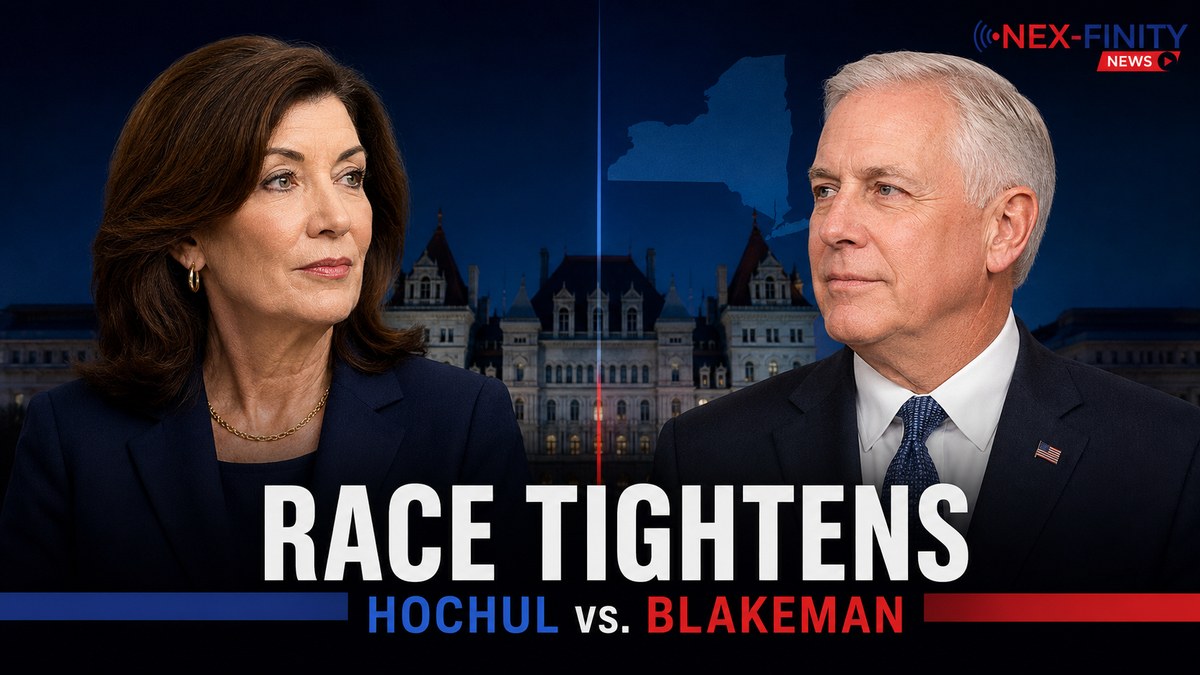
Nassau County Executive Bruce Blakeman has cut Gov. Kathy Hochul’s lead in the New York governor’s race to 10 points, according to the Siena College Research Institute survey released Aug. 12- down from a 20-point gap in the same pollster’s June measurement.
The 10-point figure has driven a week of coverage framing the contest as unexpectedly competitive. It has also obscured a methodological detail that explains a meaningful share of the movement: Siena switched from surveying registered voters to surveying likely voters between the two polls.
Both facts can be true at once. The race is tightening. And the single largest jump in the trend line is partly an artifact of who was asked.
With 76 days until the Nov. 3 general election, the question is no longer whether Blakeman has closed ground. It is whether a Republican who has not led a single public poll can convert a narrowing margin into the first statewide GOP win in New York since 2002.
Background
Hochul took office in August 2021 following Andrew Cuomo’s resignation and won a full term in 2022 with 53.1% – the closest New York governor’s race since 1994. Her 2022 opponent, then-Rep. Lee Zeldin, is now EPA administrator.
Blakeman entered the 2026 race in December 2025, weeks after winning reelection as Nassau County executive by roughly 12 points in a county with a Democratic registration advantage. He initially faced a primary against Rep. Elise Stefanik, who withdrew on Dec. 19, 2025. President Trump endorsed Blakeman the following day.
The trend line since then, all from Siena:
| Poll | Sample | Result | Margin |
|---|---|---|---|
| December 2025 | Registered voters | Hochul 50, Blakeman 25 | +25 |
| February 2026 | Registered voters | – | +20 † |
| March 2026 | Registered voters | Hochul 47, Blakeman 34 | +13 |
| June 2026 | Registered voters | Hochul 52, Blakeman 32 | +20 |
| August 2026 | Likely voters | Hochul 49, Blakeman 39 | +10 |
† The February margin is drawn from later secondary reporting rather than a Siena release reviewed directly by NexfinityNews.
The June-to-August move is the one generating headlines. It is also the only point in the series where the population being surveyed changed.
What the Poll Actually Measured
The August survey was conducted Aug. 3–6 among 811 New York likely voters, with a margin of error of plus or minus 4.6 percentage points.
In simple terms: a registered-voter poll asks everyone who is signed up to vote. A likely-voter poll screens for people who will actually show up. In a midterm year – when turnout runs well below a presidential cycle – that screen almost always shifts results toward the party with more motivated voters.
New York’s registration rolls lean heavily Democratic. Its actual midterm electorate leans less so. Applying a likely-voter screen in a blue state with an enthusiasm gap will move the number toward the Republican before a single voter changes their mind.
This does not mean the tightening is fictional. Siena’s own March poll of registered voters showed a 13-point race, indicating real movement on the same measurement basis. It means the June-to-August delta overstates how much changed in eight weeks, and readers should compare like to like.
Inside the Crosstabs
The internals show a race decided by two blocs moving in opposite directions.
Partisans are locked. Hochul leads Democrats 80-8. Blakeman leads Republicans 84-9. Neither candidate is meaningfully bleeding into the other’s base.
Independents have flipped to Blakeman. He leads unaffiliated likely voters 45-40 – a five-point edge in the group that decides close statewide races in New York.
The issue splits explain why. Hochul leads on affordable housing supply, 51-35, and on making prices more affordable, 48-41. Her advantages narrow sharply elsewhere: energy policy 47-42, public safety 47-44, and handling undocumented immigrants living in New York, 45-44.
Among independents specifically, Siena found Hochul ahead by nine points on housing but behind by between eight and 15 points on the other four issues tested.
Name recognition remains the asymmetry. Hochul carries a 46-49 favorability rating and 48-49 job approval – underwater on both, but fully defined. Blakeman posts 33-26 favorable, with 40% saying they do not know enough about him to have an opinion.
That 40% is the pivot. A candidate with four in ten voters undefined has room to grow – and equal room to be defined by an opponent with more money.
What “Affordability” Actually Means in This Race
The Siena crosstabs identify affordability as the issue with the tightest margin – Hochul 48, Blakeman 41. Both campaigns have spent the summer attacking each other on taxes. Neither claim survives contact with how a Long Island tax bill is actually assembled.
Blakeman’s record is a freeze, not a cut. His FY2026 budget forecasts county property tax revenue holding flat at $755 million within a $4.4 billion county budget. He describes it as his fourth consecutive no-tax-increase budget, and says he vetoed more than $150 million in tax hikes approved by predecessor Laura Curran. That is a defensible claim on its own terms – and a different claim than lowering anyone’s taxes.
The distinction matters because of the arithmetic. School tax bills represent more than 65% of the average annual property tax obligation in Nassau County, with the remainder divided among towns, villages, special districts, and the county. In simple terms: the line Blakeman controls is roughly a sixth of the bill. Holding it flat for four years means the county stopped adding to the total. It does not reduce what a homeowner pays, because school districts and towns set their levies independently.
The only tax Blakeman cut outright was a sales tax. In April 2022, Nassau and Suffolk capped the local sales tax on gasoline above $3 per gallon, saving roughly five cents a gallon, running June through December of that year only.
The assessment freeze is the unexamined half of his record. Blakeman campaigned in 2021 against Curran’s reassessment. In office, he kept the tax roll frozen – a practice first used under Ed Mangano, lifted by Curran, reinstated during the pandemic, and continued under Blakeman. By 2024, Newsday reported the county had frozen its rolls for a fourth consecutive year while making it easier for challengers to win reductions – conditions that expand assessment inequities and degrade roll accuracy. Appraiser Jonathan Miller of Miller Samuel told Newsday that under a continued freeze, assessments are no longer tied to actual value.
The most recent freeze reporting NexfinityNews has confirmed covers the 2024 roll. Whether the freeze remains in effect for the 2026–27 roll has not been independently verified for this article.
The consequence is distributional rather than aggregate. Under the previous freeze, more than half of Nassau’s 424,000 property owners filed annual grievances, lowering their own bills and shifting the burden onto those who did not protest. A frozen roll does not lower the levy. It redistributes it toward homeowners who do not hire a grievance firm.
Hochul’s record is state-level relief that also does not touch property taxes. Her administration points to a middle-class tax cut delivering nearly $1 billion in relief to more than 8.3 million New Yorkers beginning January 2026, first-ever inflation refund checks of up to $400 sent to 8.2 million households beginning in September 2025, an expanded child tax credit, and universal free school meals. The administration claims more than $9 billion in cumulative tax relief since she took office.
These figures come from the governor’s office and have not been independently audited here. They are also income-tax and transfer measures. New York’s property tax is levied locally; the state’s principal lever is the tax cap, not the bills themselves.
Both attacks are shaded. Hochul’s campaign says Blakeman “jacked up property taxes.” That charge does not refer to his tenure as county executive. It traces to Daily News reporting that in 1998 and 1999, as Nassau County Presiding Officer, Blakeman voted for tax increases of 3.6% and 9.4% – the latter the largest since 1991. That is a 27-year-old vote answering a present-tense question.
Blakeman, in turn, campaigns statewide on lowering taxes with a county record of holding one line flat while the roll underneath it goes stale.
The Siena number that best captures this is not the head-to-head. It is that likely voters split 48-41 on affordability – close to a coin flip on the dominant issue, between two candidates whose records both stop short of the largest line on a Long Island tax bill.
The Money Gap
Campaign finance filings from July describe a race with a very different shape than the polling.
Hochul’s campaign reported approximately $21 million cash on hand as of the start of July, after announcing $17 million raised in the filing period – $5.6 million to her campaign committee and $11.4 million to the New York State Democratic Committee, which reported more than $22 million on hand.
Blakeman’s campaign reported $4.6 million cash on hand over the same period, a gap of more than four to one at the campaign-committee level.
The Blakeman filing also drew scrutiny. His campaign told the New York Post in mid-July that it had raised roughly $11 million since launching. City & State reported that the July periodic report showed about $3 million raised since March, roughly $1 million transferred from the Nassau and Suffolk County Republican committees, and about $770,000 from the first round of public matching funds. The campaign filed an amended report on July 22 adding $1.6 million in contributions and a $1.2 million matching-funds payment, attributing the discrepancy to state Board of Elections reporting systems.
Blakeman is participating in New York’s public matching funds program; Hochul is not. The state Public Campaign Finance Board initially ruled his campaign ineligible on filing grounds in March. He sued and won, and the Appellate Division, Third Department unanimously upheld that ruling in May, unlocking roughly $4 million.
Even with matching funds, the disparity matters most in the New York City media market – the most expensive in the country, and the one where Blakeman is least known.
What Each Campaign Says
Blakeman disputed the Siena result directly, telling Spectrum News that his campaign’s polling over the prior two months showed a near-tie, and that “this poll is always off.” A March polling memo circulated by his campaign had shown a nine-point race, 52-43.
Campaign-commissioned polls are released selectively and use turnout models chosen by the campaign. They are evidence of what a campaign wants the narrative to be, not an independent measurement.
Hochul’s campaign, through spokesperson Ryan Radulovacki, has responded by tying Blakeman to Trump and to his Nassau record on property taxes and crime.
The Zeldin Comparison
Siena pollster Steven Greenberg supplied the historical benchmark himself: in August 2022, Hochul led Zeldin by 14 points among likely voters, 53-39, and won the election by six, 53-47.
Blakeman is four points better positioned in August than Zeldin was. That is the strongest single argument for the race being live.
The counterargument sits in the same comparison. Zeldin’s late surge was powered by a crime-focused closing message during a period of unusually high salience for public safety, plus national Republican investment that arrived in October. He still lost. A challenger starting closer than Zeldin, but with roughly a quarter of the incumbent’s cash and 40% of voters unable to form an opinion of him, is not automatically on a better trajectory.
New York has not elected a Republican governor since George Pataki’s third-term win in 2002.
The Down-Ballot Stakes
The more consequential effect of the top-line margin may be in the House races.
Hochul has publicly acknowledged the need to overperform in order to help down-ballot Democrats, with control of the House in play. Analysts on Spectrum’s Capital Tonight raised the same question after the Siena release: what a compressed gubernatorial margin means for turnout in competitive New York congressional districts.
The mechanism is straightforward. A governor winning by 15 points drags a different set of House candidates across the line than a governor winning by five. Long Island’s seats – where Blakeman’s name recognition is strongest and where his 2025 county margin was built – are the clearest test case.
In a chamber that may be decided by a handful of seats, the New York governor’s race functions as a turnout instrument regardless of who wins it.
Analysis
Three readings of the August poll are defensible, and the evidence supports elements of each.
The race is genuinely competitive. Independents have moved. Hochul is underwater on favorability and job approval. Affordability is the dominant issue and her advantage on it is single digits.
The tightening is partly measurement. The June-to-August comparison crosses a methodology change. On a consistent registered-voter basis, the race sat at 13 points in March and 20 in June – a noisier, less linear picture than the current narrative suggests.
Structural factors still favor the incumbent. A four-to-one cash advantage, a 22-year Republican statewide drought, an 80-8 hold on her own base, and an opponent undefined to 40% of the electorate are not conditions that typically produce an upset.
The variable that would move all three readings at once is spending. Whether Blakeman can raise or attract enough outside money to define himself in the New York City market before Hochul defines him for voters is the question the polling cannot yet answer.
Conclusion
Blakeman has closed the gap. The August Siena poll is real data showing a competitive race and a vulnerable incumbent, and the independent-voter numbers are the most credible sign of movement in the entire series.
It is also a single survey, with a 4.6-point margin of error, that changed its own sampling universe between measurements. Readers should watch the next likely-voter poll – the first apples-to-apples comparison in the cycle – rather than the June-to-August delta.
The next public Siena survey and the next campaign finance filings will say more about this race than the last two weeks of commentary have.
Editor’s Note on Sourcing
NexfinityNews labels what it has verified and what it has not. Four disclosures apply to this article.
The Nassau assessment freeze. Reporting confirming the freeze runs through the 2024 roll. Whether it remains in effect for 2026–27 has not been verified here, and the article’s claims are limited accordingly.
Hochul’s tax relief figures. The middle-class tax cut, inflation refund, child tax credit, and cumulative $9 billion relief figures come from the governor’s office and its budget releases. They have not been independently audited by NexfinityNews or checked against an outside fiscal monitor.
The February 2026 Siena margin. Drawn from later secondary reporting rather than a Siena release reviewed directly.
Comment requests. NexfinityNews sent written questions to the Blakeman campaign, the Hochul campaign, and the Nassau County Assessment Review Commission on Aug. 19, 2026, with a response deadline of Aug. 21. Statements attributed to either campaign in this article are drawn from published remarks to other outlets. This article will be updated with any response received, and the update will be noted.
Corrections and responses: nexfinitynews.com/corrections-policy/
Image: The lead illustration is digitally generated and does not depict a real event or photograph.
Key Takeaways
- Siena’s Aug. 12 poll shows Hochul 49, Blakeman 39 among 811 likely voters, margin of error ±4.6 points.
- The prior 20-point margin came from a June poll of registered voters; the change in sampling universe accounts for part of the narrowing.
- Blakeman leads independents 45-40 and trails on affordability 41-48 and housing 35-51.
- Blakeman’s county record is a flat $755M property tax levy, not a cut – and school taxes make up 65%+ of a Nassau bill, a line the county executive does not control.
- Nassau’s tax roll was frozen under Blakeman through at least the 2024 roll, a practice that shifts burden toward homeowners who do not file grievances rather than lowering the levy.
- Hochul’s affordability record – a middle-class tax cut and inflation refund checks – is income-tax and transfer relief that likewise does not reach property tax bills.
- 40% of likely voters say they do not know enough about Blakeman to rate him.
- Hochul reported roughly $21M cash on hand in July against Blakeman’s $4.6M, a better than four-to-one advantage.
- Blakeman is four points better positioned than Lee Zeldin was in August 2022; Zeldin lost by six.
- No Republican has won a New York statewide race since 2002.
Sources
- Siena College Research Institute, “Siena Poll of Likely New York State Voters: Hochul 49%, Blakeman 39%,” Aug. 12, 2026.
- Spectrum News NY1 / State of Politics, “Siena poll: Hochul’s lead over Blakeman narrows as voters weigh issues,” Aug. 12, 2026.
- CBS New York, “Latest New York gubernatorial election poll shows Gov. Hochul’s lead over Bruce Blakeman narrowing,” Aug. 2026.
- The Hill, “New York Gov. Kathy Hochul holds 10-point lead over Bruce Blakeman in new poll,” Aug. 2026.
- Fox News Digital, “Blakeman cuts into Hochul’s New York governor’s race lead in new poll,” Aug. 2026.
- Spectrum News, “Poll: Hochul lead over Blakeman in race for governor narrows to 13 points,” Mar. 31, 2026.
- City & State New York, “Internal GOP poll shows Blakeman just 9 points behind Hochul,” Mar. 25, 2026.
- City & State New York, “Blakeman fundraising numbers much lower than he initially touted,” July 15, 2026.
- City & State New York, “Blakeman reports extra $1.6 million raised in amended campaign filing,” July 23, 2026.
- Gothamist, “Buffalo Bills owners stuff Hochul campaign coffers after stadium support,” July 17, 2026.
- amNewYork, “NY Governor’s Race: Blakeman can unlock millions in campaign matching funds, appeals court says,” May 2026.
- NBC News, “Trump endorses Bruce Blakeman in New York governor’s race,” Dec. 20, 2025.
- Spectrum News / Capital Tonight, “How could N.Y. governor’s race impact congressional races?,” Aug. 14, 2026.
- Nassau County, “Multi-Year Financial Plan FY2026–2029, June Update,” Blakeman administration.
- Farrell Fritz, “Property Tax Bills in Nassau County Spell Trouble for Commercial and Multifamily Properties,” Oct. 18, 2024.
- NY State Senate / Herald Community Newspapers, “Nassau County tax assessments remain frozen,” Feb. 2023.
- Long Island Board of Realtors, citing Newsday, “As Property Assessment Freeze Continues For 4th Year,” Feb. 28, 2024.
- CBS New York, “Nassau County’s Property Assessment Woes May Be Coming To An End.”
- Greater Long Island, “Suffolk and Nassau Counties cap gas tax at $3 per gallon,” Apr. 14, 2022.
- Long Island Life & Politics, “Blakeman, Hochul Trade Barbs over Taxes,” Apr. 22, 2026.
- Office of Gov. Kathy Hochul, “Money in Your Pockets,” Jan. 1, 2026, and inflation refund announcement, Sept. 26, 2025.