
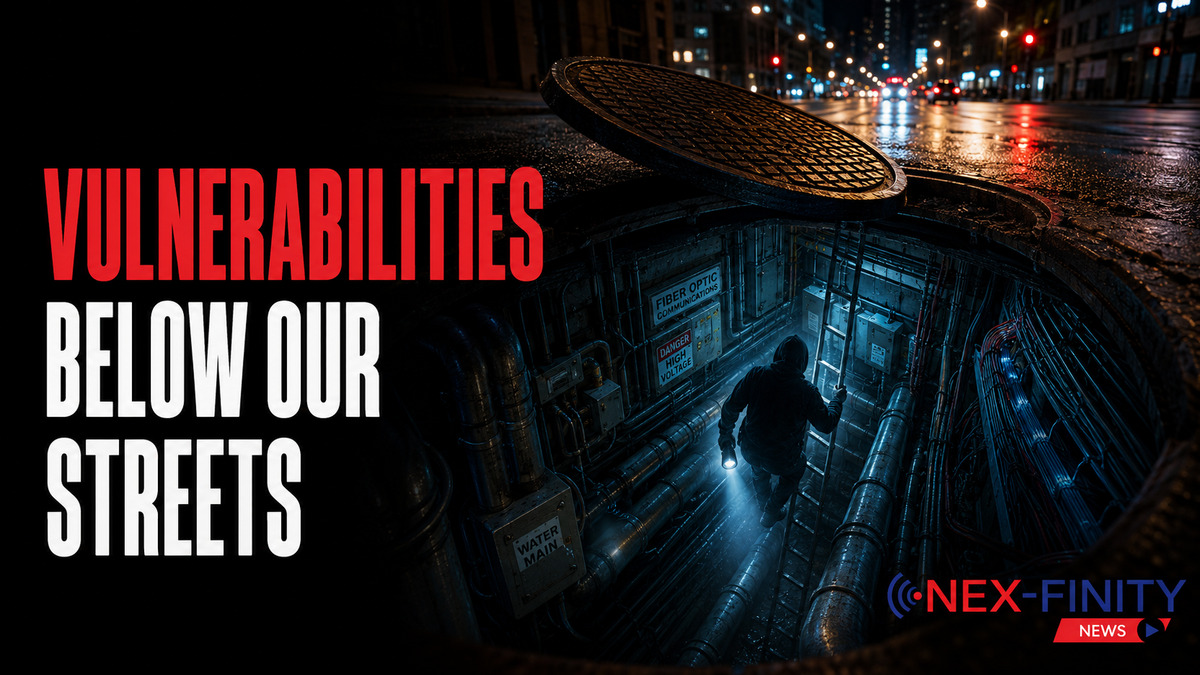
A manhole cover weighs a couple hundred pounds, sits in a public street, and in most American cities is locked to nothing. Lifting one is the entire physical barrier between the sidewalk and the cables running beneath it. People have been lifting them. Groups were filmed climbing into and out of New York sewers on at least five separate occasions this summer, with no explanation offered by anyone. In California, fiber-optic lines have been cut inside roadside manholes on at least three occasions since 2009, taking 911 service down with them, and no one has ever been arrested for any of it.
The most recent outage came three weeks ago. On Sunday, August 9, Verizon customers across Southern California found their phones locked in SOS mode. The company told them the cause was not a software fault or a tower failure. Vandals had cut multiple fiber cables.
Verizon disclosed little about where the cables were cut or how they were reached. It has since offered a $25,000 reward for information leading to an arrest and conviction, and told customers that theft and vandalism against its network threaten community safety directly. Three weeks later, the case appears unresolved.
It is not an isolated event, and it is not a local one. Communications providers reported 18,327 incidents of intentional theft or vandalism against their networks in 2025 roughly 50 a day, affecting more than 11.8 million customers, a 59 percent increase over the year before.
The method in most of these cases is not sophisticated. Someone reaches infrastructure that was never physically secured, and cuts it.
Background: The Number Nobody Talks About
That 18,327 figure works out to an average of 1,527 incidents a month. The estimated societal cost of the resulting outages runs from $294 million to $1.47 billion, with California absorbing $252.6 million and Texas $97.4 million. Ten states account for the large majority of incidents. Los Angeles alone reported 1,131; Houston 532; Dallas 441; St. Louis 361.
Two caveats belong on those figures before anyone builds policy on them. They come from a survey of participating internet service providers compiled by NCTA and USTelecom industry self-reporting, not a government series. Participation is voluntary and internal tracking methods vary between carriers, which the report itself acknowledges. The compilers argue the real total is higher. That may well be true, and it is also exactly what a trade association has an interest in arguing.
What is not in dispute is that no federal agency publishes a comparable count. The best national picture of physical attacks on American communications infrastructure is assembled by the industry that owns it.
In simple terms: the people being robbed are also the people keeping the crime statistics.
What Is Actually Underground
“Manhole” is doing a lot of work in most coverage of this subject, and it obscures the thing that matters: underground utility corridors are owned by different parties, secured to different standards, and accessed through different covers.
In New York City, underground telecommunications in Manhattan and the Bronx run through conduit built and maintained by Empire City Subway, a wholly owned Verizon subsidiary operating under a franchise the city granted in 1891. ECS controls roughly 11,000 manholes and some 58 million feet of conduit, leased to Verizon and to competing carriers and cable operators. Its access points carry their own covers, stamped ECS. Con Edison maintains a separate electrical network. The Department of Environmental Protection’s sewers carry wastewater.
Elsewhere, those systems are not separate at all. Beginning in 2001, CityNet Telecommunications used remotely operated robots built by the Swiss firm Ka-Te marketed as Sewer Access Modules to install stainless-steel-clad fiber conduit inside live sewer pipes as small as eight inches across. Albuquerque, Indianapolis and Omaha signed the first access agreements; Dallas, Fort Worth, Pittsburgh, Scottsdale, St. Paul and Vienna followed. The pitch to cities was that it avoided tearing up streets and turned the sewer into a revenue-generating asset.
The practical consequence is that there is no single answer to what sits behind any given cover, and no single agency responsible for who opens it.
Severance, Not Interception
Documented compromises of American carrier traffic have come through the network, not through the street. The PRC-linked Salt Typhoon campaign reached major U.S. providers including AT&T, Verizon and Lumen by way of network equipment and edge devices, prompting a joint CISA, NSA and FBI hardening guide for communications infrastructure. That is a software and network-architecture problem, and it is being treated as one.
What physical access produces is cruder and, in the immediate term, more disruptive: cutting.
And it has a long unsolved history.
In April 2009, someone in South San Jose lifted a manhole cover, climbed down eight to ten feet and cut four or five fiber-optic cables. Ten lines were severed that night across San Jose and San Carlos. Landline, cellular and internet service across southern Santa Clara County went dark for close to 24 hours. The county’s 911 system was disrupted. ATMs stopped dispensing cash and restaurants took credit card numbers by hand. In Gilroy, a woman fleeing a robbery could not call for help and ran to a firehouse to report it in person. AT&T posted what it called its largest reward ever $250,000. No one was arrested.
It happened again in 2013, when cables were severed beneath manhole covers at two locations south of San Jose on the same night a rifle was fired at a PG&E substation; the Santa Clara County sheriff described it as sabotage and said there was no suspect. It happened in 2015, when fiber was cut inside two manholes on Altamont Pass Road near Livermore, one of a series of Bay Area incidents that drew in the FBI and another $250,000 reward.
Seventeen years separate the first of those cases from this month’s outage in Southern California. The reward amounts have gone down. The incident counts have gone up.
An AT&T spokesman noted at the time that stripped copper has resale value but severed fiber does not, calling it “just pure vandalism.”
That observation cuts deeper than it first appears. The 2026 industry report finds that most modern infrastructure is fiber-based rather than copper, meaning attackers frequently take material with little resale value while inflicting substantial outage and repair costs. In February 2023, someone cut a fiber line in Philadelphia hours before the Super Bowl, knocked out internet and television for tens of thousands of households, found nothing worth taking, and left.
In simple terms: the economics are lopsided in the worst possible direction. The person doing the damage often gains nothing, and the public loses a great deal.
The Consequences Are Not Abstract
Between 2024 and 2026, documented incidents took down an airport’s internet in Sacramento, cell service inside Austin-Bergstrom International Airport, and communications at a Washington state airport alongside a correctional facility in a single cut. In June 2025, vandals in Van Nuys severed thirteen fiber cables, cutting through more than 2,600 individual strands and leaving over 50,000 residential customers and 500 businesses offline for as long as 30 hours. The outage reached 911 dispatch, hospitals, schools, a military base, financial institutions, courts and cell towers. Charter’s Spectrum characterized it as domestic terrorism.
In a separate Los Angeles case cited by the FCC, an elderly woman lost her landline for months after copper thieves stripped the wiring, taking down her medical alert system and home cameras with it. A joint LAPD and city task force eventually made 82 arrests and recovered more than 2,000 pounds of copper.
In 2008, thieves in Jackson, Mississippi stripped copper from five tornado warning sirens. The sirens did not sound.
Speaking at the fourth National Summit on Protecting Critical Communications Infrastructure in Philadelphia on June 4, 2026, FCC Commissioner Olivia Trusty described the problem as escalating into a national security matter. She characterized copper theft as “the gateway” to something more serious. Trusty also noted that rural networks suffer disproportionately, since remoteness makes outages longer and repairs slower.
The Legal Patchwork
Federal law criminalizes willful injury to communications lines under 18 U.S.C. § 1362 but the statute is written around systems operated or controlled by the United States and used for military or civil defense functions. The privately owned commercial networks that carry the overwhelming majority of American traffic, including most 911 routing, largely sit outside it.
H.R. 2784, the Stopping the Theft and Destruction of Broadband Act of 2025, would close that gap. Introduced on April 9, 2025 by Rep. Laurel Lee (R-Fla.) and Rep. Marc Veasey (D-Texas), it would strike the military and civil-defense limitation and extend the statute to facilities providing broadband internet access service regardless of ownership. It was referred to the House Judiciary Committee. Sixteen months later it has not been enacted.
States have moved faster and unevenly. Twenty-three considered protective legislation in 2025 and thirteen enacted it. Colorado, Connecticut, Oregon and Virginia added felony-level protections in 2026, bringing the national total to 28 states which means roughly twenty-two states still do not classify intentional damage to communications infrastructure as a felony. Trusty’s word for the resulting map was a patchwork, and her stated concern was that offenders migrate toward the jurisdictions with the weakest consequences.
Where New York Sits
New York has a bill. It has not finished.
The Prevention of Damage to Critical Infrastructure Act of 2026 S8302-D, sponsored by Sen. Leroy Comrie (D-Queens), and its Assembly counterpart A8675-C, sponsored by Assemblymembers Edward Braunstein and Steven Otis passed the Assembly and cleared the Senate 58-2 on June 4, 2026, with Sens. Jabari Brisport and Kristen Gonzalez voting no. The legislature’s own action log shows it returned to the Assembly after Senate passage and does not record delivery to or signature by the governor.
The bill would write a definition of “critical infrastructure provider” into Penal Law § 145.15, criminal tampering in the second degree (a class A misdemeanor), and § 145.20, criminal tampering in the first degree (a class D felony). The definition is broad on the communications side: cable television companies, internet service providers, cellular carriers, and any other entity providing voice or data communications to the public regardless of its regulatory status. It also rewrites the General Business Law provisions governing junk dealers and scrap processors, requiring government-issued photo identification from sellers and prohibiting the purchase of metal bearing a provider’s name or logo.
Two features of the bill deserve more attention than they have received.
First, it strikes an affirmative defense. Current § 145.15 allows a defendant to argue they did not act for a larcenous or otherwise wrongful purpose. The amended section removes that language. That is a substantive change to the burden in tampering prosecutions, and it has been discussed publicly almost entirely as a scrap-metal bill.
Second, and this is our reading rather than the sponsors’ stated intent: the existing statute explicitly lists property of a “sewer” corporation among the protected categories. The replacement definition is constructed from Public Service Law utility definitions, cable and internet provider definitions, and public authorities. Whether a municipal wastewater agency New York City’s DEP, for instance, or a county sewer district remains within the protected class after that substitution is a question a legislative counsel or criminal defense attorney should answer before this becomes law. If the answer is no, a bill written to expand critical-infrastructure protection would narrow it in one direction while widening it in another.
Analysis
Three failures compound here, and only one of them is about criminals.
Detection has been outsourced. Almost every incident in the public record surfaced through a carrier’s own alarm, a private business camera, or a bystander’s phone. There is no municipal or federal system that notices a manhole being opened at 3 a.m. and flags it. A Department of Homeland Security reference manual recommended more than two decades ago that covers ten inches and larger be secured against unauthorized opening. There is no public accounting of how widely that was implemented, by whom, or at what cost and the absence of that accounting is itself an answer of a kind.
The deterrence math is inverted. The material taken is often worthless. The damage caused is frequently catastrophic and occasionally life-threatening. In roughly twenty-two states the offense is not a felony. The penalty scales to the value of what was stolen rather than to what was broken, which is precisely backward for infrastructure whose worth lies in continuity of service rather than in scrap weight.
The data belongs to the industry. Every serious number in the national conversation traces back to a voluntary carrier survey run by trade associations that are also lobbying for the legislation the survey supports. The findings may be entirely sound. But there is no independent series to check them against, and policymakers are being asked to act on figures they cannot verify.
Conclusion
The San Jose reward has gone unclaimed for seventeen years. In that time the annual incident count has reached eighteen thousand, the affected customer count has passed eleven million, and the federal statute has not changed.
The vulnerability was never sophisticated. It is a heavy metal disc, unlocked, in a public street, above a line that carries emergency calls. Everything downstream of that the outages, the unclaimed rewards, the patchwork of state felony statutes, the bill sitting in House Judiciary follows from a physical access problem that no one has been made responsible for solving.
NexfinityNews has requested comment from the Federal Communications Commission, CISA, AT&T, Verizon, Empire City Subway, NCTA, USTelecom, the offices of Rep. Laurel Lee and Rep. Marc Veasey, and the offices of Sen. Leroy Comrie and Assemblymember Edward Braunstein. This article will be updated.
Key Takeaways
· Providers reported 18,327 incidents of intentional theft or vandalism against communications networks in 2025 roughly 50 a day, affecting 11.8 million customers, a 59 percent increase over 2024. The figures come from a voluntary industry survey, not a government series.
· Estimated societal cost of the resulting outages ranges from $294 million to $1.47 billion.
· On August 9, 2026, cut fiber cables put Verizon customers across Southern California into SOS mode. Verizon has offered a $25,000 reward; the case appears unresolved.
· A 2009 fiber cut reached through a South San Jose manhole took down 911, landline, cell and internet across southern Santa Clara County for nearly 24 hours. A $250,000 reward went unclaimed and no arrests were made.
· The realistic physical threat from underground access is severance, not interception. Documented interception attacks on U.S. carriers came through the network, not the street.
· Attackers often take fiber with no resale value while causing substantial outage and repair costs the economics run against everyone, including the offender.
· 18 U.S.C. § 1362 is written around government-operated systems. H.R. 2784 would extend it to private networks; it has sat in House Judiciary since April 2025.
· Twenty-eight states classify intentional damage to communications infrastructure as a felony, leaving roughly twenty-two that do not.
· New York’s Prevention of Damage to Critical Infrastructure Act of 2026 passed the Senate 58-2 on June 4, 2026. It also strikes an existing affirmative defense in Penal Law § 145.15, a change that has drawn little public attention.
Sources
· NCTA “Protecting Critical Communications Infrastructure: June 2026 Overview” (2025 incident data, economic impact, state legislative tracking)
· USTelecom / NCTA “Protecting the Nation’s Critical Communications Infrastructure from Theft & Vandalism,” Fall 2025 update
· NBC Los Angeles, ABC7 Los Angeles August 9, 2026 Southern California Verizon fiber vandalism outage and $25,000 reward
· FCC Commissioner Olivia Trusty, “Responding to a Growing Threat: Defending Communications Infrastructure from Attack,” Copper Theft Crisis Summit, El Segundo, Oct. 7, 2025 (DOC-415046A1)
· DatacenterDynamics / Charter Communications Van Nuys fiber vandalism labeled domestic terrorism
· Data Center Knowledge, NBC Bay Area, The Register April 2009 San Jose and San Carlos fiber cuts, 911 outage, AT&T reward
· CBS San Francisco 2013 San Jose fiber cuts and PG&E substation sabotage; 2015 Altamont Pass manhole fiber cuts
· Radio World / Wireless Estimator FCC Commissioner Olivia Trusty, 4th National Summit on Protecting Critical Communications Infrastructure, Philadelphia, June 4, 2026
· Route Fifty “Feds call on more states to make network vandalism a felony” (July 2026)
· H.R. 2784, Stopping the Theft and Destruction of Broadband Act of 2025 Congress.gov and GovInfo bill text
· 18 U.S.C. § 1362 Malicious injury to communication lines, stations or systems
· NY Senate Bill S8302-D / Assembly Bill A8675-C bill text, sponsor memo, action log and June 4, 2026 floor vote
· Empire City Subway company site, manhole standards and access protocol documents
· Urban Omnibus “Pulses of Light Beneath the Streets” (ECS conduit and manhole counts)
· Lightwave, WaterWorld, Electrical Contractor Magazine CityNet Telecommunications in-sewer fiber deployment and Ka-Te robotics (2001)
· CISA / NSA / FBI Enhanced Visibility and Hardening Guidance for Communications Infrastructure (Salt Typhoon)
· CISA CI Fortify initiative (2026)
· ABC7 New York “Securing manhole covers” investigation (2009), on DHS cover-securing guidance