
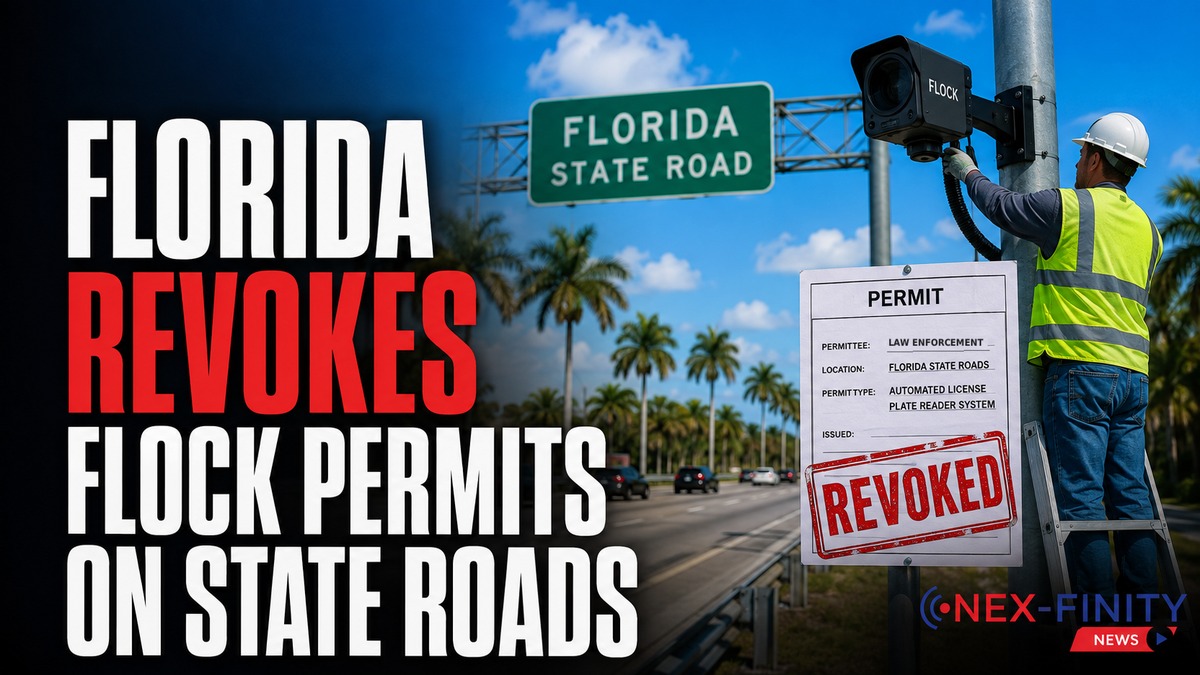
The Florida Department of Transportation revoked every permit it had issued for automated license plate readers in state highway rights-of-way on Monday, August 31, giving law enforcement agencies 30 days to take the equipment down and warning that the department will remove whatever remains after September 30.
The one-page memorandum, signed by FDOT chief operating officer and assistant secretary Will Watts, went further than a rollback. It also closed the pipeline: the department said it will stop processing future requests for license plate reader installations within its jurisdiction entirely.
Within hours, sheriffs across the state began shutting down programs the order did not actually reach.
Background
Automated license plate readers ALPRs, or LPRs photograph passing vehicles and convert the plate images into searchable, timestamped records. The technology dates to the 1970s but spread rapidly in the past several years as camera costs fell and recognition software improved.
Flock Safety, an Atlanta company founded in 2017, became the dominant vendor by pairing the hardware with a shared database. Agencies that contribute their camera data gain the ability to search other agencies’ data through a national lookup tool. Flock told Congress last August that roughly 75 percent of its law enforcement customers had opted in a participation rate driven in part by the company restricting nationwide search access to agencies willing to share.
In simple terms: a camera bought by one small-town police department can be queried by a detective 1,500 miles away.
That architecture is what turned a local procurement decision into a national argument. According to a tally compiled by the California civil liberties group Social Justice, more than 200 cities and counties nationwide have terminated Flock contracts.
What the Order Actually Does
The memo’s scope is narrower than the reaction to it. It applies only to the State Highway System interstates and state-maintained roads, and the strips of land adjacent to them.
Gov. Ron DeSantis put the figure at 98 percent for cameras sitting outside that footprint, on private property or on county and municipal rights-of-way. Those cameras were untouched by Monday’s action. Orange County alone operates roughly 160 units at an annual cost of about $158,000.
Watts cited three grounds in the memo: a sharp recent increase in deployments along Florida roadways, reports of misuse, and what the document called surveillance schemes. The stated purpose was preserving Floridians’ sovereignty and quality of life.
The order is administrative, not legislative. It rests on FDOT’s discretionary authority over what gets installed in the land it controls. A future transportation secretary could reverse it without a vote.
The Misuse Cases
The privacy argument in Florida did not arrive as an abstraction. It arrived as a series of arrests.
In Haines City, an officer was arrested after investigators alleged he ran searches on his estranged wife’s vehicle more than 700 times between September 2024 and June 2026. A former Sumter County detective was fired and charged after investigators alleged she used Flock and other databases to gather information on her husband’s former wife. Other Florida officers have faced accusations involving former romantic partners.
DeSantis pointed to the pattern directly, arguing that penalties for that category of misuse are weak.
Privacy researchers make a further point that is difficult to rebut: the known cases are the ones where someone noticed. Audit logs only produce accountability when somebody reads them.
The Cascade
Monday’s order technically obligated agencies to move cameras out of state right-of-way. A number of sheriffs read it as a signal and shut down entirely.
The Jacksonville Sheriff’s Office said it would discontinue license plate reader technology across Duval County a jurisdiction of roughly one million residents effective immediately, while still calling the technology a valuable investigative tool. Putnam County Sheriff H.D. “Gator” DeLoach ordered all 18 of the county’s readers disconnected immediately and removed within 30 days. Clay County Sheriff Michelle Cook, Nassau County Sheriff Bill Leeper, Liberty County Sheriff Dusty Arnold, and Brevard County Sheriff Wayne Ivey announced discontinuations or suspensions. Pasco County Sheriff Chris Nocco had already committed to terminating by September 30 after two county commission meetings in which commissioners objected.
Volusia County Sheriff Mike Chitwood shut his program down while objecting to the reasoning, saying the readers had solved violent crimes and that recent state directives had made the technology unworkable in Florida.
The Oviedo City Council voted to pull eight cameras at the city’s boundaries and defund the program after residents raised objections.
The Company’s Response
Flock called an outright ban the wrong remedy. Founder and CEO Garrett Langley compared banning the technology to banning vehicles, and the company defended the readers as a tool for solving serious crimes, locating missing people, and recovering stolen vehicles.
Flock has also been moving. In a video statement in August, Langley announced that the company’s Audit Assistance system would become mandatory for every law enforcement customer. The system flags anomalous behavior repeated searches for the same plate, searches run while an officer is off duty and can automatically lock out flagged users pending review. By the end of the year, the company said, most searches will require a case code tying the query to an open investigation, with emergency searches permitted to bypass the requirement but flagged for later review. Flock is also cutting its default retention window from 30 days to seven, though agencies may elect longer periods.
In the same statement, Langley committed the company to three limits: it will not sell its data to third parties, will not add facial recognition, and will not weaponize its drones. He framed the obligation as a condition of selling a capability this powerful.
Those commitments are corporate policy. They are not Florida law, they carry no statutory penalty, and no state agency is charged with verifying them.
The Part Nobody Ordered Stopped
Here is where the accountability picture gets complicated.
At his Jacksonville press conference Monday, DeSantis warned that a company able to assemble a record of a person’s movements could make a fortune selling it for advertising and product placement. He said Florida must not become a digital AI surveillance state, and he called on the Legislature to act.
Florida’s own Department of Highway Safety and Motor Vehicles has been in the driver-data business for more than 15 years.
Rep. Peggy Gossett-Seidman (R-Highland Beach) filed HB 357, the Motor Vehicle Operator Privacy Act, in November 2025 after finding that FLHSMV had generated more than $490 million selling driver information to private companies, data brokers, insurance analytics firms, and foreign-owned entities. The categories of information involved included names, addresses, dates of birth, license numbers, driving histories, crash records, vehicle information, organ donor status, and in some cases driver photographs. An earlier investigation found the state sold to more than 30 private companies, taking in $77 million in 2017 alone, some records priced at pennies.
The bill would have banned commercial sales outright, blocked foreign-owned access, and required written consent before non-law-enforcement disclosure. It died in the House in March 2026.
Florida is not unusual here. State motor vehicle agencies across the country treat record sales as a budget line. But the sequencing matters: the state ordered private-sector cameras off its roads for collecting movement data while its own agency continued selling identity data, legally, under an existing statutory framework that the Legislature declined to change five months ago.
DeSantis also noted a second exception in his own remarks toll-by-plate. Florida’s Turnpike Enterprise photographs plates at every gantry statewide and bills the registered owner. The governor drew a line between tolling and criminal enforcement, which is a defensible distinction on purpose. It is a thinner one on data.
Analysis
Three things are true at once, and the coverage has mostly picked one.
The order is real but small. By the governor’s own accounting, it reaches about 2 percent of the cameras in Florida. Its practical force came from the sheriffs who chose to read it as policy direction rather than a right-of-way instruction. Those decisions are reversible by the same sheriffs, or their successors.
The reform is voluntary. Flock’s mandatory auditing, case-code requirement, shortened retention, and no-sale pledge are the most substantive concessions the company has made. They are also self-administered. There is no Florida statute requiring an audit trail, no penalty schedule for improper queries beyond existing computer-misuse law, and no state body auditing the auditor. Sen. Ron Wyden’s office concluded in October 2025 that the company could not meet privacy commitments it had made in Oregon; he and Rep. Raja Krishnamoorthi asked the FTC to investigate the company’s security practices the following month.
The Legislature is the only durable actor, and it has already passed once. DeSantis said the Florida Senate approved an AI bill of rights 39-1 and the House declined to take it up. HB 357 met the same fate. An administrative memo can be rescinded; a statute cannot, not without another vote. Everything the governor described Monday as urgent has an existing legislative vehicle that failed.
Florida Democratic Party Chair Nikki Fried argued the technology was allowed to proliferate without safeguards under Republican leadership a criticism that lands, though the driver-data bill that died was filed by a Republican and the chamber that killed it is the one both parties have to work through.
What Comes Next
The removal deadline is September 30. Watch for four things.
Whether agencies that announced full shutdowns actually terminate contracts or simply relocate cameras from state right-of-way to county and municipal poles, which the order permits.
Whether the Legislature takes up an ALPR statute in the session beginning in January, and whether it covers retention limits, audit requirements, query justification, third-party sharing, and penalties or only camera placement.
Whether the driver-data question returns. HB 357’s core finding that the state has monetized resident data at scale has not been rebutted, only shelved.
And whether Flock’s January safeguards ship as described. The case-code requirement is the meaningful one. Retention windows limit how far back a search can reach; a case code limits whether the search should have happened at all.
Conclusion
Florida did something on Monday that no other state had done at this scale, and the reaction from law enforcement was faster and broader than the order itself required. That is worth reporting accurately rather than expansively.
What Florida did not do is prohibit anyone from selling license plate or driver data. The company volunteered a no-sale commitment. The state kept its own sales legal. The distinction between those two facts is the whole question of whether this week represents a privacy reform or a right-of-way cleanup.
Key Takeaways
· FDOT revoked all permits for license plate readers in state highway rights-of-way on August 31, 2026, with a 30-day removal deadline of September 30 and no new permits going forward.
· The order covers only the State Highway System. DeSantis estimated 98 percent of Florida’s cameras sit on private property or local rights-of-way and are unaffected.
· At least eight sheriffs’ offices, including Jacksonville’s, went further than the order required and shut down their programs entirely.
· Flock Safety has made auditing mandatory, is cutting default retention from 30 days to seven, will require case codes on most searches by year end, and has pledged not to sell data to third parties. All of it is voluntary corporate policy, not Florida law.
· Florida’s own DHSMV has generated more than $490 million selling driver data. HB 357, which would have banned commercial sales, died in the House in March 2026.
· The order is administrative and reversible. No statute governs ALPR retention, audit, or query justification in Florida.
Sources
· Florida Department of Transportation, Engineering and Operations Memorandum, Will Watts, August 31, 2026
· NBC News, “Florida bans Flock and other license plate readers from state highways as backlash grows”
· Florida Phoenix, “Sheriffs drop license plate readers as DeSantis warns against ‘surveillance state,'” August 31, 2026
· News4JAX, “DeSantis says Florida must avoid becoming a ‘digital AI surveillance state,'” August 31, 2026
· FOX 35 Orlando / FOX 13 Tampa Bay, coverage of FDOT order and Flock policy changes, August 31, 2026
· WRAL, “Flock Safety’s CEO says safeguards will be added to cameras in January,” August 2026
· Action News Jax, “Florida revokes permit for 34 Nassau County license plate reader cameras,” August 31, 2026
· ClickOrlando/WKMG, “Florida revokes all permits for Flock cameras on state roads,” August 31, 2026
· Florida House of Representatives, HB 357 (2026), Motor Vehicle Operator Privacy
· WFTV, “Driver data sales remain legal in Florida as privacy bill fails,” March 16, 2026
· WPTV/Tampa Bay 28, “Florida lawmaker moves to stop state from selling driver data,” November 2025
· Office of Sen. Ron Wyden, letter to Garrett Langley, October 16, 2025; Wyden/Krishnamoorthi letter to FTC Chair Ferguson, November 3, 2025