
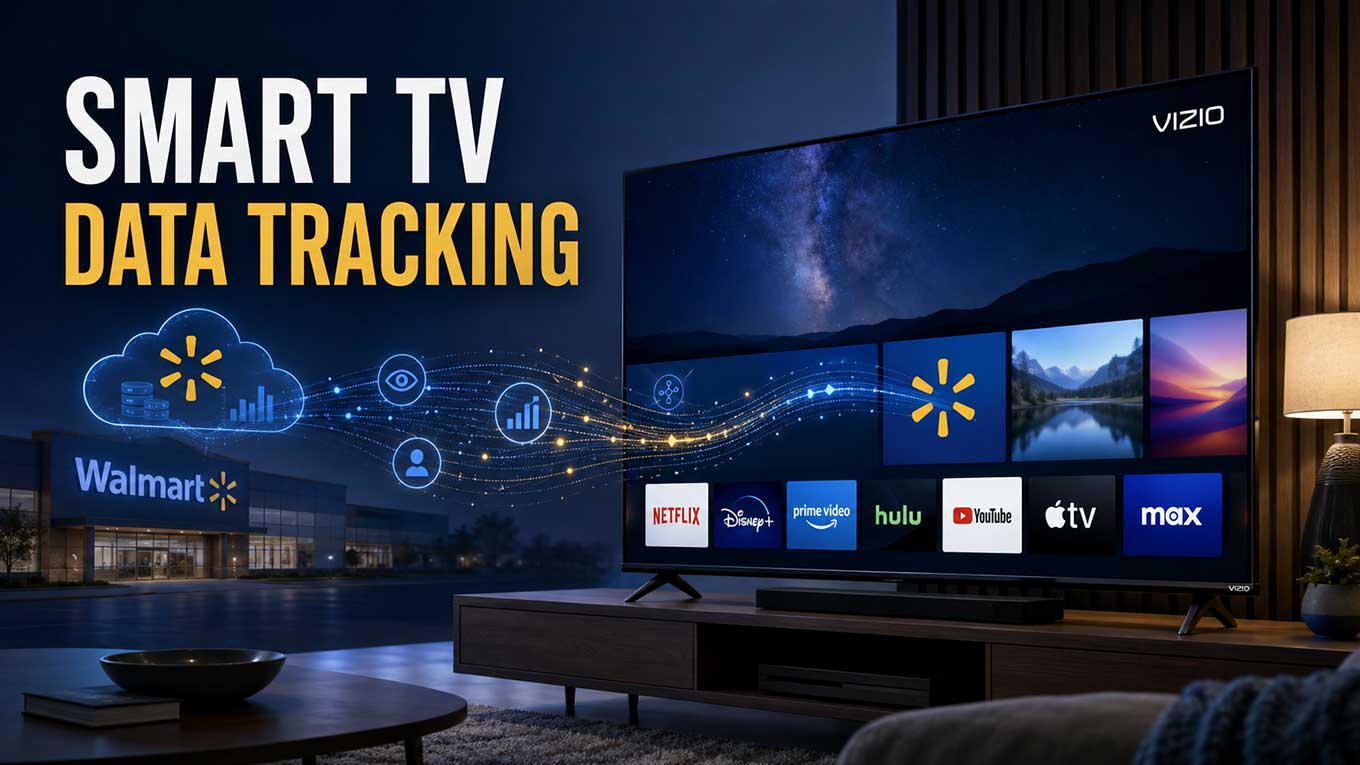
Since mid-March 2026, Walmart has required owners of select new Vizio televisions to sign in with a Walmart account before they can finish setting up the television or use its smart features. The retailer announced the change on March 23, 2026, at the IAB NewFronts, the annual event where media companies pitch advertisers on the coming year’s inventory.
The requirement extends to onn-branded televisions, Walmart’s house electronics line, which now run Vizio’s operating system. Walmart has never disclosed which specific models or SKUs are affected — a gap that has persisted through five months of the policy being in force.
What looked in March like a single company’s product decision now reads as the opening move in a broader consolidation. In the months since, Fox agreed to acquire Roku for $22 billion and Walmart agreed to buy a second connected-TV advertising platform. In each case, the asset being purchased was a direct relationship with households and the data that relationship produces.
Background
Walmart closed its acquisition of Vizio on December 3, 2024, paying $11.50 per share for roughly $2.3 billion in fully diluted equity value. Vizio was delisted from the New York Stock Exchange the same day and became a wholly owned subsidiary reported within the Walmart U.S. segment. Founder William Wang continued to lead the company under Seth Dallaire, Walmart’s executive vice president and chief growth officer. At closing, Vizio’s SmartCast platform had approximately 19 million active accounts.
The financial logic of the deal is visible in Vizio’s last quarter as a public company. Its Platform+ segment — essentially the advertising business — reported gross profit of $115.8 million. Its Device segment, the televisions themselves, reported a gross loss of $6.7 million.
In simple terms: Vizio has not made money selling televisions for years. It makes money on what the television does after it is plugged in, and the low sticker price is the acquisition cost of an advertising viewer.
Walmart’s own advertising business has grown into the second pillar of that model. Global advertising revenue reached $6.4 billion in fiscal year 2026, a 46 percent increase year over year. On the February 19, 2026, earnings call, Chief Financial Officer John David Rainey reported triple-digit growth in advertising tied to Vizio, and Walmart disclosed that advertising and membership income together accounted for roughly one-third of operating profit — a significant shift for a company historically defined by thin retail margins.
What the Requirement Does
A Walmart spokesperson told Ars Technica in March that a Walmart account is mandatory on select new Vizio OS televisions for owners to complete onboarding and to use smart TV features. Walmart’s own support documentation states that beginning in mid-March 2026, customers must sign in with or create a Walmart account when setting up a new Vizio or onn set, and that the account is required for smart TV features and streaming apps.
Customers with an existing Vizio account are offered a merge into a Walmart account. Customers who decline can delete their Vizio account, but doing so removes access to smart features. Those who delete are reported to have a 30-day window to request a copy of their stored data.
Vizio had already required an account for smart functionality since mid-2024. What changed in March 2026 is whose account it is, and what other data that account is already attached to.
Vizio’s privacy policy describes a consent toggle governing whether Vizio OS data is combined with Walmart account data. The category Vizio calls “VIZIO OS Data” includes viewing data, activity data, mobile app data and mobile streaming data. Notably, the supplemental disclosure states that even when the toggle is off, “limited disclosure to Walmart of VIZIO OS Data may continue,” including for aggregate audience measurement, aggregate advertising performance reporting and pseudonymized target audience groups.
That same disclosure names the recipients when the toggle is on: Walmart Connect, the company’s internal advertising network, along with advertisers, ad measurement providers, ad tech and analytics vendors, and corporate affiliates including Sam’s Club.
The underlying collection technology is automatic content recognition, or ACR. Vizio’s Viewing Data Supplement describes ACR as capturing what is playing on the display in real time — programming, advertisements, channel and input information, picture controls and volume, and whether the set is on or off.
In simple terms: ACR identifies what is on the screen regardless of where the signal came from. Plugging a Roku or an Apple TV into the HDMI port does not place that content outside the television’s field of view.
Walmart’s Stated Rationale
Walmart’s NewFronts announcement framed the login as a convenience and security measure that also serves advertisers, describing it as establishing an identity framework across devices and “connecting streaming engagement directly with retail interaction.”
A Walmart representative told Ars Technica the integration is “designed to respect consumer choice and privacy,” with data used in aggregated, permissioned and compliant ways, but did not specify what data is collected or how consent is obtained. That level of specificity has not been added in the months since.
Alongside the account requirement, Walmart announced a branded content partnership with L’Oréal placing product integrations inside Vizio’s streaming environment that link directly to Walmart product pages. The company cited internal figures claiming 65 percent of surveyed customers said connected TV advertisements helped them discover new products, and that successful Walmart Connect CTV campaigns delivered a median 44 percent view rate.
Vizio’s chief revenue officer has said the combined Vizio and onn footprint gives the operating system potential reach into 25 to 30 percent of U.S. households. Walmart serves roughly 150 million U.S. shoppers weekly.
Regulatory Context
Vizio has prior federal enforcement history on this precise issue. In February 2017, the company agreed to pay $2.2 million to settle Federal Trade Commission and New Jersey Attorney General charges that it collected viewing histories from 11 million televisions without consent. The payment comprised $1.5 million to the FTC and $1 million to New Jersey, with $300,000 suspended.
According to the FTC complaint, beginning in February 2014, Vizio captured second-by-second information about what appeared on screen, then appended demographic attributes to those viewing records — including sex, age, income, marital status, household size, education level, home ownership and home value — and sold the resulting profiles to third parties for cross-device ad targeting. The consent order, approved 3-0, required affirmative express consent for collection, deletion of data gathered before March 1, 2016, a comprehensive privacy program and biennial assessments.
State enforcement has since accelerated. On December 15, 2025, Texas Attorney General Ken Paxton sued Sony, Samsung, LG, Hisense and TCL, alleging unlawful ACR collection without consumer knowledge or consent. A Texas court issued a temporary restraining order against Hisense two days later. On February 26, 2026, Samsung reached an agreement requiring express consent from Texas consumers before ACR data is collected or processed.
Vizio was not named in the Texas action, and has not been named in the five months since the account requirement took effect.
Legislatures are moving more slowly. In Kentucky, House Bill 692 passed the state House 92-0 on March 13, 2026, and the Senate 38-0 on March 31, 2026. As amended, it would bar controllers from collecting ACR data without consumer consent, taking effect July 1, 2027, if enacted.
How to Opt Out
There is no way to opt out of the account requirement itself on an affected set. Walmart’s setup flow presents sign-in or account creation with no skip option. What consumers can do is limit what the account collects and what leaves the device. The controls below are drawn from Vizio’s published privacy documentation.
1. The television still works without smart features. Declining the account leaves the set functional as a display. HDMI inputs and over-the-air antenna tuning continue to operate. What is locked is the built-in app store, streaming apps, WatchFree+ and voice search. An external streaming device — Roku, Apple TV, Fire TV, Chromecast — restores app access independently of Walmart’s account system.
2. Turn off Viewing Data. This is the single most consequential setting, because it stops the ACR feed. Per Vizio’s combination disclosure, the paths are:
- Newer Vizio OS sets: All Settings > Privacy & Legal > Viewing Data
- Older sets: All Settings > Admin & Privacy > Viewing Data
- SmartCast sets before 2020: Menu > System > Reset & Admin > Viewing Data
The toggle remains available after a Walmart account merge. It is independent of the account requirement — turning it off does not restore locked smart features, and creating the account does not remove the toggle.
3. Decline the “Consent to Combine” toggle. Vizio states it maintains Vizio OS data separately from Walmart account data unless and until the customer opts in. Consumers should be aware of the stated limit: the policy says limited disclosure to Walmart may continue whether the setting is on or off, for aggregate measurement and pseudonymized audience groups.
4. Exercise state privacy rights at the Walmart account level. Under the California Consumer Privacy Act and comparable statutes in roughly a dozen other states, residents can opt out of the sale or sharing of personal information, including for targeted advertising. Walmart provides this through the “Your Privacy Choices” link in the Walmart.com footer, which leads to a privacy rights request form covering access, deletion and opt-out.
Vizio’s Ads and Privacy FAQ states that if a customer signs in to a Vizio OS product with a Walmart account that has opted out of sale and sharing, the company will honor that opt-out on account-linked devices running firmware that supports the feature, and that Walmart will email instructions if a linked device is not yet eligible.
The important caveat is in the same FAQ: an opt-out from sale and sharing does not stop collection. Viewing data continues to be gathered for personalization unless the Viewing Data toggle is switched off on the set itself.
5. Enable Global Privacy Control in your browser. GPC is a browser-level signal that communicates an opt-out request automatically. Roughly a dozen states — including California, Colorado, Connecticut, New Jersey and Texas — require covered businesses to honor it. Firefox and Brave transmit it by default; other browsers support it through an extension.
6. Use Limit Ad Tracking on older sets. For Vizio OS products on older firmware with no user account or with a legacy Vizio account, the Limit Ad Tracking setting in the settings menu restricts targeted advertising on the device.
7. Residual collection to be aware of. Vizio’s documentation states that Activity Data on Vizio OS sets can be turned off only by restoring the television to factory settings — which would return the owner to the setup screen requiring a Walmart account. Mobile Streaming Data collection in the Vizio mobile app is stopped by reinstalling the app and declining WatchFree+.
8. If you already have a Vizio account and want out. The merge prompt offers deletion as the alternative. Deleting removes access to smart TV features. Vizio’s account and unsubscribe page consolidates viewing data, advertising and communication preferences. Consumers who delete should request a copy of their data within the 30-day window before it becomes unavailable.
Consumer Reports maintains a general guide to disabling ACR across manufacturers, relevant to households running sets from more than one brand.
Analysis
The account requirement tests a distinction that existing privacy frameworks handle poorly.
American privacy law largely operates on a notice-and-choice model: a company discloses what it collects, and the consumer consents or walks away. That model was built for free, ad-supported services, where the exchange of attention for data is at least legible. A television is a purchased good. The buyer has already paid, and the data condition attaches after the transaction, at the setup screen.
The FTC’s 2017 order against Vizio treated granular household viewing activity as sensitive information — believed at the time to be the first such designation by the Commission. It required affirmative express consent. Whether consent obtained at a setup screen that otherwise halts a purchased device qualifies as freely given is an unresolved question, and one no federal or state regulator has publicly tested against Walmart in the five months the policy has operated.
Consumer response has been muted, confined largely to technical publications and privacy forums. The practical reason is straightforward: most buyers of a discounted Vizio at Walmart already have a Walmart account, and one more login screen does not register as unusual.
What Gets Bought Next
The more consequential development since March is not the setup screen. It is what the Vizio transaction demonstrated to every other company sitting on a household dataset.
On June 15, 2026, Fox Corporation agreed to acquire Roku for $160.00 per share in cash and stock, valuing Roku at approximately $22 billion in enterprise value. The announcement named the assets plainly: Roku’s connected TV platform, The Roku Channel, its first-party data, and a direct relationship with more than 100 million global streaming households.
Eight days later, Walmart agreed to acquire Vibe.co, a self-serve connected-TV advertising platform aimed at small and mid-sized advertisers. Walmart did not disclose terms; the Wall Street Journal reported a price around $1.4 billion, while Retail Dive later reported $1.2 billion in cash. The deal is subject to Hart-Scott-Rodino antitrust review and is expected to close by the end of Walmart’s fiscal 2027.
That is roughly $23 billion committed to connected-television data assets inside nine days, by two buyers, eighteen months after the Vizio deal closed.
The thesis was published in advance. In November 2024, days after the Vizio acquisition closed, Needham analyst Laura Martin argued Roku would be acquired at a large premium, listing the reasons a buyer would pay: installed base, unique data sets, pricing power, shelf space, buy-versus-build advantages, and the fact that Roku was the only scaled connected-TV platform still available for purchase. Martin named several categories of plausible acquirers — streamers, connected-TV ad buyers, retailers, and large language model developers hungry for data points. The call was early by roughly eighteen months and the buyer was a legacy broadcaster rather than a retailer, but the underlying logic held.
With Roku spoken for, the question becomes which datasets remain unowned.
A caveat on what follows. NexfinityNews is not reporting that any company named below is in acquisition talks, and none has confirmed any. What follows is an analysis of which assets match the profile that Vizio, Roku and Vibe.co established: a direct consumer relationship, a dataset that cannot be replicated by purchasing third-party data, and a business where the data is worth more inside a larger buyer than it is standalone. This is not investment advice.
Automatic content recognition pure-plays. The clearest structural match. Samba, formerly Samba TV, embeds content-identification software in televisions sold by manufacturers including Sony and states on its corporate site that it holds first-party TV and web data covering 1.5 billion people. The company filed to go public in 2021 and never completed the offering, leaving it private and standing on the same asset Walmart paid $2.3 billion for. Alphonso sits inside LG Ads. Inscape, Vizio’s ACR arm, is now Walmart’s. Measurement firms in adjacent positions include VideoAmp and iSpot.tv.
Remaining connected-TV operating systems. After Roku, the independent scaled platforms thin out quickly. VIDAA belongs to Hisense — a defendant in the Texas ACR action. Titan OS operates in Europe. Xumo is a Comcast-Charter joint venture. Telly, which gives televisions away outright in exchange for an always-on advertising screen, is the purest expression of the model and is privately held. The Trade Desk built Ventura OS rather than buy one.
Grocery and receipt-level purchase data. The category closest to Walmart’s own advantage. Instacart, which trades publicly as Maplebear, holds basket-level grocery data across hundreds of retail banners and has been acquiring aggressively — most recently a computer-vision shelf-intelligence company in July 2026. Ibotta and Fetch monetize scanned receipts, which capture purchases across every retailer rather than one. Inmar sits on promotions and returns data. Kroger’s 84.51° is captive but demonstrates what the asset is worth.
Transaction and location data. Cardlytics converts bank transaction records into advertising audiences and has traded well below its former valuation, a combination that historically precedes acquisition. Life360 tracks family location across tens of millions of users and has spent the past two years buying advertising technology — Fantix and, for $120 million, Nativo — which positions it as either an acquirer or a more valuable target. Foursquare and Placer.ai hold foot-traffic datasets.
Health and biometric data — with a warning attached. The precedent here is not hypothetical. When 23andMe entered Chapter 11 in March 2025, the principal asset in the estate was the DNA profiles of more than 15 million customers. More than two dozen state attorneys general sued to block the transfer, arguing genetic information is categorically unlike the assets a bankruptcy court normally reassigns. The court permitted the sale anyway, to the nonprofit TTAM Research Institute for $305 million, on the reasoning that the buyer would honor existing privacy policies. As one legal analysis concluded, bankruptcy sales of sensitive personal data may proceed with minimal new consent obligations so long as existing policies carry over.
That ruling establishes the operative rule for every consumer wearable, sleep tracker and fitness platform now holding continuous biometric records. A privacy policy is a promise made by a company that can be sold, and the promise transfers with the company.
What this means in practice. The Walmart requirement and the acquisition wave are the same phenomenon viewed at different scales. A dataset assembled under one company’s privacy policy can be revalued the moment ownership changes, and consumers who consented to the original arrangement are rarely asked again. Vizio owners consented to a television manufacturer’s data practices in 2024. In 2026 those practices belong to the largest retailer in the United States, and the setting that would sever the connection is three menus deep.
Impact on Consumers
Existing Vizio owners are still not subject to the account requirement, though the company has indicated the merge will eventually extend to them. For buyers of affected new models, the practical choice is between a fully featured smart television tied to a retail identity, a display driven by an external streaming device, or a set with the account created and viewing-data collection switched off — a configuration that preserves app access while removing the second-by-second content feed.
None of those options restores the pre-2024 arrangement, in which a television could be set up and used without an account of any kind.
Conclusion
The Walmart-Vizio integration was never a policy change so much as the visible completion of a business model assembled in public over two years. The televisions were always sold near or below cost. The revenue was always downstream. What changed in March is that the identity layer connecting the two became mandatory, and that it belongs to a retailer rather than a device maker.
The five months since have answered one question and sharpened another. The answered question is whether the Vizio deal was an outlier: $23 billion in connected-television data acquisitions across nine days in June says it was a template. The sharpened question is whether merger review is equipped to evaluate a transaction whose principal asset is a record of what households watch and buy. Hart-Scott-Rodino review examines competitive overlap. It was not built to ask what happens to a privacy commitment when the company that made it is sold.
Key Takeaways
- Since mid-March 2026, select new Vizio OS and onn televisions have required a Walmart account to complete setup and use smart features. Walmart has still not disclosed which models are affected.
- There is no opt-out from the account requirement itself. There are opt-outs from the data collection: the Viewing Data toggle on the set, the consent-to-combine toggle, and state-law opt-outs from sale and sharing at the Walmart account level.
- Turning off sale and sharing does not stop collection. Only the on-device Viewing Data toggle stops the ACR feed.
- Fox agreed to acquire Roku for approximately $22 billion on June 15, 2026, citing first-party data and a direct relationship with more than 100 million streaming households. Walmart agreed to acquire CTV platform Vibe.co eight days later, reported at $1.2 billion to $1.4 billion.
- Assets matching the same profile and not yet consolidated include ACR data firms such as Samba, purchase-data platforms including Instacart and Ibotta, transaction and location firms including Cardlytics and Life360, and independent CTV operating systems. No acquisition talks have been reported for any of these.
- The 23andMe bankruptcy established that sensitive consumer data can transfer in a sale without fresh consent, provided the buyer honors the existing privacy policy — a precedent that applies to any dataset assembled under a promise.
- Vizio paid $2.2 million in 2017 to settle FTC and New Jersey charges over collecting viewing data from 11 million televisions without consent. Texas sued five other TV makers over ACR in December 2025 and reached an agreement with Samsung in February 2026. Vizio was not named.
Sources
- Walmart and VIZIO Scale Content to Commerce at NewFronts — Walmart Corporate, March 23, 2026
- Scharon Harding, Newly purchased Vizio TVs now require Walmart accounts to use smart features — Ars Technica, March 24, 2026
- Walmart Completes Acquisition of VIZIO — Walmart Corporate, December 3, 2024
- VIZIO Holding Corp. Reports Q3 2024 Financial Results — BusinessWire, November 1, 2024
- Walmart’s Ad Revenue Totaled $6.4 Billion In 2025 — AdExchanger, February 20, 2026
- VIZIO Privacy Policy, with the Combine VIZIO OS Data with Your Walmart Account Data, Viewing Data Supplement and Ads & Privacy FAQ supplements
- VIZIO & onn powered by VIZIO TV Setup — Walmart Help Center
- VIZIO to Pay $2.2 Million to FTC, State of New Jersey — Federal Trade Commission, February 6, 2017
- Paxton Sues Five Major TV Companies — Office of the Texas Attorney General, December 15, 2025
- Paxton Secures Court Order Stopping Smart TV Company from Spying on Texans — Office of the Texas Attorney General, December 17, 2025
- Paxton Secures Major Agreement with Samsung — Office of the Texas Attorney General, February 26, 2026
- House Bill 692 — Kentucky General Assembly, 2026 Regular Session
- Fox Corporation to Acquire Roku, Inc. — Fox Corporation, June 15, 2026
- Walmart to Acquire Vibe.co to Expand Access to Connected TV Advertising — Walmart Corporate, June 23, 2026
- Chris Kelly, What Walmart’s Vibe.co deal means for CTV, retail media convergence — Retail Dive, June 30, 2026
- Needham predicts Roku will be acquired for big premium — The Fly, November 2024
- Samba company overview and Samba TV Form S-1 (2021) — U.S. Securities and Exchange Commission
- Instacart Acquires Arpalus — PR Newswire, July 16, 2026
- A Rundown Of (Pretty Much) Every Ad Tech Deal Of 2025 — AdExchanger, December 2025
- Judge OKs sale of 23andMe — and its trove of DNA data — NPR, June 30, 2025
- 23andMe Bankruptcy Update — Foley Hoag LLP, July 2025
- How to Turn Off Smart TV Snooping Features — Consumer Reports