
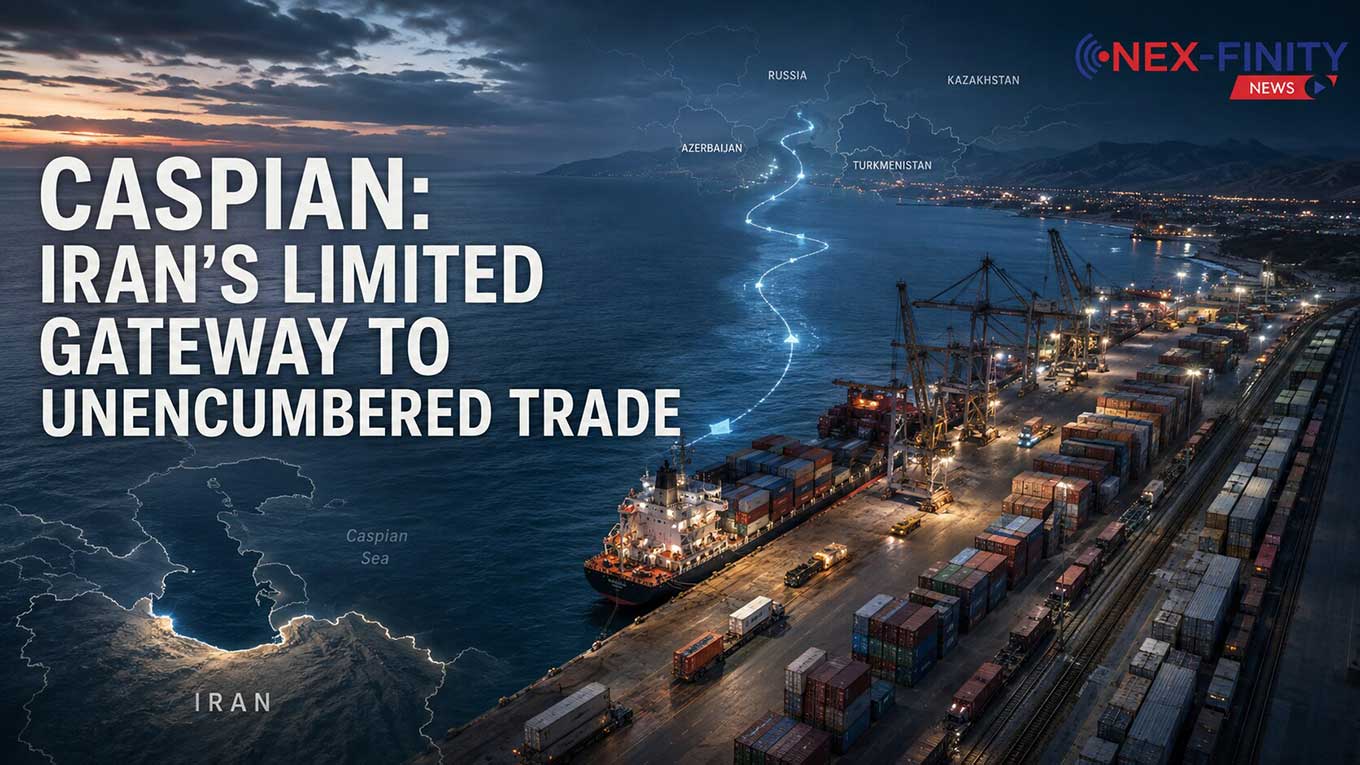
The U.S. naval blockade of Iran is frequently described as a total maritime cutoff. By the U.S. military’s own definition, it is not. It covers Iran’s southern coastline the Persian Gulf and the Gulf of Oman and nothing else.
Iran has a second coastline. It runs roughly 650 kilometers along the southern shore of the Caspian Sea, and it holds five commercial ports: Bandar Anzali, Amirabad, Nowshahr, Astara, and the newer Caspian Port inside the Anzali Free Zone. No U.S. warship has ever entered the Caspian, and under the 2018 Convention on the Legal Status of the Caspian Sea signed by all five littoral states no non-littoral military vessel can.
That leaves an open door in a policy designed to close them. The question is how much cargo is actually moving through it, whether the volume has risen since the blockade took effect on April 13, 2026, and what that cargo consists of.
The answers are, in order: more than a year ago, but less than the headline figures suggest; yes, though most of the growth predates the blockade; and according to a European government document reported by NBC News on August 17 drone components, ammunition, and TNT alongside the wheat.
It is a gateway. It is also a narrow one, and that combination is the whole story.
Background: What the Blockade Actually Covers
The blockade began at 10 a.m. ET on April 13, 2026, after talks in Islamabad between U.S. and Iranian negotiators collapsed. It was ordered by President Donald Trump and executed under Adm. Brad Cooper at U.S. Central Command, with interdiction outside the Gulf handled by Adm. Samuel Paparo at U.S. Indo-Pacific Command.
CENTCOM’s framing of the operation was specific. It stated that enforcement would apply impartially to vessels of all nations entering or departing Iranian ports and coastal areas, and named the covered waters as Iran’s Persian Gulf and Gulf of Oman ports. It also stated that vessels transiting the Strait of Hormuz to and from non-Iranian ports would not be impeded. Days later, Defense Secretary Pete Hegseth and Gen. Dan Caine clarified in a Pentagon briefing that the blockade was on Iran’s ports and coastline rather than on the strait itself.
In simple terms: the blockade is a ring drawn around Iran’s southern ports, not around Iran.
The operation was lifted on May 29, 2026 following U.S.–Iran negotiations, then reinstated after the June 17 memorandum of understanding between Trump and Iranian President Masoud Pezeshkian broke down. It remains in force. The Congressional Research Service’s running assessment of the Hormuz crisis tracks the sequence.
Enforcement in the south has been aggressive. CENTCOM reported turning away 94 vessels by May 22. U.S. forces seized the Iran-flagged cargo ship Touska on April 19 after disabling its engine room with gunfire from the destroyer USS Spruance. The Pentagon estimated Iran lost $4.8 billion in oil revenue between April 13 and May 1 alone, with 31 tankers holding roughly 53 million barrels stranded in the Gulf.
The blockade is not airtight even where it applies. Lloyd’s List reported that at least 26 Iranian shadow-fleet vessels had bypassed the blockade line in both directions by April 20, including 11 tankers that exited the Gulf of Oman with Iranian cargo.
But the Caspian requires no evasion at all. It was never inside the ring.
Why the Caspian Cannot Be Blockaded
The Caspian is the world’s largest inland body of water, bordered by Russia, Iran, Azerbaijan, Kazakhstan, and Turkmenistan. It connects to the global ocean only through Russian inland waterways the Volga, the Volga-Don Canal, and the Volga-Caspian Sea Shipping Canal.
There is no naval approach for a non-littoral power. The 2018 Aktau convention bars military vessels of non-Caspian states from the sea entirely, and the physical route in would run through Russian locks in any case. As University at Albany professor Christopher Clary noted in April, Iran retained Caspian access to Russia and Kazakhstan throughout the blockade.
That is a structural constraint on U.S. options, not a policy choice. Washington’s available tools in the north are sanctions, airstrikes, and pressure on third countries not interdiction.
Sanctions have been used steadily. The European Union sanctioned the ports of Amirabad and Anzali in November 2024. In April 2025, the Treasury Department’s Office of Foreign Assets Control designated Ali Moalemi, who heads Iran’s North Oil Terminal on the Caspian, noting that Iran’s remaining oil exports depart from Caspian terminals. On July 14, 2026, OFAC named four Iran-flagged vessels in Ali Shamkhani’s Caspian fleet the SEPEHR PAYAM, ERIKA, ARKANOOR 2, and ARKANOOR 3 describing a group of container and cargo ships moving goods primarily between Iran and Russia.
The Traffic Data: Up, But Read the Dates
Four figures are being cited to argue the Caspian is absorbing displaced southern trade. Each is real. Each also carries a timing problem.
The INSTC figure. Cargo flow along the Caspian leg of the International North-South Transport Corridor rose 68 percent year-on-year to 2.2 million tonnes over the first four months of 2026, according to Astrakhan Oblast Governor Igor Babushkin and Iranian Ambassador to Russia Kazem Jalali. Russian meat shipments rose nearly fourfold; flour and grain products doubled.
That window is January through April. The blockade began April 13. Roughly two and a half weeks of the reporting period fall after it.
The Caspian Port figure. Mostafa Ta’ati-Moghaddam, CEO of the Anzali Free Zone Organization, announced 58 percent growth in loading and unloading at Caspian Port in July 2026, tying it explicitly to relieving pressure on Iran’s southern ports. His underlying numbers: approximately 760,000 tonnes handled in Iranian year 1403, rising to 1.2 million tonnes in 1404.
Iranian year 1404 ran from March 21, 2025 to March 20, 2026. The war began February 28, 2026. The blockade began three weeks after the year closed. The 58 percent figure is almost entirely a pre-war number, presented in a post-blockade frame.
The docking and export figures. Caspian Port reported a 56 percent increase in ship dockings in November 2025 and a 181 percent increase in exports in February 2026. Both predate the blockade outright.
The commodity flows. These are the cleanest post-blockade data points. Commodities analytics firm Kpler counted roughly a dozen ships from Russia, Kazakhstan, and Turkmenistan carrying grain, corn, and sunflower oil arriving at Iranian Caspian ports since mid-April. The New York Times reported that roughly two million tons of Russian wheat are now moving to Iran across the Caspian, and that U.S. officials say Russia is shipping drone components north-to-south to help Iran rebuild an arsenal depleted in the fighting. Iranian officials told the paper that wheat, corn, and cooking oil imports are increasingly being rerouted through Caspian ports.
The defensible conclusion: Caspian volumes were on a steep upward trend well before the blockade, driven by Russia–Iran trade expansion and INSTC investment, and post-blockade reporting shows that trend continuing with a visible shift toward food staples and military components. Attributing the growth rate itself to the blockade is not supported by the figures currently in circulation.
Is This a Gateway for Military Equipment and Drone Components?
The commercial figures are the visible layer. The military traffic is the reason three separate militaries have now struck targets on or around the Caspian.
What the reporting says
On August 17, 2026, NBC News reported that Russia is shipping drone components, ammunition, and TNT to Iran across the Caspian, helping Tehran replenish stockpiles depleted by U.S. and Israeli airstrikes. The reporting rests on a European government document obtained by NBC and verified by a Western official.
The specifics in that document, as summarized by NBC and by the Institute for the Study of War’s Critical Threats Project:
· More than two dozen Russian vessels have carried deliveries to Amirabad Port in Mazandaran province.
· Many of the vessels involved are already under U.S. or European sanctions.
· The cargo includes drone components, small-arms ammunition, and TNT an explosive Iran uses in ballistic missile warheads and drones, per its own Ministry of Defense and Armed Forces Logistics.
· Moscow rejected the account when NBC sought comment.
NBC was explicit about the limits of what the document establishes: neither the total volume of the shipments nor their overall significance to Iran’s military position is known. That caveat belongs in any responsible retelling.
Separately, U.S. intelligence officials have said Iran has used what they describe as Russian-enhanced versions of Shahed drones, along with Russian targeting intelligence, against U.S. forces and assets during the war. That is a capability claim, not a shipping-manifest claim, but it points in the same direction.
The route ran the other way first
The most useful context is that this corridor is not new. It has reversed.
In June 2023, the White House released a graphic laying out how Iranian-made attack drones reached the Russian battlefield: shipped across the Caspian from Amirabad, Iran, to Makhachkala, Russia, then used operationally against Ukraine. National Security Council spokesman John Kirby said Russia had received hundreds of one-way attack drones and drone production equipment from Iran, and was offering unprecedented defense cooperation in return.
In November 2022, Ukraine’s defense intelligence agency reported an expected delivery of more than 200 Shahed-136, Arash-2, and Mohajer-6 aircraft, shipped disassembled across the Caspian to the port of Astrakhan for reassembly and repainting under Russian markings.
In simple terms: the same water route that armed Russia against Ukraine is now being used to rearm Iran against the United States. The cargo changed direction; the infrastructure did not.
Why it cannot be interdicted
The tactical appeal of the route is not subtle:
· No Western navy has legal access. The 2018 convention reserves the sea to its five littoral states. No U.S. or allied warship can enter, let alone board a vessel.
· Port-to-port transfers stay inside sanctioned jurisdictions. Cargo moves from Russian ports Astrakhan, Makhachkala, Olya to Iranian ports without transiting any water either country does not control.
· Transponders can go dark cheaply. Vessels switching off AIS in the Caspian do not draw the scrutiny that the same move attracts in open-ocean shipping lanes. Iranian and Russian ships have routinely done so between Anzali, Amirabad, and Russian ports.
· The blockade does not reach it. CENTCOM’s enforcement scope stops at the Gulf of Oman.
Three militaries have tried anyway
Absent interdiction, the response has been kinetic and notably, mostly not American.
Israel, March 18, 2026. Israeli Air Force jets struck Iranian Navy vessels and port infrastructure at Bandar Anzali, home to the northern fleet’s base. The IDF said it was the first strike on northern Iran in the operation. The Wall Street Journal reported the target was the supply route itself, describing a corridor used to swap weapons, drones, ammunition, oil, and foodstuffs. Israeli media reported roughly five Iranian vessels hit. Russia’s Foreign Ministry condemned the strike, with spokeswoman Maria Zakharova saying the American-Israeli coalition was pushing the war toward expansion. Eliezer Marum, a former Israeli Navy commander, told the Journal the aim was to limit Russian smuggling and demonstrate Iran had no sea defenses in the Caspian.
Ukraine, July 25, 2026. Ukraine’s Security Service said its long-range drones hit two sanctioned cargo ships in the Caspian, the Port Olya 2 and the Begey, which it said had been carrying Iranian military equipment and ammunition to Russia. The same operation reportedly struck the Filanovsky offshore platform and a Project 12418 Molniya-class missile boat. President Volodymyr Zelenskyy announced the results publicly, and Iran said one sailor was killed, summoning Ukraine’s chargé d’affaires in Tehran over what it called a hostile and criminal act.
The United States, July 24, 2026. Gilan’s deputy governor told the state news agency IRNA that U.S. bombs struck the IRGC Navy headquarters at Zibakenar, damaging equipment. This account remains single-sourced to Iranian provincial officials.
The disruption record
Airstrikes have slowed the route. They have not closed it.
Reporting after the March Bandar Anzali strike indicated shipments resumed, and the NBC document describes deliveries continuing through July four months later, at a different port. Analysts quoted at the time of the Israeli strike assessed it would disrupt Iran-Russia trade only temporarily, a judgment RFE/RL examined in detail.
The structural reason is redundancy. The five littoral states have multiple port facilities between them, and Iran alone has five. Amirabad, the port named in the NBC document, is a different facility from Bandar Anzali, which Israel struck in March. A corridor designed to evade Western observation is not easily constrained by strikes on any single node.
There is also a strike-economics problem. Anzali and Amirabad sit roughly 900 to 1,000 kilometers from the Persian Gulf, at the far end of Iranian airspace. For the United States, targets on the Caspian coast cost far more to reach than targets a few minutes off a carrier deck in the Gulf, and offer far less tonnage. That calculus is why U.S. strikes have concentrated overwhelmingly in the south and why, so far, Israel and Ukraine have done most of the work in the north.
The Ceiling Nobody Has Repealed
The more consequential commercial question is not whether traffic rose. It is how much the route can carry.
The Caspian corridor has hard physical limits that no amount of rerouting demand can overcome quickly:
Depth. The Volga-Don Canal has a registered depth of no less than 3.5 meters, and silting with irregular dredging means some stretches run shallower. Vessels built for it are capped near 5,000 tonnes, and closer to 3,000 tonnes in shallow sections of the Volga and Don.
Ice. Navigation on the canal typically ends in December when it freezes. That is a seasonal shutdown of the ocean connection, not a slowdown.
Fleet. Analysis published by the Valdai Club found 53 Iranian ships active in the Caspian against an estimated need of at least 100. Russian officials have separately described a shortage of river-sea class vessels with an average fleet age of 30 to 35 years.
Rail. Of Iran’s Caspian ports, only Amirabad in Mazandaran province has direct access to the national rail network. Cargo landed elsewhere moves inland by truck.
Then there is the scale problem. Bandar Anzali, the largest port on the Caspian, handles roughly four million tonnes of cargo annually. Anzali’s stated throughput ceiling is 10 to 15 million tonnes. The INSTC Caspian leg moved 2.2 million tonnes in four months an annualized pace near 6.6 million tonnes.
Set that against what the blockade is squeezing. Oil accounted for more than 40 percent of Iran’s export revenue in 2023. A total blockade of Iranian oil would remove roughly two million barrels per day from the market, per Brookings Institution analysis cited by the Times on the order of 100 million tonnes a year.
In simple terms: the entire Caspian corridor, running at its current record pace, moves a small fraction of the tonnage the southern blockade is holding back. It is a lifeline for imports. It is not a substitute for oil exports.
Analysis
The Caspian’s function in this conflict is asymmetric, and the asymmetry explains why the traffic story matters more for imports than exports.
Inbound, the route works and it works best for exactly the cargo that matters most under a blockade. Wheat, corn, cooking oil, cement, ferrous metals, drone components, ammunition, and TNT all move in tonnage ranges a 5,000-tonne river-sea vessel handles comfortably. A shipment of drone parts does not need a supertanker. Food security and weapons resupply are precisely the pressures a blockade is meant to create, and precisely the pressures the Caspian relieves.
That is the asymmetry that should worry blockade planners. The corridor’s low ceiling is irrelevant to military resupply, because military resupply was never a tonnage-limited problem. A blockade that leaves a country fed and rearmed is a blockade with a shorter political clock than its designers assume.
Outbound, the route does not work at scale. Crude exports require terminals, tankers, and a route to buyers. The Caspian offers a swap trade with northern neighbors and a small terminal footprint, not a replacement for Kharg Island. Iran’s oil revenue problem cannot be solved from Bandar Anzali.
There is also a dependency question. Everything moving through the Caspian moves with Russian permission, through Russian canals, on a Russian-controlled connection to the wider ocean. Analysts speaking to Al Jazeera in April cautioned that Moscow offers a lifeline but that logistics and cost provide little long-term incentive. Iran’s alternative to a U.S. chokepoint is a Russian one.
Finally, the strategic picture is not static. The Zibakenar strike and the Ukrainian attacks on Caspian shipping both suggest the corridor’s perceived sanctuary is eroding. The Financial Times, cited by Fortune, reported speculation in Tehran that Kyiv’s strike was intended as a demonstration that Iran’s northern coast is exposed and could be leveraged in negotiations. The Caspian is not blockade-proof. It is navy-proof, which is a narrower thing.
Conclusion
The blockade is partial by design, not by failure. CENTCOM drew it around Iran’s southern ports because that is where the oil is and where the U.S. Navy can operate. The Caspian remains open because international law and physical geography put it beyond reach.
Traffic through that opening is meaningfully higher than a year ago, and the mix has shifted toward staples and military resupply since April. But the growth curve began before the war, the reporting most often cited as blockade evidence covers pre-blockade periods, and the corridor’s physical ceiling shallow canals, small ships, a winter freeze, one rail connection has not moved.
On the military question, the answer is less hedged. Multiple governments now assess the Caspian as an active weapons corridor, the reported cargo has moved from dual-use ambiguity to explosives and drone components, and the volumes involved are small enough that the route’s physical limits do not constrain them at all. What constrains the reporting is precision: no public document establishes how much has moved or what difference it has made.
The honest framing is that the Caspian keeps Iran supplied and rearmed without keeping Iran solvent. It is a gateway, and it is a limited one. That gap is where the next phase of this conflict will be decided.
Key Takeaways
· The U.S. blockade, in CENTCOM’s own terms, covers Iran’s Persian Gulf and Gulf of Oman ports. Iran’s five Caspian ports are outside its scope.
· The 2018 Convention on the Legal Status of the Caspian Sea bars non-littoral military vessels, and the only ocean access runs through Russian canals. Naval interdiction is not an option.
· Caspian INSTC cargo rose 68 percent year-on-year to 2.2 million tonnes in the first four months of 2026 a window that includes only about two and a half weeks of the blockade.
· The 58 percent growth figure cited by Anzali Free Zone officials covers the Iranian year that ended March 20, 2026, three weeks before the blockade began.
· NBC News reported on August 17, 2026 that Russia is shipping drone components, ammunition, and TNT to Iran via the Caspian, citing a European government document verified by a Western official. More than two dozen Russian vessels, many already sanctioned, have delivered to Amirabad Port. Moscow denies it.
· The corridor is not new it has reversed. In 2023 the White House documented Iranian attack drones moving from Amirabad to Makhachkala for use against Ukraine. The same route now carries Russian components south.
· Neither NBC’s reporting nor the underlying document establishes the volume of the shipments or their significance to Iran’s military position.
· Airstrikes have disrupted but not closed the route: Israel hit Bandar Anzali on March 18, 2026 and shipments resumed; Ukraine struck two sanctioned cargo vessels on July 25.
· Physical limits cap the route: a 3.5-meter canal depth, vessels near 5,000 tonnes, a December ice shutdown, 53 active Iranian Caspian ships against an estimated need of 100, and rail access at only one port. None of these constrain weapons resupply, which was never tonnage-limited.
· The corridor’s annualized pace is a fraction of the roughly 100 million tonnes of annual oil exports the blockade targets. It sustains imports; it cannot replace export revenue.
Sources
· U.S. Central Command blockade scope and enforcement statements, via Reuters (April 12–14, 2026)
· Department of Defense press briefing, Secretary Pete Hegseth and Gen. Dan Caine (April 16, 2026)
· Congressional Research Service, The Strait of Hormuz: Security Developments and Impacts on Oil, Gas, and Other Commodities (R45281)
· Lloyd’s List, “At least 26 Iranian shadow fleet vessels bypass US blockade” (April 20, 2026)
· Axios, Pentagon estimate of $4.8 billion in lost Iranian oil revenue (May 1, 2026)
· Haaretz, CENTCOM figure of 94 vessels turned away (May 22, 2026)
· Christopher Clary, “Yes, Iran has options, despite the U.S. blockade,” Good Authority (April 2026)
· Russia’s Pivot to Asia, INSTC Caspian cargo figures citing Gov. Igor Babushkin and Amb. Kazem Jalali (June 8, 2026)
· Tehran Times, “Caspian port can offset pressures on southern Iranian ports” (July 18, 2026)
· Tehran Times, “Anzali Port: Iran’s gateway to Caspian and beyond” (July 2025)
· RFE/RL, “Iran Is Using Alternative Routes To Bypass US Naval Blockade,” including Kpler vessel counts (May 11, 2026)
· Iran International, summarizing New York Times reporting on Caspian trade and drone components (May 9, 2026)
· The Wire, Russian wheat tonnage via the Caspian (May 26, 2026)
· The New York Times, “What the U.S. Blockade Means for Iran’s Economy,” including Brookings estimate (April 16, 2026)
· U.S. Department of the Treasury, OFAC designations: North Oil Terminal (April 2025), Shamkhani Caspian fleet (July 14, 2026)
· NBC News, “Russia is shipping explosives to Iran to bolster its missile and drone arsenal in U.S. war” (August 17, 2026)
· Critical Threats Project / Institute for the Study of War, Iran Update Special Report (August 18, 2026)
· The Wall Street Journal, via JNS, on the Bandar Anzali strike and the Iran-Russia supply route (March 2026)
· Israel Hayom and JNS, IDF confirmation of the Bandar Anzali strike (March 18, 2026)
· UAWire, Russian Foreign Ministry response to the Bandar Anzali strike (March 21, 2026)
· RFE/RL, “With Israeli Strike On A Caspian Port, Iran War Could Endanger Russia’s Trade Route With Tehran” (April 1, 2026)
· Ukraine Security Service statements on the July 25, 2026 Caspian strikes, via United24 Media; CNBC on Iran’s response
· The White House / National Security Council, John Kirby statement and route graphic on Iranian drone transfers via the Caspian (June 2023)
· Ukrainian Defence Intelligence, reported Shahed-136 / Arash-2 / Mohajer-6 shipments to Astrakhan (November 2022)
· Voice of Emirates / IRNA, Gilan deputy governor on the Zibakenar strike (July 24, 2026)
· Valdai Club, “Expanding Maritime Trade Between Iran and Russia in the Caspian Sea: Capacities and Challenges”
· The Maritime Executive and Bloomberg, Volga-Don Canal draft and tonnage limits
· Russia’s Pivot to Asia, Volga-Caspian Sea Shipping Canal depth and fleet-age constraints (May 11, 2026)
· Al Jazeera, “Can Russia serve as an economic lifeline for Iran amid the Hormuz blockade?” (April 29, 2026)
· Al Jazeera, “Mapping the latest US strikes across Iran,” citing ACLED (July 15, 2026)
· Fortune, citing Financial Times, on Tehran’s reading of the Ukrainian strike (July 26, 2026)