
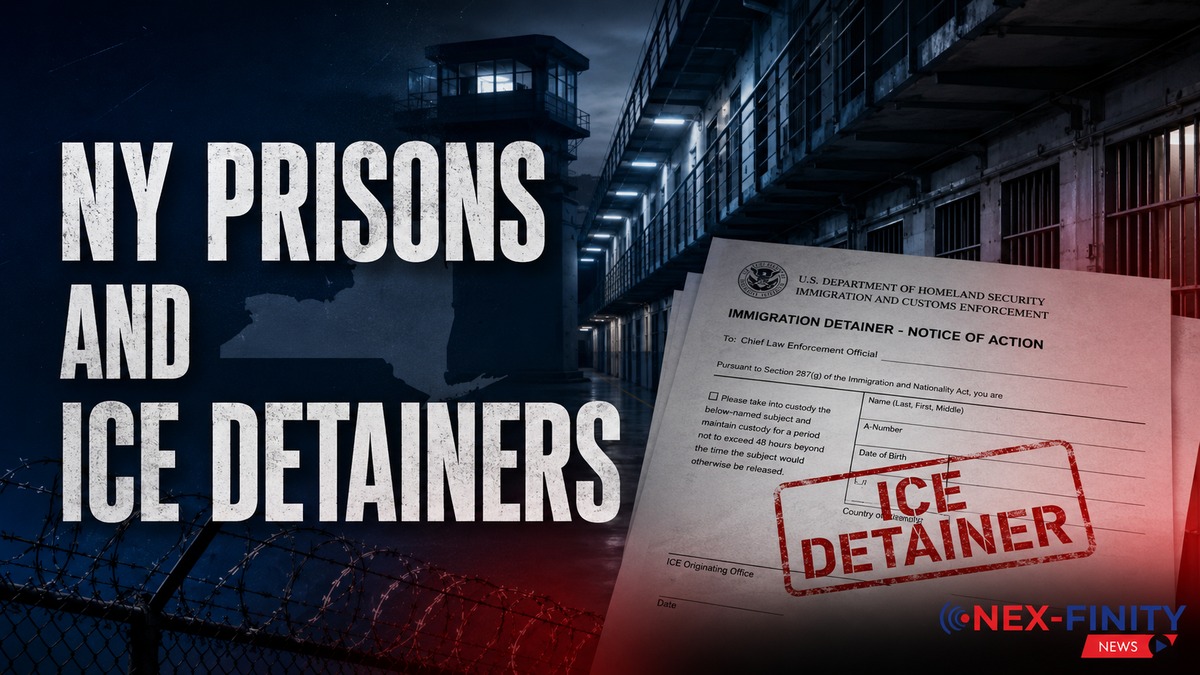
The Department of Homeland Security has spent the past nine months publishing the same number about New York: 7,113 people sitting in the custody of a New York jurisdiction with an active immigration detainer against them. The figure has appeared in DHS statements in December, January, February, April and again in June, unchanged.
The federal argument attached to that number is straightforward. These are people ICE wants, they are already in a jail or a prison, and handing them over inside a secure facility is safer and cheaper than sending officers to find them later on a street corner.
The counterargument is also straightforward, and it is mostly about law rather than policy: detainers are requests, not orders, and several federal appeals courts have said honoring them can create constitutional liability for the county that does it.
What almost nobody in either camp is discussing is that New York already has a statute on the books designed to do exactly what the federal government says it wants transfer deportable prisoners to immigration authorities before their sentences end and that the statute is used rarely enough that the state does not routinely publish how often it is granted.
Background: what a detainer actually is
An ICE detainer is a request that a jail or prison do two things: tell ICE before it releases someone, and hold that person up to 48 hours past their release time so ICE can pick them up.
In simple terms: it is a note asking a jail to wait a day or two before opening the door.
It is not a judicial warrant. No statute requires a county sheriff to honor one. That is not a sanctuary-city talking point it is the settled reading of the law. The First and Second Circuits have held that a detainer can violate the Fourth Amendment when it lacks a probable-cause determination, a New York appellate court reached a similar conclusion, and the New York State Sheriffs’ Association advised its members as far back as 2014 not to comply. Several counties adopted restrictive detainer policies for liability reasons, not ideological ones.
That legal history is why the standoff exists at all. A sheriff who honors a detainer and gets it wrong can be sued. A sheriff who declines one cannot be prosecuted.
The numbers, and where they are contested
DHS attributes a specific criminal breakdown to the 7,113: 148 homicides, 717 assaults, 134 burglaries, 106 robberies, 235 dangerous drug offenses, 152 weapons offenses and 260 sexual predatory offenses. It says New York’s failure to honor detainers resulted in the release of 6,947 people since January 20, 2025.
California’s figure is far larger. ICE says it holds 33,179 active detainers across that state’s local, state and federal facilities.
The national number is smaller than either of those totals might suggest. Testifying before Congress on March 4, 2026, Homeland Security Secretary Kristi Noem said sanctuary jurisdictions declined 17,864 detainers in 2025.
Those figures have been disputed in at least one state with unusual specificity. In January, Minnesota Corrections Commissioner Paul Schnell said his department surveyed every facility in the state and found 207 people with ICE detainers in state prisons and 94 in county jails 301 total, against a DHS claim of roughly 1,360. Schnell said his agency asked DHS repeatedly to reconcile the difference and received no documentation. He also said Minnesota prisons honor every detainer and coordinate transfers in advance, which the state’s own data appeared to support.
Nexfinity News has not independently verified either the DHS figures or the Minnesota figures. What the exchange establishes is that the detainer counts circulating in the political debate come from one agency, are not published with a methodology, and have been contradicted by at least one state corrections department using its own records.
There is also a distinction the headline numbers tend to flatten. State prison systems and county jails behave differently. State prisons hold sentenced felons with known release dates and generally coordinate handoffs. County jails hold a churning population of pretrial detainees, many of whom are released within days on charges that are later dropped. Most of the detainer fight is happening in the second category.
The policy nobody is invoking
Here is where the cost question why keep paying to incarcerate someone the federal government wants to deport runs into something unexpected.
New York Executive Law § 259-i(2)(d)(i) authorizes what the state calls Conditional Parole for Deportation Only, and its earlier-eligibility variant, Early Conditional Parole for Deportation Only. Under CPDO, the Board of Parole can release someone directly to ICE for removal once they have served their minimum term. Under ECPDO, the board can release certain non-violent offenders before they reach parole eligibility at all.
The eligibility conditions are strict. The person must have a final order of removal from an immigration judge and must have waived or exhausted appeals meaning they must give up the right to fight deportation. Violent felony convictions disqualify someone from the early version.
Federal law contains a parallel mechanism. Under 8 U.S.C. § 1231(a)(4)(B)(ii), the chief state corrections official can submit a written request to the Attorney General to remove a prisoner before the sentence is complete, provided the conviction was for a non-violent offense and the official determines removal is in the state’s interest. The statute explicitly bars anyone from suing to force such a request.
So the tool exists, at both levels of government, and it has existed for three decades. Governor Mario Cuomo’s administration litigated over the federal government’s handling of these transfers in the early 1990s.
Impact: the savings are real but smaller than they look
Incarceration in New York is expensive by any measure. The state spends roughly $315 a day close to $115,000 a year per person in its prison system. New York City’s figures are higher still: the Comptroller’s office calculated a full annual cost of $556,539 per incarcerated person in Fiscal Year 2021, counting fringe benefits, pensions and health care alongside the Department of Correction’s own budget.
Multiplying those figures by 7,113 produces a headline number in the billions. That arithmetic does not survive contact with how jail budgets work.
In simple terms: prison costs are mostly fixed. Removing prisoners from a facility does not remove the facility, the officers, the pensions or the medical unit. The city’s own data makes the point as New York City’s jail population fell 61 percent over a decade, the cost per person nearly quadrupled, because the denominator shrank faster than the spending did. Marginal savings from releasing several thousand people are real, but they are a fraction of the average-cost figure.
The eligibility rules cut the population further. CPDO and ECPDO reach non-violent offenders with final removal orders. The categories DHS emphasizes most in its press releases homicide, sexual offenses, robbery are precisely the categories the early-release statutes exclude.
There is also a durability problem that any cost analysis has to price in. A person removed under these provisions who reenters the country can be returned to serve the balance of the state sentence and can face a separate federal charge for illegal reentry. Removal is not a permanent transfer of custody. It is a bet on the border.
Analysis: two arguments passing in the night
The detainer fight and the early-removal question are being treated as the same issue. They are not.
A detainer is about the final 48 hours of someone’s confinement. It asks a jail to delay a release that is already scheduled. Nothing about honoring or declining a detainer changes how long anyone is incarcerated, and nothing about it saves a jurisdiction money if anything, complying costs a county two extra days of custody and some legal exposure.
Early conditional parole for deportation is the opposite: it shortens the sentence and does save money, and it is available to states without any federal permission beyond a written request.
That divergence produces an uncomfortable question for both sides.
If the federal government’s priority is getting deportable people out of the country efficiently, the ECPDO pathway moves more people, sooner, than winning any individual detainer dispute. It requires ICE to produce final removal orders while people are still incarcerated, which is administratively demanding but not novel the Institutional Hearing Program was built for exactly this. Federal messaging has focused instead on detainers, which generate confrontation with elected officials but move people only at the margins.
If New York’s priority is fiscal discipline and reducing its prison population, the state has an underused statute that does both, aimed at a population with no realistic path to remaining in the country. Advocacy groups have documented why individuals often decline it accepting ECPDO means surrendering any claim to stay, including valid asylum or family-based claims. That is a serious objection at the individual level. It is not an explanation for why the state does not report aggregate usage.
Meanwhile, the political conflict continues to escalate on the detainer track. Governor Kathy Hochul proposed legislation in January to bar local police departments from partnering with ICE. Mayor Zohran Mamdani signed an executive order in February extending New York City’s restrictions. On August 26, fifteen New York county sheriffs with existing 287(g) agreements sued in the Northern District of New York, represented by the Federation for American Immigration Reform, challenging the state’s Local Cops, Local Crimes Act and the newly created Office of Immigrant Trust.
None of that litigation touches Executive Law § 259-i.
Conclusion
The question of why states keep paying to house prisoners the federal government wants deported is a fair one. It has a partial answer that no one in the current fight seems interested in giving: the mechanism already exists, at both the state and federal level, and it is not the mechanism anyone is arguing about.
The detainer debate is a fight over the last two days of a sentence. The statute that could shorten the whole sentence has been sitting unused since the Clinton administration.
Key Takeaways
· DHS says 7,113 people in New York custody have active ICE detainers, a figure it has published unchanged since December 2025. California’s figure is 33,179. Secretary Noem testified that sanctuary jurisdictions declined 17,864 detainers nationwide in 2025.
· Minnesota’s corrections commissioner publicly disputed the DHS count in his state, reporting 301 detainers against a federal claim of about 1,360, and said DHS never produced supporting documentation.
· Detainers are voluntary requests. Federal appeals courts have found that honoring them without a probable-cause determination can violate the Fourth Amendment, which is why several counties restrict compliance for liability reasons.
· New York Executive Law § 259-i(2)(d)(i) already allows early release of non-violent, deportable prisoners directly to ICE. Federal law, at 8 U.S.C. § 1231(a)(4)(B)(ii), allows a state corrections chief to request the same thing.
· The cost savings from mass transfers are smaller than average-cost math implies, because prison spending is largely fixed New York City’s per-person jail cost nearly quadrupled as its population fell 61 percent.
Sources
· U.S. Department of Homeland Security, “DHS Calls on Mamdani Not to Release Criminal Illegal Aliens from New York City’s Custody,” February 6, 2026
· U.S. Department of Homeland Security, “Sanctuary New York Released Nearly 7,000 Criminal Illegal Aliens,” December 1, 2025
· U.S. Department of Homeland Security, “DHS Urgently Calls on Gavin Newsom… 33,179 Criminal Illegal Aliens,” February 10, 2026
· Newsmax, “Noem: Sanctuary Jurisdictions Declined 17,864 ICE Detainers,” March 4, 2026
· Minnesota Department of Corrections, “Fact Sheet: ICE Detainers in Minnesota,” January 22, 2026
· CBS News, “Top Minnesota corrections official denies DHS claim,” January 22, 2026
· New York Executive Law § 259-i(2)(d)(i); NYS DOCCS Community Supervision Handbook
· Immigrant Defense Project, “Step-by-Step Guide to ECPDO & CPDO”
· 8 U.S.C. § 1231(a)(4)(B)
· Cuomo v. Barr, 7 F.3d 17 (2d Cir. 1993)
· Albany Law School Government Law Center, “Sanctuary Jurisdictions”
· Office of the New York City Comptroller, “NYC Department of Correction: FYs 2011-21 Operating Expenditures,” December 6, 2021
· Stateline, “Sanctuary policies are keeping prisoners in local jails away from ICE,” August 24, 2026
· CNSNews/NewsBusters, “15 New York County Sheriffs Sue to Stop Gov. Hochul’s New Sanctuary Provisions,” August 26, 2026
· Congressional Research Service, IF11438, “‘Sanctuary’ Jurisdictions: Policy Overview”