
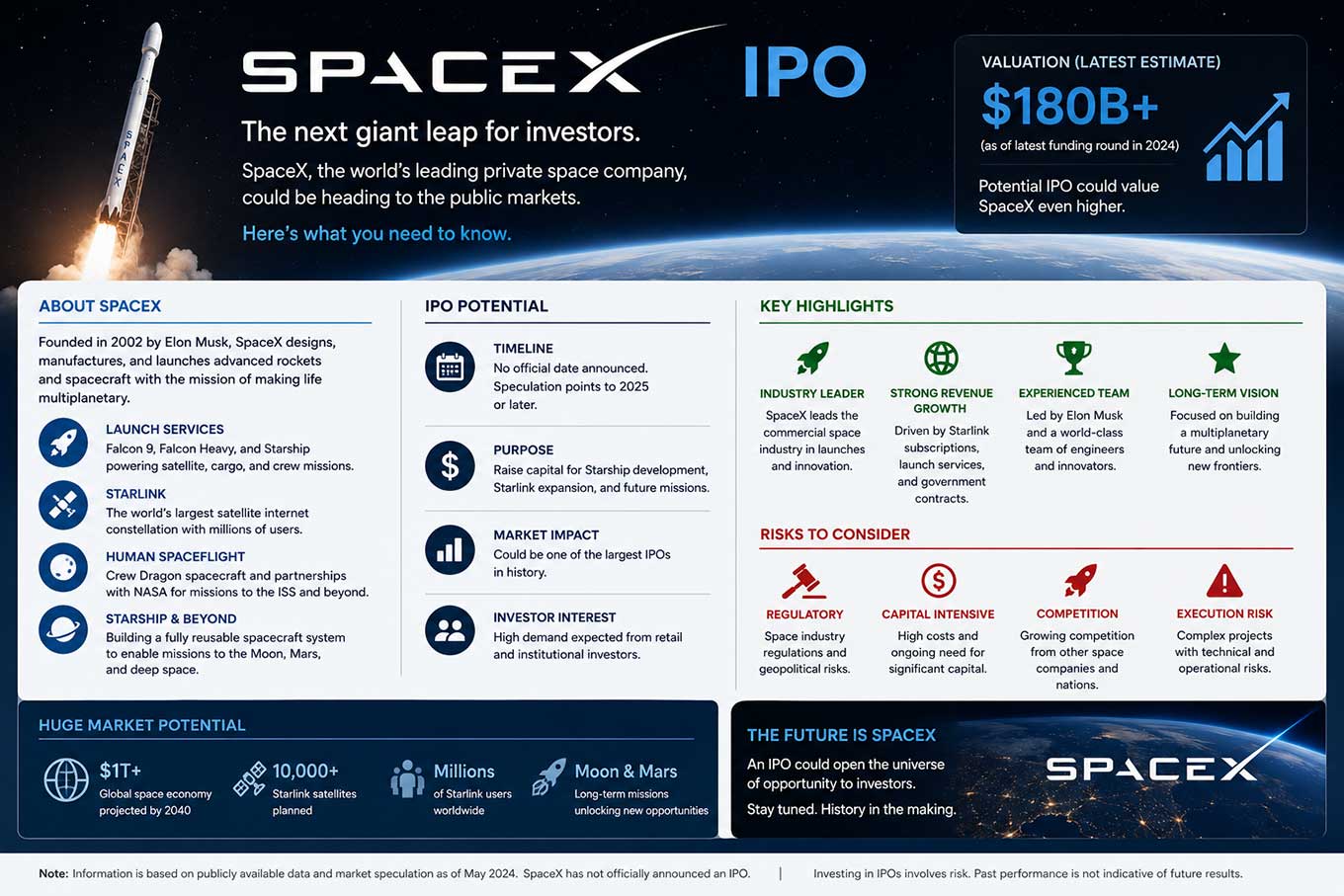
Space Exploration Technologies Corp. (SpaceX) began trading on the Nasdaq on Friday under the ticker SPCX, capping the largest initial public offering on record. Shares priced at $135 the night before, opened at $150 and closed near $161 — a gain of roughly 19% — valuing the rocket-and-satellite company at about $2.1 trillion. The offering raised approximately $75 billion.
Beyond the headline valuation lies a quieter story for public finance. An IPO of this scale converts years of paper wealth into potentially taxable income, and the way that income is recognized over the next several years will shape revenue for the federal government and a handful of states. It will also highlight a structural feature of the U.S. tax system: where a shareholder lives, and when they sell, can matter as much as how much they gain.
Background
Founded in 2002 and long held privately, SpaceX had resisted going public for more than two decades. Chief Executive Elon Musk told investors on a pre-IPO livestream that the company sought capital for a major expansion, including plans to add tens of thousands of satellites and to build artificial-intelligence data centers. SpaceX absorbed Musk’s AI startup, xAI, in early 2026.
The debut reordered global wealth rankings. Musk, who holds roughly 42% of SpaceX, became the world’s first trillionaire on paper based on his combined SpaceX and Tesla stakes. Crucially, he is barred by the company’s filing from selling SpaceX shares for one year after the offering.
In simple terms: an IPO does not, by itself, create a tax bill. Tax is generally owed only when shares are actually sold (or, for certain employee equity, when it vests or is exercised). A locked-up shareholder who cannot sell has not yet realized a taxable gain.
How the Tax Falls — Federal and State
The federal layer
At the federal level, profit on shares held longer than a year is taxed as a long-term capital gain. The top federal rate is 20%, and high earners also pay the 3.8% Net Investment Income Tax, for a combined top rate of about 23.8%. By contrast, employee equity such as restricted stock units (RSUs) and non-qualified stock options is generally taxed as ordinary income — up to 37% federally — when it vests or is exercised, not when the shares are later sold.
This distinction matters at SpaceX because much of employee compensation has historically come in equity. RSU vesting tied to the IPO can produce ordinary-income tax even before any shares change hands, while later sales of long-held shares would fall under the lower capital-gains rates.
The state layer — and why it varies so widely
States diverge sharply, and SpaceX’s geography spreads the workforce across several tax regimes:
- Texas — the company’s headquarters since its 2024 relocation to Starbase, plus large operations in McGregor and Bastrop — levies no personal income tax and therefore no tax on capital gains.
- Florida, home to SpaceX’s Cape Canaveral launch operations, similarly has no state income tax.
- California, where the Hawthorne campus remains the primary manufacturing site for Falcon rockets and Dragon capsules, taxes capital gains as ordinary income at rates reaching 13.3% — among the highest in the nation.
- Washington, where the Redmond facility leads Starlink satellite engineering, applies a 7% tax on long-term capital gains above a standard deduction (about $278,000 for 2025), rising to 9.9% on gains exceeding $1 million under a surtax that took effect for the 2025 tax year.
In simple terms: two SpaceX employees holding identical stock could owe very different state taxes on the same gain — a six-figure difference at the top — depending solely on whether they live in Texas, California or Washington.
What This Looks Like in Practice
Because insiders cannot sell freely on day one, the taxable events will unfold over months. According to SpaceX’s registration statement, employee shares are subject to a staggered lock-up structure within the standard 180-day window, with early-release tranches that open after the company reports earnings and additional time-based releases thereafter. Musk’s own stake is locked for a full year.
Consider a Redmond-based Starlink engineer who sells $500,000 of long-term gains after a release window opens. After Washington’s standard deduction, roughly $222,000 would be taxed at 7%, producing about $15,540 in state tax — on top of federal capital-gains tax. A Hawthorne employee with the same gain would instead see it taxed at California’s ordinary-income rates, which climb to 13.3% at the highest brackets. An employee who has relocated to Starbase, Texas, would owe no state income tax at all on the sale.
For the single largest holder, the timing is decisive. Musk’s shares are locked for a year, deferring any realized gain, and his domicile in income-tax-free Texas means the eventual sale — whenever it occurs — would not generate state personal-income tax in the way a California sale would.
Impact on Public Budgets
For the federal government, a deep and liquid market in SPCX shares creates a long runway of potential capital-gains revenue as lock-ups expire and early investors, employees and funds diversify. The amount and timing are uncertain because they depend on individual decisions to sell, the share price at the time, and each holder’s cost basis.
For states, the episode revives a familiar lesson about volatility. California’s budget has long ridden what officials describe as a capital-gains roller coaster: revenue surges when markets and IPOs are hot and falls sharply when they cool. The state’s Legislative Analyst’s Office and Governor Gavin Newsom have repeatedly attributed multibillion-dollar swings in the state budget to the timing of stock sales by high earners. One AI-driven market rally was credited with an unexpected multibillion-dollar revenue boost; in a weaker year, actual receipts came in roughly $20 billion below forecast.
Washington’s capital-gains tax, enacted in 2021 and upheld by the state’s Supreme Court as an excise tax, was designed to apply to a narrow band of high earners — the state Department of Revenue estimated only about 0.2% of taxpayers would owe it. A concentrated liquidity event among Redmond-based Starlink staff could push more filers into the higher 9.9% tier in a single year.
Analysis
The SpaceX debut underscores a tension that tax economists have flagged for years: capital-gains revenue is large but episodic, and concentrating budget expectations on it invites whiplash. States that taxed the dot-com boom’s IPO gains as recurring revenue were forced into painful cuts when the bubble burst — a history California budget writers cite when urging caution.
The case also illustrates how mobility shapes who benefits. SpaceX reincorporated in Texas and moved its headquarters from California, and its single largest shareholder is a Texas resident. The states that taxed SpaceX’s rise during its private decades — chiefly California, through ordinary-income tax on equity compensation — may capture proportionally less of the IPO windfall than they once would have, while no-income-tax states host a growing share of the workforce and the controlling stake.
A further wrinkle is the qualified small business stock (QSBS) exclusion under Section 1202 of the federal tax code, which can exempt a portion of gains on stock issued when a company was small. Eligibility is fixed at the time shares were issued, so only a limited set of very early SpaceX equity would plausibly qualify; for the vast majority of recent holders, full capital-gains tax applies. Tax professionals advising employees emphasize cost-basis tracking, holding periods and the spreading of sales across calendar years to manage both federal and state exposure.
Conclusion
SpaceX’s $75 billion offering is historic for the equity markets, but its fiscal footprint will be written gradually, in tax filings spread across several years and several states. The federal government stands to collect capital-gains revenue as shares are sold; California and Washington could see concentrated, one-time bumps tempered by their own rules and exclusions; and Texas and Florida, by design, will tax none of the personal gains directly. For budget officials, the more durable takeaway is an old one — that a single blockbuster IPO is a windfall to be banked carefully, not a revenue stream to be counted on.
Key Takeaways
- SpaceX raised about $75 billion in the largest IPO on record, closing near $161 (up ~19%) for a valuation of roughly $2.1 trillion; CEO Elon Musk became the first trillionaire on paper.
- An IPO does not trigger tax by itself — gains are taxed when shares are sold or equity vests. Lock-up rules, including a one-year hold on Musk’s stake, delay most realizations.
- Federal long-term capital gains top out near 23.8% (20% plus the 3.8% NIIT); employee RSUs and options are taxed as ordinary income up to 37%.
- State outcomes vary widely: Texas and Florida levy no income tax on gains; California taxes them as ordinary income up to 13.3%; Washington applies 7% above ~$278,000 and 9.9% above $1 million.
- SpaceX’s move to Texas and Musk’s Texas residency mean a large share of the windfall — including the single biggest stake — is shielded from state personal-income tax.
- California’s budget history shows capital-gains revenue is volatile; analysts caution against treating IPO windfalls as recurring income.
Sources
CNBC, “SpaceX IPO: SPCX closes at $161, jumping 19% after record debut,” June 12, 2026.
ABC News, “SpaceX soars after trading begins in largest IPO of all time,” June 12, 2026.
NBC News, “SpaceX locks in IPO price of $135, making it largest stock debut ever,” June 2026.
Fidelity, “SpaceX IPO explained,” June 2026.
Darrow Wealth Management, “SpaceX IPO: Employee Lockup Release Dates,” 2026.
Washington State Department of Revenue, “New tiered rates for Washington’s capital gains tax,” effective tax year 2025.
SmartAsset, “2026 Capital Gains Tax Rates by State,” 2026.
CalMatters, “California budget whiplash caused by volatile taxes,” 2026; San Francisco Examiner / California Legislative Analyst’s Office on IPO-driven revenue, 2025.
Wikipedia / company filings, Space Exploration Technologies Corp. corporate profile and headquarters (Starbase, Texas), 2026.