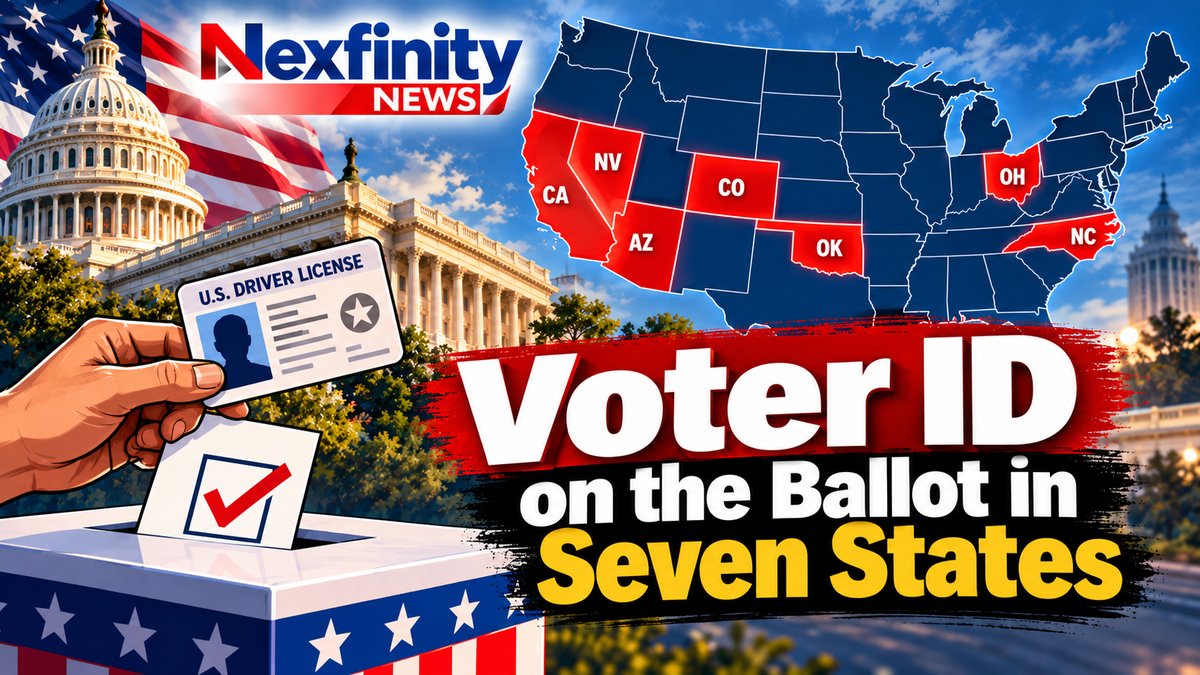
Voters in seven states are deciding voter identification measures in 2026, the most in any single year on record, according to Ballotpedia. Oklahoma approved its measure on Aug. 25. Arizona, California, Colorado, Nevada, North Carolina and Ohio vote on Nov. 3.
History favors passage. Of 13 statewide voter ID measures from 2004 through 2025, voters approved 10. The three that failed had something in common: each reached past the polling place and into mail voting.
Does having voter ID on the ballot bring more people out to vote? No study has tested that directly. Research on ballot measures in general finds that most do not raise turnout, and the few that do are high-profile and well funded. There is also a timing fact that most coverage has skipped. None of the six November measures changes the rules for the ballots being cast in this election.
In simple terms: whatever a voter ID rule does to turnout, it cannot do it this fall. If these measures touch a close race in 2026, they do it by changing who shows up to vote on them, not who gets turned away.
Background
Voter ID is already the norm. Thirty-six states require some form of identification at the polls, and 24 of them ask for photo ID, per Ballotpedia. Thirty-nine states require an ID or ID number for at least some mail ballots, Ballotpedia reports.
The policy polls well nationally. In an August 2025 Pew Research Center survey, 83% of adults favored requiring government-issued photo ID to vote, including 71% of Democrats and 95% of Republicans, per PolitiFact’s review of the poll.
The 2026 count is a record. Seven statewide measures beat the prior high of three, set in 2022. Every one would add or expand an ID requirement; none would loosen one. Legislatures referred four (Arizona, North Carolina, Ohio, Oklahoma), and citizens petitioned three onto the ballot (California, Colorado, Nevada), per Ballotpedia.
The wave runs parallel to Washington. A Republican election bill adding proof-of-citizenship and ID rules has stalled in Congress, and legislators in eight more states tightened ID rules by statute this year, NPR reported, citing the Voting Rights Lab.
Oklahoma went first. State Question 846 passed Aug. 25 by 54.61% to 45.39%, per unofficial State Election Board returns. It wrote the state’s existing 2010 ID law into the constitution, so voters saw no change at the polls.
What the November Measures Do
The six measures fall into two groups. Three would change how people vote: Arizona, California and Colorado. Three would write existing practice into a constitution, or ratify it a second time: Nevada, North Carolina and Ohio.
| State | Measure | Origin | What it requires | Change for voters |
| Arizona | Prop 144 | Legislature | Government-issued ID for every ballot, including mail; also citizens-only voting, a foreign-money ban and on-site tabulation | Large. Mail ballots need no ID today, and the Legislature would decide how mail voters “show” one |
| California | Prop 39 | Citizen initiative | Government ID in person; last four digits of a government ID number by mail; free state ID cards | Large. California has no ID requirement at the polls today |
| Colorado | Initiative 362 | Citizen initiative | Mail voters add an ID number (Social Security last four or a REAL ID number) to their signature | Moderate. Today a signature alone verifies a mail ballot. Needs 55% to pass |
| Nevada | Question 7 | Citizen initiative (second vote) | Photo ID in person; last four of a license or Social Security number by mail | Moderate. Takes effect only after a second approval, as soon as the 2028 election; signature matching governs today |
| North Carolina | Voter ID Amendment | Legislature | Photo ID for all voters, including by mail, in the constitution | None. State law has required photo ID for mail ballots since 2024 |
| Ohio | Issue 3 | Legislature | Writes the 2023 photo ID law into the constitution | None. Mail voters keep their alternative ID options |
Arizona’s measure carries the most practical weight. Nearly 80% of Arizonans vote by mail, according to Arizona Clean Elections, and the text leaves the mail-ID method to future legislation. Former Maricopa County Recorder Stephen Richer, a Republican, told Axios he is not sure an ID number alone would satisfy the requirement to “show” ID.
The measures’ own texts confirm that none governs this fall’s ballots. Arizona’s applies to elections on or after Jan. 1, 2028, per the resolution text. Nevada’s could first apply in the 2028 election, The Nevada Independent reported. California’s requires the Legislature to pass implementing laws, per the Legislative Analyst. Colorado’s would take effect when the governor proclaims the vote, after Election Day, per Legislative Council staff; as a constitutional amendment it needs 55% to pass, Colorado Politics reported. Ohio’s and North Carolina’s restate existing law.
The Ohio and North Carolina amendments are about durability, not change. Supporters in both states say a constitutional rule is harder to repeal and easier to defend in court.
The Track Record
Voter ID measures usually pass. From 2004 through 2025, voters in 12 states decided 13 of them, approving 10 and rejecting three, per Ballotpedia. Missouri in 2016 and Arkansas and North Carolina in 2018 each passed by at least 10 points, Bolts reported.
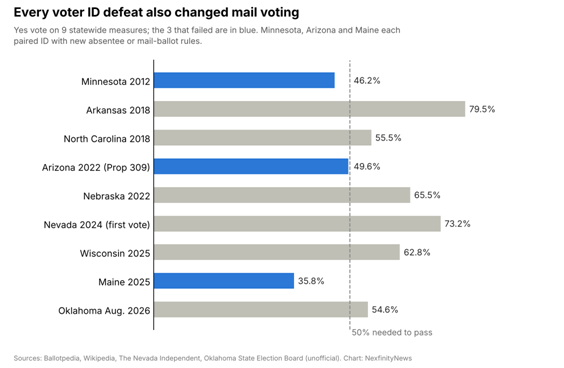
Yes vote on nine statewide voter ID measures, 2012 to August 2026. The three that failed, Minnesota 2012, Arizona 2022 and Maine 2025, each also changed absentee or mail voting.
The three defeats share a feature. Minnesota’s 2012 amendment would have held voters “not voting in person” to “substantially equivalent” verification, per the enacted text. Arizona’s Prop 309 would have added a birthdate and ID number to the mail-ballot affidavit and dropped the option of showing two utility-style documents, AP reported. Maine’s 2025 Question 1 bundled photo ID with cuts to absentee voting and drop boxes.
Touching mail voting does not doom a measure, though. Nevada’s 2024 Question 7 asked mail voters for four digits and passed with 73.2%. The losers changed a routine that large numbers of voters already relied on, and opponents campaigned on that change rather than on ID itself. In Maine, the opposition outraised supporters about $1.96 million to $650,000, per Ballotpedia.
That pattern points at Arizona and Colorado this year, both heavy mail-voting states where the measure changes the mail ballot. California is the other test: a Berkeley IGS poll in August found Prop 39 trailing, 42% for and 51% against, NBC Palm Springs reported. In Nevada, a Noble Predictive Insights poll taken Sept. 22-26 had Question 7 at 65% yes, per Wikipedia’s summary of the poll.
Does Putting Voter ID on the Ballot Raise Turnout?
No published study has tested whether a voter ID measure, simply by appearing on the ballot, brings more people to the polls; NexfinityNews found none. The wider research on ballot measures gives a qualified answer: some measures raise turnout, most do not, and the ones that do share traits most voter ID measures lack.
The case that measures drive turnout. Political scientists Caroline Tolbert and Daniel Smith found each initiative on the ballot raised midterm turnout by about 1.7%, on average, from 1980 to 2002 (American Politics Research, 2005). Mark Smith found the effect depends on visibility: high-profile measures lifted midterm turnout by roughly four points, while low-profile ones did little (Initiative & Referendum Institute paper).
The case that most do not. Daniel Biggers’s Morality at the Ballot (Cambridge, 2014) found most ballot measures have little or no effect on turnout. The exceptions were mostly moral issues, which make voting an act of self-expression and draw in occasional voters, per the publisher’s summary. Even the best-known test case is disputed. After the 2004 same-sex marriage amendments, Emory’s Alan Abramowitz found no turnout effect (Emory), while Stanford’s Simon Jackman estimated turnout about 3.3% higher in the 11 states with the measures (as summarized by The Gay & Lesbian Review). Tufts University’s CIRCLE concluded that controversial measures do not raise youth turnout unless campaigns and media coverage come with them (CIRCLE).
Awareness is a further limit. A 2019 study in Political Behavior found voters’ knowledge of specific statewide measures far lower than earlier research assumed (Springer). A measure few people know about cannot pull them to the polls.
Where voter ID fits. In simple terms: a measure moves turnout when voters know about it, care about it and someone pays to bring them out. By that test, the answer differs by state.
- California (Prop 39): the strongest candidate. It has drawn the most money of any 2026 voter ID measure (Ballotpedia), 56% of voters had heard of it by August (Daily Signal, citing Berkeley IGS), and Sen. Alex Padilla and the Legislature’s Democratic leaders have rallied against it.
- Arizona (Prop 144): a possible candidate. It changes mail voting in a state where nearly 80% vote by mail, and an organized “No on 144” campaign is running.
- Nevada (Question 7): an unlikely one. The committees for and against it reported almost no money in the first half of 2026; the main supporting committee raised $3,000 (The Nevada Independent).
- Ohio (Issue 3) and North Carolina: unlikely. Neither changes anything for voters, which gives campaigns little to mobilize around.
Mobilization cuts both ways. A measure that energizes supporters can energize opponents too. Economists Enrico Cantoni and Vincent Pons found campaigns became 4.7 points more likely to contact nonwhite voters after strict ID laws passed, a sign that ID fights prompt counter-mobilization (NBER). For a close race, the question is the net partisan effect, and no study has measured it for voter ID measures.
A separate question is whether ID laws, once in force, reduce turnout. The GAO found turnout fell 2 to 3 points more in Kansas and Tennessee in 2012; Cantoni and Pons found no significant national effect from 2008 to 2018. Because none of the November measures governs this fall’s ballots, that question bears on 2027 and later, not on Nov. 3.
The Tight Races
Nevada’s governor’s race is the one where a voter ID measure sits beside a genuine toss-up. Ohio’s two statewide races are close but less so. Arizona and Nevada have no U.S. Senate race this year.
| State | Race | Latest polling | Measure |
| Nevada | Governor: Joe Lombardo (R, inc.) vs. Aaron Ford (D) | Lombardo 42, Ford 40, Danielle Ford (I) 7 among likely voters, Noble Predictive Insights, Sept. 22-26 (Political Wire); Ford 44, Lombardo 42, Emerson, Sept. 5-8 | Question 7 |
| Ohio | U.S. Senate special: Jon Husted (R, inc.) vs. Sherrod Brown (D) | Brown +3.1 in the RealClearPolitics average; Brown 48, Husted 42, Bowling Green/YouGov (RCP) | Issue 3 |
| Ohio | Governor: Vivek Ramaswamy (R) vs. Amy Acton (D) | Acton 50, Ramaswamy 44, Bowling Green/YouGov (RCP) | Issue 3 |
| North Carolina | U.S. Senate, open: Michael Whatley (R) vs. Roy Cooper (D) | Cooper +9.5 in the RCP average (Election Central) | Voter ID amendment |
| Arizona | Governor: Katie Hobbs (D, inc.) vs. Andy Biggs (R) | Five recent public polls all show Hobbs ahead, by margins from a statistical tie to 15 points (Cronkite News) | Prop 144 |
Nevada also has the tightest link between a measure and a candidate. Lombardo co-chaired the Nevada Voter ID Coalition that backed Question 7, the Las Vegas Sun reported. He won in 2022 by about 15,000 votes out of more than 1 million cast, per The Center Square. Early voting began Oct. 17.
Measured against the turnout research above, Nevada is the clearest mismatch: the closest race shares a ballot with a measure that has almost no campaign behind it. California’s Prop 39 is the measure most likely to move turnout, but California has no close statewide race in the polling reviewed. Any effect there would land in competitive U.S. House districts, which this article did not examine.
Analysis
The idea polls at 83%; the measures do not. National surveys measure support for voter ID in the abstract. Ballot measures ask about a specific text, in a partisan year. California’s Prop 39 trails, with 80% of Democrats opposed and 93% of Republicans in favor, per the August Berkeley IGS poll. Oklahoma’s measure, which changed nothing at the polls, passed with 54.6%. The gap suggests voters judge the details and the sponsors, not the slogan.
Two of the six are about durability, not change. In North Carolina and Ohio, the ID rule already exists in statute. A constitutional version is harder to repeal and harder to strike down in state court. North Carolina’s history explains the motive: voters approved photo ID in 2018, and court fights kept it from taking effect until the state Supreme Court reversed itself in April 2023, per Ballotpedia.
The policy stakes sit in mail-voting states. Arizona, Colorado and California would each change how mail ballots are verified. That is the feature every past defeat shared. Arizona’s version also leaves the mail-ID method to a Legislature that has not written it.
The race effect is probably small, and it runs through salience. Nevada has the closest race and the closest candidate link, but its measure is a quiet second vote with almost no campaign money. Ohio’s Issue 3 changes nothing for voters. North Carolina and Arizona’s top races are not close in current polling. On this evidence, voter ID measures are more likely to shape who votes in 2028 than who wins in 2026: if Prop 144 passes, Arizona’s next presidential election would run under mail-ID rules no one has drafted yet.
Conclusion
Voter ID enters Election Day 2026 with a long winning record and a record number of measures. The record holds a warning for supporters, though: measures that rewrite mail voting are the ones voters have turned down.
On turnout, the research suggests a measure moves voters only when it is visible, contested and funded. Among this year’s voter ID measures, only California’s clearly fits that description. For the close races, timing settles most of the question. None of these measures governs the ballots now being cast, so any influence on Nevada, Ohio or elsewhere runs through mobilization, and the measure with the most at stake for a close race has drawn almost no campaign. The larger consequences, if they come, arrive in 2027 and 2028.
Key Takeaways
- Seven states vote on voter ID in 2026, a record; Oklahoma approved its measure Aug. 25 with 54.6%.
- From 2004 through 2025, voters approved 10 of 13 voter ID measures. All three defeats also changed absentee or mail voting.
- None of the six November measures changes the rules for ballots cast this fall.
- No study has measured whether voter ID measures raise turnout. Research on ballot measures finds most do not; the exceptions are high-profile, well-funded campaigns, which in 2026 describes California’s Prop 39 best.
- Nevada’s governor’s race is the closest contest sharing a ballot with a voter ID measure, but that measure has drawn almost no campaign spending.
- Arizona’s Prop 144 carries the most policy weight: nearly 80% of Arizonans vote by mail, and the method for showing ID by mail is not yet defined.
Frequently Asked Questions
Which states have voter ID measures on the November 2026 ballot? Six: Arizona (Prop 144), California (Prop 39), Colorado (Initiative 362), Nevada (Question 7), North Carolina (Voter ID Amendment) and Ohio (Issue 3). Oklahoma approved State Question 846 on Aug. 25, 2026, making seven voter ID measures in 2026, a record for one year.
Do voter ID ballot measures usually pass? Yes. From 2004 through 2025, voters in 12 states decided 13 voter ID measures and approved 10, with an average yes vote of 60.3%, according to Ballotpedia. The three defeats, in Minnesota (2012), Arizona (2022) and Maine (2025), each also changed absentee or mail voting.
Does putting voter ID on the ballot increase voter turnout? No study has tested voter ID measures specifically. Research on ballot measures in general finds that most have little or no turnout effect, and that the exceptions are high-profile, well-funded campaigns.
Will these measures change how people vote on Nov. 3, 2026? No. Arizona’s measure applies to elections from Jan. 1, 2028; Nevada’s could first apply in 2028; California’s needs implementing legislation; Colorado’s takes effect after the vote is proclaimed; Ohio’s and North Carolina’s restate existing law.
How We Reported This
NexfinityNews reviewed the measures’ official texts and analyses (Arizona Legislature, California Legislative Analyst’s Office, Colorado Legislative Council, Ohio Secretary of State), Ballotpedia’s ballot-measure records, peer-reviewed turnout research, the GAO’s 2014 report and public polling available as of Oct. 18, 2026. Oklahoma figures are unofficial returns pending certification. Errors are corrected under our corrections policy.
Sources
- Ballotpedia News: seven voter ID measures, a record; six measures, July 27; Maine 2025 result; North Carolina amendment; Oklahoma SQ 846 preview
- Pew Research Center, Majority of Americans Continue to Back Expanded Early Voting, Voting by Mail, Voter ID, Aug. 22, 2025
- U.S. Government Accountability Office, GAO-14-634, Issues Related to State Voter Identification Laws
- Cantoni and Pons, Strict ID Laws Don’t Stop Voters, Quarterly Journal of Economics 136(4), 2021
- Tolbert and Smith, The Educative Effects of Ballot Initiatives on Voter Turnout, American Politics Research, 2005
- Mark Smith, The Contingent Effects of Ballot Initiatives and Candidate Races on Turnout
- Daniel R. Biggers, Morality at the Ballot, Cambridge University Press, 2014
- Emory University, Abramowitz analysis of 2004 marriage referenda and turnout
- Tufts CIRCLE, Do Controversial Ballot Measures Affect Youth Voter Turnout?
- Political Behavior, study of voter awareness of statewide ballot measures, 2019
- Arizona Legislature, HCR 2001 (Prop 144) text
- California Legislative Analyst’s Office, Proposition 39 analysis
- Colorado Legislative Council, review memo on Initiatives 362-364
- Ohio Secretary of State, Issue 3 report; Signal Cleveland, Issue 3 ballot language
- Minnesota Revisor of Statutes, 2012 Laws ch. 167
- WUNC, North Carolina amendments explainer
- Axios Phoenix, Prop 144 and mail voting; KOLD, Prop 144 explainer
- NBC Palm Springs, Berkeley IGS poll on Props 39 and 40; The Daily Signal, Prop 39 polling
- The Nevada Independent, 2026 Nevada ballot measures; Las Vegas Sun, Nevada’s November ballot
- Political Wire, Nevada governor poll; RealClearPolling, latest polls; Cronkite News, Arizona governor polling
- NPR, voter ID on the ballot