
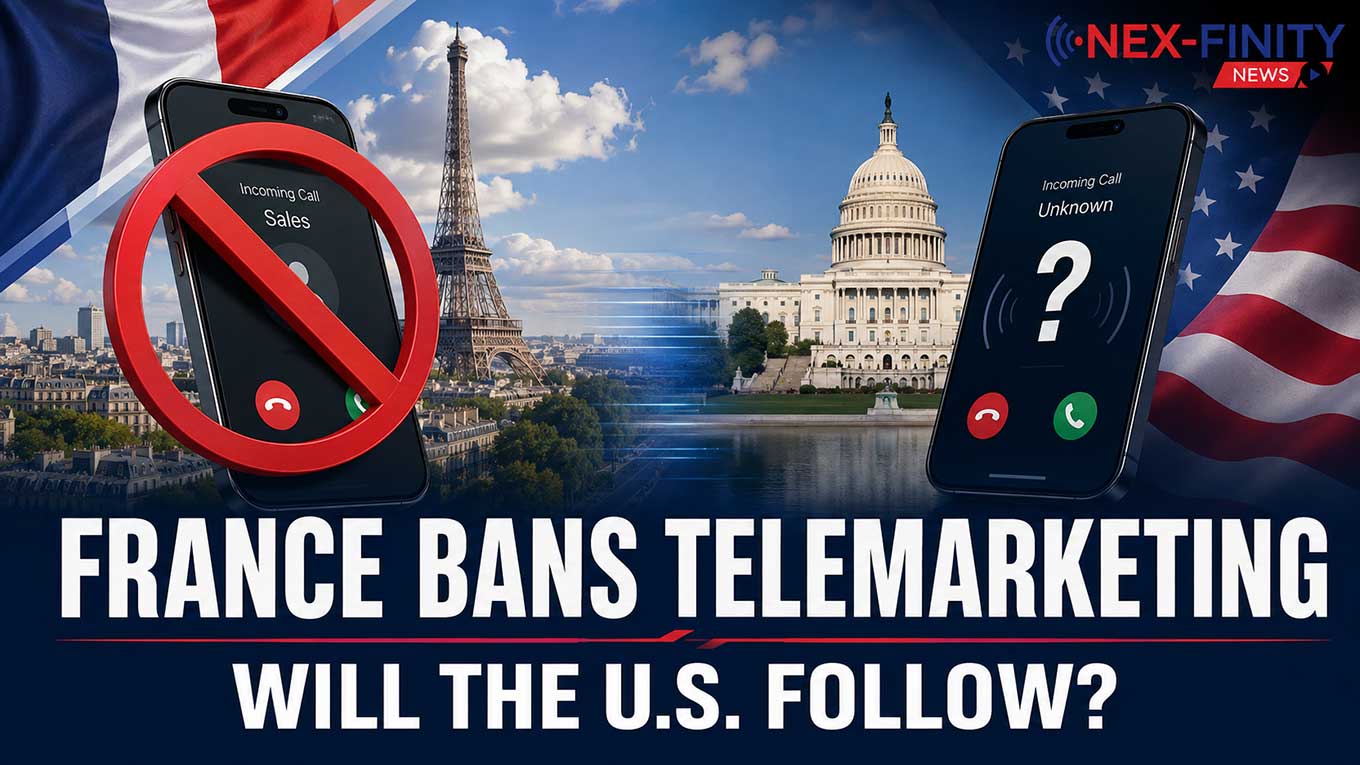
France’s ban on unsolicited telemarketing calls takes effect Tuesday, Aug. 11, 2026, replacing the country’s opt-out registry with a rule that requires businesses to obtain a consumer’s consent before dialing. Individuals who place illegal calls face fines up to €75,000 (about $87,000) per call. Companies face up to €375,000 (about $435,000) per call.
The law, backed by President Emmanuel Macron’s government and approved by Parliament last year, is the strictest consumer-side telemarketing regime in a major Western economy. It also arrives at a moment when the United States is moving in the opposite direction at the federal level — and in the same direction, state by state.
The question of whether Washington follows Paris is less interesting than what the answer reveals: outbound calling is one of the last mass-market channels for reaching consumers that is not owned, priced, or auctioned by a technology platform.
Background
Before this week, French consumers who wanted to stop sales calls had to register on a government-run list. Consumer groups said some call centers ignored it. French authorities estimate that roughly three-quarters of the population received at least one unsolicited sales call every week. In 2024, eleven consumer organizations issued a joint call for an outright ban, describing the calls as a persistent intrusion into daily life.
Enforcement under the old regime was not trivial. Alice Vilcot, chief of staff at France’s Directorate-General for Competition, Consumer Affairs and Prevention of Fraud, noted that an Ireland-based company was fined €6 million last year for calling numbers on the French no-call list.
France is not the first mover. Germany has operated a similar consent-first system since 2009. The Netherlands tightened its rules last month, going further than France by barring companies from calling even their own customers with promotional offers. The United States, Canada, and the United Kingdom all still run opt-out systems: the National Do Not Call Registry, Canada’s Do Not Call List, and Britain’s Telephone Preference Service.
In simple terms: opt-out means a company may call you until you tell it not to. Opt-in means it may not call you until you say it can.
What the French Law Actually Does
The ban is narrower than the headline suggests. Consent may be given by checking a box on a form, and it can be withdrawn at any time. Companies may still contact consumers about a contract already in force, and may pitch new offers to existing customers with whom they have a contractual relationship. Consumers report violations through a government portal.
That structure matters for the economic analysis. The law does not eliminate outbound calling. It eliminates cold calling — contact with people who have no prior relationship with the seller. That is precisely the segment used for customer acquisition rather than customer retention.
The Labor Question
The direct U.S. headcount is smaller than most people assume. The Bureau of Labor Statistics counted approximately 67,400 workers in the narrow “telemarketers” occupation in 2024, with a 2025 median wage of $17.04 an hour, or $35,450 a year. BLS projects the occupation will decline over the 2024–2034 period, with roughly 6,500 annual openings driven mostly by turnover rather than growth.
The broader U.S. industry is larger. IBISWorld puts the telemarketing and call center sector at $28.5 billion in 2026 across roughly 45,130 businesses, with revenue contracting at a compound annual rate of 2.1% since its 2021 pandemic peak. Market concentration is low; the largest single operator is TTEC Services Corporation. Most of that revenue is inbound customer service, not outbound sales.
On the skills question, the Labor Department’s O*NET classification places telemarketers in Job Zone 1–2 — “very little to some preparation needed.” Among surveyed employers, 39% said a high school diploma was required, 37% said some college with no degree, and 20% said less than a high school diploma. Training ranges from a few days to a year on the job. It is, by federal classification, one of the lowest-barrier entry points into white-collar sales work in the United States.
The larger exposure is offshore. Morocco’s employment minister, Younes Sekkouri, said in March that between 40,000 and 50,000 call center jobs in the country were at risk from the French law, noting that the French market has historically accounted for more than 80% of the Moroccan sector’s revenue. Youssef Chraïbi, president of the Moroccan Outsourcing Services Federation, told local media that pure telemarketing now represents only 15% to 20% of total activity, and that the sector has diversified.
For the U.S., the analogous exposure sits in the Philippines. The IT and business process management industry there closed 2025 with roughly $40 billion in export revenue and about 1.9 million workers, contributing more than 8% of national GDP, according to the IT and Business Process Association of the Philippines. North America accounts for roughly 70% of Philippine BPO client revenue, with the U.S. alone near 65%. The global business process outsourcing market is estimated at $302 billion to $348 billion for 2025, depending on the research firm and market definition.
That is the pattern worth noting: a consumer protection law passed in one country lands as an employment shock in another.
Which Businesses Actually Depend on This
Outbound calling is concentrated in a specific set of verticals: insurance (particularly Medicare Advantage and final-expense products), home services, solar and HVAC installation, security systems, extended auto warranties, debt relief, timeshare, home improvement financing, and business-to-business software sales development.
What these have in common is a product with a low natural search volume, an infrequent purchase cycle, and a customer who does not know they are in the market until someone tells them. A homeowner does not search for a roof replacement before the roof leaks.
Political and charitable calls occupy a separate legal category in the United States and are largely exempt from the Do Not Call Registry — an exemption that would have to be resolved in any American version of the French rule, and one that has historically drawn bipartisan resistance to broader restrictions.
Financial services already operate under tighter constraints. FINRA’s telemarketing rule (Rule 3230) imposes calling-time restrictions, do-not-call list obligations, and disclosure requirements on broker-dealers that go beyond baseline federal law. For private placements and pre-IPO offerings, general solicitation is governed by Regulation D, which limits how issuers may market to investors in the first place. A French-style ban would change the marketing economics of retail financial products less than it would change those of home services.
Impact
The immediate effect of an opt-in regime is a repricing of customer acquisition. Firms that lose the ability to originate contact must buy it. The available substitutes are paid search, paid social, retail media, email, direct mail, and affiliate lead generation — and most of those routes run through a small number of intermediaries.
EMARKETER forecasts that Google and Meta together will hold 44.8% of U.S. digital ad spending in 2026, down from 47.1% in 2025, while Amazon rises to 17.3% from 13.9%. That puts the three at roughly 62.1% of U.S. digital ad revenue. IAB and PwC data show the top ten companies captured 79.8% of U.S. digital ad dollars in 2024, up from a range of 76.6% to 78.6% in the four prior years. WARC estimates Alphabet, Amazon, and Meta accounted for 56.1% of global advertising investment outside China in 2025, rising to 58.0% in 2026, and notes that once the largest digital platforms are excluded, the remainder of the advertising market has been structurally flat since 2018.
Analysis: Does an Opt-In Rule Entrench the Platforms?
There is a coherent argument that it does.
Search advertising captures existing demand. It works when a consumer already knows the product category exists and types it into a box. Outbound calling, like direct mail and broadcast advertising before it, creates demand — it reaches people who did not know they were in the market. Removing a demand-creation channel does not remove the demand for demand creation. It routes that spend into channels where price is set by auction, and where the auctioneer takes a margin.
Small businesses, new entrants, and companies launching genuinely novel products are the most exposed to that shift, because they have the least search volume to bid on and the least first-party data to target with. Established brands with existing customer relationships are the least exposed — their exemption is written into the French law itself.
There is an equally coherent argument that it does not.
Outbound telemarketing is a small and shrinking share of total marketing expenditure, and the counterfactual is not obviously platform ads. Many displaced budgets would move to SMS, email, direct mail, or in-person channels. The verticals most dependent on cold calling skew toward low-trust categories, and a substantial share of the call volume in question is not legitimate marketing at all. YouMail’s Robocall Index recorded 52.5 billion robocalls placed to U.S. consumers in 2025, with unwanted telemarketing and scam calls rising 15.4% year over year to 57% of total volume, up from 49% the prior year. Reducing fraud has measurable economic value that offsets some of the acquisition cost imposed on legitimate sellers.
The evidence to settle the question does not yet exist. Germany’s ban has run since 2009, and no published study isolates its effect on advertising concentration.
Would the United States Follow?
Not federally, and not soon.
The federal trajectory has been deregulatory. In January 2025, the Eleventh Circuit vacated the FCC’s one-to-one consent rule in Insurance Marketing Coalition v. FCC, holding that the agency exceeded its statutory authority under the Telephone Consumer Protection Act. The court reasoned that “prior express consent” carries its ordinary meaning: a consumer who clearly and unmistakably states a willingness to receive a robocall has consented. The FCC declined to appeal and formally removed the rule in 2025 as part of its broader deregulatory review.
The states have moved the other way. Florida’s Telephone Solicitation Act set the template in 2021 and generated close to 12% of national TCPA filings in 2024 despite holding 6.5% of the population. Oklahoma, Maryland, Washington, and Connecticut have enacted comparable statutes. Texas SB 140 took effect Sept. 1, 2025, extending “telephone solicitation” to text messages and creating a private right of action with statutory damages up to $5,000 per violation. Virginia’s amended Telephone Privacy Protection Act took effect Jan. 1, 2026, with a ten-year opt-out honoring requirement. Oregon’s HB 3865, also effective Jan. 1, 2026, caps calls at three per consumer per day within an 8 a.m. to 8 p.m. window.
Demand-side pressure remains substantial. The FTC’s National Do Not Call Registry held about 258.5 million active registrations as of Sept. 30, 2025, with more than 2.6 million complaints filed in fiscal 2025 — though total unwanted-call reports remain roughly 48% below fiscal 2021 levels.
The constitutional question is settled enough to be a poor excuse. Federal courts upheld the Do Not Call Registry against First Amendment commercial-speech challenges in 2004. A consent-first regime would face litigation, but not an obvious constitutional bar.
The practical answer is that the United States is likely to arrive at something functionally close to France’s rule without ever passing France’s law — assembled from state statutes, carrier-level call blocking, STIR/SHAKEN authentication, and private class action liability rather than a single federal ban.
Conclusion
France has run an experiment the United States has not been willing to run directly. Within a year, there will be data on what happens to French consumer complaints, to Moroccan call center employment, and to the acquisition costs of French home services and insurance firms.
That data is worth watching for reasons that extend beyond telephony. The underlying question — whether restricting a direct channel between sellers and buyers concentrates commerce in the hands of the intermediaries that operate the remaining channels — applies with equal force to email filtering, app store policy, and platform content ranking.
Key Takeaways
- France’s opt-in telemarketing ban takes effect Aug. 11, 2026, with fines up to €375,000 per call for companies. Existing customer relationships are exempt.
- U.S. direct exposure is modest: roughly 67,400 telemarketers, median pay of $35,450, in an occupation BLS projects to decline. The U.S. telemarketing and call center sector is $28.5 billion and shrinking.
- Offshore exposure is larger. Morocco’s government has estimated 40,000 to 50,000 jobs at risk from the French law. The Philippines’ $40 billion IT-BPM sector draws roughly 65% of client revenue from the United States.
- The federal U.S. trajectory is deregulatory after the Eleventh Circuit vacated the FCC’s one-to-one consent rule; the state trajectory is restrictive, with Texas, Virginia, and Oregon adding requirements in 2025–2026.
- The concentration question is unresolved. Google, Meta, and Amazon are forecast to hold roughly 62% of U.S. digital ad spending in 2026, and displaced acquisition budgets would likely flow toward auction-priced channels — but no published study isolates the effect of Germany’s seventeen-year-old ban on advertising concentration.
Sources
- Associated Press via PBS NewsHour, “France is banning unsolicited telemarketing calls starting next week,” Aug. 2026
- France 24, “France bans unsolicited telemarketing calls to protect consumers,” Aug. 6, 2026
- ABC News, “France is banning unsolicited telemarketing calls starting next week,” Aug. 2026
- Euronews, “France to ban cold calling from 11 August,” Aug. 6, 2026
- U.S. Bureau of Labor Statistics, Occupational Outlook Handbook — Telemarketers
- O*NET OnLine, 41-9041.00 Telemarketers (2025 wage data; 2024–2034 projections)
- IBISWorld, “Telemarketing & Call Centers in the US,” NAICS 56142, February 2026
- IT and Business Process Association of the Philippines, via Philippine Daily Inquirer, January 2026
- YouMail Robocall Index, 2025 annual summary, Jan. 8, 2026
- Federal Trade Commission, National Do Not Call Registry Data Book, Fiscal Year 2025
- Federal Trade Commission press release on the FY 2025 Data Book, Dec. 11, 2025
- Insurance Marketing Coalition v. FCC — Eleventh Circuit vacatur of the one-to-one consent rule, Jan. 24, 2025
- FCC final rule formally eliminating the one-to-one consent requirement, 2025
- State mini-TCPA tracker: Florida, Oklahoma, Maryland, Connecticut, Texas, Virginia, Oregon
- EMARKETER U.S. digital ad spend share forecasts, via Marketing Charts
- WARC global advertising investment forecasts, via The Drum