
Editor’s note disclosure: NexfinityNews accepts no pharmaceutical advertising and has no financial interest in the outcome of the rulemaking described in this article. We are stating that because this article argues other outlets should state theirs.
Intro
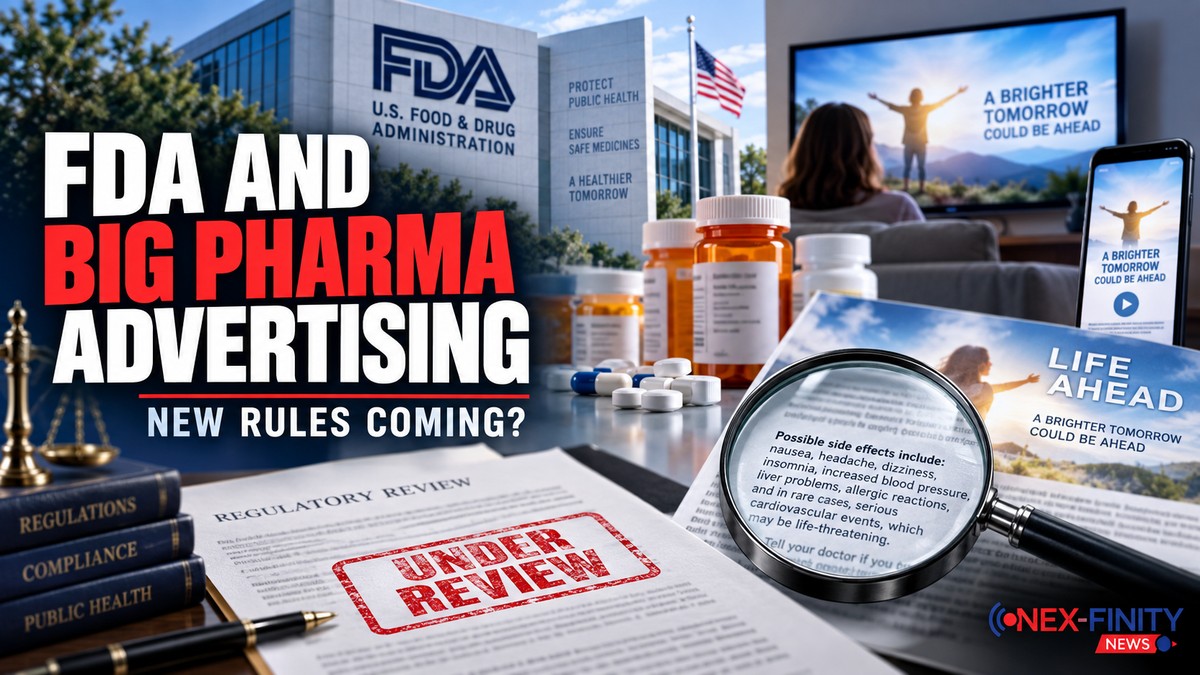
A rule due from the Food and Drug Administration in December would end most prescription drug advertising on American television. It would also remove roughly one out of every seven dollars that national television networks collect from advertisers.
Both of those things are true. Only the first one is being reported.
The proposed rule, “Transparency in Direct-to-Consumer Advertising,” appeared on the FDA’s 2026 Regulatory Plan and Unified Agenda in July. It would eliminate the “adequate provision” standard that has made broadcast drug advertising possible since 1999. The agency expects to publish a notice of proposed rulemaking in December 2026, with final rulemaking targeted for mid-2027.
Coverage so far has focused on what the rule means for pharmaceutical companies. That is a legitimate story. It is not the only one.
Prescription drug brands accounted for 13.1% of all national linear television advertising spending in the third quarter of 2025, and ABC, CBS and NBC capture the largest shares of those dollars. The organizations reporting on this rule are, in several cases, the organizations that would lose the revenue.
None of them have said so.
Background: How Drug Ads Got on Television
Prescription drug advertising to consumers was never explicitly illegal in the United States. It was impractical.
The 1962 Kefauver-Harris Amendments, passed after the thalidomide disaster, moved authority over prescription drug advertising from the Federal Trade Commission to the FDA and required advertisements to carry a “brief summary” of a drug’s side effects, contraindications and effectiveness.
In simple terms, that meant reading the package insert aloud. It worked in a medical journal. It did not work in a thirty-second commercial.
The first consumer-facing drug advertisements appeared in print in 1981. The FDA requested a voluntary industry moratorium in 1983 and lifted it in 1985, concluding that existing rules were adequate. Print advertising grew. Broadcast stayed rare.
That changed in 1997, when the FDA issued draft guidance permitting broadcast advertisers to satisfy the disclosure requirement through “adequate provision” directing viewers to a toll-free number, a website, a print advertisement or a pharmacist rather than reciting the full summary on air. The guidance was finalized in 1999.
The “ask your doctor” formula and the rapid-fire side-effect voiceover both date from that decision.
The United States and New Zealand remain the only two countries that permit direct-to-consumer advertising of prescription drugs.
What the Rule Would Do
The proposed rule would strike the adequate provision standard from 21 C.F.R. §202.1(e)(1)(i)(B) the specific regulatory text that enabled broadcast advertising for nearly three decades.
Manufacturers would again have to include the full brief summary of side effects, contraindications and effectiveness inside the advertisement itself. Attorneys analyzing the proposal have described that standard as commercially unworkable in most cases.
The FDA characterizes the proposal as a transparency measure rather than a prohibition. The practical effect, if finalized as described, would be to make broadcast drug advertisements long enough to be cost-prohibitive.
The rulemaking implements a directive from a presidential memorandum issued September 9, 2025, instructing the Department of Health and Human Services and the FDA to ensure transparency and accuracy in direct-to-consumer prescription drug advertising.
Enforcement has already intensified ahead of the rule. The FDA sent more than 50 untitled letters to pharmaceutical advertisers last year. Since 2014, the agency had never issued more than 11 regulatory action letters on drug promotion in a single year.
The Revenue at Stake
Pharmaceutical companies spent more than $6 billion on direct-to-consumer television advertising in 2024, with 75 individual brands each putting at least $10 million behind television.
The concentration is what matters. Drug brands represented 13.1% of all national linear television advertising spending in the third quarter of 2025, up from roughly 11.6% a year earlier. From January through August 2025, pharmaceutical companies put $3.73 billion into national television about 14% of all television advertising spending in that window.
Drug advertisements account for only 4.2% of commercials aired but consume 8.3% of total advertising time, because the risk disclosures make the spots run long.
Why television, when most advertising has moved online? Because of who is watching. Every major network’s median prime-time viewership age has been above 50 for years, and older viewers are the pharmaceutical market. Linear television delivers the audience the industry needs.
That audience concentration is the same reason this revenue sits disproportionately with network and cable news.
The trade press has covered the financial exposure. The general-audience press has not. The News Media Alliance, the newspaper industry’s trade association, told members it is active in a broader advertising coalition, is developing an engagement strategy on the rule, and welcomes member input on how it could affect publisher revenue.
That is an industry organizing around a policy question on commercial grounds which is legitimate, and which readers of member publications have not been told about.
What the Last Drug Scandal Looked Like on Television
There is a record of how pharmaceutical accountability journalism performs on the medium most dependent on pharmaceutical advertising. It is measurable, and it is not encouraging.
A content analysis published in the journal Substance Abuse examined national network television evening news segments on the opioid crisis from January 2000 through August 2020, using the Vanderbilt Television News Archive. The researchers queried five terms: opioid epidemic, OxyContin, heroin, fentanyl and naloxone.
They found 191 segments. Across ABC, CBS and NBC. Over twenty years. Roughly nine per year for all three networks combined.
Coverage peaked in 2016 fifteen years after the first sustained national reporting on OxyContin, nine years after the drug’s manufacturer pleaded guilty to federal charges, twenty years after the drug launched.
The framing is as notable as the volume. Segments most often provided a general overview of the epidemic (55.5%) or conveyed personal stories (40.3%). The people interviewed most frequently were patients with opioid use disorder (47.1%), healthcare providers (36.7%), family members and friends (31.9%) and law enforcement (30.9%).
The study’s authors concluded that the emphasis on emotionally compelling personal stories came at a cost to systemic coverage.
Print moved on a different schedule. American newspaper coverage of OxyContin peaked in July 2001; articles mentioning prescription opioids rose 149% between January and July of that year.
The medium with the least pharmaceutical advertising exposure spiked at the beginning. The medium with the most peaked fifteen years later.
Examples: The Record Is Worse Than Silence
The available history does not describe a press that was prevented from reporting. It describes a press that reported the manufacturer’s version.
Before 2001, newspaper articles about OxyContin focused on pharmaceutical earnings and pain management, and coverage was concentrated in New Jersey a state with a high density of pharmaceutical companies and their financial service providers. The drug entered the news as a business story.
The Associated Press quoted a pain-management specialist in 2000 saying that among patients with no history of drug abuse or psychological problems, hardly any become dependent on pain medication. A 2001 US News and World Report story described OxyContin as a safe and effective medication with few side effects and put the chance of addiction at one percent.
The Columbia Journalism Review’s retrospective assessment of this period is titled “The news industry was complicit in the opioid crisis.”
The manufacturer was also placing material directly. Reporting by ProPublica and STAT documented Purdue Pharma’s media strategy, including an essay that ran across the top of the New York Times health section in October 2004 arguing that law enforcement was overzealous about opioid prescribing. The author’s employer had an undisclosed financial relationship with Purdue.
ProPublica’s assessment is that the campaign may have helped thwart more vigorous regulation of opioid prescribing, and that the Sackler family’s role did not receive widespread coverage for another decade after the 2007 guilty plea.
A complicating fact belongs here. The largest newspaper in the country was early. New York Times reporter Barry Meier began writing about OxyContin in 2001 on a tip from a state pharmacy board regulator and published Pain Killer in 2003 years before the federal case concluded. The prosecutor who brought that case drafted a press release thanking Meier by name, which Meier asked him to remove because he was still covering the story.
Accurate, prominent, early reporting existed in the paper of record. The epidemic ran for two more decades anyway.
Whatever failed here, it was not the absence of a story.
Impact: What the Rule Would and Would Not Change
The case for restricting the advertisements rests partly on cost. HHS Secretary Robert F. Kennedy Jr. has argued that when a pharmaceutical product is advertised, the government is most likely to be the payer, and that the advertisement itself is tax-deductible so taxpayers fund both the advertisement and the drug.
The exposure is real. The Government Accountability Office found that Medicare Parts B and D and beneficiaries spent $560 billion on drugs from 2016 through 2018, of which $324 billion went to drugs that were being advertised directly to consumers. Roughly 58 cents of every Medicare drug dollar in that period went to an advertised product.
The population-level evidence is weaker than the spending figures suggest.
Retail prescription drug spending reached $467.0 billion in 2024, up 7.9%. But the Centers for Medicare and Medicaid Services attributes nearly all of the recent increase to higher utilization more people treated, more prescriptions dispensed rather than to price increases.
And the National Center for Health Statistics found that the age-adjusted percentage of Americans taking at least one prescription drug did not change significantly from 2001–2004 through March 2020. The widely cited increase from 51% of adults in 1999–2000 to 59% in 2011–2012 is not age-adjusted; a substantial portion of it is the aging of the population.
Canada, which bans direct-to-consumer advertising, reports 65.5% of adults aged 40 to 79 using at least one prescription drug in the past 30 days, against 69.0% in the United States. That is a gap, but a modest one for a categorical difference in policy.
The rule may also be aimed at a channel that is already shrinking. Healthcare and pharmaceutical digital advertising spending reached an estimated $24.8 billion in 2025 against roughly $7.9 billion in traditional advertising, and 2025 marked the first year social media outpaced linear television in the category.
Analysis
There is no evidence in the public record that the administration designed this rule to damage news media revenue, and this article does not assert one.
The policy has an independent rationale that predates the current fight, has been argued publicly on cost grounds, and has bipartisan history the American Medical Association called for a ban in 2015.
The structural point stands regardless of intent. This is a policy whose costs fall heavily on an industry currently in open conflict with the administration, and neither party has an incentive to discuss that. The networks cannot report the revenue exposure without disclosing it. The administration gains nothing by acknowledging a side effect no one is blaming it for.
What readers are left with is coverage of a rulemaking, produced in part by parties with an undisclosed financial stake in its outcome, about an industry whose last major scandal those same parties covered 191 times in twenty years.
One further caution, for anyone certain that more coverage would have been better. A study published in PLOS One found news media reporting volume was a statistically significant predictor of opioid-related mortality, even after adjusting for seasonality and trend consistent with a longer historical pattern in which publicity about a drug drives its nonmedical use.
The counterfactual in which the networks covered OxyContin aggressively in 2001 is not obviously one in which fewer people died.
Conclusion
The proposed rule publishes in December. A comment period follows, and a First Amendment challenge from the industry is close to certain, turning on whether courts treat a disclosure requirement severe enough to function as a ban as a disclosure requirement or as a ban.
The thing worth watching is not only the rule. It is whether the outlets covering it tell their audiences what they stand to lose.
Key Takeaways
· The FDA plans to propose a rule in December 2026 eliminating the “adequate provision” standard that has permitted broadcast prescription drug advertising since 1999. Final rulemaking is targeted for mid-2027.
· Prescription drug brands account for about 13.1% of all national linear television advertising spending roughly one in seven dollars with ABC, CBS and NBC taking the largest shares.
· The newspaper industry’s trade association has told members it is organizing around the rule and has asked how it would affect publisher revenue. General-audience coverage has not disclosed the industry’s financial stake.
· National network evening news aired 191 segments on the opioid crisis across all three networks between 2000 and 2020, peaking in 2016 fifteen years after the first sustained national reporting.
· Early press coverage transmitted the manufacturer’s safety claims rather than suppressing the story, including a 2001 magazine report putting OxyContin addiction risk at one percent.
· The population-level case for the rule is weaker than the spending figures suggest: age-adjusted prescription drug use did not change significantly between 2001–2004 and March 2020.
Frequently Asked Questions
When did prescription drug advertising become legal on American television?
It was never illegal. The 1962 Kefauver-Harris Amendments required advertisements to carry a full “brief summary” of side effects and contraindications, which made broadcast advertising impractical rather than prohibited. The FDA’s 1997 draft guidance, finalized in 1999, allowed broadcasters to satisfy that requirement by directing viewers elsewhere a standard called “adequate provision.” Broadcast drug advertising grew rapidly after that.
What exactly would the proposed FDA rule change?
It would eliminate the adequate provision standard at 21 C.F.R. §202.1(e)(1)(i)(B), requiring the full brief summary to appear inside the advertisement. The FDA describes this as a transparency measure. Attorneys reviewing the proposal have said the practical effect would be to make most broadcast drug advertisements commercially unworkable.
How much television advertising revenue is involved?
Prescription drug brands accounted for 13.1% of all national linear television advertising spending in the third quarter of 2025. Pharmaceutical companies spent $3.73 billion on national television from January through August 2025, roughly 14% of all television advertising in that period.
Does direct-to-consumer advertising actually increase prescription drug use?
The evidence is mixed. Medicare spending is heavily concentrated in advertised drugs $324 billion of $560 billion from 2016 through 2018. But age-adjusted prescription drug use in the United States did not change significantly between 2001–2004 and March 2020, and Canada, which bans the advertisements, shows only modestly lower usage rates.
Which countries allow direct-to-consumer prescription drug advertising?
The United States and New Zealand are the only two.
When will the rule take effect?
The FDA expects to publish a notice of proposed rulemaking in December 2026, with final rulemaking targeted for mid-2027. A legal challenge from the pharmaceutical industry is widely anticipated.
Related Coverage
· The Right to Privacy Was Never Written Into the Constitution
· Political Polling: How Do They Keep Getting It Wrong?
· The Lenders Say the Consumer Is Fine. The Consumer Says Otherwise.
If you or someone you know is struggling with substance use, the SAMHSA National Helpline is available 24/7 at 1-800-662-4357.
Sources
· U.S. Food and Drug Administration 2026 Regulatory Plan and Unified Agenda, “Transparency in Direct-to-Consumer Advertising” (RIN 0910-AJ14)
· Presidential Memorandum on direct-to-consumer prescription drug advertising, September 9, 2025
· 21 C.F.R. §202.1(e)(1)(i)(B)
· Kefauver-Harris Drug Amendments of 1962
· Jay J, Chan A, Gayed G, Patterson J. “Coverage of the opioid crisis in national network television news from 2000–2020: A content analysis.” Substance Abuse 43(1), 2022. https://doi.org/10.1080/08897077.2022.2074594
· Dasgupta N, et al. “Breaking the News or Fueling the Epidemic? Temporal Association between News Media Report Volume and Opioid-Related Mortality.” PLOS One. https://journals.plos.org/plosone/article?id=10.1371%2Fjournal.pone.0007758
· “The news industry was complicit in the opioid crisis.” Columbia Journalism Review. https://www.cjr.org/opinion/opioids-news-prescription-doctor.php
· “Prescribing Practices Amid the OxyContin Crisis: Examining the Effect of Print Media Coverage on Opioid Prescribing Among Physicians.” The Journal of Pain. https://www.jpain.org/article/S1526-5900(13)01231-5/fulltext
· Peterson-KFF Health System Tracker trends in prescription drug spending. https://www.healthsystemtracker.org/chart-collection/recent-forecasted-trends-prescription-drug-spending/
· Centers for Medicare and Medicaid Services National Health Expenditure data, retail prescription drug spending
· National Center for Health Statistics Health, United States, prescription drug use
· Kantor ED, et al. trends in prescription drug use among adults, 1999–2012, JAMA
· U.S. Government Accountability Office Medicare spending on direct-to-consumer advertised drugs
· iSpot.TV and Guideline.ai national television advertising share data, 2025
· News Media Alliance member communications on the proposed rule
· ProPublica and STAT reporting on Purdue Pharma’s media strategy
· Meier B. Pain Killer, 2003; New York Times reporting beginning 2001
· Canadian Health Measures Survey prescription drug use, adults 40–79