
Introduction
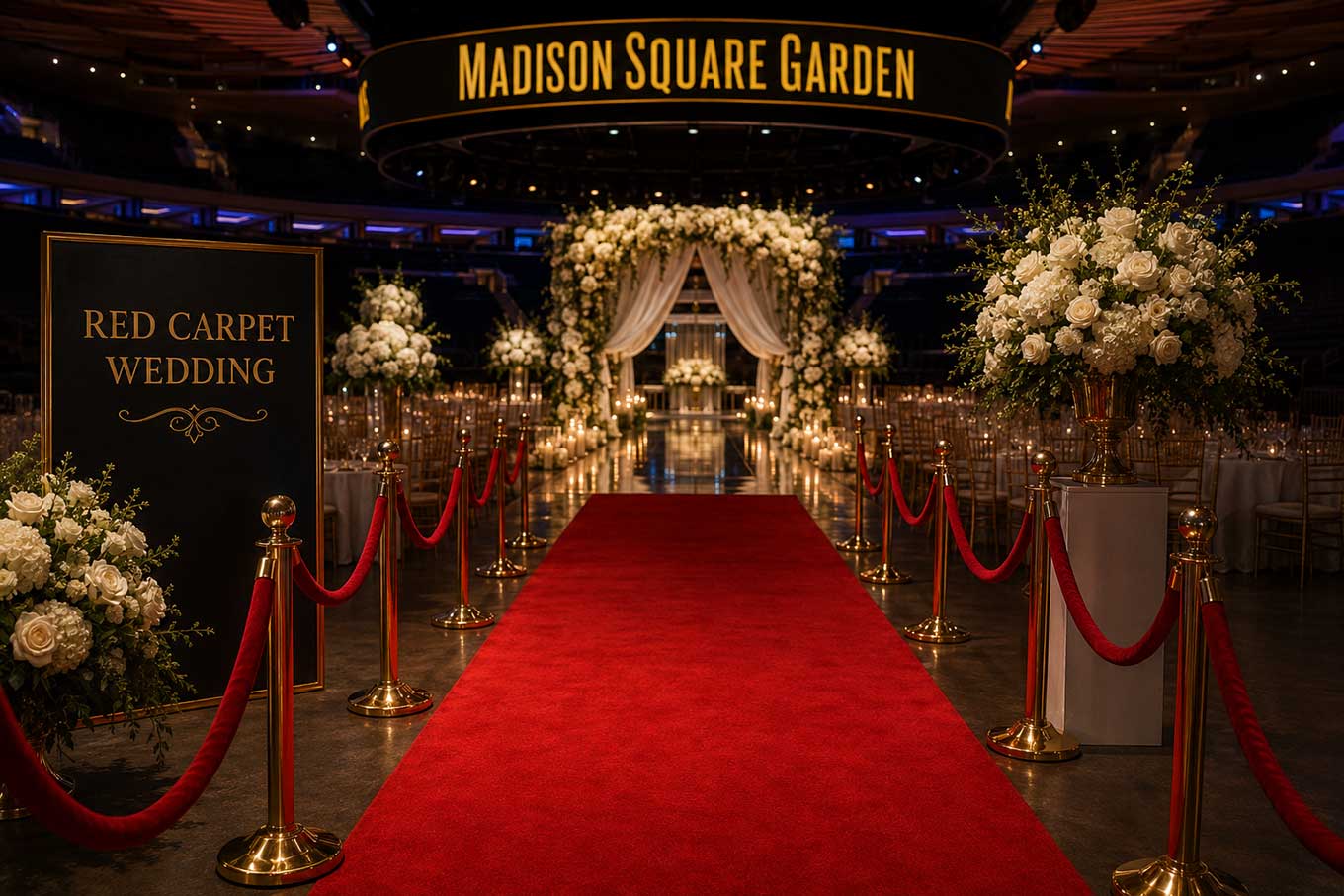
Over the July 4 weekend, the busiest travel stretch of the summer, a stretch of Midtown Manhattan around Madison Square Garden is set to go quiet — not for a parade, not for the nation’s 250th birthday, but for what is widely reported to be the wedding of pop superstar Taylor Swift and Kansas City Chiefs tight end Travis Kelce.
A permit to close the streets around the arena from July 2 through midday July 4 has been filed and confirmed by New York City Hall. For a Long Island reader whose train home runs underneath that very building, the question is not whether two famous people deserve a private celebration. It’s simpler: who absorbs the cost of clearing public streets for a private party — and does the man who won City Hall promising to fight for the “common man” see a problem with it?
Background: What We Actually Know
Here is what has been confirmed, and what has not.
Reports first surfaced in The New York Times that Swift rented Madison Square Garden for July 2 through July 4, with a roughly 100-person gathering on July 2 and a guest list approaching 1,000 to 1,200 people on July 3. City Hall spokesperson Dora Pekec confirmed to multiple outlets that a permit application was filed in early June with the city’s Street Activity Permit Office to close the streets around the Garden on those dates.
The permit was not filed by the city, and not by the couple directly. It was filed by Winick Productions, a private event-planning company that has staged red-carpet events at MSG before. The application reportedly requested space for a tent, canopies, and trucks, and listed an event of roughly 500 to 999 people.
In simple terms: a private company asked the city for permission to shut public streets for a private event, and the city is processing it like any other street-activity permit.
What is not confirmed is the wedding itself. Neither Swift, Kelce, nor Madison Square Garden has publicly acknowledged the event. A dozen NYPD officers stationed near the Garden and Penn Station told CNN they remain skeptical it will happen there at all, with one reportedly dismissing it outright. Swift is famous for misdirection, and a competing theory holds that MSG hosts only an after-party while the vows happen elsewhere. Readers should treat the venue as strongly reported but officially unconfirmed.
The Policy: How a Street Closure Actually Happens
New York City’s Street Activity Permit Office (SAPO), housed under the Mayor’s Office of Citywide Event Coordination and Management, reviews thousands of applications a year — block parties, film shoots, farmers markets, and large private events. Approval typically involves sign-off from agencies including the NYPD and the Department of Transportation.
This is routine machinery. The mayor does not personally bless each permit, and supporters of Mayor Zohran Mamdani are quick to point that out. But routine machinery still produces a political picture, and the picture here is striking: a city government built on an affordability mandate clearing the public right-of-way around its busiest transit hub for a celebration thrown by one of the wealthiest entertainers on earth. Swift became a billionaire in 2023, according to CBS News.
The Examples: Who Sits in the Blast Radius
The businesses. The streets around MSG are lined with delis, bars, parking operators, and Penn Station-adjacent retail that depend on foot traffic — and a holiday weekend is normally a payday, not a penalty. TMZ reported that wedding buzz has already rippled through Midtown, with some MSG-area businesses irritated over road closures, security, and crowds putting a dent in their holiday-weekend plans. When trucks, tents, and a security perimeter swallow the curb for two and a half days, the small operator who can’t relocate eats the loss.
The commuters — and Long Island in particular. Madison Square Garden sits directly on top of Penn Station, the single busiest transit hub in the Western Hemisphere and the Manhattan terminal for the Long Island Rail Road. Hundreds of thousands of LIRR riders move through that complex on a normal day; July 3 is one of the heaviest getaway days of the year, layered this year on top of the America250 celebrations. Amtrak police, per The New York Times, were told to expect a Swift-Kelce wedding that weekend.
In simple terms: the people most likely to be squeezed by a security cordon around the Garden are the workers and commuters passing through underneath it — many of them Long Islanders heading home.
To be fair, the closure is for surface streets, not the rail concourse, and the LIRR is not being shut down. But anyone who has tried to navigate the Penn Station/MSG block during a major event knows the surface chaos doesn’t stay politely on the surface.
The Impact: A Stress Test for “Affordability”
Mayor Mamdani won the most votes of any New York City mayor in 60 years on a platform that can be summarized in three words: tax the rich. His pitch was that the wealthiest residents and most profitable corporations should “pay their fair share” to fund relief for working-class New Yorkers — free buses, universal child care, a rent freeze, and a $22 billion housing plan branded “Block by Block.”
The backdrop is real hardship. Median Manhattan rents have topped $5,400 a month, the typical New York household spends more than half its income on rent, roughly 100,000 people sleep in shelters each night, and about 1.4 million residents are food insecure. This is the city Mamdani promised to make livable for the people who keep it running.
So the optics write themselves. The administration spent its first six months insisting that the powerful must sacrifice for the many. Now, on the nation’s birthday weekend, the city’s permitting apparatus is poised to hand over the public commons around Penn Station to a billionaire’s wedding — and the mayor’s most notable public comment was to welcome it. Asked about the event at a June 15 press conference, Mamdani folded it into a celebration of the city’s big-event summer: “We are the biggest city in the country… and we are so excited to welcome the world here.” Asked whether he was invited, he laughed: “No and no.”
Analysis: Fighting for the Common Man, or Catering to the Elite?
Here is the uncomfortable tension at the center of this story.
A populist administration’s legitimacy rests on a simple promise: that the rules bend toward the many, not the few. Permitting is where that promise gets tested, because permitting is where the city decides whose convenience is worth the public’s inconvenience. When the answer is “the billionaire’s,” the working-class mandate starts to look like branding.
The critique writes itself, and it is worth stating plainly because it is the question on a lot of readers’ minds: a mayor cannot spend six months lecturing the wealthy about fair shares and then roll out the carpet — literally clearing the streets — when one of the wealthiest people alive wants to throw a party over the busiest commuter weekend of the summer. If the affordability agenda has a blind spot for celebrity and spectacle, then “for the common man” was a slogan, not a governing principle.
But honesty requires the other side of the ledger, too.
First, this is almost certainly not a Mamdani decision in any meaningful sense. SAPO processes thousands of permits administratively; a mayor who personally vetoed a lawfully filed street-activity application because he disliked the applicant’s wealth would be setting a far more dangerous precedent than a weekend road closure. In simple terms: you don’t want the mayor picking which private citizens are allowed to use the permit system based on their bank account.
Second, the economics may cut the other way. A Swift-Kelce wedding draws global press, books out hotels — Chiefs players reportedly booked the Marriott Marquis — and pumps spending into the exact Midtown economy that funds the city. The hospitality workers, drivers, and vendors who benefit are themselves working-class New Yorkers. Inconvenience for some block-front businesses is not the same as a transfer of wealth upward.
Third, New York closes streets for the powerful and the famous constantly — for the UN General Assembly, for presidential motorcades, for film studios, for the Macy’s parade. Singling out this event as uniquely elitist proves less than it seems.
The fair verdict, then, is narrower and sharper than “Mamdani is a fraud.” It is this: the affordability mayor has a messaging problem he chose not to manage. He could have used the moment to say something — about commuter protections, about compensating affected small businesses, about ensuring the July 3 LIRR crush is staffed and the cordon kept tight and brief. Instead he greeted it as a tourism win. For an administration whose entire brand is whose side are you on, greeting a billionaire’s street closure with unqualified enthusiasm, on the busiest travel weekend of the year, is a self-inflicted wound.
Conclusion
The wedding, if it happens at MSG, will be over by midday July 4 and the streets will reopen. The deeper question lingers. A government that asks the many to trust it to redistribute from the few is judged not only by its tax plans but by its instincts — by reflex, in the small moments, about whose comfort matters.
When the test arrived in the form of a permit and a pop star, the affordability administration didn’t fail it outright. But it didn’t pass it convincingly either. It welcomed the spectacle, said nothing about the commuters and shopkeepers in its shadow, and left the rest of us to ask whether “for the common man” is a conviction — or a campaign.
Key Takeaways
- A permit to close streets around Madison Square Garden from July 2 to midday July 4 has been confirmed by City Hall, filed by private event company Winick Productions; the Swift-Kelce wedding at MSG is strongly reported but not officially confirmed, and some NYPD and MSG sources are skeptical.
- MSG sits atop Penn Station, the LIRR’s Manhattan terminal — placing Long Island commuters and Midtown small businesses directly in the disruption’s path on one of the year’s busiest travel weekends.
- The episode collides with Mayor Mamdani’s “tax the rich” affordability mandate and $22 billion housing agenda, raising a fair question about whether the populist brand bends for the wealthy and famous.
- The strongest defense: permitting is administrative, not a personal mayoral favor, and the event injects spending into a working-class hospitality economy.
- The strongest criticism: the mayor greeted the closure as a tourism win rather than addressing commuter and small-business impacts — a messaging failure for an administration whose identity is built on whose side it’s on.
Sources
- The New York Times — reporting on MSG rental, permit filing, and guest counts (via NBC Sports, NBC News)
- CBS News — City Hall confirmation of street-closure permit; Dora Pekec statement
- NBC News — Winick Productions permit application details; Mamdani June 15 press conference quotes
- TODAY / NBC — Street Activity Permit Office filing; Mamdani “No and no” remark
- TMZ — guest count, security/street-closure reporting, MSG-area business reaction
- CNN (via Heavy.com) — NYPD and MSG-source skepticism about the venue
- Spectrum News NY1 — Mamdani 100-days affordability agenda; “tax the rich” remarks
- NYC Mayor’s Office — “Block by Block” housing plan ($22B investment); SPEED reforms
- CNN Business — NYC affordability data (median rent, shelter population, food insecurity)
This is an opinion/editorial analysis. Factual claims are sourced as of June 26, 2026; the MSG wedding venue had not been officially confirmed by Taylor Swift, Travis Kelce, or Madison Square Garden at publication.