
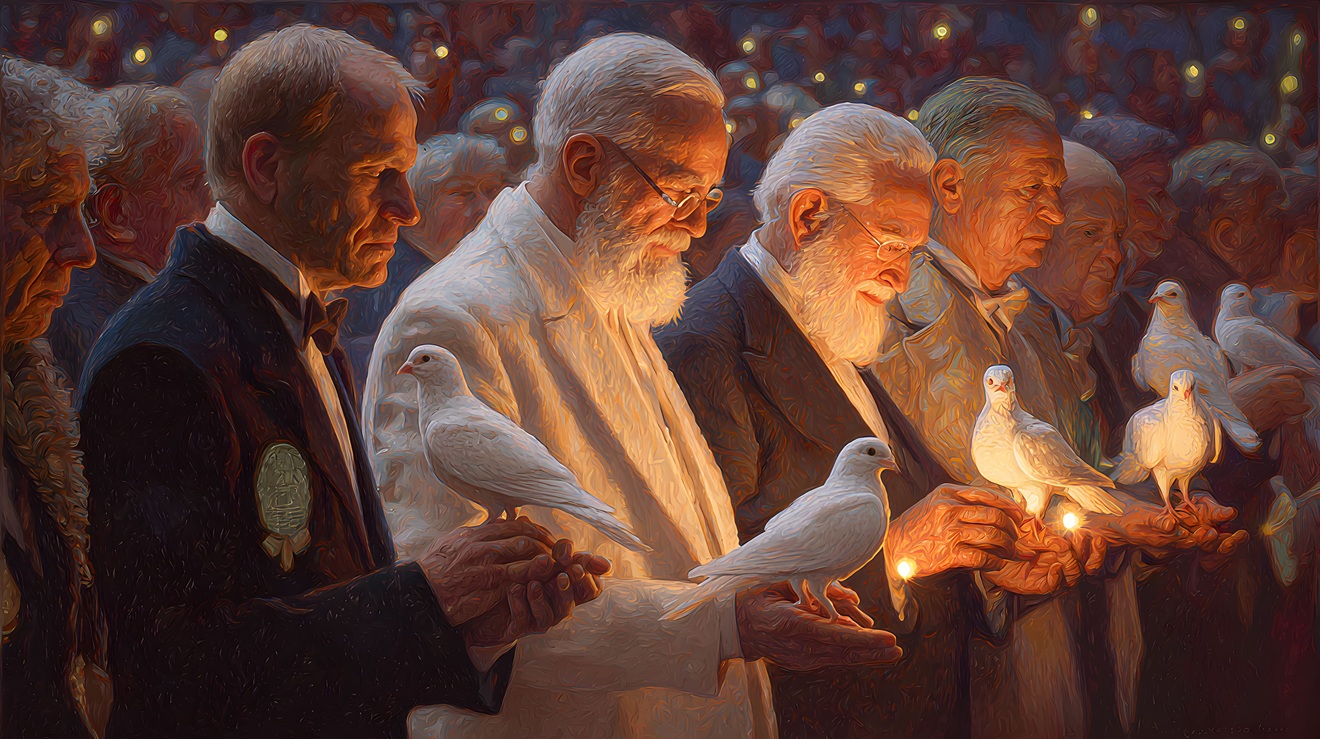
Let’s start with a simple question. Have you ever wondered who decides who gets the Nobel Peace Prize?
Five people. Five Norwegian citizens, appointed by the Norwegian Parliament, are operating without any required expertise in international law, diplomacy, or conflict resolution. No formal credentials. No public accountability. Just five individuals — typically former politicians and academics — who meet behind closed doors and bestow the world’s most prestigious honor on whoever they collectively see fit.
Sound familiar? It should. Because it’s the same basic architecture that runs virtually every institution at the top of the global power structure. A small, self-selecting group of elites, insulated from public oversight, operating under the cover of prestige and procedure. And right now, in real time, that architecture is crumbling under the weight of three million pages of Justice Department documents and the fallout of one man’s very well-documented network.
Jeffrey Epstein is dead. But his address book is very much alive.
The Files That Changed Everything
On January 30, 2026, the Department of Justice released over three million pages of documents tied to its investigation into Epstein — including 180,000 images and 2,000 videos — following the passage of the bipartisan Epstein Files Transparency Act. The law, signed by President Trump in November 2025, required the DOJ to make its investigative files public. What followed wasn’t just a political scandal. It was a stress test on the entire concept of elite institutional legitimacy.
The arrests started almost immediately.
On February 19, Andrew Mountbatten-Windsor — formerly known as Prince Andrew, son of Queen Elizabeth II — was arrested at Sandringham Estate on suspicion of misconduct in public office. He was released roughly eleven hours later without charges, but he remains under investigation. The files showed emails suggesting he forwarded confidential British trade documents to Epstein during his time as the UK’s trade envoy. Documents also surfaced showing a photograph of Mountbatten-Windsor crouched over an unidentified woman on the floor at one of Epstein’s properties. He was the first member of the House of Windsor to be arrested in the institution’s history — reportedly the first British royal arrested in 379 years. Let that sink in.
His ex-wife Sarah Ferguson wasn’t spared either. Emails in the DOJ release revealed that Ferguson maintained contact with Epstein long after his 2008 conviction, corresponding with him about her business while he was sitting in prison for soliciting sex from a minor. The files show Epstein made travel arrangements for her and that she visited his residence with her two daughters. Her charity trust, Sarah’s Trust, has since shut down indefinitely.
Four days after the Andrew arrest, British politician Peter Mandelson — one of the most powerful figures in the Labour Party for three decades and, until recently, the UK’s ambassador to the United States — was arrested outside his London home. He too was released on bail. The files show Epstein made three separate $25,000 payments to Mandelson in the early 2000s and wired nearly $12,000 to his husband for an osteopathy course in 2009. When Epstein was sentenced to eighteen months for sex trafficking in 2008, Mandelson wrote to him expressing that he thought the world of him and felt furious about what had happened. That is a senior British official, a man who shaped Labour Party policy for a generation, professing deep personal loyalty to a convicted child sex offender.
The Norwegian Thread — And Why It Matters Here
Here’s where it gets particularly pointed, given our earlier conversation about the Nobel Peace Prize.
The Epstein files have opened up a remarkable window into the Norwegian diplomatic and political establishment — the very world from which Nobel Peace Prize committee members are drawn.
Thorbjorn Jagland, former Prime Minister of Norway and former Secretary-General of the Council of Europe, has been charged with aggravated corruption. Norwegian authorities raided his properties as part of a criminal investigation into his Epstein connections. The files show that Jagland and his family visited Epstein’s residences on multiple occasions, with all travel expenses covered by Epstein. In one particularly striking email chain, Epstein attempted to arrange a meeting between Jagland and Russian President Vladimir Putin. Oh, and one more detail that deserves its own paragraph: Jagland was also the former chair of the Norwegian Nobel Committee. The man who helped decide who gets the world’s most prestigious peace prize was apparently on Epstein’s payroll.
Norwegian Crown Princess Mette-Marit, wife of Crown Prince Haakon and heir to the Norwegian throne, has now been forced to issue a public apology for her long and close friendship with Epstein. The released files include hundreds of emails the two exchanged, many about arranging meetings. She stayed at Epstein’s Palm Beach house in his absence and continued their relationship even after his first conviction. This is Norway’s future queen.
Meanwhile, Mona Juul, a former Norwegian ambassador to the United Nations, Jordan, and Iraq, and one of the architects of the Oslo Accords, has resigned her current ambassadorial post, had her security clearance revoked, and been charged with aggravated corruption. Her husband, diplomat Terje Rod-Larsen, faces charges of contributing to aggravated corruption. The couple allegedly stand to inherit millions of dollars left to them in Epstein’s will. Rod-Larsen, who ran a think tank called the International Peace Institute, described Epstein in the released files as his best friend. Reporting by Norway’s largest newspaper, Aftenposten, revealed that the think tank under Rod-Larsen brought in young women from Eastern Europe as interns — and their photographs were then shared with Epstein.
Remember: the Nobel Peace Prize is decided by Norwegian political and diplomatic elites. The very ecosystem from which the committee draws its members is now producing Epstein-connected names at an alarming rate. That’s not a conspiracy theory. That’s a documented overlap of the same small, interconnected world where everyone knows everyone — and apparently, everyone knew Jeffrey.
The Pattern Is the Point
What the Epstein files are revealing isn’t a single bad actor. Epstein has been dead since 2019. What they’re revealing is a system — a self-reinforcing network of elite institutions that protect their own, trade access for loyalty, and operate with almost no accountability to the public they claim to serve.
The list of figures facing consequences now spans virtually every sector of the global establishment.
In the legal world, Brad Karp — the longtime chairman of prestigious law firm Paul, Weiss, Rifkind, Wharton & Garrison — resigned after emails surfaced showing his effusive gratitude to Epstein for what he called a “once-in-a-lifetime” evening. Epstein responded that Karp was always welcome and that there would be “many many nights of unique talents.” The firm did not elaborate on what those unique talents were.
At Goldman Sachs, Kathy Ruemmler — former White House Counsel to Barack Obama and the former chief legal officer at one of the most powerful banks on Earth — resigned after emails revealed friendly exchanges with Epstein. The files show that after leaving the White House, she received personal gifts from Epstein including a Hermes handbag and a spa day at a Four Seasons hotel. She had also corresponded with him about possible candidates to replace Attorney General Eric Holder — a role she herself was widely considered for at the time.
Thomas Pritzker, executive chairman of Hyatt Hotels and member of one of America’s most prominent billionaire families, resigned after emails showed he maintained contact with Epstein through their assistants, coordinating dinners, and continued corresponding with him even after Epstein’s 2008 guilty plea for soliciting sex from a minor.
Sultan Ahmed bin Sulayem, the chairman and CEO of DP World — one of the world’s largest logistics companies, managing the most important port in the Middle East — stepped down after his name appeared more than 4,700 times in the DOJ release. In a 2013 email, Epstein called him one of his most trusted friends in every sense of the word. In a reply that speaks for itself, bin Sulayem suggested he was off to enjoy the company of a young woman on his yacht.
In academia, Columbia University cut ties with professor Thomas Magnani and stripped administrator Letty Moss-Salentijn of her duties after emails revealed they helped Epstein’s girlfriend gain mid-program admission to the university in 2012. David Ross, a prominent figure in the contemporary art world, resigned from his leadership position at the School of Visual Arts after it emerged he had enthusiastically supported an Epstein proposal to fund an exhibition featuring images of minors portrayed to look older or younger than their actual age. In a 2015 email, Ross told Epstein he was proud to call him a friend.
In the diplomatic world beyond Norway, Miroslav Lajcak — former President of the UN General Assembly and national security adviser to Slovakia’s Prime Minister — resigned after emails showed an Epstein coordinator arranging multiple meetings between them, while Epstein arranged tickets for Lajcak’s family to a Las Vegas show and received the diplomat’s personal vacation itinerary.
And in France, former Culture Minister Jack Lang and his daughter are under investigation by financial crimes prosecutors for suspected money laundering tied to their relationship with Epstein. The files show Lang thanking Epstein for hosting him on trips and making plans to meet in Marrakech.
What “Prestigious” Really Means
Think about what all these institutions have in common. The British Royal Family. The Labour Party. The Council of Europe. Norwegian diplomacy. Ivy League academia. Wall Street’s top law firms. Multinational investment banks. Global port operators. They don’t require demonstrated merit to join at the highest levels. They require connection. Access. The right relationships with the right people in the right rooms.
Epstein was, at his core, a relationship manager for the powerful. He didn’t build rockets or cure diseases. He cultivated proximity to people who made decisions — and then leveraged that proximity in ways the files are still making clear. The fact that he operated so comfortably across so many prestigious institutions for so long isn’t a bug. It’s a feature of how those institutions work.
The Nobel Peace Prize is a useful lens here because it sits at the apex of institutional prestige. It confers moral authority. It signals to the world that someone has been judged, by serious people using serious criteria, to have done exceptional work in service of humanity.
But as we’ve walked through, the people doing that judging are former politicians appointed through a partisan process, with no required expertise, operating behind closed doors. The former chair of that very committee has now been criminally charged with aggravated corruption. The Norwegian diplomatic world that surrounds it is under multiple criminal investigations. And the Crown Princess of the country itself has issued a public apology for her friendship with a convicted child sex trafficker.
The Reckoning Isn’t Over
The DOJ acknowledged that as many as six million pages may qualify as responsive to the Epstein Files Transparency Act. Only about half that has been released. Ghislaine Maxwell, the only person sentenced to prison for Epstein-related crimes, invoked the Fifth Amendment in a congressional hearing this month and has offered to speak only if granted clemency. The files are still being processed. The names are still being read.
What’s already clear is that the institutions we’ve been told to trust — the royal families, the diplomatic corps, the prize committees, the investment banks, the law firms, the universities — were not merely adjacent to Epstein’s network. Many were woven through it at the highest levels. And the same characteristics that made those institutions prestigious — exclusivity, opacity, self-governance, access to power — are the same characteristics that made them vulnerable to exactly this kind of corruption.
Trust in institutions is built on the assumption that they police themselves. The Epstein files are the most thorough answer we’ve ever received to the question of how well that actually works.
The reckoning isn’t a political moment. It’s an institutional one. And it’s far from finished.
NexfinityNews.com is committed to accountability journalism and independent reporting. Follow our ongoing coverage of the Epstein files and their implications for American institutions and the global elite.