
I Have No Sympathy for Nidal Hasan
Let me be clear about where I stand before I say anything else.
Nidal Hasan walked into a medical processing center at Fort Hood on Nov. 5, 2009, and murdered 12 soldiers and a civilian. He wounded 32 more. He shot people in the back as they ran for the parking lot. He did it in uniform, against the men and women he had sworn to serve alongside.
As a Marine veteran, I do not lose sleep over his fate. A military jury convicted him. He admitted it. If the courts allow the sentence to be carried out, the law will be carried out.
This column is not about whether Hasan dies. It is about how.
What the Pentagon Announced
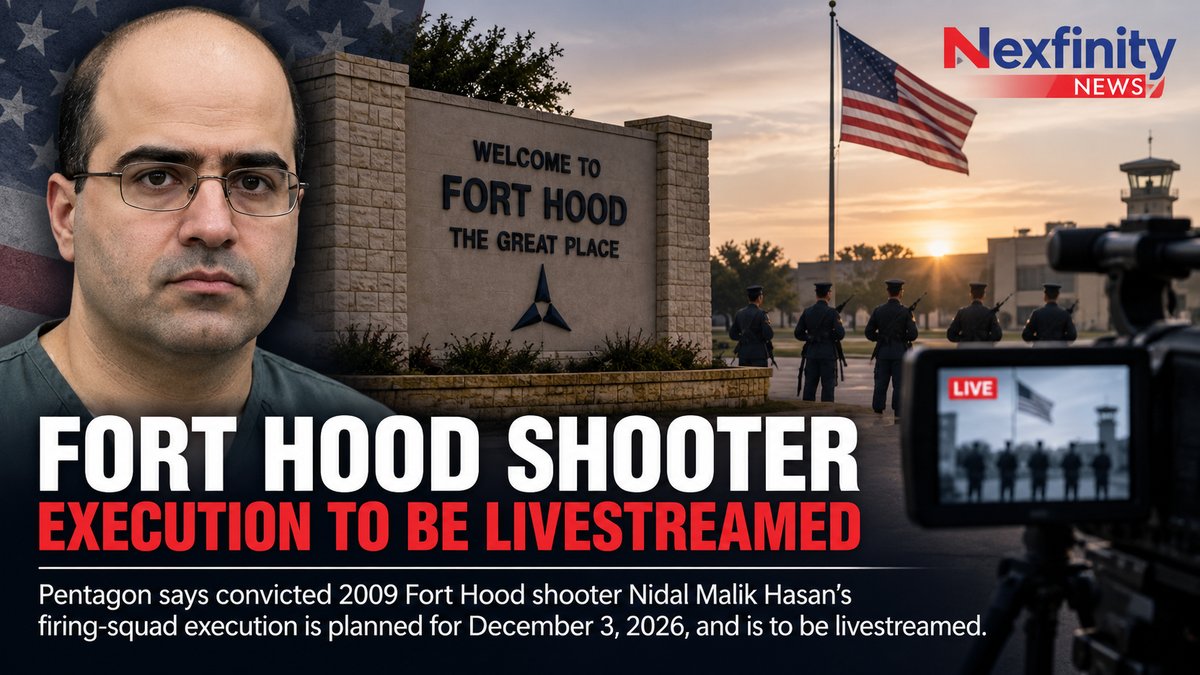
The Army has set Hasan’s execution by firing squad for Dec. 3 at Fort Hood. On Thursday, the Pentagon said the execution will be livestreamed. Defense Secretary Pete Hegseth put it plainly in an interview the day before: “We’ll make sure that people are able to watch it, that it’s public.”
That is a decision no American government has made in roughly 90 years. It is the wrong one.
This Is What Tyrants Do
The public execution is not an American tradition. It is the signature of the regimes we hold up as the opposite of everything we stand for.
Take Iran. Amnesty International documented at least 2,159 executions there in 2025 more than double the prior year and roughly 80% of all recorded executions worldwide. Amnesty also documented public hangings, carried out in town squares, often from construction cranes, sometimes in front of crowds that include children. The point is not justice. The point is to make the population watch.
That is the machinery the Islamic Republic and its Revolutionary Guard rely on: arrest, a closed trial, a forced confession on state television, and a death staged for an audience. The spectacle is the message. It tells everyone watching who holds power and what happens to those who cross it.
ISIS built a propaganda operation on the same idea, filming its executions and distributing them to the world.
When the United States stages an execution for the cameras, it is not making a different point. It is making the same one.
We Already Said This Was Wrong
This administration has said so itself.
Earlier this year, President Trump warned Tehran against hanging protesters and later told Congress in his State of the Union that U.S. pressure had stopped Iran from carrying out those hangings. Washington rightly treated a regime that kills its people for show as a regime beyond the pale.
We cannot condemn the gallows in Tehran in January and build a broadcast set at Fort Hood in December.
America has also been here before, and we learned. In 1936, thousands gathered in Owensboro, Kentucky, to watch the hanging of Rainey Bethea. The scene was so grotesque that it ended public executions in this country.
Even Timothy McVeigh, who murdered 168 people in Oklahoma City, was not put on public television. His 2001 execution was shown on a closed-circuit feed to survivors and victims’ families, and to no one else. That is the line a serious country draws.
A Livestream Hands Hasan What He Wanted
There is a practical argument here, too, and it should matter to anyone who cares about national security.
Hasan did not see himself as a murderer. He told the jury he was a soldier who had “switched sides.” He was in contact with Anwar al-Awlaki, the cleric who became a recruiter for al-Qaeda in the Arabian Peninsula. His own standby attorneys believed he wanted the death sentence.
A livestream gives him exactly what a man like that wants: a stage. It produces footage of a uniformed American firing squad executing a Muslim man in a wheelchair. That footage will not stay on a Pentagon feed. It will be clipped, captioned and recirculated by every extremist channel that wants a martyr and a recruiting video. Some online accounts are already calling him a hero.
We would be producing their propaganda for them, at taxpayer expense.
Think About Who Has to Watch
The families of the 13 victims have waited 17 years. Each of them deserves the right to decide whether to witness this. A livestream takes that decision away. The moment their loved one’s killer dies will play on phones, in group chats and on social media feeds whether they choose to look or not.
Think, too, about the soldiers ordered onto that firing squad. They will carry out a lawful sentence. They should not have to do it on camera, as content.
The Supreme Court Has Already Answered This in 1879
If this reaches the Supreme Court, the justices will not need to invent anything. The answer is in the very case that made the firing squad legal.
In Wilkerson v. Utah (1879), the Court upheld execution by firing squad. In the same opinion, it drew a line: the Constitution forbids punishments in which terror, pain or disgrace is “superadded” to death itself.
That principle is not a relic. In Bucklew v. Precythe (2019), Justice Neil Gorsuch, writing for the Court’s conservative majority, revived it. He pointed to punishments the Founders’ generation rejected, such as public dissection and displaying the bodies of the condemned, practices designed to heap humiliation on top of death.
In simple terms: the Court has said the state may take a life, but it may not turn the taking into a degradation. A livestream of a paralyzed man being shot, broadcast to anyone with a phone, is about as clear a modern example of superadded disgrace as one could design.
Why the Court May Never Get the Chance
Here is the uncomfortable part. The case may never reach the justices.
The only person with a clear right to challenge how Hasan dies is Hasan. Under Whitmore v. Arkansas (1990), outsiders cannot step in on a death-row prisoner’s behalf unless he is shown to be incompetent. Victims’ families, veterans’ groups and civil liberties organizations would likely be turned away. And a man who told his jury he had “switched sides” may welcome the camera.
The existing case law does not fill the gap. In Garrett v. Estelle (1977), a federal appeals court ruled that the press has no First Amendment right to film an execution, and in Houchins v. KQED (1978) the Supreme Court held the media has no special right of access to prisons. Those cases say the government does not have to let cameras in. No court has ever been asked whether the government may put an execution on camera itself. That question is genuinely open.
The Court has also made clear in Bucklew that it disfavors last-minute stays. Anyone who intends to challenge the livestream needs to file now, not on Dec. 2.
So the restraint may have to come from where it should have come in the first place: the Pentagon. If the courts are not asked, common sense has to be exercised by the people who made the decision.
Process Is What Makes Us Different. Spectacle Erases It.
Supporters will say this is about transparency. It isn’t. Transparency already exists. Army regulation requires media witnesses at a military execution. Reporters can describe what they saw. The public can read the record of the trial, the appeals and the order. That is accountability.
A live feed adds nothing to accountability. It adds only spectacle.
Here is the honest distinction between the United States and the Islamic Republic of Iran: Hasan got a public trial. He got appeals that took more than a decade. He had lawyers, judges and a review process that Iran’s prisoners will never see. That process is the entire difference between justice and vengeance.
The livestream throws that difference away for a moment of theater. It tells the world that, in the end, we too want the crowd to watch.
Conclusion
If the courts allow it, carry out the sentence. Do it lawfully, soberly and behind prison walls, with the witnesses the law requires. Let the families choose. Let reporters report.
But cancel the livestream. A nation that fought the IRGC should not be borrowing its methods. Justice does not need an audience. Tyranny does.
Key Takeaways
· The Army set Nidal Hasan’s firing squad execution for Dec. 3 at Fort Hood, and the Pentagon says it will be livestreamed.
· Public, staged executions are a hallmark of regimes like Iran, which carried out at least 2,159 executions in 2025, including public hangings, according to Amnesty International.
· The United States ended public executions after the 1936 Bethea hanging; even Timothy McVeigh’s execution was shown only on closed circuit to victims’ families.
· A livestream risks handing extremists propaganda footage of a man some already call a martyr.
· Transparency already exists through required media witnesses and the public record. The livestream adds spectacle, not accountability.
· The Supreme Court’s own firing squad ruling, Wilkerson v. Utah (1879), bars punishments that “superadd” disgrace to death, a principle the Court reaffirmed in Bucklew v. Precythe (2019). But under Whitmore v. Arkansas, only Hasan himself may be able to bring the challenge.
Sources
· Pentagon says firing squad execution of Fort Hood shooter will be livestreamed Associated Press via PBS NewsHour, Oct. 8, 2026
· Fort Hood shooter’s execution will be live-streamed, Defense Dept. says The Washington Post, Oct. 8, 2026
· Mass murderer Nidal Hasan set for Dec. 3 execution by firing squad at Fort Hood, email states CBS Texas, Oct. 7, 2026
· Nidal Hasan May Be Executed on December 3 by Firing Squad Death Penalty Information Center, Oct. 7, 2026
· Fort Hood shooter Nidal Hasan to be executed by firing squad, Pentagon says CBS News, Oct. 6, 2026
· Pentagon to execute convicted Fort Hood mass shooter Nidal Hasan by firing squad ABC News, Oct. 6, 2026
· Iran’s Executions More Than Double in 2025, Making Up 80% of Global Total The Algemeiner, reporting Amnesty International’s 2025 death penalty report, May 18, 2026
· Iran: Over 1,000 people executed as authorities step up horrifying assault on right to life Amnesty International USA, Sept. 26, 2025
· Wilkerson v. Utah, 99 U.S. 130 (1879) Justia
· Bucklew v. Precythe, 587 U.S. ___ (2019) Justia
· Whitmore v. Arkansas, 495 U.S. 149 (1990) Justia
· Houchins v. KQED, Inc., 438 U.S. 1 (1978) Justia
· Garrett v. Estelle, 556 F.2d 1274 (5th Cir. 1977) Justia
This is an opinion column. The views expressed are those of the author.