
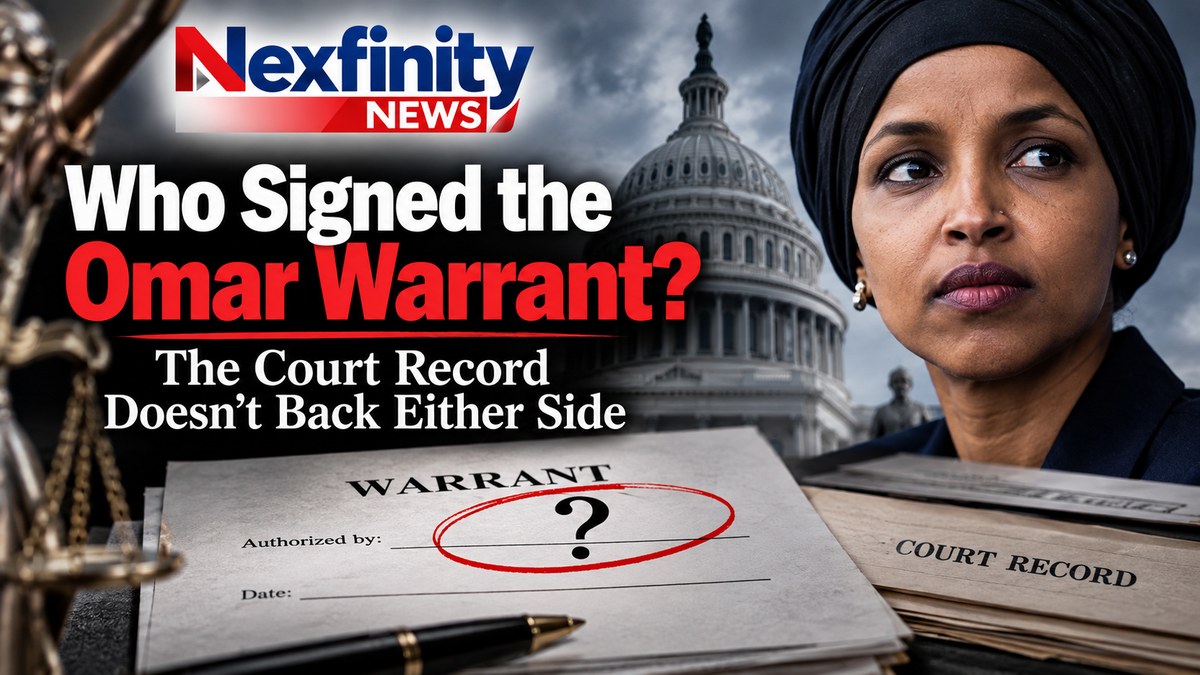
Federal agents searched Rep. Ilhan Omar’s Washington, D.C., home on Monday, Oct. 12, 2026, under a judicially authorized warrant. Within a day, a second fight broke out over who signed it.
Conservative commentators have named U.S. Magistrate Judge Matthew J. Sharbaugh as the likely signer. Their argument: if a judge they describe as a Democrat approved the search, the evidence must be strong. Omar’s allies call the search political retaliation, timed 22 days before the midterms.
NexfinityNews checked the judge question against court records. The signer has not been confirmed. The “Democrat or Republican appointee” label does not fit how magistrate judges are chosen. And we found no record of this judge blocking Trump policies which is expected, because magistrate judges generally cannot issue injunctions.
What Is Known About the Search
Homeland Security Investigations executed the warrant, which the Justice Department says it secured as part of an ongoing federal criminal investigation (ABC News). Omar has not been charged and denies wrongdoing.
· The allegations. The New York Times reported the warrant lists potential immigration crimes, including false statements and fraudulent paperwork (The 19th). Fox News sources tie it to documents her late father filed when she was a child (SAN).
· The approval chain. Senior DOJ leadership, including Acting Deputy Attorney General Trent McCotter, approved the search, according to NPR’s sources (NPR).
· The judge pushed back first. Prosecutors applied more than a week before the search. The judge went back and forth with them over whether they had made their case and addressed the constitutional protections specific to lawmakers (PBS NewsHour).
· The timing. DOJ practice has been to avoid overt investigative steps against candidates within 60 days of an election (ABC7). The search came 22 days out.
· A prior probe. A Biden-era DOJ investigation into Omar stalled for lack of evidence, the Times reported earlier this year (The 19th via Yahoo).
Who Signed the Warrant? Not Yet Confirmed
The Sharbaugh identification is an inference from the court’s public duty schedule. Mike Davis, founder of the Article III Project, posted that Sharbaugh was the magistrate on criminal duty Oct. 3–16, 2026, and therefore would have signed the warrant (The Gateway Pundit). Several outlets repeated the claim, some dropping the hedge (Twitchy).
Three reasons for caution:
1. The application predates the search by more than a week. Depending on the exact date, it may have first reached a judge before Sharbaugh’s rotation began on Oct. 3.
2. Duty rotation is a default, not a rule. Sensitive warrants can go to a district judge. The 2006 search of Rep. William Jefferson’s Capitol Hill office was approved by then–Chief Judge Thomas Hogan, a district judge.
3. No one has named the judge. Neither DOJ nor the court has identified the signer, and the warrant and affidavit remain sealed. Other coverage notes his involvement has not been confirmed (The Snarky Correspondent).
In simple terms: Sharbaugh is a reasonable guess based on the calendar. It is not an established fact.
Who Could Have Signed It? More Than Four Judges
The pool of judges who could sign this warrant is at least 19, not four. Posts circulating since the search name only the court’s four magistrate judges Zia Faruqui, G. Michael Harvey, Moxila Upadhyaya and Matthew Sharbaugh and argue all are Democrats (Townhall). That leaves out the district judges.
Federal Rule of Criminal Procedure 1(c) says that when the rules authorize a magistrate judge to act, any other federal judge may act too. So every district judge on the D.C. federal bench could have signed the warrant.
| Judge type | How chosen | Number | Could sign the warrant? |
| Magistrate judges | Selected by the district court, 8-year terms | 4 full-time | Yes one is assigned to criminal duty at a time |
| Active district judges | Nominated by a president, confirmed by the Senate | 15: 11 Democratic-appointed, 4 Republican-appointed (as of April 1, 2026, Ballotpedia) | Yes, under Rule 1(c) |
| Senior district judges | Same; semi-retired, still hearing cases | Not counted here | Yes, under Rule 1(c) |
The duty magistrate handles the routine flow of warrants. A search involving a sitting member of Congress is not routine, because it raises Speech or Debate Clause protections. That is the kind of application that can go to a district judge, as the 2006 Jefferson office search did.
One more limit: Rule 41(b) generally requires the warrant to come from the district where the property sits. Reports place Omar’s residence in Washington, D.C. If it were in Maryland or Virginia, none of these judges would have been the right court.
In simple terms: four of the possible signers were appointed by Republican presidents. Until the court or DOJ names the judge, the signer’s party affiliation is unknown.
Democrat or Republican Appointee? Neither
No president appointed Sharbaugh. Magistrate judges are not nominated by the White House or confirmed by the Senate. The district judges of each court select them for eight-year terms under 28 U.S.C. § 631.
Sharbaugh was sworn in on Oct. 28, 2024, by Chief Judge James E. Boasberg, after a merit selection process (D.D.C. announcement). His background, per the court’s biography (D.D.C.):
· Partner at Morgan, Lewis & Bockius, focused on employment litigation and appeals
· Earlier, an associate at Littler Mendelson, a management-side employment firm
· Two clerkships for Judge Robert L. Wilkins, an Obama appointee, on the district court and the D.C. Circuit
· Adjunct professor of legal research and writing at George Washington University Law School
The case for a partisan label: he was chosen by a court whose active bench is mostly Democratic appointees, he clerked for an Obama appointee, and Boasberg swore him in. Social media posts also claim he is a registered Democrat and a Hillary Clinton donor (Townhall). NexfinityNews has not verified those two claims against voter or FEC records.
The detail those posts leave out: the court’s Merit Selection Panel that screened him was chaired by Jessie Liu (D.D.C. announcement). President Trump appointed Liu as U.S. Attorney for the District of Columbia in 2017.
In simple terms: “picked at the end of the Biden administration” describes the calendar. President Biden had no role in the selection.
Has He Blocked Trump? No Record Found
NexfinityNews found no injunction or temporary restraining order by Sharbaugh against the Trump administration. That is what the law would predict. Under 28 U.S.C. § 636(b)(1)(A), a magistrate judge cannot decide a motion for injunctive relief unless both parties consent to the magistrate hearing the case. The high-profile D.C. rulings blocking administration policies came from district judges.
His published docket is small and mostly civil. One judge-analytics service counts 16 signed rulings, nine of them reports and recommendations to district judges (Ezel).
Critics point to two criminal-duty decisions instead:
| Case | What Sharbaugh did | Context |
| Emily Sommer, charged with spitting on then–interim U.S. Attorney Ed Martin (May 2025) | Released her after her first appearance, with a no-contact order covering Martin (Law&Crime) | The government had not sought pretrial detention (Daily Wire); U.S. Attorney Jeanine Pirro later moved to revoke release after alleged violations |
| Cole Tomas Allen, accused of attempting to assassinate Trump (2026) | Raised concerns about his solitary confinement and access to counsel, saying pretrial detention is not meant to punish (Davis Vanguard) | Called the charges extremely serious; did not order release |
Neither ruling is an injunction, and neither involved Trump administration policy. Both are routine pretrial matters. Readers can weigh whether they signal a bias.
What the Signature Proves and What It Doesn’t
Both sides are asking the judge’s identity to carry more weight than a warrant can.
“A Democrat judge signed it, so the evidence must be damning.” A warrant requires probable cause that evidence of a crime is in the home. As the Times’ Devlin Barrett noted, that is a far lower bar than the proof a jury needs to convict (PBS NewsHour). The reported back-and-forth does show the judge did not rubber-stamp the request. It says nothing about how a case would fare at trial.
“The search is political retaliation.” A judge reviewed the application, pushed back, and found probable cause. That is the check the Fourth Amendment provides. But judicial approval does not settle questions about why DOJ pursued the case or chose this moment (Davis Vanguard). The 60-day election practice is DOJ’s own policy; no judge enforces it.
In simple terms: the judge decides whether the government has a reason to search. The judge does not decide whether the government should have chosen to investigate, or when.
The questions that will actually resolve this:
· What does the sealed affidavit allege, and will it be unsealed?
· Why search a residence for records from decades ago? Former U.S. Attorney Joyce Vance has raised this question (The Snarky Correspondent).
· What new evidence emerged after the Biden-era inquiry stalled?
Conclusion
The most likely signer of the Omar warrant is a magistrate judge chosen by his court, not by a president, through a panel led by a Trump-appointed former prosecutor. He has no record of blocking Trump policies, and his position largely bars him from doing so. The partisan framing on both sides runs ahead of the record. The affidavit, once unsealed, will say more than the judge’s résumé.
Key Takeaways
· The judge has not been officially identified; Magistrate Judge Matthew Sharbaugh is an inference from the Oct. 3–16 duty schedule. At least 19 federal judges could have signed it, including four Republican appointees.
· Magistrate judges are selected by district judges for eight-year terms, not appointed by a president. Sharbaugh was sworn in Oct. 28, 2024.
· His selection panel was chaired by Jessie Liu, Trump’s 2017 pick for U.S. Attorney in D.C.
· No injunction against the Trump administration by Sharbaugh was found; federal law generally bars magistrates from issuing them.
· A signed warrant means probable cause, not proof of guilt and it does not answer questions about DOJ’s timing.
Sources
· U.S. District Court for D.C. Sharbaugh appointment announcement (Oct. 28, 2024)
· U.S. District Court for D.C. Magistrate Judge Sharbaugh biography
· NPR Agents search Rep. Omar’s D.C. home
· PBS NewsHour Devlin Barrett interview
· ABC News Omar residence searched
· The 19th What we know about the search
· Yahoo / The 19th Biden-era investigation
· Straight Arrow News Fox reporting on immigration paperwork
· Ballotpedia Current federal judges by appointing president
· The Gateway Pundit Mike Davis on the duty schedule
· Twitchy Judge identification claims
· Townhall “Four magistrates” claim (Oct. 13)
· Townhall Party and donation claims (Oct. 14)
· The Snarky Correspondent Unconfirmed involvement; Joyce Vance question
· Law&Crime Sommer release conditions
· Daily Wire Pirro motion in Sommer case
· Davis Vanguard Allen detention concernsDavis Vanguard Warrant does not resolve motive