
On the night of Sept. 27, more than 600 people walked out of Tapachula, the Mexican city closest to the Guatemalan border, and headed north on the Chiapas coastal highway, according to EFE. They call themselves “Fe y Esperanza,” or Faith and Hope. Most of them had left San Pedro Sula, Honduras, a week earlier.
The nearest U.S. crossing, Brownsville, Texas, is more than 1,500 kilometers away by road. Election Day is Nov. 3. Within a day of the group leaving Tapachula, it was being covered in the United States as an election story. Conservative outlets presented it as a sign of what a Democratic win would bring, and progressive ones presented the coverage itself as a campaign tactic.
This article looks at two questions: whether the caravan can physically reach the border before the vote, and what the record shows about who organized it and why now.
Background: From San Pedro Sula to the Chiapas Coast
The group left San Pedro Sula on Sept. 20 with roughly 200 to 400 people, mostly Hondurans, traveling in small groups toward Guatemala. It entered Mexico on Sept. 24 and walked about 40 kilometers in 12 hours to Tapachula, where members camped in Bicentenario Park.
The caravan roughly doubled in Tapachula. Migrants who had been waiting in the city for Mexican immigration paperwork joined, including people from El Salvador, Guatemala, Ecuador and Haiti. Counts vary by source and by day. EFE put the group at more than 600 when it left Tapachula; a Chiapas newspaper counted about 500 leaving Huixtla on Sept. 29 toward Villa Comaltitlán.
The planned route follows the Pacific coast through Escuintla, Mapastepec, Pijijiapan, Tonalá and Arriaga, entering Oaxaca near San Pedro Tapanatepec. As of the afternoon of Sept. 29, the group had not reached Oaxaca.
By historical standards, it is small. A 2022 caravan had more than 10,000 people.
In simple terms: A caravan is a large group of migrants traveling together for safety and to avoid paying smugglers. Caravans are loosely organized and usually shrink as they move north.
The Timeline: Can It Reach the Border by Nov. 3?
Tapachula to Brownsville is more than 1,500 kilometers by road. The routes to Arizona and California are more than twice as long.
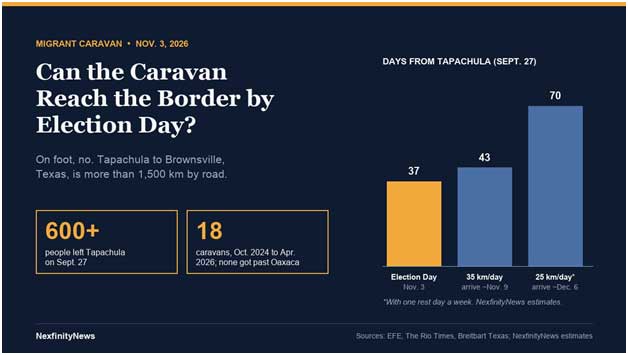
Estimated walking time from Tapachula to Brownsville, Texas, compared with Election Day. Sources: EFE, The Rio Times, Breitbart Texas. Estimates and graphic: NexfinityNews.
On foot, the calendar works against the caravan. At 35 kilometers a day with no rest days, a pace few large groups with children can keep up, the walk to Brownsville would take about 43 days, with arrival around Nov. 9. At a more typical 25 kilometers a day with one rest day a week, it would take about 10 weeks, into early December. Both figures are NexfinityNews estimates.
Rides change the math. The October 2018 caravan left San Pedro Sula on Oct. 13, and its first groups reached Tijuana on Nov. 14, covering a much longer route in just over a month. A group that gets rides or buses for part of the way moves faster than one that walks.
The bigger obstacle is Mexico. Between President Claudia Sheinbaum’s inauguration in October 2024 and April 2026, 18 caravans set out, and none moved beyond Chiapas or Oaxaca before being broken up, according to Breitbart Texas. Mexico’s National Migration Institute (INM) typically ends a caravan by offering migrants transit documents and bus rides in exchange for leaving the group. The previous caravan, “Dreams Without Borders,” ended that way in September.
U.S. officials expect the same result. DHS Secretary Markwayne Mullin said the caravan has “zero chance” of reaching the U.S. border, and a DHS source told Breitbart Texas it would “likely be broken up before it can leave the southern states of Mexico.” DHS told Fox News that anyone who tries to cross unlawfully “will be taken into custody, charged and deported.”
In simple terms: On foot, the caravan cannot reach the border before Nov. 3. With rides, it could in theory, but no caravan in the past two years has made it out of southern Mexico. If it affects the election, it will be through news coverage, not arrivals at the border.
Theory One: Migrants Are Betting on a Political Shift
Some conservative commentators argue that migrants are watching U.S. politics and moving now because they expect Democrats to gain power and loosen enforcement. One pro-Trump influencer wrote that migrants are “already moving through Mexico because they think America might blink.” Townhall and Hot Air both covered the caravan with the election in the headline.
What the record shows: NexfinityNews found no on-the-record statement from a caravan member tying the trip to U.S. elections. Asked why they left, migrants cited unemployment, poverty, earlier deportations and long delays in Mexican asylum and residency paperwork. One member said the group had no leaders “beyond hunger, need.” A change in which party controls Congress would also not, on its own, change border enforcement, which the executive branch runs.
Theory Two: The Caravan Is Being Amplified for Votes
Progressive outlets argue the reverse. Media Matters, Rolling Stone and WhoWhatWhy contend that caravan coverage predictably spikes before U.S. elections and fades soon after, as it did in October 2018. In their account, a group of about 600 people more than 900 miles away is being presented as a crisis because border security is one of the few issues on which Republicans still lead in polls.
The skepticism is not limited to the left. Former Republican Congresswoman Marjorie Taylor Greene asked publicly: “We have not seen a caravan headed to the U.S. southern border in several years, why now?”
What the record shows: The coverage pattern is real and easy to document. But heavy coverage of a caravan is not evidence that anyone in the United States created it. The caravan exists, and its members are walking through Chiapas.
Theory Three: Organized, but From Inside Mexico
This explanation has the strongest documentation and gets the least attention in U.S. coverage.
The caravan has a public coordinator. Mexican migrant-rights activist Luis García Villagrán has led or supported several caravans out of Tapachula in recent years. He predicted the group’s arrival before it reached the city, and he filed collective legal petitions, known as amparos, to protect members from detention by Mexican immigration authorities. He has called Tapachula “a great migrant prison.”
That fits how Tapachula caravans usually work. Thousands of migrants wait in the city for months for Mexican documents, and a caravan is a way to pressure the Mexican government to act on them. The usual outcome is a negotiated one: the INM issues transit or residency papers, and the group breaks up.
In simple terms: The caravan was planned and promoted in advance by a known activist network. The available evidence indicates its main target is Mexico’s immigration system, not the U.S. election calendar.
Analysis: Organized Is Not the Same as Manufactured
Neither label in the headline fits cleanly.
The caravan is not spontaneous. It has a named coordinator, it was promoted before it reached Tapachula, and it relied on legal filings prepared ahead of time. People did not all decide to start walking at the same moment by chance.
NexfinityNews found no evidence that it was engineered around the U.S. midterms, whether by a U.S. political party, a nonprofit or an outside funder. The documented drivers are local: paperwork backlogs in Tapachula, economic hardship in Honduras, and an activist network with a history of using caravans to pressure Mexico City.
One question the current reporting does not answer is whether the organizers weighed the U.S. calendar when they chose a September departure. That is a fair question to put to them. Until it is answered, it is a question, not a finding.
What is clear is that once a caravan exists, both parties have a reason to use it. One side presents it as proof of a border threat. The other presents it as proof of fear-mongering.
Conclusion
The “Fe y Esperanza” caravan left Honduras on Sept. 20 with a few hundred people, doubled in Tapachula, and is now walking north along the Chiapas coast. It is more than 1,500 kilometers from Brownsville, weeks away even at the fastest realistic walking pace, and moving through the region where Mexican authorities have broken up every caravan in the past two years.
The next test is Oaxaca. If the INM disperses the group there in the coming weeks, as it has done repeatedly, the story may end before Election Day. If the caravan keeps growing and moving into November, the questions about its timing will get louder.
Key Takeaways
- The “Fe y Esperanza” caravan left San Pedro Sula, Honduras, on Sept. 20 and left Tapachula, Mexico, on Sept. 27 with more than 600 people, according to EFE.
- On foot, the roughly 1,500-kilometer walk to Brownsville, Texas, would take an estimated 43 to 70 days, ending after the Nov. 3 election.
- Mexico broke up all 18 caravans that set out between October 2024 and April 2026 before they left Chiapas or Oaxaca, according to Breitbart Texas. DHS says this group has “zero chance” of reaching the U.S.
- The caravan is organized. Activist Luis García Villagrán is its public coordinator and filed legal protections for members in advance.
- NexfinityNews found no evidence that the caravan was organized around the U.S. election. Its documented drivers are Mexican paperwork backlogs and economic hardship.
What to Watch
- Where it is now: the Chiapas coast, moving from Huixtla toward Villa Comaltitlán (as of Sept. 29)
- Last Chiapas stops: Tonalá and Arriaga
- Oaxaca line: near San Pedro Tapanatepec. No caravan since October 2024 has made it past Oaxaca.
- Signs of a breakup: INM offers of transit documents or bus rides
- Election Day: Tuesday, Nov. 3, 2026
Sources
- EFE via Latin Times, “U.S. Vows Deportations as New 600-Migrant Caravan Sets Off From Mexico” (Sept. 29, 2026)
- The Rio Times, “Migrant Caravan of 600 Sets Out From Southern Mexico Toward the U.S. Border” (Sept. 2026)
- Yahoo News, “Migrant caravan from Honduras heads toward US border” (Sept. 2026)
- Infobae, “Caravana ‘Fe y Esperanza’ llega a México con migrantes hondureños” (Sept. 26, 2026)
- Radio Sonora, “Reanuda marcha caravana migrante ‘Fe y Esperanza’ desde Tapachula” (Sept. 2026)
- El Orbe (Tapachula), “Caravana ‘Fe y Esperanza’ avanza en la carretera costera” (Sept. 29, 2026)
- El Heraldo de México (Oaxaca), caravan route and size (Sept. 29, 2026)
- Breitbart Texas, “DHS: ‘Zero Chance’ of New Migrant Caravan Reaching U.S. Border” (Sept. 29, 2026); conservative news site
- Breitbart Texas, “Latest Migrant Caravan in Southern Mexico Begins to Dissolve” (April 30, 2026); conservative news site
- Mexico Solidarity Media, “National Institute of Migration Dissolves Migrant Caravan in Oaxaca” (Oct. 2025); progressive media project
- Waging Nonviolence, “How the migrant caravan sparked a movement” (Nov. 2018)
- WhoWhatWhy, “Five Weeks Ahead of the Midterms, It’s ‘A Caravan Is Headed for the Border’ Time” (Sept. 2026); nonprofit news site
- Media Matters for America, “Fox News is running its midterms migrant caravan playbook again” (Sept. 2026); progressive media watchdog
- Rolling Stone, “Surprise! Republicans Found a Migrant Caravan Just in Time for the Midterms” (Sept. 2026)
- Townhall, “Just in Time for the Midterms, a Migrant Caravan Is Headed for the Border” (Sept. 28, 2026); conservative news site
- Hot Air, “There’s a New Migrant Caravan on the Way to the US Border” (Sept. 28, 2026); conservative news site