
Intro
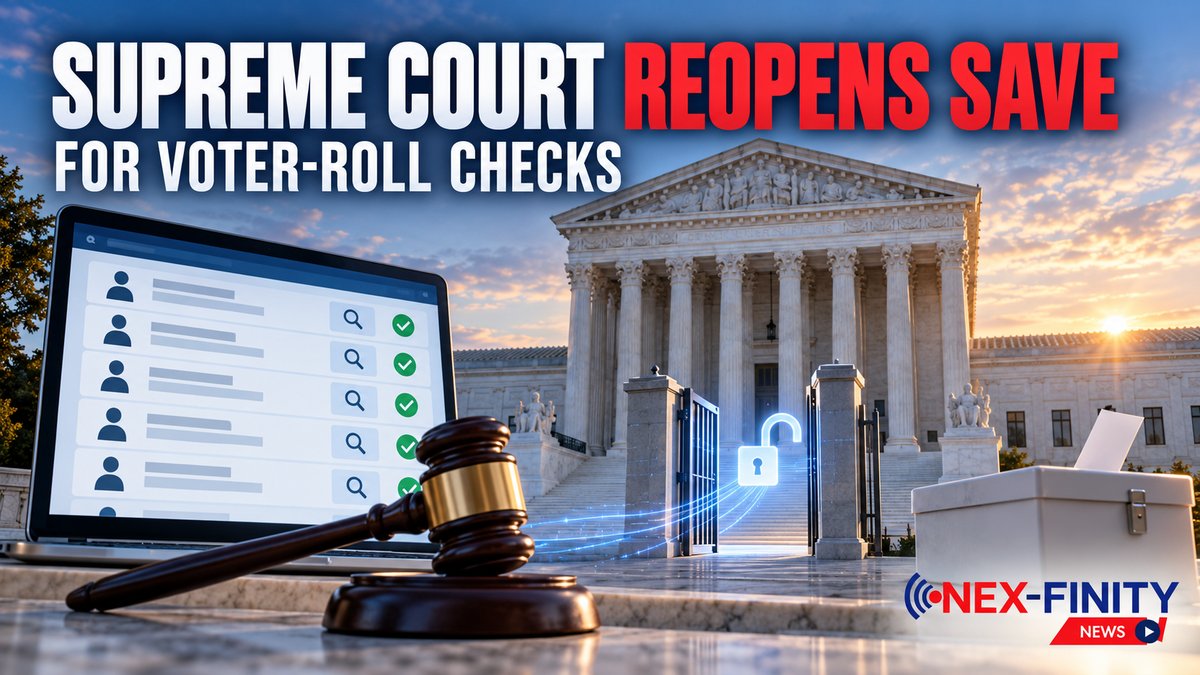
The U.S. Supreme Court on Friday, Sept. 25, 2026, cleared the way for states to again use the Department of Homeland Security’s revamped SAVE database to check the citizenship of registered voters. The 6-3 emergency order paused a lower-court ruling that had found the expanded system violated federal privacy law.
The ruling lands two months after New Jersey disclosed that a motor-vehicle software error registered roughly 6,600 people who had told the state they were not U.S. citizens. It also arrives days after a Reuters tally put the national total of such error-driven registrations above 30,000 since 2000.
Those two numbers now sit at the center of the same argument. One side says they prove the rolls need federal citizenship checks. The other says they show the problem is administrative, not fraud, and that SAVE itself makes mistakes.
Background
SAVE, the Systematic Alien Verification for Entitlements program, dates to 1986. Congress created it so agencies could confirm a person’s immigration status before paying out benefits such as Social Security. For years, state and local election officials used it to check individual voters one at a time.
A 2025 executive order changed its scale. It directed DHS and the Social Security Administration to build a tool that could verify the citizenship of people registering to vote and those already on the rolls. The overhaul allowed bulk queries, and DHS encouraged states to upload entire voter files, waiving the usual fee.
In simple terms: a tool built to check one benefits applicant at a time was turned into one that can scan a whole state’s voter list at once.
Tens of millions of voter records ran through the new system before U.S. District Judge Sparkle Sooknanan in Washington blocked it in June 2026. She found the expanded program violated multiple federal laws, including privacy protections. A federal appeals court left her order in place. The administration then took the case to the Supreme Court on an emergency basis.
Policy Explanation
The order is a stay, not a final ruling on the merits. It lets SAVE operate while litigation continues.
The legal basis. The majority accepted the government’s reading of a provision in the 1996 Illegal Immigration Reform and Immigrant Responsibility Act (IIRIRA). That provision, the Court said, authorizes DHS to obtain citizenship data from other federal agencies, including Social Security records, and share it with states. The unsigned opinion said the federal government has an obligation to answer election officials who ask to verify a voter’s citizenship, according to CBS News.
The limits. The opinion stressed that SAVE may be used for individualized checks ahead of the election. It also noted that federal law bars systematic voter purges close to Election Day. That refers to the National Voter Registration Act’s 90-day quiet period before a federal election. With the midterms on Nov. 3, that window opened in early August.
What is still unresolved. Whether bulk, list-wide use of SAVE is lawful is a separate question. The Court will take it up in a case this term, but not before the midterms.
Voluntary use. No state is required to run its rolls through SAVE. That limits the order’s near-term reach. However, DHS has tried to tie some federal anti-terrorism and disaster grants to states’ willingness to use it.
The Court’s three liberal justices dissented.
Examples
New Jersey: the “no” that became a registration
On July 21, 2026, Gov. Mikie Sherrill disclosed that roughly 6,600 people had been registered to vote through the state Motor Vehicle Commission between June 2023 and June 2024. Each had answered “no” on a keypad when asked whether they were U.S. citizens while applying for a license or ID. The error predates Sherrill, who took office in January 2026.
In simple terms: the applicants told the state they were not citizens, and the system registered them anyway.
Sherrill blamed a software error by Idemia, the vendor that has run New Jersey’s driver’s license printing since 2010. Idemia has denied responsibility. It has said the registration data it sends must still be validated by the state Division of Elections. Former Gov. Phil Murphy has said he was unaware of the problem. Sherrill ordered an independent investigation and began replacing the vendor.
On Aug. 19, the state reported what its review found:
| Measure | Count |
| Registered in error, June 2023 – June 2024 | ~6,600 |
| Deleted from rolls (no other proof of eligibility) | 5,100 |
| Status changed to “rejected” pending county review | ~1,450 |
| Cast ballots, per the state | ~340 |
| Also voted, but with records suggesting eligibility (under county review) | 220 |
Source: New Jersey Monitor, Aug. 19, 2026
The state has not said in which elections those ballots were cast. Assemblyman Paul Kanitra (R-Ocean) has argued the true number of noncitizen votes may be higher and has pressed the administration to release that detail. Sherrill has directed counties to finish their reviews before voting begins.
The national picture: more than 30,000 since 2000
A Reuters review published Sept. 23 found that states may have added more than 30,000 self-declared noncitizens to voter rolls since 2000. The cause, in case after case, was software glitches or clerical errors in driver’s license and state ID processing. Reuters built the tally from data compiled by the nonprofit Center for Election Innovation & Research, then checked it against state records, court filings and local reporting.
Errors were documented in at least 12 states: New Jersey, California, Illinois, Iowa, Nevada, Ohio, Oregon, Pennsylvania, South Dakota, Texas, Utah and Virginia. Reuters said the figures are inexact because state data is often revised. It could not determine how many of those registrants actually voted.
Several cases show how early counts shrink under review:
- Iowa announced before the 2024 election that more than 2,000 self-reported noncitizens had registered or voted. Six months later the figure was 277. State officials said 35 noncitizens cast counted ballots, out of more than 1.6 million votes.
- Virginia has reported hundreds of self-identified noncitizens on its rolls each year since 2014, more than 4,500 in 2025. State officials say that figure includes people who later naturalized.
- Oregon DMV clerks registered hundreds of American Samoans who showed U.S. passports. American Samoans are U.S. nationals, not citizens, and cannot vote.
- Texas used the revamped SAVE to review more than 18 million registrations. It flagged 2,724 potential noncitizens in October 2025. At least one flagged voter, a naturalized citizen of more than a decade, was removed after missing a 30-day county notice.
For scale: the nation has more than 170 million registered voters, according to the Reuters report.
Impact
For states. Election offices that want federal citizenship data can get it again, for individual checks, five weeks before the Nov. 3 midterms. Texas filed a brief urging the Court to allow it, calling the tool transformational for its election administration. A handful of GOP-led states had already secured carve-outs from the June injunction through separate litigation in Florida.
For voters. A SAVE flag is not proof of noncitizenship. In Texas, flagged voters get a county notice and 30 days to prove citizenship; those who miss it can be removed. Naturalized citizens are most exposed, because SAVE may not reflect a recent change in status. Stephen Richer, the Republican former Maricopa County recorder, said election offices should treat a SAVE result as a starting point, not a final answer.
For the purge calendar. The NVRA quiet period means large-scale removals should not happen before Nov. 3, whatever SAVE returns. Individual challenges can still proceed.
For privacy. The plaintiffs argued the overhaul fused immigration, Social Security and state voter data into one federal system. The Court’s IIRIRA reading, if it holds, makes that data sharing lawful. NPR reports the administration is also using SAVE to compile lists of adult citizens in each state.
Analysis
New Jersey is the strongest evidence each side has, and it cuts in both directions.
The case for federal checks. New Jersey’s error ran for a year and went undisclosed until 2026. The state’s own review found 5,100 registrations with no other proof of eligibility and roughly 340 ballots cast. The White House points to 11 federal arrests for noncitizen voting since May. Don Palmer of the Heritage Foundation, a former Election Assistance Commission chair, told Reuters that driver’s license agencies often make mistakes and that states must do more to verify eligibility. Supporters argue a federal cross-check is the backstop that would have caught New Jersey’s problem sooner.
The case against. In New Jersey, every applicant answered the citizenship question truthfully. The failure was in the state’s own software. David Becker of the Center for Election Innovation & Research told Reuters that a proof-of-citizenship requirement would not have stopped these errors, because the process, not the person, failed. Critics also note SAVE has its own error rate: it has flagged citizens as potential noncitizens. And initial counts, such as Iowa’s, have repeatedly fallen once reviewed.
What the numbers support. Two things are true at once. Error-driven noncitizen registration is documented, recurring and bipartisan, spanning Democratic and Republican states. It is also small relative to 170 million-plus registrations. Federal prosecutors have charged 129 people under the 1996 “voting by aliens” statute, per an earlier Reuters analysis, with no coordinated scheme alleged.
In simple terms: the evidence points to a data-quality problem at the DMV counter more than an organized fraud problem at the ballot box.
The open question the Court left for later is the one that matters most. Individual SAVE checks are low-risk if flags are verified. Bulk scans of entire state rolls, run by a system with a known false-positive rate, carry more risk of removing eligible citizens.
Conclusion
The Supreme Court’s Sept. 25 order restores a federal citizenship check that states can use now, one voter at a time. It does not settle whether whole-roll scans are legal, and federal law blocks mass removals before Nov. 3.
New Jersey shows both why officials want the tool and why its critics worry. A state system registered people who said they were not citizens. A federal system meant to catch that has flagged citizens who were. The next test is whether states verify SAVE flags before acting on them, and what the Court decides on bulk use after the midterms.
Key Takeaways
- On Sept. 25, 2026, the Supreme Court voted 6-3 to let DHS’s revamped SAVE database be used again to check voter citizenship, pausing a June lower-court ruling.
- The Court relied on a 1996 immigration law and emphasized individualized checks; bulk use will be decided later this term, after the midterms.
- New Jersey’s MVC software error registered about 6,600 self-declared noncitizens from June 2023 to June 2024; 5,100 were deleted and about 340 voted.
- Reuters counts more than 30,000 error-driven noncitizen registrations in at least 12 states since 2000, against 170 million-plus registered voters.
- State use of SAVE is voluntary, and the NVRA bars systematic purges within 90 days of a federal election.
Sources
- CBS News Supreme Court allows Trump administration to use SAVE database (Sept. 25, 2026)
- NPR The Supreme Court revives the controversial SAVE data system (Sept. 25, 2026)
- CNN The Supreme Court’s SAVE database ruling explained (Sept. 25, 2026)
- CNN Supreme Court says states can use citizenship data tool (Sept. 25, 2026)
- NBC News Supreme Court allows expanded database (Sept. 25, 2026)
- AP via PBS News Supreme Court lets Trump administration use revamped database (Sept. 25, 2026)
- NBC4 Washington (AP) (Sept. 25, 2026)
- Democracy Docket Supreme Court revives DHS use of immigration database (Sept. 25, 2026)
- NBC News 6,600 noncitizens were registered to vote in N.J. (July 21, 2026)
- ABC News New Jersey accidentally registered 6,600 noncitizens (July 22, 2026)
- Axios N.J. removes noncitizens from voter rolls (July 21, 2026)
- New Jersey Monitor NJ strikes 5,100 from voter rolls (Aug. 19, 2026)
- Reuters (via West Hawaii Today) How US states mistakenly added 30,000 non-citizens to voter rolls (Sept. 23, 2026)
- Center for Election Innovation & Research Review of noncitizen claims
- NPR Trump’s SAVE tool is flagging U.S. citizens (Dec. 10, 2025)
- Texas Tribune / Votebeat Texas SAVE lawsuit
- Arkansas Advocate via Yahoo 240 potential noncitizens on Arkansas rolls