
This article reflects the court record as of September 13, 2026.
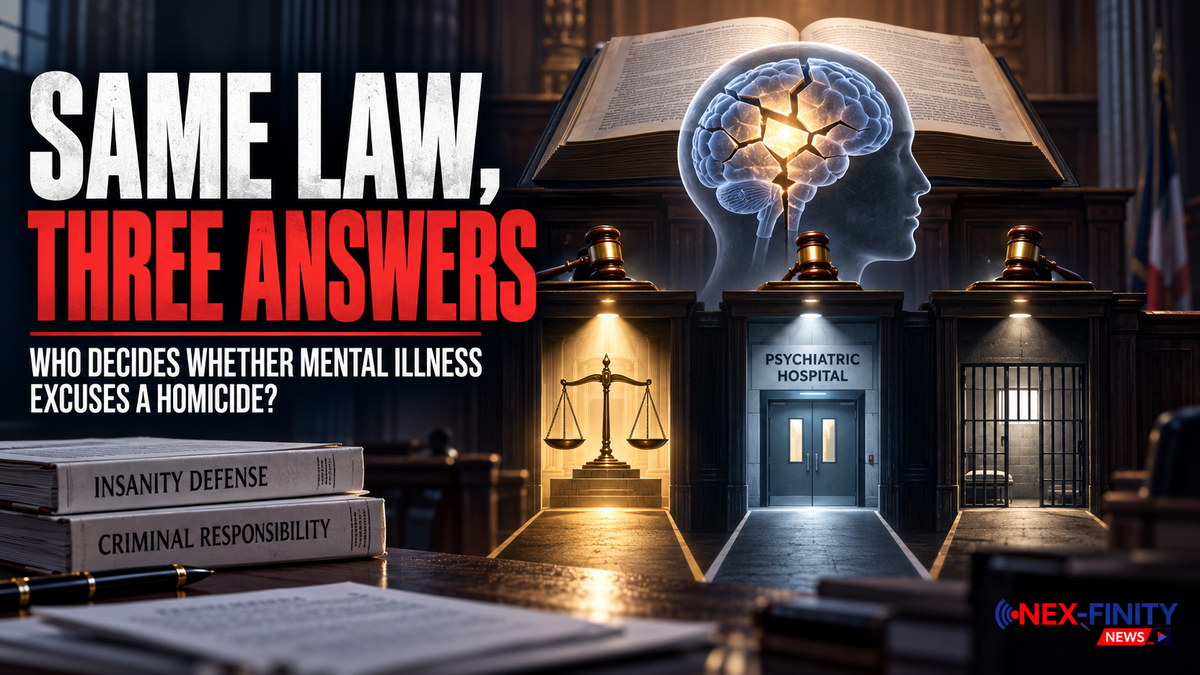
In the space of eleven days this summer, three American courts confronted nearly the same legal question about three mothers who had killed their children. Each case was a homicide in which no one disputed who caused the deaths. Each turned entirely on whether severe mental illness excused it. The three courts produced three different answers.
On August 6, the Massachusetts Supreme Judicial Court vacated the first-degree murder convictions of Latarsha Sanders, a Brockton mother serving two life sentences, and ordered a new trial. On August 24, a Bronx judge found Dimone Fleming not responsible by reason of mental disease or defect in the deaths of her two young sons. On September 4, after a seven-week trial and seven days of deliberation, a Plymouth County jury deadlocked 11-1 in the case of Lindsay Clancy, and the judge declared a mistrial.
The legal standard governing all three is narrow and has barely changed in decades. What varied was not the law. It was who was applying it, and what they were permitted to see.
The test, and why it is hard to apply
Massachusetts uses the standard set out in Commonwealth v. McHoul (1967), which adopted the American Law Institute’s formulation: a defendant is not criminally responsible if a mental disease or defect left her without substantial capacity either to appreciate the wrongfulness of her conduct or to conform her conduct to the requirements of law. Mental illness alone does not satisfy it. A defendant can be severely ill and still criminally responsible.
Massachusetts is unusual in one respect. Once the defense is properly raised, the burden shifts to the prosecution, which must prove criminal responsibility beyond a reasonable doubt. Most states place the burden on the defendant.
Four states Kansas, Idaho, Montana and Utah have abolished the defense outright, an approach the U.S. Supreme Court upheld 6-3 in Kahler v. Kansas (2020). James Kraig Kahler shot and killed his estranged wife, their two teenage daughters and his wife’s grandmother in 2009. Kansas law allowed the jury to weigh his mental illness only on the question of intent. He was convicted and sentenced to death.
In simple terms: whether a defendant can even argue that mental illness excused her conduct, and who must prove what, depends on which side of a state line the homicide occurred on.
The defense is also rarer and less successful than public perception suggests. An eight-state study by Lisa Callahan, Henry Steadman and colleagues, published in the Journal of the American Academy of Psychiatry and the Law, found the insanity defense raised in about 1% of felony cases, and only 26% of those who raised it acquitted. A follow-up by Carmen Cirincione and the same group, drawing on 8,138 felony defendants across seven states, found an inverse relationship between how often the plea is raised in a state and how often it works where it is used freely it succeeds less often, and where it is used sparingly it succeeds more. Both studies are now decades old, and no comparable multi-state research has replaced them.
Discretion point one: the prosecutor
Nothing requires a district attorney to put the question to a jury at all.
Plymouth County District Attorney Timothy Cruz charged first-degree murder in both the Sanders and Clancy cases and tried both to verdict.
In the Bronx, the outcome came a different way. Fleming was indicted in July 2024 on first-degree murder, four counts of second-degree murder and two counts of first-degree manslaughter in the 2022 stabbing deaths of 3-year-old Daishawn Fleming and 11-month-old Octavius Canada at a family shelter in Mount Hope. Examiners for both sides concluded she had been psychotic. The prosecution’s own psychiatrist, Dr. Eric Goldsmith, wrote that she was grossly psychotic and out of touch with reality, hallucinating and convinced the world was ending. On August 24 the parties agreed on that account and the court entered the finding. No jury was empaneled. Assistant District Attorney Tiffany Wichman said publicly that prosecuting mothers cannot prevent these crimes, though public discussion of them might.
The Sanders file shows what the same decision looks like when it goes the other way.
The Commonwealth retained its own psychologist, Dr. Stacey Fiore, who evaluated Sanders and diagnosed paranoid schizophrenia. According to the SJC’s account of her report, Fiore concluded Sanders had experienced severe symptoms both before and after the homicides, held fixed delusional beliefs, and was highly likely to have been symptomatic at the time she stabbed her sons. Fiore stopped short of an opinion on the two legal prongs, citing conflicting information Sanders had cleaned the apartment and blamed two relatives, which Fiore read as indicating some appreciation of wrongfulness.
The Commonwealth never called her. Her findings reached the jury only indirectly, as one of the materials the defense expert said he had reviewed.
Two prosecutors’ offices each held an evaluation, commissioned by the state, finding severe psychosis. One treated that as dispositive and resolved the case without a jury. The other took the case to verdict and won it. Both were lawful exercises of the same discretion.
Discretion point two: the judge
Sanders was convicted on December 27, 2022, after a nine-day trial, of two counts of first-degree murder in the 2018 stabbing deaths of her sons, 8-year-old Edson “Marlon” Brito and 5-year-old La’Son Brito, and of one count of willfully misleading police officers. Her defense argued she lacked criminal responsibility.
Before her expert testified, defense counsel moved to admit thousands of pages of psychiatric records generated after her arrest at MCI-Framingham and the Worcester Recovery Center and Hospital. Trial judge William F. Sullivan ruled that their contents could reach the jury only if the prosecutor raised them on cross-examination. The prosecutor never did, so the door never opened. The defense expert was left able to say only that he had reviewed records he found significant. CBS News Boston reported the jury deliberated about four hours. Sullivan imposed two concurrent life sentences without parole, plus nine to ten years on the misleading-police count.
The excluded records documented paranoia and hallucinations, a 2019 diagnosis of schizophrenia spectrum and other psychotic disorders, and a 2020 discharge diagnosis of schizoaffective disorder. A November 2019 clinical note from Worcester described a presentation consistent with paranoid schizophrenia that had gone undetected and untreated for decades.
The SJC’s holding is narrower than it has generally been reported, and the narrowness is the point. The court did not rule that hospital records are simply admissible. It ruled that Sullivan resolved the question under the wrong body of law applying a common-law rule about what an expert may recount on direct examination, when what was actually before him was a motion to admit the records themselves under G.L. c. 233, § 79. That statute carries its own four-part test, and judges retain discretion under it to exclude portions that are irrelevant, cumulative, or laden with second-level hearsay. Sullivan never ran that test. Writing for the court, Justice Frank Gaziano held that the exclusion stripped the sole defense of the medical foundation supporting it, and that the error was prejudicial.
The court separately addressed the prosecutor’s closing argument, and split. Her repeated characterization of Sanders as “evil” was permissible, the SJC held, because it was drawn from Sanders’ own notebook entries and recorded jail calls and bore on whether she appreciated the wrongfulness of her conduct. Her suggestion that Sanders had lifted her account from episodes of Law & Order: SVU which happened to be playing on a television when police arrived was not. No evidence connected the program to the homicides or showed Sanders had ever watched it.
The convictions were vacated. The charges stand, and Sanders can be retried.
Why this matters beyond one case is clinical. Psychosis is rarely documented as it happens; a person in the middle of an episode is not generating a paper trail. The proof usually arrives afterward, from clinicians who evaluate the defendant in custody. A ruling that keeps that evidence out does not merely limit the defense. In most cases it eliminates it.
Sullivan also presided over the Clancy trial. There the jury heard from more than 80 witnesses across seven weeks, including extensive psychiatric testimony, and he permitted the jury to consider manslaughter alongside the murder counts and the not-criminally-responsible verdict. Same judge, same county, same statute two evidentiary records that were not remotely comparable.
Discretion point three: the jury
Clancy’s jury deliberated for about 38 hours across seven days, by CNN’s count, and could not agree. Juror Paula Devlin, in an interview with CBS Mornings, described a first straw poll running eight for not responsible, two for guilty and two undecided, and said the panel ultimately split 11-1, with one juror unwilling to return a not-responsible verdict. The defense asked Sullivan to remove that juror or order further deliberation; he declined both, and an emergency appeal to the SJC failed. The mistrial stood.
Devlin also said the holdout was the only person of color on the panel and that the other eleven jurors were white. That detail was seized on within hours by commentators in both directions. It is worth stating plainly what one juror in one case can establish about systemic patterns: nothing. It is an anecdote, and it runs opposite to the direction most commentary about race and this case had been running.
The research is more useful, and more equivocal. Several studies have found that Black Americans are not underrepresented among successful insanity acquittees, and some find them overrepresented. Experimental work points the other way at the level of mechanism. Evelyn Maeder, Susan Yamamoto and Kendra McLaughlin of Carleton University gave 216 online participants a fictional second-degree murder case, varying only the defendant’s race and whether the diagnosis was schizophrenia or depression. When the defendant was Black, participants were significantly more likely to convict if the diagnosis was schizophrenia. No comparable difference appeared for the white defendant. The finding, published in the International Journal of Law and Psychiatry in 2020, concerns how race and diagnosis interact rather than race alone and it suggests the same psychiatric evidence can carry different weight depending on who is offering it.
Aggregate acquittee counts do not show a clean racial pattern. Experimental and case-level evidence shows bias operating in specific configurations. Both are true, and an account citing only one is an account with a thumb on the scale.
The gap the law never filled
Severe postpartum mental illness fits the insanity framework badly, and the United States has done less about that than most peer countries.
England and Wales have treated infanticide as a distinct offense since the Infanticide Act of 1938, which permits a manslaughter rather than murder charge where the balance of a mother’s mind was disturbed by the effects of childbirth. Roughly two dozen countries adopted comparable statutes. Convictions under them rarely result in prison; psychiatric commitment is the norm.
The United States has no such statute. Illinois alone has legislated in the area. Public Act 100-0574, sponsored by Rep. Linda Chapa LaVia and signed January 8, 2018, made postpartum depression and postpartum psychosis a mitigating factor in sentencing for forcible felonies, and opened a post-conviction route to a new sentencing hearing for women whose illness was never presented at trial. It operates after a finding of guilt, not instead of one. A 2025 amendment requires the Illinois Prisoner Review Board to weigh the same conditions in release decisions. Massachusetts and several other states have considered similar bills without enacting them.
Chicago clinical psychologist Susan Feingold, who pushed for the Illinois law, has argued that the standard insanity framework is poorly matched to the illness. Insanity arguments typically lean on a documented history of mental health treatment, and many women with postpartum psychosis have none. The condition also waxes and wanes, so a woman can appear entirely normal hours before and after an episode which cuts against her in front of a jury looking for continuous incapacity.
Both features were present in the Sanders trial. She had no prior treatment history, and the Commonwealth made that absence a centerpiece. Her cleanup of the apartment and her false accounts to police were offered as proof she understood what she had done the same behavior her expert attributed to psychosis that had temporarily receded, and the same behavior that gave the Commonwealth’s own psychologist pause.
Postpartum Support International puts the incidence of postpartum psychosis at one to two per 1,000 births. The organization estimates that roughly 4% of those cases involve infanticide, which is another way of saying that the overwhelming majority of women who experience it harm no one.
Analysis: discretion is not the same as bad faith
The word for what these three cases document is discretion, not corruption. No one in them acted outside the law. Cruz was entitled to charge first-degree murder. Sullivan’s exclusion ruling was reversible, and was reversed, but it was a ruling within his authority to make. The Bronx court was entitled to accept two concurring evaluations. The Clancy holdout was entitled to his doubt.
The problem is structural. The statute asks factfinders to reconstruct, retrospectively and beyond a reasonable doubt, the interior mental state of a person at a moment that has passed and cannot be re-examined. It then delegates that reconstruction to three sequential decision-makers a prosecutor, a judge, and a jury operating with no shared evidentiary floor beneath them. Across these three cases, the variable that best predicted the outcome was not the severity of the illness. It was whether the psychiatric record reached the factfinder at all.
That is a policy defect, and it has policy answers. The SJC has now told Massachusetts trial judges which test to apply when psychiatric records are offered, which narrows one gap though it left the discretion to exclude intact, so the next case turns on how a judge exercises it. Requiring a completed forensic evaluation before the charging decision in parental child-homicide cases would narrow another. A postpartum statute on the Illinois model, or the more substantial English one, would narrow a third.
None of these would make the underlying judgment easy. They would make it less dependent on which courthouse, which judge, and which twelve people a defendant happened to draw.
What happens next
Cruz’s office has not announced whether it will retry Clancy. Judge Sullivan set a status conference for September 29, at which the parties are expected to address the path forward; Clancy’s attorney Kevin Reddington has indicated he would consider a bench trial if the charge were reduced to second-degree murder. Clancy remains held without bail at Tewksbury Hospital and is separately suing her medical providers.
Sanders faces a possible retrial on the vacated counts. Fleming was not released; the court ordered a further evaluation of whether she poses a danger, with a hearing scheduled for September 18.
All three cases remain open.
Key Takeaways
· Three courts applied substantially the same legal question to three mothers in eleven days and reached three different results: a vacated conviction, a not-responsible finding, and a hung jury.
· Massachusetts places the burden on prosecutors to prove criminal responsibility beyond a reasonable doubt, an unusual posture. Four states permit no insanity defense at all, upheld in Kahler v. Kansas (2020).
· The decisive factor in the Sanders reversal was procedural: the SJC held the trial judge applied the wrong legal test to her psychiatric records and never reached the statutory question.
· The Commonwealth’s own retained psychologist diagnosed Sanders with paranoid schizophrenia. She was never called to testify.
· Postpartum psychosis fits the insanity test poorly because it often arises with no treatment history and fluctuates within hours. Illinois is the only state with a statute addressing it, and only at sentencing.
· Commentary tying the Clancy mistrial to jury composition is running ahead of what one juror in one case can support. The empirical literature is mixed.
If you or someone you know is in crisis, call or text 988 to reach the Suicide and Crisis Lifeline, or chat at 988lifeline.org.
Sources
· Commonwealth v. Sanders, SJC-13552 (Mass. Aug. 6, 2026) slip opinion: https://www.mass.gov/doc/commonwealth-v-sanders-sjc-f13552/download
· Commonwealth v. Sanders case summary, Justia: https://law.justia.com/cases/massachusetts/supreme-court/2026/sjc-13552.html
· Commonwealth v. McHoul, 352 Mass. 544 (1967)
· Kahler v. Kansas, 589 U.S. 271 (2020); State v. Kahler, 410 P.3d 105 (Kan. 2018): https://caselaw.findlaw.com/ks-supreme-court/1888978.html
· Bronx District Attorney, “Bronx Woman Indicted for Murder of Her Two Young Sons Inside Family Shelter,” July 17, 2024: https://www.bronxda.nyc.gov/downloads/pdf/pr/2024/
· ABC7 New York, ruling in the Fleming case, August 2026: https://abc7ny.com/post/judge-finds-mother-dimone-fleming-not-responsible-deaths-sons-bronx-shelter-due-postpartum-psychosis/19751843/
· CNN, Clancy mistrial coverage, September 4, 2026: https://www.cnn.com/2026/09/04/us/live-news/lindsay-clancy-trial
· NBC News, Clancy mistrial coverage, September 4, 2026: https://www.nbcnews.com/news/us-news/lindsay-clancy-jury-hopelessly-deadlocked-mistrial-declared-rcna594052
· Callahan, Steadman, McGreevy & Robbins, “The Volume and Characteristics of Insanity Defense Pleas: An Eight-State Study,” J. Am. Acad. Psychiatry & Law 19(4):331 (1991): https://jaapl.org/content/19/4/331
· Cirincione, Steadman & McGreevy, “Rates of Insanity Acquittals and the Factors Associated with Successful Insanity Pleas,” J. Am. Acad. Psychiatry & Law 23(3):399 (1995): https://jaapl.org/content/23/3/399
· Maeder, Yamamoto & McLaughlin, “The influence of defendant race and mental disorder type on mock juror decision-making in insanity trials,” Int’l J. Law & Psychiatry 68:101536 (2020): https://www.sciencedirect.com/science/article/abs/pii/S0160252719301967
· Illinois Public Act 100-0574 (2018): https://ilga.gov/Legislation/publicacts/view/100-0574
· Postpartum Support International, perinatal psychosis: https://www.postpartum.net/get-help/postpartum-psychosis-help/