
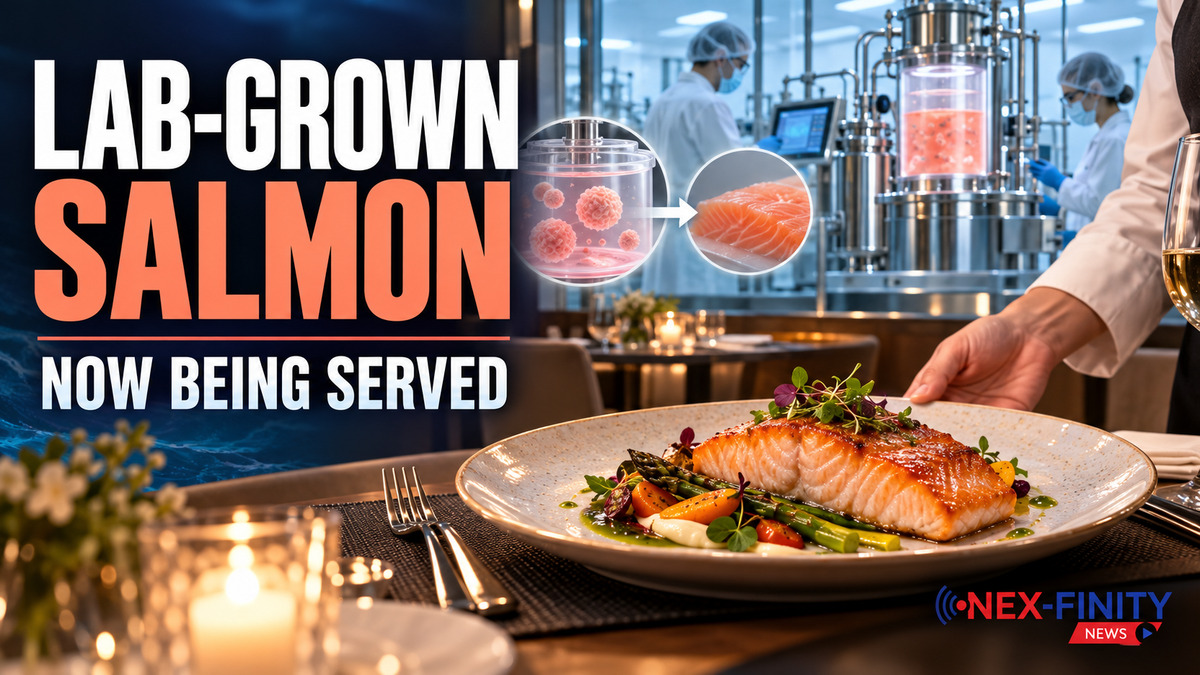
Four restaurants in the United States are currently serving salmon that was never caught, never farmed, and never alive as a fish. It is grown from Pacific coho cells in steel vessels in San Francisco, harvested, and combined with plant-based ingredients into something that looks and cuts like a fillet.
Eight states have made selling it a crime.
In the four states where it is actually sold, no law requires the restaurant to tell the diner what it is.
That gap between the states racing to ban cultivated protein and the states that have not written a single rule about disclosing it is the real regulatory story of cultivated seafood’s first year on the American market. The bans are broad enough to catch fish. The disclosure laws, for the most part, are not.
Background
On May 28, 2025, the Food and Drug Administration issued a “no questions” letter to Wildtype, a San Francisco company founded in 2016, concluding it had no objection to the company’s finding that food made from cultured salmon cell material is as safe as comparable foods produced by other methods. It was the first time any government anywhere had cleared cultivated seafood for sale.
Sales began within days. Kann, the James Beard Award–winning Haitian restaurant in Portland run by chef Gregory Gourdet, served it on Thursday nights in June and moved it onto the full menu in July. The first night sold out.
In simple terms: the FDA did not “approve” the product the way it approves a drug. A company is not required to seek the agency’s pre-market consultation before selling a food. Wildtype went through the process voluntarily, and the letter records that the agency reviewed the submission and raised no objection.
As of this writing, Wildtype lists four restaurants serving its salmon: Kingfisher in Tucson, Robin in San Francisco, The Walrus and the Carpenter in Seattle, and barmini by José Andrés in Washington, D.C. A fifth, Otoko in Austin, stopped selling it when the Texas ban took effect. Kann, the launch partner, no longer appears on the company’s list.
Production remains tiny. This is single-dish, tasting-menu volume. Nothing has reached a grocery shelf.
The Federal Disclosure Rule That Does Not Exist
Cultivated seafood sits entirely with the FDA. Under a formal agreement, the FDA and the U.S. Department of Agriculture split oversight of cultivated products: USDA’s Food Safety and Inspection Service handles livestock and poultry, along with Siluriformes fish catfish while the FDA regulates everything else, including salmon.
The FDA opened the labeling question more than five years ago. On October 7, 2020, the agency published a request for information on the labeling of foods comprised of or containing cultured seafood cells, asking whether terms such as “cell-cultured,” “cell-based,” or “cell-cultivated” would adequately inform consumers, and whether labels should disclose the production method at all. Comments closed on March 8, 2021. Industry groups, the Environmental Defense Fund and the Center for Science in the Public Interest all weighed in; most favored a term that distinguishes the product from wild-caught and farm-raised fish.
No rule followed. Five and a half years after the request for information, there is no federal labeling standard for cultivated seafood and no federal menu-disclosure requirement of any kind.
What remains is the general prohibition on misbranding in the Federal Food, Drug, and Cosmetic Act a company cannot sell one food under the name of another. Wildtype’s own disclosures, and the language its restaurant partners use, are voluntary.
What the States Actually Require
Twenty-one states have enacted labeling laws covering alternative proteins, according to the National Agricultural Law Center’s compilation, last updated April 7, 2026. Reading them together, three structural problems emerge for anyone hoping they cover a plate of salmon.
Most of them regulate packages, not plates. Arizona’s statute prohibits a manufacturer, packager or retailer from selling a cell-cultivated product without the words “cell-cultivated” or “cell-cultured” on its packaging. Colorado’s requires a food processing plant to apply a “cell-cultivated meat” label. North Dakota, Wyoming, Kansas, Missouri and others are written the same way. A restaurant dish has no principal display panel.
Most of them are written around meat. The statutes turn on terms like “meat food product,” “identifying meat term,” and products “derived from harvested livestock, poultry, or cervids.” Cultivated salmon is none of those things. South Carolina is a notable exception its law expressly reaches products labeled as beef, poultry, fish, crustacean, or any other animal protein.
A handful do reach restaurants. Oklahoma’s law, effective November 1, 2025, deems a manufactured-protein food product sold in a food establishment misbranded if it is not labeled in a manner clearly and distinctly separate from conventional animal products. Louisiana requires cell-cultured food products to bear a disclosure in bold type of not less than 30-point font. Utah requires food establishments to notify the state before selling a cultivated meat product, agree to an inspection and pay a fee. Tennessee created a permitting program for sellers rather than a ban.
One state says it plainly. Idaho’s Senate Bill 1270, effective July 1, 2026, created a new chapter of the state code governing “alternative animal proteins,” defined as food products derived from animal sources other than traditional livestock production or wild game harvest. Section 37-1602(3) provides that restaurants or other vendors offering such products for sale must provide labeling on menus or equivalent notifications. Violations carry a civil penalty of up to $500, enforced by the Idaho Department of Agriculture.
Idaho appears to be the only state in the country that requires a menu to say so. No restaurant serving cultivated salmon is in Idaho.
The Bans Are Broader Than the Labels
The prohibitions did not inherit the drafting problem. They were written around cells, not species.
Texas Senate Bill 261 defines cell-cultured protein as a food product derived from harvesting animal cells and artificially replicating those cells in a growth medium to produce tissue. Animal cells not livestock cells. Salmon is covered, which is why Otoko stopped serving it rather than test the question. The law took effect September 1, 2025 and runs through September 2027 unless extended, with civil penalties reaching $25,000 per day and criminal exposure for repeat violations.
Seven other states have bans of varying scope: Alabama, Florida, Indiana, Mississippi, Montana, Nebraska and, as of this year, South Dakota. Indiana’s runs from July 1, 2025 to June 30, 2027. Louisiana has a ban on its books that does not take effect unless and until the U.S. Supreme Court clarifies that such prohibitions are constitutional.
South Dakota’s addition is instructive about where the politics sit. House Bill 1077 would have classified cultivated protein as adulterated food the statutory category reserved for products that are filthy, putrid or unfit for food which would have banned it indefinitely. Gov. Larry Rhoden vetoed it in February 2026, writing that a categorical and permanent prohibition risked placing an undue burden on interstate commerce, offered protectionist benefit to in-state industries, and invited expensive constitutional challenges. He said it was against the state’s values to ban a product simply because he did not like it. Lawmakers passed Senate Bill 124 instead, a five-year moratorium running July 1, 2026 through June 30, 2031. The House failed to override the veto on March 30, 2026, deadlocking 32-32.
A second tier of states restricts purchasing rather than sales. Nebraska’s governor barred state agencies from procuring cultivated meat by executive order. Iowa and Ohio bar schools and public universities from buying it. South Dakota prohibits the use of state money for research, production, promotion or distribution, with a carve-out for the Board of Regents.
The Courts
The industry has lost twice.
On March 23, 2026, a three-judge panel of the Eleventh Circuit upheld Florida’s SB 1084 against a preemption challenge brought by Upside Foods and the Institute for Justice. Writing for the panel, Judge Andrew Brasher held that because Florida’s ban does not regulate the company’s ingredients, premises, facilities or operations, the Poultry Products Inspection Act does not preempt it. The practical holding: federal clearance is permission to sell, not a right of access to every state market.
In Texas, Upside and Wildtype sued jointly over SB 261. Judge Alan Albright allowed the case to proceed on Commerce Clause grounds but declined to enjoin the ban while the litigation runs, so Texas continues to enforce it.
There is a wrinkle worth flagging for cultivated seafood specifically. The Eleventh Circuit’s reasoning ran entirely through the Poultry Products Inspection Act, a statute with an express preemption clause covering ingredients and facilities. Salmon is not poultry. A preemption challenge on behalf of cultivated seafood would have to be built on the Federal Food, Drug, and Cosmetic Act instead a different and generally weaker vehicle for displacing state food law. Whether that changes the analysis has not been tested.
Impact
For consumers, the practical effect is narrow but real. A diner in Tucson, San Francisco, Seattle or Washington who orders the salmon course is relying on the restaurant’s own choice to say where it came from. Both the company and the chefs have made that disclosure part of the pitch the novelty is the selling point, and Wildtype maintains a public list of every restaurant carrying it. Voluntary transparency and required transparency are not the same thing, but at this scale they have produced the same result.
The scale is the point. With four restaurants and no retail distribution, the disclosure gap is currently theoretical. It stops being theoretical the first time cultivated salmon appears in a grocery case or a sushi counter at a chain, which is the outcome Wildtype has pursued since signing distribution agreements with a supermarket sushi operator and a fast-casual poke chain in 2021 agreements contingent on manufacturing scale the company has not yet reached.
For the states, the sequence is unusual. Legislatures have moved faster to prohibit a product than to require that it be identified. Eight states have banned cultivated protein outright. One has told restaurants to put it on the menu.
Key Takeaways
· The FDA cleared Wildtype’s cultivated coho salmon on May 28, 2025 the first cultivated seafood cleared for sale anywhere in the world.
· It is served at four U.S. restaurants: Tucson, San Francisco, Seattle and Washington, D.C. None is in a state that requires menu disclosure.
· There is no federal labeling or menu-disclosure rule. The FDA’s request for information on cultivated seafood labeling closed in March 2021 and produced no regulation.
· Of 21 state labeling laws, most govern packaging and most are drafted around meat, livestock and poultry language that may not reach fish.
· Idaho’s S1270, effective July 1, 2026, is the only statute identified that expressly requires restaurant menu disclosure.
· Eight states now ban cultivated protein: Alabama, Florida, Indiana, Mississippi, Montana, Nebraska, Texas and South Dakota. Indiana’s, Texas’s and South Dakota’s are time-limited.
· The Eleventh Circuit upheld Florida’s ban in March 2026 on grounds specific to poultry law, leaving the question open for FDA-regulated seafood.
Frequently Asked Questions
Is lab-grown salmon legal in my state?
It is legal to sell in most states. It is prohibited in Alabama, Florida, Indiana, Mississippi, Montana, Nebraska, South Dakota and Texas, though the Indiana, Texas and South Dakota prohibitions are time-limited and expire in 2027, 2027 and 2031 respectively unless extended.
Does a restaurant have to tell me if the fish is cultivated?
In nearly every state, no. Idaho’s law, effective July 1, 2026, requires restaurants to disclose alternative animal proteins on menus. Oklahoma, Louisiana and Utah impose obligations on food establishments through labeling, disclosure and notification requirements. Elsewhere, disclosure is voluntary.
Can I buy it at a grocery store?
No. Production has not scaled beyond a small number of restaurant partners.
Is it safe?
The FDA reviewed Wildtype’s safety submission and stated it had no questions about the company’s conclusion that the product is as safe as comparable foods. That is the federal government’s only formal position on the product.
Is it the same as farmed or wild salmon?
It is grown from Pacific coho salmon cells and combined with plant-based ingredients. Chefs who have served it describe it as close to conventional salmon sashimi in appearance, with a taste that is not identical.
Sources
· FDA, “no questions” letter to Wildtype (CCC 000005), May 28, 2025
· FDA, Labeling of Foods Comprised of or Containing Cultured Seafood Cells; Request for Information, 85 FR 63277 (Oct. 7, 2020)
· FDA–USDA formal agreement on cultured cell oversight
· Wildtype, “Try Wildtype” restaurant list and company news posts
· National Agricultural Law Center, Alternative Protein Laws State Compilation (updated Apr. 7, 2026)
· Idaho S.B. 1270 (2026), Idaho Code §§ 37-1601 to 37-1604
· Tex. Health & Safety Code §§ 433.057, 433.0415 (S.B. 261)
· S.D. S.B. 124 (2026); Gov. Rhoden veto message on H.B. 1077
· Ind. Code § 15-17-5-6.1; Fla. Stat. § 500.452; Okla. Stat. tit. 63 § 1-1150; Utah Code § 4-5-301; Tenn. Code Ann. § 53-1-120; S.C. Code Ann. § 47-17-510; La. Stat. Ann. §§ 3:4741–4746; Ariz. Rev. Stat. § 36-917
· Upside Foods v. Florida Department of Agriculture and Consumer Services, No. 24-13640 (11th Cir. Mar. 23, 2026)
· Council of State Governments Midwest, cell-cultured meat legislative tracker (May 4, 2026)
Related Coverage:
Egg Recalls, Salmonella and Bird Flu: Why America Won’t Vaccinate Its Chickens