
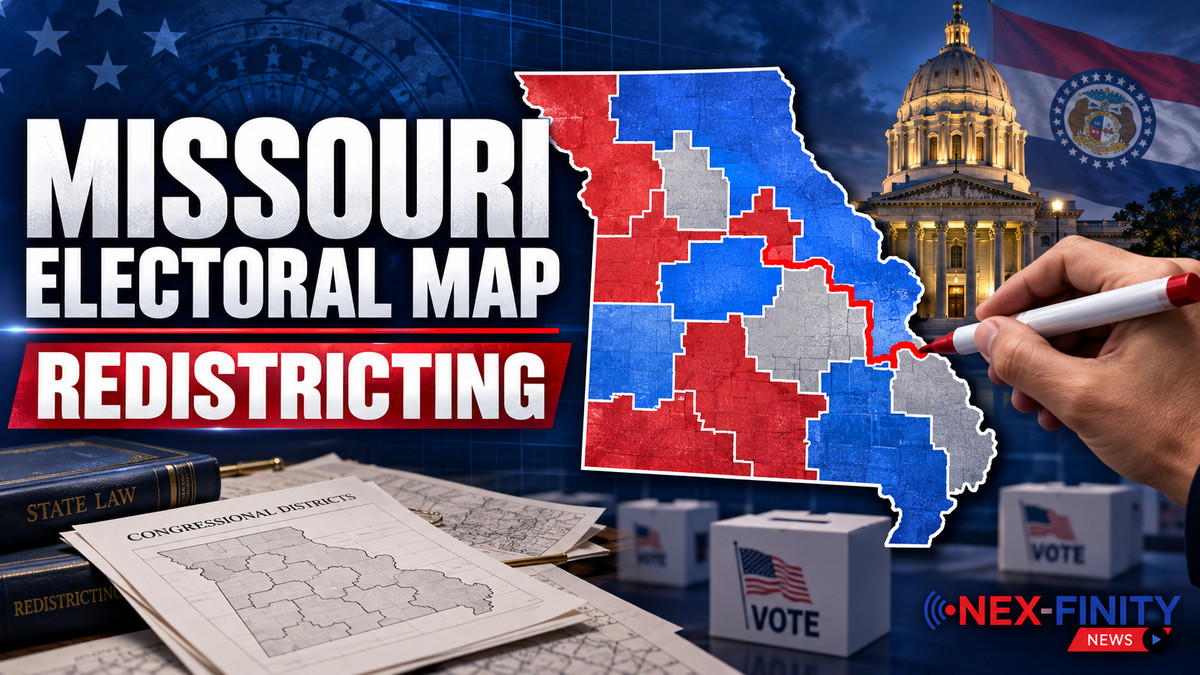
Missouri voters cast primary ballots on August 4 in congressional districts drawn by House Bill 1. One month later, the Missouri Supreme Court ruled unanimously that HB 1 never took effect and has never been the law of the state.
Both statements are accurate. Reconciling them is the whole of Missouri’s redistricting fight, and the answer is not that a court changed the districts after an election. The answer is that the state held an election under a map whose legal status had not yet been determined, because the official responsible for determining it did not do so until the polls were open.
As of Wednesday morning, Missouri election administrators are operating under two orders that point in opposite directions: a state court injunction barring them from using the new map, and a federal restraining order barring them from using anything else. The orders conflict in effect. They are not, as much of the national coverage has framed it, two courts answering the same question two ways.
Background
The Missouri General Assembly passed HB 1 during a special session in September 2025, part of a national wave of mid-decade redistricting undertaken at President Trump’s urging to protect a narrow House majority. Gov. Mike Kehoe signed it in late September 2025.
The 2022 map produced a delegation of six Republicans and two Democrats. HB 1 was drawn to produce seven and one. It did so by splitting Kansas City across three districts, dismantling the Democratic-leaning 5th District held by Rep. Emanuel Cleaver II.
Opponents did not sue to block the map. They filed a referendum petition the mechanism Missouri’s constitution provides for voters to veto an act of the legislature before it takes effect.
The Mechanism: What a Referendum Petition Actually Does
This is the part that answers the question.
Under Article III, Section 52(a) of the Missouri Constitution, a referendum on an act of the General Assembly may be ordered by petitions signed by five percent of the legal voters in each of two-thirds of the state’s congressional districts, and those petitions must be filed with the Secretary of State before the bill takes effect. If the petition is legal, sufficient and timely, Section 52(b) provides that the challenged law does not take effect unless and until voters approve it.
In simple terms: a valid referendum petition does not pause a law. It prevents the law from ever having become law in the first place, retroactive to the day the petition was filed.
That retroactivity is the hinge. The organizers a group called People Not Politicians, led by Richard von Glahn filed 691 boxes of petitions on December 9, 2025, carrying more than 305,000 signatures. The threshold was roughly 106,000 to 110,000 valid signatures, spread across six of the state’s eight congressional districts. HB 1’s effective date was December 11.
If the petition was sufficient, HB 1 died on December 9 and the map never went anywhere. If it was insufficient, HB 1 took effect on December 11 as scheduled. There was no third option and no middle state. But nothing in the constitution makes the answer self-executing. Someone has to certify it.
How the Question Stayed Open Through a Primary
Secretary of State Denny Hoskins did not certify the petition. He did not reject it either. He ordered signature verification and declined to treat the law as suspended in the meantime.
Referendum supporters sued, arguing that the filing itself suspended HB 1. On May 13, 2026, the Missouri Supreme Court ruled against them in Maggard v. State. The court held that the December 9 filing did not automatically suspend HB 1 under Article III, Sections 49, 52(a) or 52(b). Prior secretaries of state had treated delivered petitions as suspending the challenged law, but those officers had assumed the petitions were valid. Hoskins assumed the opposite and proceeded with the verification the statute permits.
The same opinion spelled out what would follow if he was wrong. If the December 9 filing were ultimately determined to be sufficient, the court wrote, then Section 52(b) applied: HB 1 did not take effect on December 11, it was referred to the people as of December 9, and it would take effect only when approved by a majority of votes cast.
So the state entered its primary season with the map’s validity expressly conditional on a determination that had not been made. And in a footnote, Maggard flagged that it was not deciding whether a referendum could reach a congressional map at all. The court expressly reserved the question.
That reserved question is the one Hoskins would eventually answer, eight months later, at 4 p.m. on primary day.
The Eight Months
Chapter 116 of the Missouri Revised Statutes sets out the machinery. Under Section 116.130.1, the Secretary of State forwards a filed petition to Missouri’s local election authorities, which verify the signatures against the voter rolls and return the results. Section 116.150.3 then gives the secretary a deadline to issue a certificate declaring the petition sufficient or insufficient. Section 116.200.1 makes that certificate reviewable in court.
For a petition filed December 9, 2025, the local election authorities had until late July 2026 to finish. The secretary’s own deadline was August 4 the day of the primary.
The Counties Finished, and the Numbers Were There
The county verification did not stall, and it did not fail. It completed.
Cole County began checking signatures in late December 2025. By March 2026 more than four months before the secretary’s deadline People Not Politicians announced that verified signatures had crossed the threshold. The local election authorities completed their review within the statutory period.
In August, the Missouri Independent reported that data posted on the Secretary of State’s own website showed both petitions Hoskins had rejected carried the required signatures. According to that reporting, Hoskins’ office conceded the point in a filing in the companion initiative case, acknowledging that the referendum petition carried signatures from at least 8 percent of voters in two-thirds of Missouri’s congressional districts. The constitutional requirement is 5 percent. The same filing denied that any of it was relevant.
That is the posture Hoskins carried into August 4. He had the verification. He never issued a certificate of sufficiency, and at the press conference where he rejected the petition, he declined to tell reporters whether it had enough valid signatures to qualify.
He explained why the question did not interest him. Whether the campaign had one signature or 500 million, he said, did not really matter, because the petitions were unconstitutional.
What He Did and Did Not Send to the Counties
One qualification cuts in his favor on the numbers, and it matters.
Hoskins did not send every page to the counties. Court filings reported in January 2026 showed his office had delivered 33,068 of the 49,773 signature pages submitted withholding roughly a third, consisting of signatures gathered before he approved the petition form on October 14, 2025. His position, announced the day after that approval, was that signatures collected beforehand were invalid. The withheld pages carried roughly 103,000 signatures.
Cole County Circuit Judge Christopher Limbaugh upheld that position in August, ruling the pre-approval signatures invalid.
The campaign’s tracking showed the petition cleared the threshold without any of them, which is what the verified county returns bore out. So the withheld third narrowed the margin. It did not change the outcome.
The Constitutional Argument Was Not New in August
The secretary’s defense, argued to the U.S. Supreme Court, is one of statutory sequencing. Under Section 116.150, any defect not raised in the certificate is waived. Because the certificate is the single instrument in which every objection must appear, and because it cannot issue until verification concludes, his counsel argued, the constitutional objection could not be raised earlier without forfeiting everything else. He also argued that by the time the counties finished in the summer of 2026, the primary was imminent, and rejecting the petition then would itself have caused chaos.
Two facts sit uncomfortably alongside that account.
The first is that the state had already litigated the constitutional question before a single signature was submitted for verification. On October 15, 2025, the day after Hoskins approved the petition for circulation, Attorney General Catherine Hanaway filed suit in federal court on behalf of Hoskins and the General Assembly, arguing that a referendum on a congressional map violates both the U.S. and Missouri Constitutions. That is the same argument that appeared in the August 4 certificate. The state did not wait for verification to make it. It made it first.
The second is what the federal judge said when he dismissed that suit. On December 8, 2025 the day before the signatures were filed U.S. District Judge Zachary Bluestone, a Trump appointee, held the case unripe and told the state exactly where the argument belonged. Hoskins, he wrote, had a tool almost no other litigant could claim: the power to declare the petition unconstitutional himself. Bluestone described the mechanism in a footnote, noting that Hoskins had authority to reject the petition as unconstitutional during post-submission review and to defend that decision on the same grounds the state was advancing before him. Doing so, he wrote, would trigger litigation on the main question.
Hoskins did exactly that 239 days later, with an hour left on the clock.
He Said It Out Loud in May
By spring, both halves of the problem were public, and both came from him.
At a May 2026 press conference in Jefferson City, reported by St. Louis Public Radio, Hoskins objected to the calendar directly, saying it made no sense that he had until August 4 to certify signatures as sufficient or insufficient when that was the same day as the primary. In the same remarks he named his legal theory: he had constitutionality concerns, he said, because in his view the referendum was never meant for congressional redistricting.
That same month, in Maggard, the Missouri Supreme Court flagged the question as open and expressly declined to decide it. Also that month, Bluestone observed in a separate order that Hoskins was still conducting signature verification and still had to complete his constitutional review, which would likely produce new litigation.
Three months of calendar remained. Nothing was filed to resolve it.
At oral argument in September, according to hearing coverage by the Jefferson City News-Tribune, Judge W. Brent Powell put the point to the state from the bench, noting that Hoskins could have issued his ruling months earlier and spared everyone the expedited posture. Hoskins’ answer was that he obeyed the deadline the legislature set and that the deadline’s absurdity was itself evidence the referendum process was never meant to reach redistricting. He has said he will abide by whatever the Supreme Court decides.
The Signature Fight That Turned Out Not to Matter
The dispute over the withheld third was litigated for months, through a three-hour Cole County trial in December 2025 and a judgment in August 2026. On September 3, the Missouri Supreme Court vacated that judgment and dismissed the case as moot because the August 4 rejection had not been based on the number of signatures at all.
Not an Isolated Case
Hoskins rejected two petitions at that August 4 press conference. The second, Initiative Petition 2026-106, would have strengthened Missouri’s initiative and referendum process. Same deadline, same final hour, same certificate of insufficiency, same constitutional rather than numerical ground. Hanaway released opinion letters supplying the legal reasoning for both.
Published data showed that one had the required signatures too. On September 3, the Missouri Supreme Court reversed that rejection as well, unanimously, in Harris v. Hoskins, and ordered the measure onto the November ballot.
Cole County Circuit Judge Daniel Green had upheld the map rejection on August 19.
September 3: The Condition Resolves
The Missouri Supreme Court reversed unanimously on September 3 in von Glahn v. Hoskins.
Article III, Section 49 authorizes a referendum as to “any act of the general assembly,” the court held, and no exception applied so the petition was legal, sufficient and timely. Judge Ginger K. Gooch, writing for the court, ordered Hoskins to certify the petition and place it on the November ballot by September 8.
With the condition resolved, Maggard’s conditional holding snapped into place retroactively. HB 1 did not go into effect and will not go into effect unless approved by voters, the court wrote, and the 2022 districts remain in full force for the November 2026 general election.
Gooch addressed the disruption argument in a footnote. Regardless of any confusion, expense or practical difficulty caused by the secretary’s delay and incorrect assumption, she wrote, continuing to use HB 1 does not comport with the Missouri Constitution, because the 2022 map is the only map in effect.
September 8: A Declination and an Injunction
Hanaway sought emergency relief in Washington, arguing the state court had intruded on the U.S. Constitution’s Elections Clause and that reverting after a completed primary would disenfranchise voters. The U.S. Supreme Court rejected a similar Elections Clause theory in Moore v. Harper in 2023, and declined a comparable Democratic request out of Virginia in May.
On September 8, Justice Brett Kavanaugh, who handles emergency matters from the Eighth Circuit, denied the application. He neither referred it to the full court nor explained the decision.
What that denial is, and is not, matters. Declining to grant emergency relief is not a decision on the merits. Kavanaugh did not hold that the Missouri Supreme Court was correct, that the Elections Clause argument fails, or that the 2022 map must be used. He declined to disturb the state court’s judgment on an emergency basis. An unexplained in-chambers denial, unreferred to the full court, carries no precedential weight and resolves nothing about the underlying question.
Minutes later, Chief Judge Stephen R. Clark of the U.S. District Court for the Eastern District of Missouri issued a temporary restraining order barring the state from using any map other than HB 1. Clark, a 2019 Trump appointee, reasoned that proceeding on the 2022 map would disenfranchise voters given that the primary had already been held, and noted that September 8 was the deadline for finalizing the November ballot. The order runs 14 days.
Clark did not overrule Kavanaugh, and could not have. The two orders come out of different cases, brought by different parties, raising different legal questions. Hanaway’s application asked the Supreme Court to stay a state court judgment on Elections Clause grounds. The suit before Clark is an original federal action by Rep. Bob Onder and state Sen. Rick Brattin the Republican nominee in Cleaver’s district raising federal constitutional claims. Nothing Kavanaugh did foreclosed the second case, because the second case was never in front of him.
The defendant in that suit is Hoskins, an ally who sought the same outcome the plaintiffs did. Clark’s own opinion, as reported by KSDK, noted that the state defendants had not offered an interest justifying the challenged classifications, “nor do they want to.” Referendum organizers, who intervened to supply the opposition the named defendants would not, had spent the weekend calling the case collusive.
They noticed an emergency appeal to the Eighth Circuit the same evening. Their filing argues that Clark’s order puts election officials in an impossible position, that the federal case is an improper appeal of a state court judgment barred by the Rooker-Feldman doctrine, the Anti-Injunction Act and abstention principles, and that Clark lacked authority to act alone a challenge to the constitutionality of congressional apportionment requires a three-judge district court, and no panel was convened.
Attorney Chuck Hatfield framed the practical bind precisely. Clark cannot overrule the Missouri Supreme Court, he said; the state court bars officials from using HB 1, and the federal order tells them not to use anything else.
Impact
The referendum is on the November ballot regardless of how the map fight ends. Voters will decide whether HB 1 takes effect for 2028 and beyond.
For 2026, the exposure is administrative and immediate. Ballots for overseas and military voters must be mailed by September 19. The August primary was conducted under HB 1 and its winners have already been certified. Local election authorities the officials who actually print ballots and assign precincts are the ones absorbing the conflict between two binding orders while that clock runs.
Cleaver’s seat is the stake. Under the 2022 lines he is heavily favored; under HB 1 the Kansas City vote is divided three ways.
Analysis
The framing offered by both sides is that a court disrupted a completed election. That framing does not survive the timeline.
Missouri’s constitution sets up a binary that resolves retroactively, and the state’s own high court explained in May exactly how it would resolve. What kept the answer suspended through a primary was not litigation, and not the signature count. The signature count was finished, and the secretary had it.
What kept it suspended was that the dispositive legal question whether a referendum can reach a congressional map at all was not put to a court until August 4, even though the state had raised that identical argument in federal court the previous October, even though a federal judge had told the secretary in December where the argument belonged and how to tee it up, and even though the secretary described the argument publicly in May.
Had it been decided in the winter or the spring, the August primary would have proceeded under a settled map. Which map is a separate question. That it would have been settled is not.
This is the accountability question worth pressing, and it is largely absent from national coverage, which has focused on the state-versus-federal collision of September 8. The collision is real. It is also downstream.
Several things cut against the sharpest version of that reading, and they should be stated plainly. The Missouri Supreme Court itself declined in May to treat the petition filing as automatically suspending the law, so keeping HB 1 operative during verification had the state’s highest court behind it. The Section 116.150 waiver rule is a real feature of Chapter 116, not an invention. The August 4 deadline was set by the legislature, not by Hoskins, and he did meet it. And no court has found that he acted in bad faith. He was reversed unanimously on the merits, which is a different finding.
What makes delay hard to attribute to the statute alone is the accumulation. A calendar squeeze explains one certificate arriving at the deadline. It explains less well a second last-hour constitutional rejection issued at the same press conference against an unrelated petition, also reversed unanimously. And it does not explain the October 2025 lawsuit, in which the state pressed the same constitutional theory before verification had begun which is difficult to reconcile with the position that verification had to come first.
Hanaway has said no court has previously replaced a congressional map between a primary and a general election. We have not independently verified that claim, and it should be treated as the state’s characterization rather than as established fact.
Conclusion
The primary and the general are proceeding on different maps not because a rule changed, but because a determination arrived late. Missouri’s referendum power is designed to freeze a law on the day signatures are filed; the freeze is only visible once someone certifies it. For eight months, no one did.
Whether the 2022 or 2025 lines govern November now rests with the Eighth Circuit, on a schedule measured against a September 19 ballot-mailing deadline.
Key Takeaways
· A valid Missouri referendum petition retroactively prevents a law from ever taking effect, dated to the day it was filed not the day it is certified.
· Missouri’s local election authorities completed signature verification within the statutory period. Reporting on data posted by the Secretary of State’s office indicates the petition carried the required signatures, and that Hoskins conceded in a court filing that it held signatures from at least 8 percent of voters in two-thirds of congressional districts, against a 5 percent requirement.
· He never issued a certificate of sufficiency. He rejected the petition roughly an hour before the August 4 deadline on constitutional grounds, and declined to tell reporters whether the signatures were sufficient saying the number did not matter.
· The state had already advanced that same constitutional argument in federal court in October 2025, before verification began. In dismissing that suit in December, Judge Zachary Bluestone told the state that Hoskins could reject the petition as unconstitutional himself and trigger the litigation directly.
· The Missouri Supreme Court ruled 7-0 on September 3 that congressional redistricting is subject to referendum, making HB 1 void as of December 9, 2025.
· On September 8, Justice Kavanaugh denied emergency relief without explanation a declination to intervene, not a merits ruling. Minutes later a federal district judge, in a separate suit, ordered the state to use HB 1. The second order did not overrule the first; the two cases raise different questions.
· The referendum appears on the November 3 ballot in any event, and will determine the map for 2028.
Editor’s Note on Sourcing
This article was published on a compressed timeline while the underlying litigation was active. It is built on primary documents where those were available the Missouri Supreme Court’s opinions in von Glahn v. Hoskins and Maggard v. State, the parties’ filings in the U.S. Supreme Court, and the text of Chapter 116 and Article III of the Missouri Constitution.
Several factual details are drawn from the reporting of other outlets rather than from documents NexfinityNews reviewed directly, and are attributed in the text where that is the case. These include the contents of Hoskins’ filing in the companion initiative case, the verification data posted by the Secretary of State’s office, Judge Bluestone’s December 2025 dismissal order, remarks at the secretary’s May 2026 press conference, and exchanges at the September oral argument.
NexfinityNews did not seek comment from the offices named in this article prior to publication. The positions of Secretary Hoskins, Attorney General Hanaway, Gov. Kehoe and People Not Politicians are stated here from their public filings, press conferences, released opinion letters and public statements. We will update this article if those offices respond to subsequent inquiries.
The legal posture described here is current as of the morning of September 9, 2026. The Eighth Circuit appeal was pending at publication. We will publish corrections at our corrections policy page as warranted.
Sources
· Supreme Court of Missouri, von Glahn v. Hoskins, No. SC101805 (Sept. 3, 2026)
· Supreme Court of Missouri, Harris v. Hoskins, No. SC101806 (Sept. 3, 2026)
· Supreme Court of Missouri, Maggard v. State, 733 S.W.3d 411 (Mo. banc May 13, 2026)
· Application for Stay, Reply, and Opposition, Hoskins v. von Glahn, No. 26A304 (U.S. Sept. 4–8, 2026)
· Mo. Const. art. III, §§ 49, 52(a), 52(b); Mo. Rev. Stat. §§ 116.120, 116.130, 116.150, 116.200
· Missouri Independent coverage of the referendum, signature verification, and the August 4 rejections
· Jefferson City News-Tribune Cole County proceedings, signature-page filings, and oral argument coverage
· St. Louis Public Radio / KCUR May 2026 press conference and September 8 rulings
· Roll Call, NBC News, Reuters, Associated Press, Al Jazeera September 8 orders
· Democracy Docket Eighth Circuit emergency filing
· KSDK Clark order and local election authority response
· The Missouri Times September 3 rulings
· Ballotpedia Missouri Congressional Map Referendum (2026) timeline