
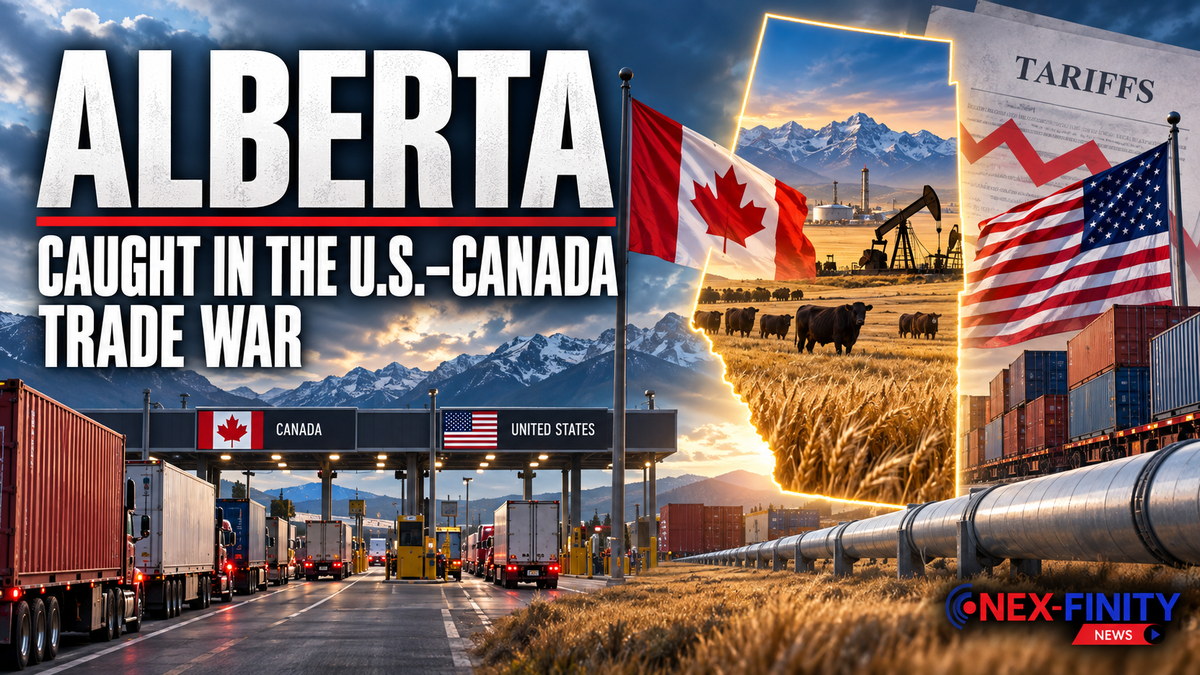
On September 8, Canada begins collecting tariffs of 15, 25 and 50 percent on more than 700 categories of American goods, matching the 50 percent duties Washington imposed on roughly $27.6 billion in Canadian products on August 22. Prime Minister Mark Carney described the American action in the language of armed conflict. “You’re at war when you get attacked. We got attacked,” he told reporters in Ottawa on August 22.
Six weeks later, on October 19, voters in one Canadian province will go to the polls to decide whether their government should begin the legal process toward leaving the country.
The province is Alberta. It holds the oil. And it is the one part of Canada that the American tariffs have almost entirely spared.
That coincidence has produced a question now circulating on both sides of the border: is the trade war, in whole or in part, an instrument aimed at Alberta’s referendum? The evidence does not support a clean yes. It does not support a clean no either.
Background: What Was on the Calendar, and When
The trade dispute is older than the scheduled vote. It is not older than the movement, and it is not older than Washington’s awareness of the movement. That distinction determines how much weight the chronology can carry, and it is worth setting out in order.
The first Trump tariffs on Canadian goods were announced February 1, 2025 25 percent on most imports, 10 percent on energy under the International Emergency Economic Powers Act, with fentanyl trafficking and border security given as the justification. Alberta’s product drew the discounted rate from the first day of the trade war.
Three months later, a 2026 separation referendum was already a public commitment. Carney’s Liberals won the federal election on April 28, 2025. The next day, Smith’s United Conservative government introduced Bill 54, cutting the citizen-initiative threshold from 20 percent of registered voters to 10 percent of eligible voters in the previous general election, and extending the signature window from 90 days to 120. On May 5, Smith said in a livestream address that her government would not itself put separation on the ballot, but would include a citizen-initiated question on the 2026 referendum ballot if petitioners cleared the bar. Bill 54 became law on May 15, 2025.
From that point the vote was a live, publicly committed possibility, and it was covered as one on both sides of the border. The Alberta Prosperity Project was filling banquet halls in Calgary by spring 2025. A rival “Forever Canadian” petition, organized by former deputy premier Thomas Lukaszuk, reported 456,000 signatures by late October 2025.
This narrows what the chronology actually disproves. It defeats the strongest version of the claim that the tariff program was constructed from the outset as a lever against Canadian unity. It does not touch the weaker and more plausible version: that the escalations of 2026, including the decision to hold energy out of the August round, were taken by an administration that knew a separation vote was on Alberta’s calendar and had known for more than a year.
The same qualification applies to the American contacts, and it cuts the other way. Dennis Modry dates the first State Department meeting to April 22, 2025 six days before the federal election, a week before Bill 54, and two weeks before Smith’s commitment. Washington was engaging the movement before there was anything scheduled to engage it about. That is difficult to characterize as a reaction to events.
What the record does establish about origins is that the annexation rhetoric came first. Alberta separatism is a decades-old current, rooted in what Albertans call Western alienation in simple terms, the belief that Ottawa takes revenue from the province’s resource industry while blocking the pipelines that industry needs. It intensified through a 2025 federal election campaign that Trump’s repeated talk of Canada as a “51st state” did much to shape.
Two rival citizen petitions then circulated. Under Alberta’s Citizen Initiative law as amended, a petition requires 177,732 valid signatures gathered within four months. Roughly 700,000 Albertans signed one or the other. Elections Alberta deemed the separation petition successful, and on May 21, 2026, Smith announced the October 19 date and the question’s final wording.
What Albertans Are Actually Voting On
The ballot question is narrower than “should Alberta leave Canada,” and the wording matters.
Voters choose between Option 1, that Alberta should remain a province of Canada, and Option 2, that the provincial government should begin the legal process required under the Canadian Constitution to hold a binding referendum on separation at a later date.
In simple terms: a Yes on Option 2 does not separate Alberta from anything. It authorizes the government to start the paperwork for a second, real vote.
The design is a workaround. A court found earlier this year that a binding separation referendum could not proceed in Alberta without first completing constitutionally required consultation with First Nations on the effect such a vote would have on treaty rights. The two-step structure sidesteps that finding by asking about a process rather than an outcome. Both separatist organizers and pro-Canada campaigners have criticized the compromise.
The separation question sits alongside nine other referendum questions announced in February 2026 and authorized by Orders in Council 109/2026 and 110/2026 on March 31, covering provincial opt-outs from federal programs and constitutional changes to provincial jurisdiction.
Smith, who called the vote, has said she will vote to remain.
Why the Tariffs Miss Alberta
The August 22 tariff list covers furniture, dairy, cement, liquor, plywood, clothing, electrical products, fishing rods and hockey equipment. It does not cover crude oil.
Canadian energy has faced a 10 percent tariff since March 2025, but crude that qualifies for preferential treatment under the U.S.-Mexico-Canada Agreement is exempt, and every subsequent American tariff action including the 50 percent round has carved energy out.
The result is measurable. Smith’s own government estimated that the August tariffs touch roughly $1.5 billion of Alberta exports. Ontario’s auto and steel sector, Quebec’s aluminum and forestry industries, and British Columbia’s wood products absorb the rest.
There is a straightforward explanation for the carve-out that has nothing to do with secession. American refineries cannot easily replace the Canadian barrel. The United States bought about 90 percent of Canada’s crude exports in 2025 roughly C$126 billion of C$140 billion and Canadian crude supplied about 63 percent of all U.S. crude imports, near 3.9 million barrels per day. The shale boom made America the world’s largest producer of light, sweet crude, while Midwest and Gulf Coast refineries were built and expanded to run heavy barrels. A tariff on Canadian oil is paid at the border by American refiners and shows up at American pumps.
The dependence is mutual. Alberta cannot easily sell elsewhere: the expanded Trans Mountain pipeline moves about 890,000 barrels per day to the Pacific, a fraction of what flows south.
This is why Smith has refused to support an export tax or supply cut, breaking with premiers who want energy on the table. She called the American tariffs tragic and unjustified while arguing that retaliation through oil would invite a response Canada could not absorb. Ontario Premier Doug Ford has separately raised cutting electricity exports to New York, Michigan and Minnesota.
The Part of the Premise That Holds Up
Where the “it’s about Alberta” thesis gains traction is not in tariff schedules. It is in a separate and documented record of contact.
The Financial Times reported in January 2026 that leaders of the Alberta Prosperity Project, a group campaigning for independence, had met U.S. State Department officials in Washington three times. Co-founder Dennis Modry said he attended all three, dating them April 22, September 29 and December 16, 2025, and said the discussions covered practical questions including currency and border security. The group’s attorney, Jeffrey Rath, said the meetings took place at State Department headquarters. Reporting at the time indicated the group intended to ask Treasury officials for a $500 billion credit facility to fund a transition.
The White House said officials meet with many civil society groups and that no support or commitments were conveyed. A senior State Department official later told NBC News that no senior officials attended and that no further meeting would occur. U.S. Ambassador Pete Hoekstra, after initially denying the meetings, characterized them as routine and said he has direction not to intervene in the referendum, while noting the president decides that.
Treasury Secretary Scott Bessent went further in a January interview, calling Alberta “a natural partner for the U.S.” and remarking on the province’s resources and independent character. In August, Rep. Andy Harris of Maryland said on the record that if Alberta secedes, the United States should make it the 51st state, citing its oil reserves.
British Columbia Premier David Eby called the separatist outreach to Washington treason. Carney has repeatedly said he expects the administration to respect Canadian sovereignty. Trump has not stated a position on the referendum.
Canadian researchers tracking foreign-origin content found a further wrinkle. In a two-week window in early August, monitoring group Cipher identified 147 examples of foreign-linked disinformation aimed at the Alberta vote, attributing roughly 80 percent to Russian content farms and 20 percent to U.S.-based sources a reminder that Washington is not the only outside party with an interest in the outcome.
Impact: Who Pays, and What It Buys
For American readers, the near-term stakes are in the Midwest. Any move to tariff Canadian crude would raise refinery feedstock costs and push up gasoline and diesel prices in the states least able to substitute. That constraint is the most persuasive reason to read the energy exemption as economics rather than strategy.
For Canada, the tariff design creates a political asymmetry that no one had to intend for it to matter. The provinces bearing the damage are the ones with the least sympathy for Alberta’s grievances, and the province taking the least damage is the one voting on whether to leave.
Whether that asymmetry is producing the effect a leverage theory would predict is testable, and the answer so far is no.
A Research Co. survey of 750 Albertans conducted August 24 to 26 found 74 percent would vote to remain and 22 percent would vote to begin the separation process, with a margin of error of 3.6 percentage points. A Leger poll of 1,001 Albertans taken August 21 to 23 found 65 percent to 23 percent, margin of error 3.1 points. An Ipsos poll in June had it 72 to 18. The trend has been stable all year, and the pollster who conducted the August survey described the issue as galvanizing rather than close.
The trade war appears to be moving Albertans toward Canada, not away from it. Former premiers Rachel Notley and Jason Kenney political opponents for a decade are now co-chairing a Canadian Chamber of Commerce campaign against separation. Kenney’s argument is that an independent, landlocked Alberta would trade a quarrel with Ottawa for dependence on Washington. Notley has called the referendum badly timed during a trade war. The campaign cites an estimated C$27.2 billion first-year deficit for an independent Alberta, a figure that comes from the No side and should be read as advocacy, not accounting.
Analysis
Three findings, separated because they are separate.
The tariff program was not built as a secession lever, but the 2026 escalations were not made in ignorance either. The February 2025 tariffs predate any commitment to a separation vote, and their stated rationale is unrelated. That disposes of the origin story. It does not dispose of the design choices made since. By the time Washington set the August 2026 rates, a scheduled Alberta separation referendum had been public for fifteen months, three State Department meetings had occurred, and the Treasury secretary had called the province a natural partner. The energy carve-out still has a sufficient economic explanation. But “they didn’t know” is not available as a defense of the 2026 decisions, and the burden of the alternative reading sits with what officials say about their own intent which is why the unanswered comment requests below matter more than usual.
The tariffs nonetheless shape the ground the referendum is fought on. Alberta is the least-injured province in a national economic fight, and the premier who most publicly resists retaliation is the premier who called the vote. That is a real political fact regardless of whether anyone designed it.
The outreach is the substantive story, and it is not about tariffs at all. Three meetings at the State Department with a provincial secession movement in an allied democracy, a Treasury secretary volunteering that the province would make a good partner, and a president who has declined to say he favors a united Canada that is a departure from how Washington handled the Quebec referendums of 1980 and 1995, when Presidents Carter and Clinton both stated support for Canadian unity while acknowledging the choice belonged to Canadians.
The honest formulation is that the trade war is not about Alberta, and Alberta is nonetheless where the trade war has the most interesting consequences.
Conclusion
On October 19, Albertans will almost certainly vote to remain in Canada, and by a margin that current polling suggests will not be close. The more durable question is what the last twenty months have established as normal: that a sitting American administration will meet with a foreign province’s independence movement, decline to disclaim interest in the result, and structure a tariff regime whose burden falls everywhere in that country except the province in question.
Canada’s counter-tariffs take effect September 8. The vote follows six weeks later.
Key Takeaways
· Albertans vote October 19 on whether their government should begin the legal process toward a future binding referendum on separation. The vote itself separates nothing.
· A 2026 separation referendum has been a public commitment since May 5, 2025, days after Alberta cut its citizen-initiative signature threshold in half. The vote was on the calendar throughout the 2026 tariff escalations.
· Polling has been consistent and lopsided: 74-22 (Research Co., Aug. 24-26), 65-23 (Leger, Aug. 21-23), 72-18 (Ipsos, June). Premier Danielle Smith says she will vote to remain.
· The August 22 U.S. tariffs on roughly $27.6 billion in Canadian goods exempt crude oil, leaving Alberta’s exposure near $1.5 billion while Ontario, Quebec and B.C. absorb the damage.
· The exemption has a market explanation: the U.S. imports about 3.9 million barrels per day of Canadian heavy crude that its refineries are configured to run, and a tariff would be paid by American refiners.
· Separately from tariffs, Alberta Prosperity Project leaders met State Department officials three times in 2025. The White House said no commitments were made.
· Treasury Secretary Scott Bessent called Alberta a natural partner for the U.S. in January. Trump has not stated a position on the referendum.
· Canada’s matching tariffs 15, 25 and 50 percent on more than 700 product categories take effect September 8.
Sources
· Government of Canada, Department of Finance list of U.S. products subject to counter-tariffs effective September 8, 2026
· NPR, “As Canada readies retaliatory tariffs, Mark Carney says his nation is ‘at war’ with U.S.,” August 22, 2026
· Al Jazeera, “Canada to hit US with retaliatory tariffs as trade war escalates,” August 23, 2026
· CNN Business, “Canada just announced new tariffs on US goods,” August 25, 2026
· Yahoo Finance, “In US-Canada trade spat, Washington left out a key lever: Canadian oil,” August 25, 2026
· U.S. Energy Information Administration, “Lower crude oil prices reduced U.S.-Canada energy trade value in 2025”
· Congressional Research Service IF12595, “U.S.-Canada Trade Relations”
· Canada Energy Regulator, market snapshot: overview of 2025 Canada-U.S. energy trade
· Alberta Referendum 2026 official site separation question and Citizen Initiative petition thresholds
· Canadian Press / CP24, “Alberta premier promises separation referendum in 2026 if petition signatures warrant,” May 5, 2025
· CBC News, “Alberta Premier Danielle Smith defends promise of a potential referendum on separation,” May 6, 2025
· Global News, Smith livestream address and Bill 54 threshold changes, May 5, 2025
· Policy Options (IRPP), “How the UCP is reframing Alberta’s separatist gambit,” June 2025
· Global News, “‘Forever Canadian’ petition surpasses goal, collects 456K signatures,” October 28, 2025
· BNN Bloomberg, “Alberta’s Smith urges de-escalation of trade war,” August 26, 2026
· CBC News, “Alberta Premier Danielle Smith wants Ottawa to resume trade talks,” August 26, 2026
· CTV News, Research Co. referendum poll, August 24-26, 2026
· Financial Times reporting on Alberta Prosperity Project meetings, January 2026
· NBC News, “Canadian separatists optimistic after meetings with Trump officials”
· Newsweek, “Canada reacts as Trump administration meets with Alberta separatist group,” January 29, 2026
· The Hill, “Trump officials met with Canadian separatists; British Columbia premier alleges ‘treason'”
· The Globe and Mail, “U.S. Treasury Secretary Scott Bessent weighs in on Alberta separatism,” January 23, 2026
· The Globe and Mail, “Russian, U.S. actors are targeting Albertans with pro-separatist content”
· Mediaite, Rep. Andy Harris remarks on Alberta statehood, August 2026
· CP24, “Notley, Kenney join forces to co-chair business campaign against Alberta separation,” August 25, 2026
· The Conversation, “51st state of mind: As Alberta votes on independence, will Trump back separation?”
· APTN News, First Nations statements on foreign interference and treaty rights