
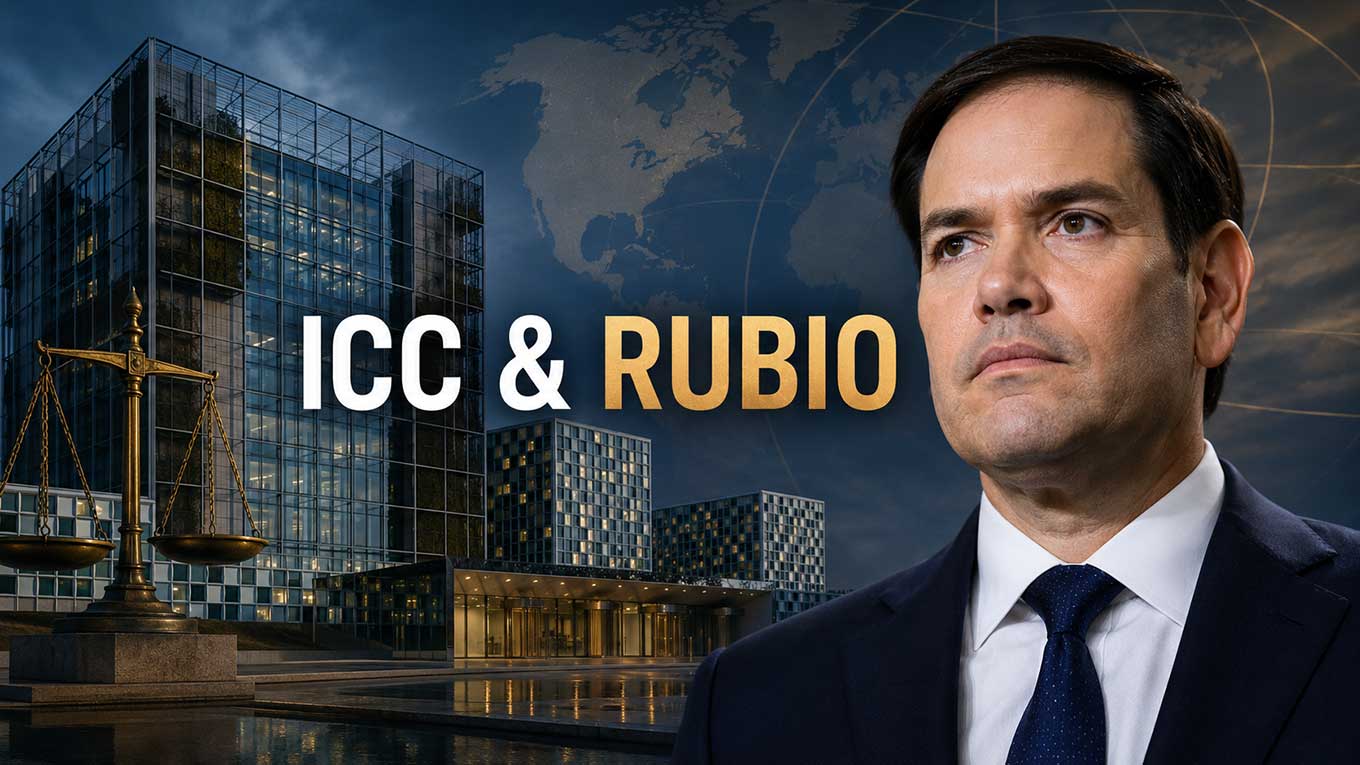
On July 14, 2026, Secretary of State Marco Rubio put the world on notice. Writing in the Wall Street Journal and following up with a State Department declaration of a “whole of government” offensive, he vowed that the United States would “dismantle the ICC — brick by brick, if necessary.” The International Criminal Court, he argued, had grown into “an intolerable threat to U.S. sovereignty” that “threatens every aspect of our political and legal system.” His framing was blunt and deliberate: sovereign states over globalism.
For supporters of the tribunal in The Hague, the language was incendiary. For a large bloc of Americans across the political spectrum, it was simply the plainest statement yet of a position the United States has held, in one form or another, for nearly a quarter century: that no American should ever be hauled before a court his country never joined, staffed by judges he never elected, enforcing law his representatives never ratified. To understand why Washington has drawn this line — and why the confrontation has sharpened now — it helps to look at what the ICC has become.
A court born of good intentions — and steadily growing
The International Criminal Court was established by the Rome Statute, a treaty adopted in 1998 that entered into force in 2002. Its stated mission is narrow and morally unimpeachable on its face: to prosecute individuals for genocide, crimes against humanity, war crimes, and the crime of aggression when national courts are “unwilling or unable” to do so. Today the Rome Statute has 125 states parties. It is headquartered in The Hague, funded largely by its member states, and presided over by a rotating bench of judges and an independent prosecutor.
Yet the roster of who is not a member is as telling as the roster of who is. The United States, China, Russia, and India — nations representing roughly half of humanity and a commanding share of global military and economic power — all remain outside the Court. Israel is likewise a non-member. These are not rogue states hiding from justice; they are among the world’s oldest and largest democracies and its major powers, each of which concluded, for reasons of constitutional structure and national sovereignty, that ceding criminal jurisdiction over their own citizens to a supranational body was a bridge too far.
The Court that critics describe today is not the modest “backstop” institution its founders advertised. Over two decades it has steadily widened its ambit. In 2016 the Office of the Prosecutor announced it would prioritize crimes involving “the destruction of the environment, illegal exploitation of natural resources, or illegal dispossession of land” — an expansion into territory the original drafters never squarely contemplated. In July 2018 the Court activated jurisdiction over the “crime of aggression,” a famously elastic concept that reaches decisions about when and whether a state may use military force at all. Each step was defensible in isolation. Together they trace an institution whose reach has only ever grown — never contracted.
From African warlords to sitting heads of state
For most of its history the ICC’s docket was dominated by cases from Africa — a pattern that drew accusations of selective, neo-colonial justice from the very governments it claimed to serve. But the last three years have marked a decisive turn. The Court has begun issuing warrants against the leaders of major powers and close allies of Washington, and in doing so it has moved from the periphery of world affairs to its center.
In March 2023 the Court issued an arrest warrant for Russian President Vladimir Putin over the alleged unlawful deportation of Ukrainian children — the first time a sitting head of state of a permanent member of the UN Security Council had been so charged. Russia’s response was to denounce the warrant as “outrageous,” place ICC officials on its own wanted lists, and, by December 2025, sentence Court staff in absentia to lengthy prison terms. In July 2025 the Court issued warrants for Taliban leaders over the systematic oppression of women and girls in Afghanistan.
The genuine turning point for Washington, however, came in November 2024, when the Court issued arrest warrants for Israeli Prime Minister Benjamin Netanyahu and former Defense Minister Yoav Gallant over the conduct of the war in Gaza — placing the elected leaders of a close American ally in the same legal category as the men who ordered the atrocities of October 7. To American critics, this was the moment the theory became the practice: a court to which neither the United States nor Israel belongs, presuming to sit in judgment over how a sovereign democracy defends its own people. If the Court would do this to Israel, the reasoning went, what exactly protects an American general, an American intelligence officer, or an American president from the same treatment tomorrow?
How a court reaches a country that never joined it
This raises the question at the heart of the whole dispute: how can a court claim authority over the citizens of nations that never signed its treaty? The answer is that the ICC does not base its jurisdiction on the nationality of the accused. It bases it on territory. Under Article 12 of the Rome Statute, the Court may act when either the state on whose soil the alleged crime occurred or the state of the perpetrator’s nationality has accepted its jurisdiction. Those two conditions are alternatives — satisfying just one is enough. So the nationality of the accused is not the gatekeeper. If the alleged crime took place on the territory of a member state, the Court asserts jurisdiction over whoever committed it, member national or not.
That “territorial hook” is what lets the Court reach the leaders of non-member states. Israel never joined, but the State of Palestine acceded to the Rome Statute in 2015; the Court treats Gaza and the West Bank as the territory of a member state and claims jurisdiction over crimes allegedly committed there regardless of the perpetrators’ Israeli nationality. Russia is not a member either, but Ukraine formally accepted the Court’s jurisdiction over crimes on its own territory through declarations lodged in 2014 — and the alleged deportations occurred on Ukrainian soil. The dormant Afghanistan investigation into U.S. personnel worked the same way: Afghanistan is a member, so conduct there fell within the Court’s asserted reach even though Washington never ratified anything.
The Court’s own theory is that this is nothing exotic. Every sovereign state has always been able to prosecute crimes committed on its soil no matter who commits them — a French court may try an American for a crime in Paris. A member state, the argument runs, is merely delegating that ordinary territorial power to the ICC. On this view the Court is not inventing a universal authority over everyone; it is exercising jurisdiction its members already possessed and chose to hand over.
The sovereignty-first rebuttal is that the delegation theory proves too much. A bedrock rule of treaty law — pacta tertiis, codified in Article 34 of the Vienna Convention on the Law of Treaties — holds that a treaty cannot create obligations for a state that never signed it. Critics argue that allowing the territorial state’s consent to substitute for the nationality state’s consent lets a handful of governments draft a treaty among themselves and then bind the citizens, and prosecute the officials, of a nation that deliberately stayed out. They add the objection of sovereign immunity: a state’s officials acting in their official capacity have long been immune from the courts of other states, and no country should be able to strip that immunity from another’s leaders by routing the case through an international body. That is precisely what the administration means by the Court’s “near-unlimited reach” — and it is why the Palestine and Ukraine hooks are so bitterly contested, since the Court reached Israeli and Russian officials without ever needing Israel’s or Russia’s consent.
Why America says no — a bipartisan tradition
The current confrontation is often portrayed as a uniquely combative posture of one administration. It is not. American resistance to the ICC is one of the more durable bipartisan positions in modern foreign policy. President Bill Clinton signed the Rome Statute in the final weeks of his presidency but pointedly declined to submit it to the Senate, warning of its flaws and recommending that his successor not seek ratification until they were fixed. In May 2002, the Bush administration formally “unsigned” the treaty, notifying the United Nations that the United States had no intention of becoming a party and no legal obligations arising from the signature.
Months later, in August 2002, Congress passed and President Bush signed the American Service-Members’ Protection Act — legislation so muscular that critics nicknamed it the “Hague Invasion Act.” It authorizes the president to use “all means necessary and appropriate” to free any American or allied personnel detained by the Court, prohibits U.S. cooperation with ICC investigations, bars the extradition of any person to The Hague, forbids the transfer of classified information, and restricts military aid to states that join the Court without signing bilateral immunity agreements shielding Americans. That law remains on the books today.
The through-line across administrations is a single principle: consent. In the American constitutional tradition, legitimate authority to prosecute and imprison a citizen flows from the consent of the governed — expressed through elected representatives, exercised through courts accountable to the people, and bounded by a Constitution that guarantees the accused a jury of his peers, protection against double jeopardy, and a web of due-process rights the Rome Statute does not replicate. The ICC prosecutor answers to no American electorate. Its judges are appointed through an international political process in which the United States has no vote. There is no meaningful appeal from The Hague to any body an American citizen helped to constitute. As Rubio put it, Americans “never signed up for this.”
That is why the Trump administration moved from rhetoric to sanctions. In February 2025, Executive Order 14203 imposed financial penalties and visa restrictions on the Court and named its chief prosecutor, Karim Khan. Over the following year the sanctions widened to include a succession of ICC judges and a United Nations special rapporteur — a campaign human-rights groups sharply condemned. By July 2026, Rubio was promising to leave “no diplomatic option off-limits,” pressuring nations to withdraw their membership and their funding, and warning states that accept American assistance while underwriting the Court that their choices would face new scrutiny.
The larger stakes: sovereignty and the globalist project
Strip away the legal specifics and the ICC becomes a case study in a much broader phenomenon that critics call the globalist agenda: the steady transfer of decisions once made by self-governing nations to supranational institutions insulated from any single people’s democratic control. The Court is not an isolated body but a node in a widening network of international courts, agencies, tribunals, and treaty regimes, each claiming a slice of authority that once belonged exclusively to the nation-state.
The objection is not to international cooperation as such — sovereign nations have always signed treaties, formed alliances, and submitted to arbitration when they chose to. The objection is to a model in which an institution asserts binding jurisdiction over the citizens of countries that never joined it, on the theory that its authority is universal and requires no one’s consent. When a court can indict the leaders of non-member states, the traditional bargain of international law — that a nation is bound only by what it has agreed to — quietly collapses. What replaces it is a system in which a self-selecting international class, staffed heavily by the very nongovernmental organizations and activist networks that lobby the Court, defines the rules that everyone must live under, whether they consented or not.
This is the deeper worry animating the American position. A general who authorizes a strike, an intelligence officer who runs an interrogation program, a president who orders a military operation — each could, in principle, find himself the target of a foreign prosecutor accountable to no American voter. The chilling effect is real: leaders forced to weigh not only the law their own nation has enacted, but the shifting interpretations of a tribunal they cannot influence and did not elect. For a self-governing republic, critics argue, that is not justice — it is the outsourcing of national destiny. Rubio’s phrase, “sovereign states over globalism,” distills the choice as its proponents see it: a world of accountable nations, or a world of unaccountable institutions.
The case for the Court — and why it hasn’t persuaded Washington
In fairness, the ICC’s defenders answer these charges directly, and their arguments deserve a hearing. They contend that the Court’s authority over the nationals of non-member states rests on an ordinary and long-accepted principle: territorial jurisdiction. Every nation, the United States emphatically included, claims the right to prosecute crimes committed on its soil regardless of the perpetrator’s citizenship. On this view, when a member state refers conduct on its own territory to the Court, the ICC is merely exercising authority that the state itself possessed and chose to delegate — not conjuring a new universal power out of nothing.
Defenders also note, accurately, that in more than two decades no American has ever been charged by the Court, that investigations touching U.S. conduct in Afghanistan never ripened into prosecutions, and that Washington has repeatedly welcomed the ICC when it served American aims — backing its scrutiny of Sudan, Libya, and, more recently, Russian conduct in Ukraine. Critics of Rubio’s campaign, including former Human Rights Watch director Kenneth Roth and a chorus of international-law scholars, argue that a country cannot cheer the indictment of its adversaries one year and declare the institution illegitimate the next. European officials have called the U.S. pressure campaign “unacceptable” and a threat to the independence of international justice; human-rights organizations warn the sanctions imperil victims’ access to justice.
These are serious points, and they explain why the debate is a genuine one rather than a settled question. But they have not moved the American position, for a reason that goes to the heart of the sovereignty argument: a power that is exercised selectively is still a power asserted. That the Court has not yet prosecuted an American is, to skeptics, cold comfort — a discretion that can be withheld can also be deployed, and a citizen’s liberty should not depend on the forbearance of a prosecutor he never chose. Supporting an indictment of an adversary, they add, is a policy judgment a sovereign nation is free to make; submitting one’s own citizens to the same court’s compulsory jurisdiction is a surrender of self-government of an entirely different order.
A defining fight over who governs
The confrontation between Washington and The Hague is unlikely to resolve quietly. The Court will continue to insist on its jurisdiction; the United States will continue to reject it, now with the full weight of a coordinated diplomatic and economic campaign behind that refusal. Allies will be caught in the middle, pressed to choose between a treaty commitment and the world’s most powerful government. And the ICC, having expanded its reach to the leaders of major powers, will discover whether that reach exceeds its grasp.
Beneath the sanctions and the sharp rhetoric lies a question older than any court: who holds legitimate authority over a free people? For a growing number of Americans, and for the government now acting in their name, the answer has not changed since the founding. Authority belongs to the governed and the representatives they elect — not to an institution across the ocean that asks no one’s permission. Whether one regards that conviction as a principled defense of self-government or an evasion of accountability may be the defining argument of this era of international affairs. What is no longer in doubt is that the United States intends to have it out in full.
Sources & Further Reading
• Rubio vows to ‘dismantle’ the ICC — The Hill
• U.S. campaign to dismantle the ICC; EU response — Euronews
• Analyzing Secretary Rubio’s ICC op-ed — Just Security
• Executive Order 14203, “Imposing Sanctions on the ICC” — The White House
• Executive Order 14203 (overview and later sanctions) — Wikipedia
• Trump authorizes ICC sanctions — Human Rights Watch
• What the sanctions mean for justice and human rights — Amnesty International
• American Service-Members’ Protection Act — Wikipedia
• ‘Hague Invasion Act’ becomes law — Human Rights Watch (2002)
• International Criminal Court: status, warrants, jurisdiction — Wikipedia
• The Role of the ICC — Council on Foreign Relations
• The States Parties to the Rome Statute — International Criminal Court