
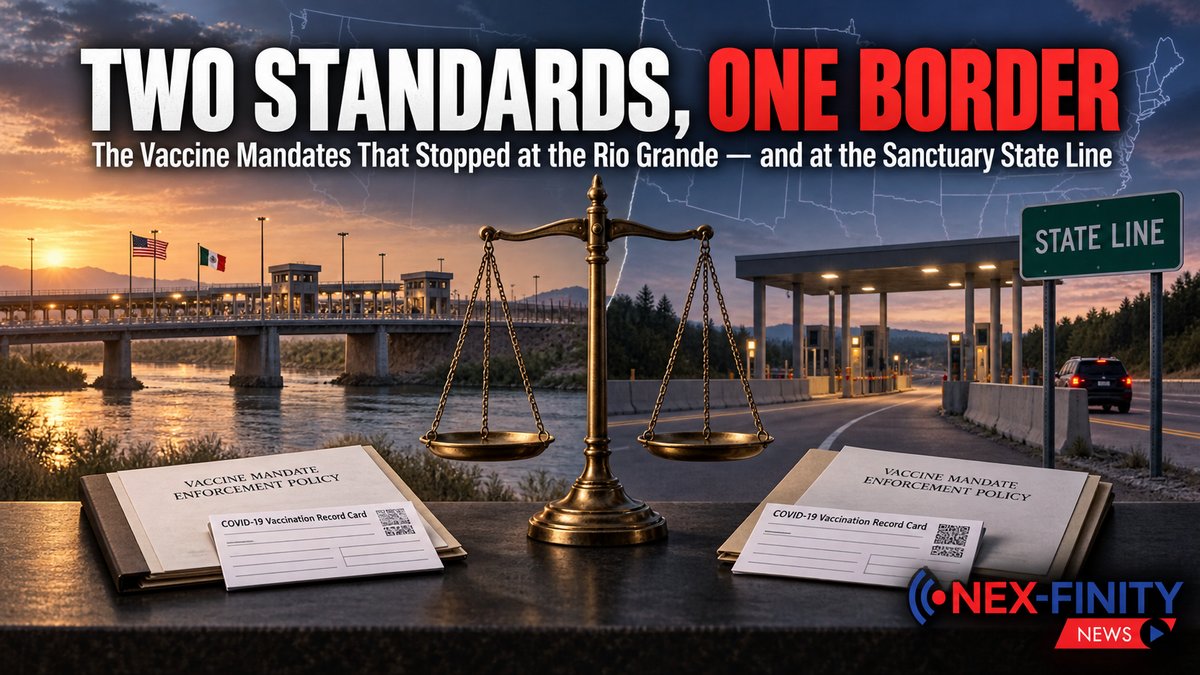
For years, federal and state governments made jobs, military service, hospital work and school enrollment depend on vaccination. Those standards were never applied at the same strength to people entering between ports of entry, or to the jurisdictions that shelter them. Measles is now at a 35-year high, largely for reasons unrelated to the border.
In the fall of 2021, a federal contractor in Hauppauge could lose her job for refusing a COVID-19 shot. A Navy corpsman could be separated from the service. A nursing-home aide in Nassau County could be pulled off the floor.
A Canadian retiree driving across the Peace Bridge for the afternoon had to show proof of vaccination at the booth: starting January 22, 2022, DHS required non-U.S. travelers entering through land ports of entry or ferry terminals on both borders to be fully vaccinated.
A person who crossed the desert forty miles west of that port of entry and turned himself in to Border Patrol faced no vaccination requirement at all.
That gap was not a talking point. It was built into the law, and the details matter, because they are what make the criticism hold up.
Where the Line Actually Falls
Federal law does require immigrants to be vaccinated, but the requirement applies later, not at the moment of entry. Under INA § 212(a)(1)(A)(ii), a person seeking admission as an immigrant or adjustment to lawful permanent residence who cannot show proof of vaccination against specified vaccine-preventable diseases is inadmissible. Those vaccines include MMR, polio, DTaP, hepatitis B and varicella.
The requirement is triggered by a green card application, not by crossing the border. CBP is not required to place migrants apprehended at the border into expedited removal. It can issue a notice to appear and release the person, or transfer the person to ICE, which decides whether to release them pending proceedings. This practice is commonly called “catch and release.” Any vaccination screening comes years later, if it happens at all.
In simple terms: the federal vaccine check happens when someone applies for a green card. It does not happen when someone crosses the border and is released to wait for an immigration court date.
The numbers are not in dispute. CBP recorded more than 10.8 million nationwide encounters from FY2021 through FY2024, about 8.72 million of them at the southwest border.
The Biden administration did briefly consider closing the gap. In early 2022, reports said the White House was weighing a COVID-19 vaccination requirement for migrants aged five and older crossing for court hearings. Public health experts responded with a letter arguing that asylum seekers and refugees should not be required to be vaccinated as a condition of entry. The requirement was never adopted. The rule for the Canadian retiree remained in place.
An administration may weigh asylum obligations against public-health screening and decide as it sees fit. It may not pretend no trade-off was made, or treat citizens who noticed the difference as arguing in bad faith. Mandates depend on the principle that everyone carries the same burden.
The Case That Proves the Narrow Point
One well-documented case produced exactly the outcome critics had predicted. On March 7, 2024, Chicago’s health department confirmed measles in a one-year-old boy living in a temporary migrant shelter. About 2,100 residents were presumed exposed, and vaccination coverage among them was low.
The department vaccinated 882 residents and verified prior vaccination for another 784 over three days, reaching 93% coverage by March 11. By May 13, 57 confirmed cases were linked to the shelter.
That outbreak is documented in the CDC’s own Morbidity and Mortality Weekly Report. Chicago then tightened vaccination policy for migrants staying in city shelters. A coherent policy would have produced that rule in advance. Instead it took an outbreak.
That outbreak involved fifty-seven cases. Keep that number in mind.
What the 2026 Outbreak Is
As of September 17, 2026, the CDC has confirmed 3,471 measles cases in the United States this year, reported across 47 jurisdictions. Seventeen of those cases were in international visitors. Ninety-five percent are outbreak-associated. This is the highest annual total since 1991.
In November 2026, a PAHO commission will review whether the United States keeps its measles elimination status. The Americas region as a whole lost its measles-free designation in November 2025, after endemic transmission was documented in Canada.
Is the border the cause? The evidence says no, and says it clearly.
The outbreaks are domestic. South Carolina’s Upstate outbreak reached 997 cases, centered on Spartanburg County. Of those patients, 95.3% were unvaccinated and 90.8% were children 17 or younger. State officials say they never identified the source of the first cases.
The CDC has found the same pattern since 2000: nearly all large U.S. measles outbreaks have occurred in close-knit, unvaccinated communities. Pennsylvania, now the largest active outbreak, fits the same pattern as South Carolina, Utah and West Texas.
The number that should concern everyone is this one: only 10 states and the District of Columbia still have at least 95% MMR coverage among kindergartners, the threshold for community protection. Idaho reports 78.5%.
The timing also works against the immigration explanation. In October 2025, DHS reported 30,561 nationwide encounters, the lowest start to a fiscal year CBP has ever recorded, and a sixth straight month of zero Border Patrol releases. If unscreened entry were driving measles, 2026 should be the year cases dropped. It is the worst year since 1991.
The States That Mandated Hardest
The same pattern shows up at the state level. Every state allows medical exemptions from school vaccine requirements. Only five California, Connecticut, Maine, New York and West Virginia refuse religious and personal-belief exemptions.
Four of those five now limit state and local cooperation with federal immigration enforcement. Maine’s “ICE Out” laws took effect this summer, putting it alongside New York, California, Illinois, Massachusetts, Vermont, Connecticut and Delaware. The exception is West Virginia, where a governor’s order adding a religious exemption was stayed by the state Supreme Court of Appeals.
New York is the clearest example. A federal appeals court this year upheld the state’s 2019 repeal of its religious exemption, passed after a large measles outbreak. Families with religious objections had to vaccinate their children or withdraw them from school.
Three years later, New York City began enrolling children from its migrant shelters. The Department of Education said students in temporary housing did not have to show proof of vaccination at enrollment and would have 30 days to get vaccinated. By September 2023, nearly 19,000 such students had enrolled. Staten Island Borough President Vito Fossella called it a double standard.
A fair account has to include what the rules actually say. In 2023, State Education Commissioner Betty Rosa and Attorney General Letitia James restated that asylum seekers’ children face the same immunization requirements as every other student. State law requires every student to receive at least the first dose of each required vaccine within 14 days of registration. The enrollment window covers all children in temporary housing, including citizen children in homeless shelters.
The written rule never changed. What changed was how many children used the window at once, and whether anyone confirmed that they were vaccinated before it closed. NexfinityNews has asked the Department of Education for those numbers.
Sanctuary laws are not health laws. They govern whether local police assist ICE. They do not admit anyone at the border, and they exempt no one from any vaccine. The inconsistency is political, not a loophole in the statutes.
In simple terms: sanctuary laws decide whether local police help federal immigration agents. They say nothing about who must be vaccinated.
The outbreak map points elsewhere. South Carolina, Utah, Texas, Virginia, Florida, Pennsylvania and Arizona account for more than 84% of this year’s measles cases. None is among the five medical-exemption-only states. Before its 2025 exemption fight, West Virginia had the highest vaccination rates and lowest exemption rates in the country.
The Argument That Survives the Data
Set the causal claim aside, and what remains is still a serious indictment on two grounds.
Consistency. A government that conditions a soldier’s career, a nurse’s license and a contractor’s paycheck on a vaccine has taken a public position on what it considers necessary. It then declined to apply that position to millions of people it released into the interior. Several states that enforced the strictest mandates also limited the federal government’s ability to find those people afterward. Officials never reconciled the two positions.
Credibility. Public health depends on consent, and consent depends on people believing the rules apply evenly. Enough parents have stopped trusting vaccine recommendations that herd immunity has failed in most states. That loss of trust has more than one cause. Visibly uneven enforcement is a plausible contributor, and no federal health agency has seriously studied it.
There is also unfinished business going the other way. USCIS stopped issuing denials for missing COVID-19 vaccination records as of January 20, 2025, and the CDC removed COVID-19 from the required list on March 11, 2025. The requirement for immigrants was dropped. The mandates imposed on Americans under the same rationale have never been formally revisited.
What We Are Asking
NexfinityNews has submitted the following questions to DHS, CBP, the CDC and the New York City Department of Education:
- What vaccination screening, if any, was conducted on individuals released into the interior pending removal proceedings between FY2021 and FY2024, and what records exist?
- What legal or policy analysis supported requiring proof of vaccination from lawful land-border travelers while exempting people processed under Title 8 after crossing between ports?
- After the Chicago shelter outbreak, did the federal government issue guidance to states or municipalities on vaccination in migrant group housing?
- Has the CDC studied how enforcement of pandemic-era mandates affected later childhood immunization rates?
- To the NYC Department of Education: between 2022 and 2024, how many students enrolled from shelters did not complete required vaccinations within the compliance window, and how many were excluded from school?
We will publish the responses, or the refusals, in full.
Key Takeaways
- Federal vaccination requirements for immigrants apply at the green card stage, not at the border, so migrants released pending court faced no vaccine check on entry.
- Lawful foreign travelers at land ports did face a COVID-19 vaccine requirement from January 2022, creating a documented two-tier standard.
- A 2024 Chicago migrant-shelter outbreak (57 cases) showed the risk in congregate housing, but the 2026 national outbreak (3,471 cases) is driven by undervaccinated U.S. communities.
- Four of the five states with the strictest school-vaccine laws also limit cooperation with ICE; none of the five is among the states driving 2026 cases.
- The case that holds up is about consistency and public trust, not disease causation.
Sources
- CDC Measles Cases and Outbreaks (data through Sept. 17, 2026)
- CDC MMWR Vol. 73, No. 19 Measles Outbreak Associated with a Migrant Shelter, Chicago
- USCIS Vaccination Requirements (INA § 212(a)(1)(A)(ii))
- USCIS Policy Manual, Vol. 8, Part B, Ch. 9
- Congressional Research Service R46755 The Law of Asylum Procedure at the Border
- CBP Nationwide Encounters
- DHS FY2026 border statistics release, Nov. 5, 2025
- NAFSA COVID Vaccine Requirements for U.S. Entry (87 FR 3425, 87 FR 3429)
- PAHO Update on review of measles elimination status, Mar. 2, 2026
- South Carolina DPH 2025 Measles Outbreak
- KFF State School Vaccine Requirements: Overview and Current Status
- KFF Recent Changes to State Vaccine Requirements
- NYSED/NY AG Guidance on Safeguarding the Rights of Immigrant Students
- Maine Morning Star Maine immigration-enforcement restrictions, July 28, 2026
- Axios 2026 measles hot-spot states, July 25, 2026
NexfinityNews takes no position on the merits of vaccination policy and reports government conduct as documented.