
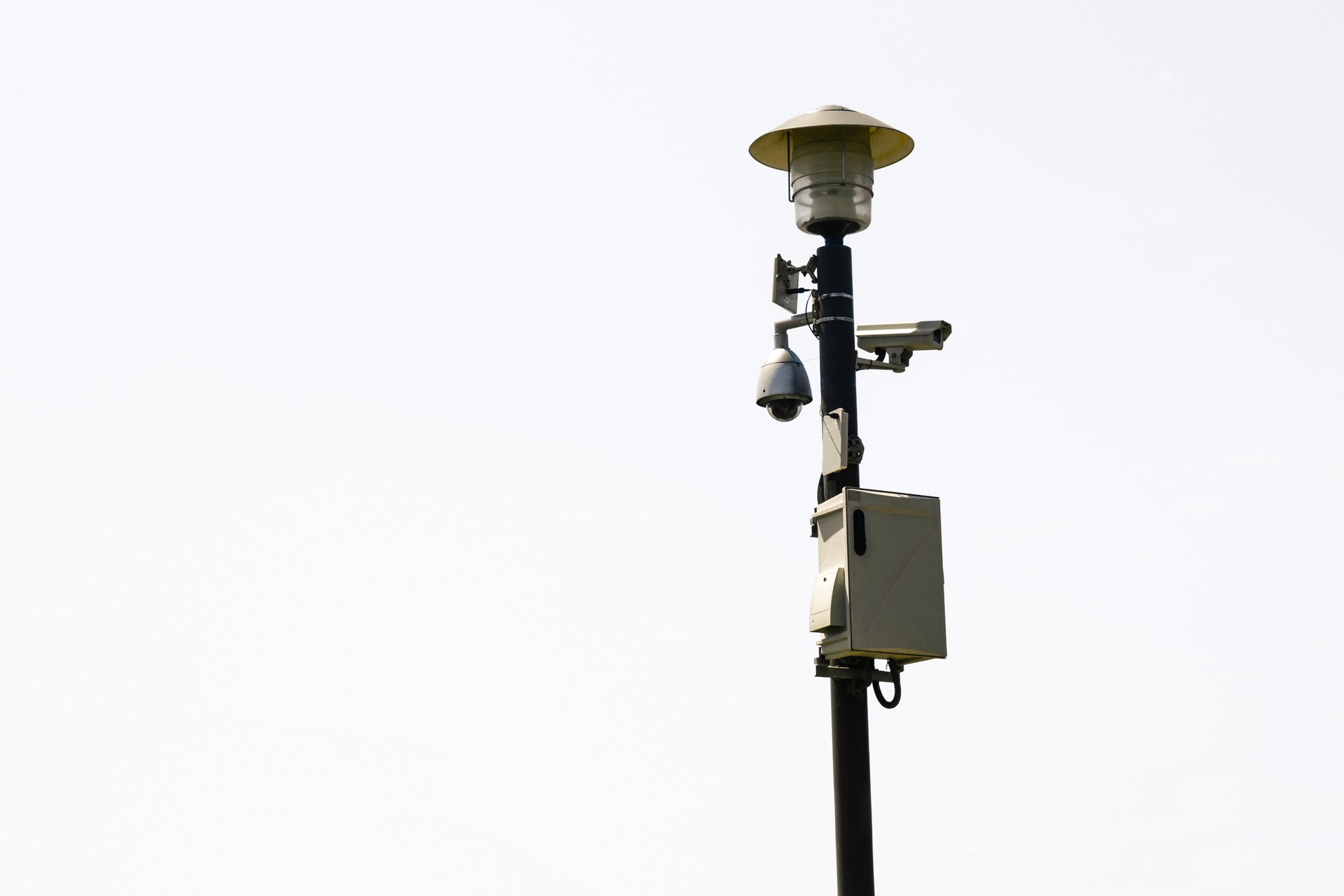
Every time you pull out of your driveway and drive down a public road in America, there is a reasonable chance you are being photographed, catalogued, and fed into a privately-operated nationwide database — without a warrant, without your consent, and without any meaningful oversight. The company doing it is called Flock Safety. You’ve probably never heard of them. They’ve been counting on that.
Founded in Atlanta in 2017, Flock Safety started as a pitch to suburban homeowners’ associations: a sleek, solar-powered camera mounted on a pole at the entrance to your neighborhood that reads every license plate that passes. By 2025, the company had metastasized into something its founders may not have imagined — or perhaps always intended. It is now, by most measures, the largest vehicle surveillance network ever built in American history, valued at $7.5 billion and operating in over 6,000 communities across 49 states.
| ~100KCAMERAS DEPLOYED NATIONWIDE | 5,000+LAW ENFORCEMENT AGENCIES |
| 20B+LICENSE PLATE SCANS PER MONTH | $7.5BCOMPANY VALUATION (SEPT. 2025) |
| 6,000+COMMUNITIES & MUNICIPALITIES | 49STATES WITH FLOCK PRESENCE |
The pitch was always public safety. Crime reduction. Stolen cars recovered. Missing persons found. And to be fair, Flock’s cameras have done some of those things. But what has quietly grown alongside the crime-fighting narrative is something far more disturbing: a dragnet system capable of tracking the movements of every American motorist in real time — and sharing that data, freely and without warrants, with thousands of law enforcement agencies, federal immigration authorities, commercial data brokers, private corporations, and anyone else with access to the platform.
This is the story of how that happened, who is profiting from it, who is fighting it, and what it means for the constitutional rights of every person who drives a car in the United States.
What Flock’s Cameras Actually Do
Flock’s primary product is the Falcon camera — a weatherproof, solar-powered device mounted at intersections, neighborhood entrances, school zones, and commercial properties. As a vehicle passes, the camera captures between six and twelve timestamped photographs of the vehicle’s rear. Using computer vision and machine learning, the system reads the license plate and also identifies the vehicle’s make, model, color, and what Flock calls ‘vehicle fingerprinting’ — distinctive characteristics that allow the system to identify and track a car even if the plate is obscured or missing.
That data is then transmitted over a cellular network to Flock’s cloud servers, where it is stored and indexed in a searchable database. A participating police department can log into Flock’s platform, enter a license plate number, and instantly see everywhere that vehicle has appeared across the entire nationwide network — not just in their city, but across any of the thousands of agencies that have opted into data sharing. The system requires users to enter a text ‘reason’ for their search, but that field is effectively an honor system: officers have typed in single words like ‘susp,’ ‘investigation,’ or simply ‘protest.’
“The company installs cameras throughout jurisdictions, and these cameras photograph every car that passes — documenting the license plate, color, make, model, and other distinguishing characteristics — pairing that data with time and location and uploading it to a massive searchable database.”
— Electronic Frontier Foundation, November 2025
In 2025, Flock dramatically escalated the scope of what its cameras can do. The company announced that police departments would soon have access not just to still photos, but to 15-second video clips and even live camera feeds. Simultaneously, Flock revealed plans to integrate its license plate data with commercial data brokers — services that sell people’s personal information — giving law enforcement the ability to, in Flock’s own promotional language, ‘jump from LPR to person.’ In other words, a license plate is no longer just a license plate. It’s a door to your identity, your address, your financial records, and your personal history.
In October 2025, Flock also launched a product called Raven — gunshot detection microphones to be deployed on the same street infrastructure as its cameras. Initial marketing materials stated that the system would also alert police to ‘screaming’ and general ‘distress.’ After public backlash, Flock quietly revised its website language, but the underlying audio surveillance capability remains.
The Data Flock Collects — And Who Gets It
Flock’s data flows in multiple directions simultaneously, and the company has been less than transparent about each of those streams. Here is what investigative reporting and FOIA disclosures have revealed.
Law Enforcement — Including Federal Agencies
The most consequential and controversial data flow is between Flock’s network and law enforcement agencies at every level of government. Flock’s ‘National Lookup’ feature allows any participating agency to search license plates across the entire nationwide database — not just cameras in their own jurisdiction. An agency in Florida can, and does, search camera networks in Oregon, Washington, Massachusetts, Virginia, and dozens of other states in a single query.
The Electronic Frontier Foundation obtained datasets representing over 12 million searches logged by more than 3,900 agencies between December 2024 and October 2025. Among the documented abuses: hundreds of searches tied to political protest activity, including the 50501 demonstrations, the Hands Off protests, and the No Kings marches. More than 80 law enforcement agencies used Flock’s system to run discriminatory searches targeting Romani people with racial slurs. Texas law enforcement used the network to search for a woman who had self-administered an abortion.
Federal immigration agencies exploited the network in ways Flock claimed were prohibited. Despite having no formal contract with Flock, U.S. Immigration and Customs Enforcement (ICE) gained access to Flock’s data through local law enforcement partners — what privacy advocates have called the ‘side door.’ In one documented case, a single search by a federal agency accessed approximately 6,000 Flock networks simultaneously, covering roughly 80,000 unique cameras. In Woodburn, Oregon, a small city of roughly 30,000 people, Department of Homeland Security and U.S. Border Patrol accessed local Flock data 384 times in just over three months — without the city’s knowledge.
| ⚠ FEDERAL ACCESS — WHAT CITIES DIDN’T KNOW |
| Woodburn, Oregon contracted with Flock in December 2024 and told residents that camera data was accessible only to local and state law enforcement. The city’s own audit later revealed that DHS accessed the data 175 times between March and May 2025, and Border Patrol conducted 209 additional searches through June 2025. |
| The searches occurred during a covert ‘pilot program’ Flock had run with federal agencies without notifying the municipalities whose data was being accessed. Flock CEO Garrett Langley, who had previously publicly denied any federal contracts, later acknowledged that the company ‘clearly communicated poorly’ and had ‘inadvertently provided inaccurate information.’ |
| The city shut its cameras off. As of late February 2026, they remain dark with no scheduled return to operation. |
Private Companies and Homeowners Associations
One of the most underreported aspects of Flock’s business model is that law enforcement agencies are not its only customers — and in many cases not even its primary ones. Flock sells directly to homeowners associations, private property developers, retail chains, and shopping malls. Simon Property Group, one of the largest mall operators in America, gave multiple law enforcement agencies open access to search and receive notifications from its Flock system across its properties.
Dozens of businesses around San Diego County — including Home Depot, Lowe’s, and local shopping centers — allowed law enforcement to search through license plate data from their Flock cameras, often with minimal or no formal agreements governing how that data could be used. A former mall security employee described the scope of what Flock enables: the ability to analyze patterns of movement, identify potential associations between drivers, and build detailed behavioral profiles — all from what most people assume is a simple security camera in a parking lot.
Data Brokers
Flock’s most chilling planned expansion is its announced integration with commercial data brokers. For years, the company had technically maintained that its cameras don’t collect ‘personally identifiable information’ — a claim the ACLU characterized as always having been ‘bogus,’ since license plates are trivially linked to specific individuals. Flock’s new product makes that falsity explicit, openly promising the ability to bridge from plate data to complete personal profiles. The Fourth Amendment is Not For Sale Act, which would have banned law enforcement from purchasing this kind of data from commercial brokers, passed the U.S. House in 2024 but was blocked in the Senate.
The FOIA Fight: Your Tax Dollars Paid For It, But You Can’t See It
Because Flock contracts with government agencies and its cameras are paid for with public funds, civil libertarians and journalists began filing Freedom of Information Act requests seeking access to the data. What followed was a revealing battle over who actually owns the surveillance record of American public roads.
Cities in Washington State — Stanwood and Sedro-Woolley — tried a novel legal argument after receiving FOIA requests for Flock footage. They asked a court to declare that data stored on Flock’s private servers is not a public record ‘unless and until a public agency extracts and downloads that data.’ The argument, if accepted, would have created a blueprint for any government agency to shield surveillance data from public oversight simply by storing it with a private contractor. In November 2025, Skagit County Superior Court Judge Elizabeth Neidzwski rejected the argument. She ruled that Flock camera images are public records, that they are ‘not exempt from disclosure,’ and that an agency does not have to physically possess a record for it to be subject to public records laws.
“If the court had ruled in favor of the cities’ claim, police could move to store all their data — from their surveillance equipment and otherwise — on private company servers and claim that it’s no longer accessible to the public. That would be the end of meaningful transparency.”
— Electronic Frontier Foundation, November 2025
In Virginia, obtaining even the locations of Flock cameras required litigation. Local cities and counties had rejected media and activist requests for lists of where the cameras were installed. A federal judge ultimately ordered those locations unsealed as part of a pending civil rights lawsuit. A reporter for Cardinal News drove 300 miles through Southwest Virginia, submitted requests for footage of her own drive, and had to take localities to court to get it.
The legal paradox at the heart of all this is jarring: Flock’s system is sold and marketed to governments as a public safety tool, deployed on public roads, paid for by public dollars, and used to collect data on the public — yet the company has consistently resisted transparency toward that same public while making data freely available to law enforcement agencies, federal authorities, and corporate clients. The public pays for the infrastructure. The company decides who sees the results.
| 🔍 HAVEIBEENFLOCKED.COM — THE SITE FLOCK TRIED TO KILL |
| When multiple police departments failed to properly redact license plate data released in response to FOIA requests, a technologist launched HaveIBeenFlocked.com — a website allowing anyone to enter their license plate number and see whether law enforcement had searched for them in the Flock system. |
| The dataset contained 2.3 million license plates and tens of millions of law enforcement search queries. Flock’s response was to quietly notify law enforcement that the data exposure was caused by ‘increased public records act/FOIA activity.’ Then a third-party company retained by Flock went to the site’s web hosts demanding it be taken down, claiming it posed ‘an immediate threat to public safety.’ Cloudflare declined, finding ‘insufficient evidence of a violation.’ The site remains active. |
| Meanwhile, the same data Flock fights to keep from citizens flows freely to thousands of law enforcement agencies and, through the ‘National Lookup’ feature, to federal agencies including DHS and CBP. |
The Accountability Vacuum — Courts, Congress, and the Fourth Amendment
The legal framework governing Flock’s surveillance network is, to put it charitably, unsettled. Courts have reached conflicting conclusions. In June 2024, a Norfolk, Virginia Circuit Court judge ruled that collecting location data from the city’s 172 Flock cameras constitutes a search under the Fourth Amendment and cannot be used as evidence when collected without a warrant — likening the system to a tracking device. A federal judge in the same city subsequently refused to dismiss a civil lawsuit arguing that the pervasive surveillance violates constitutional privacy protections, citing the Supreme Court’s landmark Carpenter v. United States ruling on cell phone tracking. Yet in October 2025, Virginia’s Court of Appeals swung the other direction, ruling that license plate readers don’t require warrants.
At the federal level, the California Attorney General sued the City of El Cajon for using Flock to illegally share information across state lines. Illinois launched a formal audit after EFF research showed Flock facilitated U.S. Customs and Border Protection access in violation of state privacy law. U.S. Representatives Raja Krishnamoorthi and Robert Garcia launched a formal congressional investigation into Flock’s role in ‘enabling invasive surveillance practices that threaten the privacy, safety, and civil liberties of women, immigrants, and other vulnerable Americans.’ The EFF and ACLU of Northern California filed a lawsuit against San Jose and its police department challenging warrantless searches of millions of ALPR records — citing that between June 2024 and June 2025, SJPD and other California agencies searched San Jose’s database nearly four million times.
The constitutional crux of the debate is a concept called the ‘mosaic theory’ of the Fourth Amendment — the idea that while any individual observation of a person in public may be lawful, the aggregate of millions of such observations over time creates an invasive portrait of a person’s private life that the founders never intended to leave unprotected. The Supreme Court gestured in this direction in Carpenter. The question is whether lower courts, Congress, or state legislatures will act before the infrastructure becomes too embedded to meaningfully regulate.
Where Flock Operates — And Where Communities Are Pushing Back
As of early 2026, Flock has contracts in virtually every major metropolitan area in the United States. Among the states and cities with documented significant Flock deployments:
- Virginia — Hampton Roads, Norfolk, Richmond, Charlottesville
- California — Oakland, San Jose, El Cajon, San Diego region
- Massachusetts — 80+ departments, over $2M in taxpayer funds
- Texas — statewide, including Houston, Dallas, San Antonio
- Illinois — Chicago metro region and Springfield
- Georgia — statewide, including Atlanta (Flock’s home state)
- Florida — statewide, Miami-Dade, Broward, Tampa
- Oregon — Portland, Eugene, Springfield, Bend, Woodburn
- Washington State — Seattle region, Stanwood, Sedro-Woolley
- New York — statewide suburban and urban deployments
- Pennsylvania — Philadelphia suburbs, Pittsburgh region
- Colorado — Denver metro and statewide
- Arizona — Flagstaff, Phoenix metro, Tucson
- North Carolina — highway pilot program, urban departments
- Michigan, Wisconsin, Indiana — regional deployments
Where Communities Are Saying No
The backlash has been building. Since January 2025, at least 30 localities have either deactivated their Flock cameras or canceled their contracts outright. The cancellations accelerated dramatically after reporting revealed that federal immigration agencies had been accessing the network, and after the EFF’s documentation of protest surveillance. Among the communities that have ended or suspended their Flock programs:
- Santa Cruz, California — contract voted out January 2026
- Flagstaff, Arizona — community trust collapsed, contract ended
- Cambridge, Massachusetts — contract canceled
- Eugene, Oregon — contract paused/ended
- Springfield, Oregon — cameras deactivated
- Woodburn, Oregon — cameras powered off, audit ongoing
- Charlottesville, Virginia — contract ended December 2025
- Staunton, Virginia — contract canceled after CEO confrontation
- Sedro-Woolley, Washington — cameras off during litigation
- Stanwood, Washington — cameras off during litigation
- Bend, Oregon — contract terminated
- Multiple other Oregon municipalities — statewide regulation pending
The cancellations share a common thread: eroded public trust, not abstract policy disagreement. In Santa Cruz, a council member cited the killing of a man in Minneapolis by an ICE agent as the tipping point. Flagstaff’s mayor said the community had ‘lost trust in Flock’ and the technology could not be rehabilitated through guardrails. In Staunton, Virginia, the police chief himself sent a remarkable letter to Flock CEO Garrett Langley after Langley criticized residents who raised concerns, calling the community’s response ‘democracy in action.’
“What we are seeing here is a group of local citizens raising concerns that we could be potentially surveilling private citizens and using the data for nefarious purposes. These citizens have been exercising their rights. In short — it is democracy in action.”
— Staunton, Virginia Police Chief Jim Williams, letter to Flock CEO Garrett Langley
Oakland, California voted in December 2025 to keep its nearly 300 cameras under a $2.25 million contract — but with significant amendments restricting which agencies can access Oakland’s data and for what purposes. The vote illustrated the difficult balance cities face: Flock’s cameras contributed to a documented drop in homicides and carjackings in Oakland, yet the same cameras are part of an infrastructure capable of enabling mass political surveillance. One council member voted ‘Flock no.’
Billboard Companies — The Same Eyes, Different Business Model
Flock Safety is the most prominent example of a broader surveillance infrastructure that has quietly colonized American public space. But it is not the only one. Digital billboard companies — operating thousands of massive screens along highways, city streets, and commercial corridors — have developed their own data collection apparatus that raises parallel and in some ways equally disturbing questions.
Modern digital billboards are not passive advertising surfaces. They are sensor platforms. A growing number of digital out-of-home (DOOH) advertising displays are equipped with high-resolution cameras capable of detecting human faces, estimating demographic characteristics including age, gender, and emotional state, and measuring ‘dwell time’ — how long a viewer looks at a given advertisement. This data is collected in real time, used to dynamically serve targeted content to whoever is standing in front of the display, and reported back to advertisers as ‘audience metrics.’
The major players in this space include companies like Clear Channel Outdoor, which operates over 1,100 digital billboards in 27 U.S. markets and has pioneered ‘first-party data collaboration’ linking billboard impressions to consumer identity data. Lamar Advertising, which operates more than 5,000 digital displays across the U.S. and Canada, markets real-time audience targeting based on traffic patterns and location data. These companies have built sophisticated data infrastructure that aggregates mobile location data, demographic profiles, and behavioral signals to deliver what advertisers call ‘precision targeting’ — which is, in plain language, surveillance-informed advertising.
| 📍 WHAT BILLBOARD CAMERAS COLLECT |
| FACIAL DETECTION ANALYTICS: Cameras embedded in digital billboard faces scan passersby to estimate age, gender, and emotional state. Companies distinguish this from ‘facial recognition’ (matching to a database), but the difference is narrowing as the technology evolves. |
| LICENSE PLATE CAPTURE: A documented UK-deployed system read passing vehicle registration plates within two seconds and displayed personalized product recommendations. Similar capabilities exist in U.S.-deployed systems. |
| MOBILE DEVICE TRACKING: Billboard platforms routinely integrate with mobile location data providers to identify which devices are present near a display, match those devices to consumer profiles, and follow those consumers across digital channels. |
| ZERO CONSENT: Unlike a website with a cookie banner, a billboard on your commute offers no opt-out mechanism. You cannot refuse. You cannot know. The World Privacy Forum has characterized the result as ‘a one-way-mirror society.’ |
Civil liberties organizations have characterized what billboard surveillance systems do as structurally identical to what Flock does — with one critical distinction. Flock’s data goes to law enforcement. Billboard companies’ data goes to advertisers. Both operate without meaningful legal oversight in the United States. Both collect detailed behavioral and location data on individuals who have not consented and have no practical way to opt out. The Netherlands’ data protection authority has ruled that such collection without explicit consent violates GDPR. No equivalent federal standard exists in the U.S.
The convergence risk is obvious and underappreciated: as Flock integrates with commercial data brokers, and as billboard companies build increasingly granular behavioral profiles, the infrastructure exists for those datasets to be linked. A person’s vehicle movements captured by Flock, their demographic profile captured by a roadside billboard’s camera, their mobile location data from their smartphone, and their personal records from a data broker can all, in theory, be connected into a single comprehensive surveillance dossier — all without a warrant, all without knowledge, and all legally, in the current regulatory environment.
The Bottom Line
America has built, largely without public debate and almost entirely without democratic authorization, the infrastructure for a surveillance state that the architects of the Constitution could not have imagined and almost certainly would not have permitted. It was not built by a government agency that could be defunded or a program that could be legislated away. It was built by a private company, funded by venture capital, marketed as a public safety tool, and embedded so deeply into local law enforcement infrastructure across 49 states that extracting it will be extraordinarily difficult.
Flock Safety will tell you this is about solving crime. And it does solve some crimes. But the question a free society must ask is not whether a surveillance tool has any legitimate use. It is whether the risks of that tool — to privacy, to civil liberties, to the rights of protesters and immigrants and women seeking healthcare and minority communities already targeted by discriminatory policing — are proportionate to the benefits. That question was never put to voters. It was decided by a sales team, one HOA contract and one police department budget allocation at a time.
The communities that have said no — Santa Cruz, Cambridge, Flagstaff, Eugene, Charlottesville, and more than two dozen others — have forced that question into the open. The courts are beginning to grapple with it. Congress is, slowly, starting to ask it. But for every city that cancels a Flock contract, three more sign one.
The cameras are already on the poles. The data is already in the cloud. The question is whether Americans are paying attention — and whether, once they are, they will demand accountability from a system built in the dark, at their expense, in their name, against their interests.
SOURCES: Electronic Frontier Foundation; American Civil Liberties Union (National and Massachusetts chapters); 404 Media; NPR; The Oaklandside; Virginia Mercury; CalMatters; Woodburn Independent; KPBS San Diego; Wikipedia (Flock Safety); Flock Safety evidence policy disclosures; University of Washington Center for Human Rights; Scenic America; World Privacy Forum; Gizmodo; Paladin Risk Solutions; court records from Washington, Virginia, California, and Illinois.